Global Automated Liquid Handlers Market

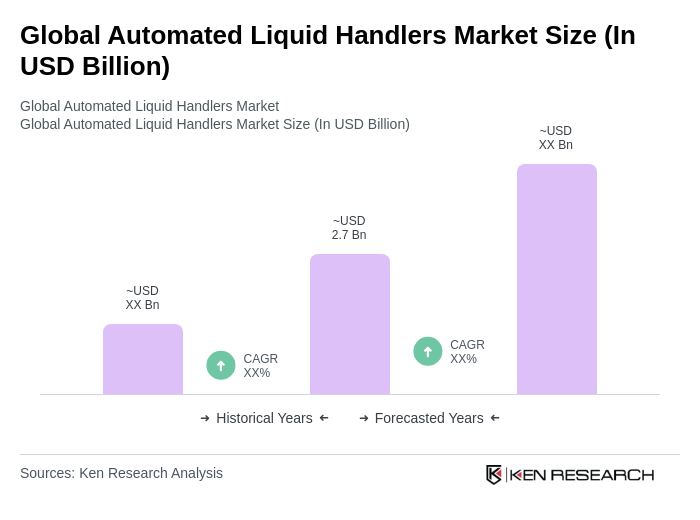
The Global Automated Liquid Handlers Market, valued at USD 2.7 billion, is growing due to demand for automation in pharmaceuticals, biotechnology, and AI-integrated workflows.

Region:Global

Author(s):Shubham

Product Code:KRAA3120

Pages:85

Published On:August 2025
About the Report

Base Year 2024

Global Automated Liquid Handlers Market Overview

  • The Global Automated Liquid Handlers Market is valued at USD 2.7 billion, based on a five-year historical analysis. This growth is primarily driven by the increasing demand for high-throughput screening in drug discovery, rapid adoption of automation in clinical diagnostics, and the rising need for precision and reproducibility in laboratory workflows across pharmaceuticals, biotechnology, and life sciences research. Additional drivers include advancements in AI-driven workflow optimization, miniaturization, and contactless dispensing technologies, which are making automated liquid handling systems indispensable in modern laboratories .
  • Key players in this market are predominantly located in North America and Europe, with the United States and Germany leading due to their robust pharmaceutical and biotechnology sectors. The presence of advanced research facilities, significant investments in R&D, and a strong focus on laboratory automation further bolster their dominance in the automated liquid handling market .
  • In 2023, the U.S. government strengthened laboratory safety standards through the Laboratory Biosafety and Biosecurity Policy Guidance, 2023 issued by the Department of Health and Human Services (HHS). This regulation mandates that automated liquid handling systems in federally funded laboratories comply with enhanced biosafety protocols, including validated decontamination procedures and operator training requirements, to minimize risks associated with hazardous materials and ensure the reliability of laboratory results. These measures are accelerating the adoption of automated systems in research and clinical settings .
Global Automated Liquid Handlers Market Size

Global Automated Liquid Handlers Market Segmentation

By Type:The market is segmented into Automated Liquid Handling Workstations, Semi-Automated Liquid Handling Systems, Reagents & Consumables, Disposable Tips, Fixed Tips, and Others. Among these, Automated Liquid Handling Workstations are leading the market due to their efficiency, scalability, and ability to handle complex liquid handling tasks with minimal human intervention. The demand for these workstations is driven by the increasing need for high-throughput screening in drug discovery, genomics, and clinical diagnostics, as well as the integration of AI and robotics for workflow optimization .
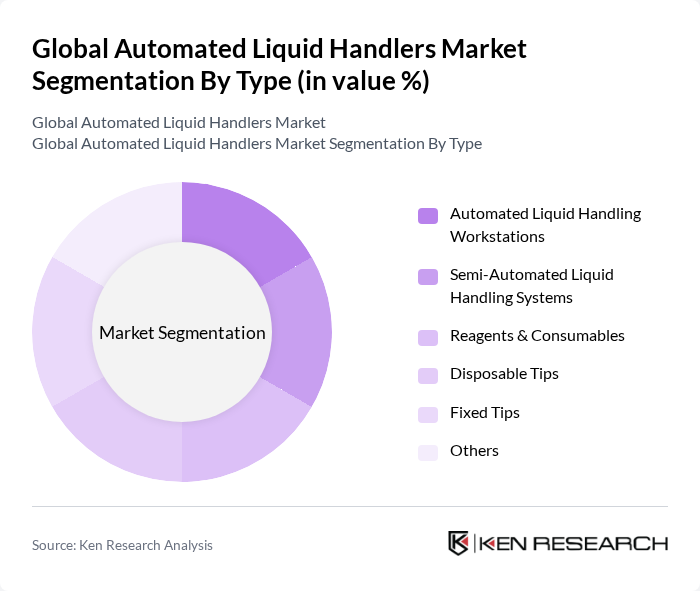
Global Automated Liquid Handlers Market segmentation by Type.

By End-User:The end-user segmentation includes Pharmaceutical & Biotechnology Companies, Contract Research Organizations (CROs), Academic & Research Institutes, Hospitals & Diagnostic Laboratories, and Others. Pharmaceutical & Biotechnology Companies dominate this segment, driven by their need for efficient and accurate liquid handling solutions in drug development, genomics, and high-throughput screening. The increasing focus on research and development, rising adoption of automation in clinical diagnostics, and outsourcing of R&D to CROs further propel the demand for automated liquid handling systems .
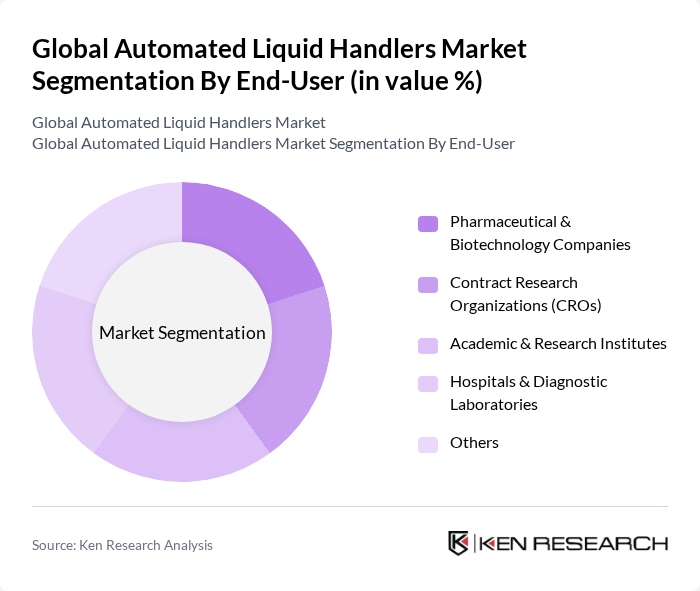
Global Automated Liquid Handlers Market segmentation by End-User.

Global Automated Liquid Handlers Market Competitive Landscape

The Global Automated Liquid Handlers Market is characterized by a dynamic mix of regional and international players. Leading participants such as Thermo Fisher Scientific Inc., Agilent Technologies, Inc., Tecan Group Ltd., PerkinElmer, Inc. (now Revvity, Inc.), Eppendorf AG, Hamilton Company, Beckman Coulter, Inc. (Danaher Corporation), BioTek Instruments, Inc. (Agilent Technologies), Mettler-Toledo International Inc., Sartorius AG, Corning Incorporated, QIAGEN N.V., Roche Holding AG, Siemens Healthineers AG, Becton, Dickinson and Company, Analytik Jena GmbH+Co. KG, Gilson, Inc., Hudson Robotics, Inc., Aurora Biomed Inc., Opentrons Labworks Inc. contribute to innovation, geographic expansion, and service delivery in this space.

Thermo Fisher Scientific Inc.

1956

Waltham, Massachusetts, USA

Agilent Technologies, Inc.

1999

Santa Clara, California, USA

Tecan Group Ltd.

1980

Maennedorf, Switzerland

PerkinElmer, Inc. (Revvity, Inc.)

1937

Waltham, Massachusetts, USA

Eppendorf AG

1945

Hamburg, Germany

Company

Establishment Year

Headquarters

Company Size (Revenue, Employees)

Global Market Share (%)

Revenue Growth Rate (CAGR)

R&D Expenditure as % of Revenue

Installed Base (Units Deployed)

Product Portfolio Breadth (No. of SKUs/Platforms)

Global Automated Liquid Handlers Market Industry Analysis

Growth Drivers

  • Increasing Demand for High-Throughput Screening:The global high-throughput screening market is projected to reach $25 billion, driven by the need for rapid drug discovery and development. This surge is fueled by the increasing number of drug candidates entering clinical trials, which reached over 5,000. Automated liquid handlers are essential for managing these high volumes efficiently, thereby supporting the growth of the automated liquid handlers market in None.
  • Advancements in Laboratory Automation Technology:The laboratory automation market is expected to grow to $6.5 billion, with innovations in robotics and software enhancing operational efficiency. Technologies such as robotic arms and advanced software solutions are streamlining workflows, reducing processing times by up to 50%. These advancements are critical in laboratories, making automated liquid handlers increasingly indispensable in None's research and development sectors.
  • Rising Focus on Reducing Human Error in Laboratories:Human error accounts for approximately 70% of laboratory mistakes, leading to significant financial losses estimated at $1.5 billion annually in the U.S. alone. The adoption of automated liquid handlers can mitigate these errors, improving accuracy and reliability in experimental results. This focus on precision is driving demand for automation solutions in None's laboratories, particularly in pharmaceutical and biotechnology sectors.

Market Challenges

  • High Initial Investment Costs:The average cost of implementing automated liquid handling systems can exceed $100,000, which poses a significant barrier for small to mid-sized laboratories. This high upfront investment often deters potential buyers, especially in None, where budget constraints are prevalent. As a result, many laboratories continue to rely on manual processes, limiting the market's growth potential.
  • Complexity in Integration with Existing Systems:Many laboratories in None face challenges when integrating new automated liquid handlers with their existing systems. Approximately 60% of laboratories report difficulties in achieving seamless integration, which can lead to operational disruptions. This complexity can result in increased downtime and additional costs, further complicating the decision-making process for potential adopters of automation technologies.

Global Automated Liquid Handlers Market Future Outlook

The future of the automated liquid handlers market in None appears promising, driven by technological advancements and increasing laboratory automation. As laboratories seek to enhance efficiency and accuracy, the integration of artificial intelligence and machine learning into liquid handling systems is expected to gain traction. Additionally, the growing emphasis on sustainability will likely lead to the development of eco-friendly solutions, further shaping the market landscape in the coming years.

Market Opportunities

  • Expansion in Emerging Markets:Emerging markets in Asia-Pacific are projected to witness a 15% annual growth rate in laboratory automation. This growth presents significant opportunities for automated liquid handlers, as these regions invest heavily in healthcare infrastructure and research capabilities, creating a demand for advanced laboratory technologies.
  • Development of Customizable Liquid Handling Solutions:The demand for customizable solutions is on the rise, with 40% of laboratories expressing interest in tailored automation systems. This trend offers manufacturers in None the opportunity to innovate and provide bespoke solutions that meet specific laboratory needs, enhancing user satisfaction and market penetration.

Scope of the Report

SegmentSub-Segments
By Type

Automated Liquid Handling Workstations

Semi-Automated Liquid Handling Systems

Reagents & Consumables

Disposable Tips

Fixed Tips

Others

By End-User

Pharmaceutical & Biotechnology Companies

Contract Research Organizations (CROs)

Academic & Research Institutes

Hospitals & Diagnostic Laboratories

Others

By Application

Drug Discovery & Development

Genomics

Proteomics

Clinical Diagnostics

Cell Culture

High Throughput Screening

PCR Setup

Others

By Distribution Channel

Direct Sales

Third-Party Distributors

Online Sales

Others

By Region

North America

Europe

Asia-Pacific

Latin America

Middle East & Africa

By Price Range

Low-End

Mid-Range

High-End

By Technology

Robotic Liquid Handling

Contactless Liquid Handling

Manual Liquid Handling

Semi-Automated Liquid Handling

Others

Key Target Audience

Investors and Venture Capitalist Firms

Government and Regulatory Bodies (e.g., U.S. Food and Drug Administration, European Medicines Agency)

Manufacturers and Producers

Distributors and Retailers

Pharmaceutical and Biotechnology Companies

Laboratory Equipment Suppliers

Healthcare Providers and Institutions

Quality Control and Assurance Organizations

Players Mentioned in the Report:

Thermo Fisher Scientific Inc.

Agilent Technologies, Inc.

Tecan Group Ltd.

PerkinElmer, Inc. (now Revvity, Inc.)

Eppendorf AG

Hamilton Company

Beckman Coulter, Inc. (Danaher Corporation)

BioTek Instruments, Inc. (Agilent Technologies)

Mettler-Toledo International Inc.

Sartorius AG

Corning Incorporated

QIAGEN N.V.

Roche Holding AG

Siemens Healthineers AG

Becton, Dickinson and Company

Analytik Jena GmbH+Co. KG

Gilson, Inc.

Hudson Robotics, Inc.

Aurora Biomed Inc.

Opentrons Labworks Inc.

Table of Contents

Market Assessment Phase

1. Executive Summary and Approach


2. Global Automated Liquid Handlers Market Overview

2.1 Key Insights and Strategic Recommendations

2.2 Global Automated Liquid Handlers Market Overview

2.3 Definition and Scope

2.4 Evolution of Market Ecosystem

2.5 Timeline of Key Regulatory Milestones

2.6 Value Chain & Stakeholder Mapping

2.7 Business Cycle Analysis

2.8 Policy & Incentive Landscape


3. Global Automated Liquid Handlers Market Analysis

3.1 Growth Drivers

3.1.1 Increasing demand for high-throughput screening
3.1.2 Advancements in laboratory automation technology
3.1.3 Rising focus on reducing human error in laboratories
3.1.4 Growing investments in pharmaceutical and biotechnology sectors

3.2 Market Challenges

3.2.1 High initial investment costs
3.2.2 Complexity in integration with existing systems
3.2.3 Limited awareness among small laboratories
3.2.4 Regulatory compliance issues

3.3 Market Opportunities

3.3.1 Expansion in emerging markets
3.3.2 Development of customizable liquid handling solutions
3.3.3 Increasing demand for automation in academic research
3.3.4 Collaborations with technology providers

3.4 Market Trends

3.4.1 Shift towards miniaturization of liquid handling systems
3.4.2 Integration of AI and machine learning in automation
3.4.3 Growing preference for eco-friendly and sustainable solutions
3.4.4 Rise in demand for integrated laboratory solutions

3.5 Government Regulation

3.5.1 Compliance with ISO standards
3.5.2 Regulations on laboratory safety and waste management
3.5.3 Guidelines for automated systems in clinical laboratories
3.5.4 Policies promoting research and development in automation

4. SWOT Analysis


5. Stakeholder Analysis


6. Porter's Five Forces Analysis


7. Global Automated Liquid Handlers Market Market Size, 2019-2024

7.1 By Value

7.2 By Volume

7.3 By Average Selling Price


8. Global Automated Liquid Handlers Market Segmentation

8.1 By Type

8.1.1 Automated Liquid Handling Workstations
8.1.2 Semi-Automated Liquid Handling Systems
8.1.3 Reagents & Consumables
8.1.4 Disposable Tips
8.1.5 Fixed Tips
8.1.6 Others

8.2 By End-User

8.2.1 Pharmaceutical & Biotechnology Companies
8.2.2 Contract Research Organizations (CROs)
8.2.3 Academic & Research Institutes
8.2.4 Hospitals & Diagnostic Laboratories
8.2.5 Others

8.3 By Application

8.3.1 Drug Discovery & Development
8.3.2 Genomics
8.3.3 Proteomics
8.3.4 Clinical Diagnostics
8.3.5 Cell Culture
8.3.6 High Throughput Screening
8.3.7 PCR Setup
8.3.8 Others

8.4 By Distribution Channel

8.4.1 Direct Sales
8.4.2 Third-Party Distributors
8.4.3 Online Sales
8.4.4 Others

8.5 By Region

8.5.1 North America
8.5.2 Europe
8.5.3 Asia-Pacific
8.5.4 Latin America
8.5.5 Middle East & Africa

8.6 By Price Range

8.6.1 Low-End
8.6.2 Mid-Range
8.6.3 High-End

8.7 By Technology

8.7.1 Robotic Liquid Handling
8.7.2 Contactless Liquid Handling
8.7.3 Manual Liquid Handling
8.7.4 Semi-Automated Liquid Handling
8.7.5 Others

9. Global Automated Liquid Handlers Market Competitive Analysis

9.1 Market Share of Key Players

9.2 Cross Comparison of Key Players

9.2.1 Company Name
9.2.2 Company Size (Revenue, Employees)
9.2.3 Global Market Share (%)
9.2.4 Revenue Growth Rate (CAGR)
9.2.5 R&D Expenditure as % of Revenue
9.2.6 Installed Base (Units Deployed)
9.2.7 Product Portfolio Breadth (No. of SKUs/Platforms)
9.2.8 Geographic Presence (No. of Countries/Regions)
9.2.9 Key Patents/Intellectual Property Holdings
9.2.10 Customer Segmentation (End-User Mix)
9.2.11 After-Sales Service Coverage
9.2.12 Product Innovation Rate (New Launches/Year)
9.2.13 Strategic Partnerships & Collaborations
9.2.14 Sustainability Initiatives
9.2.15 Customer Satisfaction Score (NPS or Equivalent)

9.3 SWOT Analysis of Top Players

9.4 Pricing Analysis

9.5 Detailed Profile of Major Companies

9.5.1 Thermo Fisher Scientific Inc.
9.5.2 Agilent Technologies, Inc.
9.5.3 Tecan Group Ltd.
9.5.4 PerkinElmer, Inc. (now Revvity, Inc.)
9.5.5 Eppendorf AG
9.5.6 Hamilton Company
9.5.7 Beckman Coulter, Inc. (Danaher Corporation)
9.5.8 BioTek Instruments, Inc. (Agilent Technologies)
9.5.9 Mettler-Toledo International Inc.
9.5.10 Sartorius AG
9.5.11 Corning Incorporated
9.5.12 QIAGEN N.V.
9.5.13 Roche Holding AG
9.5.14 Siemens Healthineers AG
9.5.15 Becton, Dickinson and Company
9.5.16 Analytik Jena GmbH+Co. KG
9.5.17 Gilson, Inc.
9.5.18 Hudson Robotics, Inc.
9.5.19 Aurora Biomed Inc.
9.5.20 Opentrons Labworks Inc.

10. Global Automated Liquid Handlers Market End-User Analysis

10.1 Procurement Behavior of Key Ministries

10.1.1 Budget Allocation Trends
10.1.2 Decision-Making Processes
10.1.3 Preferred Suppliers

10.2 Corporate Spend on Infrastructure & Energy

10.2.1 Investment Trends in Automation
10.2.2 Budgeting for Liquid Handling Solutions
10.2.3 Cost-Benefit Analysis Practices

10.3 Pain Point Analysis by End-User Category

10.3.1 Efficiency Challenges
10.3.2 Compliance Issues
10.3.3 Technology Integration Difficulties

10.4 User Readiness for Adoption

10.4.1 Training and Support Needs
10.4.2 Technology Familiarity
10.4.3 Adoption Barriers

10.5 Post-Deployment ROI and Use Case Expansion

10.5.1 Performance Metrics
10.5.2 Case Studies of Successful Implementations
10.5.3 Future Expansion Plans

11. Global Automated Liquid Handlers Market Future Size, 2025-2030

11.1 By Value

11.2 By Volume

11.3 By Average Selling Price


Go-To-Market Strategy Phase

1. Whitespace Analysis + Business Model Canvas

1.1 Market Gaps Identification

1.2 Value Proposition Development

1.3 Revenue Streams Analysis

1.4 Customer Segmentation

1.5 Key Partnerships

1.6 Cost Structure Analysis

1.7 Channels of Distribution


2. Marketing and Positioning Recommendations

2.1 Branding Strategies

2.2 Product USPs

2.3 Target Market Positioning

2.4 Communication Strategies

2.5 Digital Marketing Approaches


3. Distribution Plan

3.1 Urban Retail Strategies

3.2 Rural NGO Tie-Ups

3.3 Online Distribution Channels

3.4 Direct Sales Approaches


4. Channel & Pricing Gaps

4.1 Underserved Routes

4.2 Pricing Bands Analysis

4.3 Competitor Pricing Strategies


5. Unmet Demand & Latent Needs

5.1 Category Gaps

5.2 Consumer Segments Analysis

5.3 Emerging Trends Identification


6. Customer Relationship

6.1 Loyalty Programs

6.2 After-Sales Service

6.3 Customer Feedback Mechanisms


7. Value Proposition

7.1 Sustainability Initiatives

7.2 Integrated Supply Chains

7.3 Competitive Advantages


8. Key Activities

8.1 Regulatory Compliance

8.2 Branding Initiatives

8.3 Distribution Setup


9. Entry Strategy Evaluation

9.1 Domestic Market Entry Strategy

9.1.1 Product Mix Considerations
9.1.2 Pricing Band Strategies
9.1.3 Packaging Innovations

9.2 Export Entry Strategy

9.2.1 Target Countries Identification
9.2.2 Compliance Roadmap Development

10. Entry Mode Assessment

10.1 Joint Ventures

10.2 Greenfield Investments

10.3 Mergers & Acquisitions

10.4 Distributor Model Evaluation


11. Capital and Timeline Estimation

11.1 Capital Requirements

11.2 Timelines for Implementation


12. Control vs Risk Trade-Off

12.1 Ownership vs Partnerships


13. Profitability Outlook

13.1 Breakeven Analysis

13.2 Long-Term Sustainability Strategies


14. Potential Partner List

14.1 Distributors

14.2 Joint Ventures

14.3 Acquisition Targets


15. Execution Roadmap

15.1 Phased Plan for Market Entry

15.1.1 Market Setup
15.1.2 Market Entry
15.1.3 Growth Acceleration
15.1.4 Scale & Stabilize

15.2 Key Activities and Milestones

15.2.1 Milestone Planning
15.2.2 Activity Tracking

Research Methodology

ApproachModellingSample

Phase 1: Approach1

Desk Research

  • Industry reports from leading market research firms focusing on automated liquid handlers
  • Analysis of market trends and forecasts from scientific journals and publications
  • Data from regulatory bodies regarding compliance and safety standards in laboratory automation

Primary Research

  • Interviews with laboratory managers and automation specialists in pharmaceutical companies
  • Surveys targeting R&D directors in biotech firms to understand their automation needs
  • Field interviews with engineers and technicians involved in liquid handling systems

Validation & Triangulation

  • Cross-validation of findings through multiple expert interviews and industry panels
  • Triangulation of data from primary and secondary sources to ensure consistency
  • Sanity checks through historical data comparison and trend analysis

Phase 2: Market Size Estimation1

Top-down Assessment

  • Estimation of market size based on global laboratory automation spending trends
  • Segmentation by application areas such as drug discovery, clinical diagnostics, and academic research
  • Incorporation of growth rates from emerging markets and technological advancements

Bottom-up Modeling

  • Volume estimates derived from sales data of leading automated liquid handler manufacturers
  • Cost analysis based on pricing models of various liquid handling systems
  • Estimation of market share based on unit sales and revenue generation

Forecasting & Scenario Analysis

  • Multi-variable regression analysis incorporating factors like R&D investment and automation adoption rates
  • Scenario planning based on potential regulatory changes and technological disruptions
  • Development of baseline, optimistic, and pessimistic forecasts through 2030

Phase 3: CATI Sample Composition1

Scope Item/SegmentSample SizeTarget Respondent Profiles
Pharmaceutical R&D Automation100R&D Managers, Lab Technicians
Clinical Diagnostics Laboratories80Laboratory Directors, Quality Control Managers
Biotechnology Research Facilities70Biotech Researchers, Automation Engineers
Academic Research Institutions50Professors, Research Coordinators
Contract Research Organizations (CROs)60Project Managers, Operations Directors

Frequently Asked Questions

What is the current value of the Global Automated Liquid Handlers Market?

The Global Automated Liquid Handlers Market is valued at approximately USD 2.7 billion, reflecting significant growth driven by advancements in laboratory automation and increasing demand for high-throughput screening in drug discovery and clinical diagnostics.

What are the key drivers of growth in the Automated Liquid Handlers Market?

Which regions dominate the Automated Liquid Handlers Market?

What types of automated liquid handling systems are available?

Other Regional/Country Reports

UAE Automated Liquid Handlers MarketKSA Automated Liquid Handlers Market

Indonesia Automated Liquid Handlers Market

Malaysia Automated Liquid Handlers Market

APAC Automated Liquid Handlers Market

SEA Automated Liquid Handlers Market

Why Buy From Us?

Refine Robust Result (RRR) Framework

What makes us stand out is that our consultants follow Robust, Refine and Result (RRR) methodology. Robust for clear definitions, approaches and sanity checking, Refine for differentiating respondents' facts and opinions, and Result for presenting data with story.

Our Reach Is Unmatched

We have set a benchmark in the industry by offering our clients with syndicated and customized market research reports featuring coverage of entire market as well as meticulous research and analyst insights.

Shifting the Research Paradigm

While we don't replace traditional research, we flip the method upside down. Our dual approach of Top Bottom & Bottom Top ensures quality deliverable by not just verifying company fundamentals but also looking at the sector and macroeconomic factors.

More Insights-Better Decisions

With one step in the future, our research team constantly tries to show you the bigger picture. We help with some of the tough questions you may encounter along the way: How is the industry positioned? Best marketing channel? KPI's of competitors? By aligning every element, we help maximize success.

Transparency and Trust

Our report gives you instant access to the answers and sources that other companies might choose to hide. We elaborate each steps of research methodology we have used and showcase you the sample size to earn your trust.

Round the Clock Support

If you need any support, we are here! We pride ourselves on universe strength, data quality, and quick, friendly, and professional service.

Why Clients Choose Us?

400000+
Reports in repository
150+
Consulting projects a year
100+
Analysts
8000+
Client Queries in 2022








