















Asia Pacific Dining Table Market Outlook to 2030
Region:Asia
Author(s):Paribhasha Tiwari
Product Code:KROD9479
December 2024
80
About the Report
Asia Pacific Dining Table Market Overview
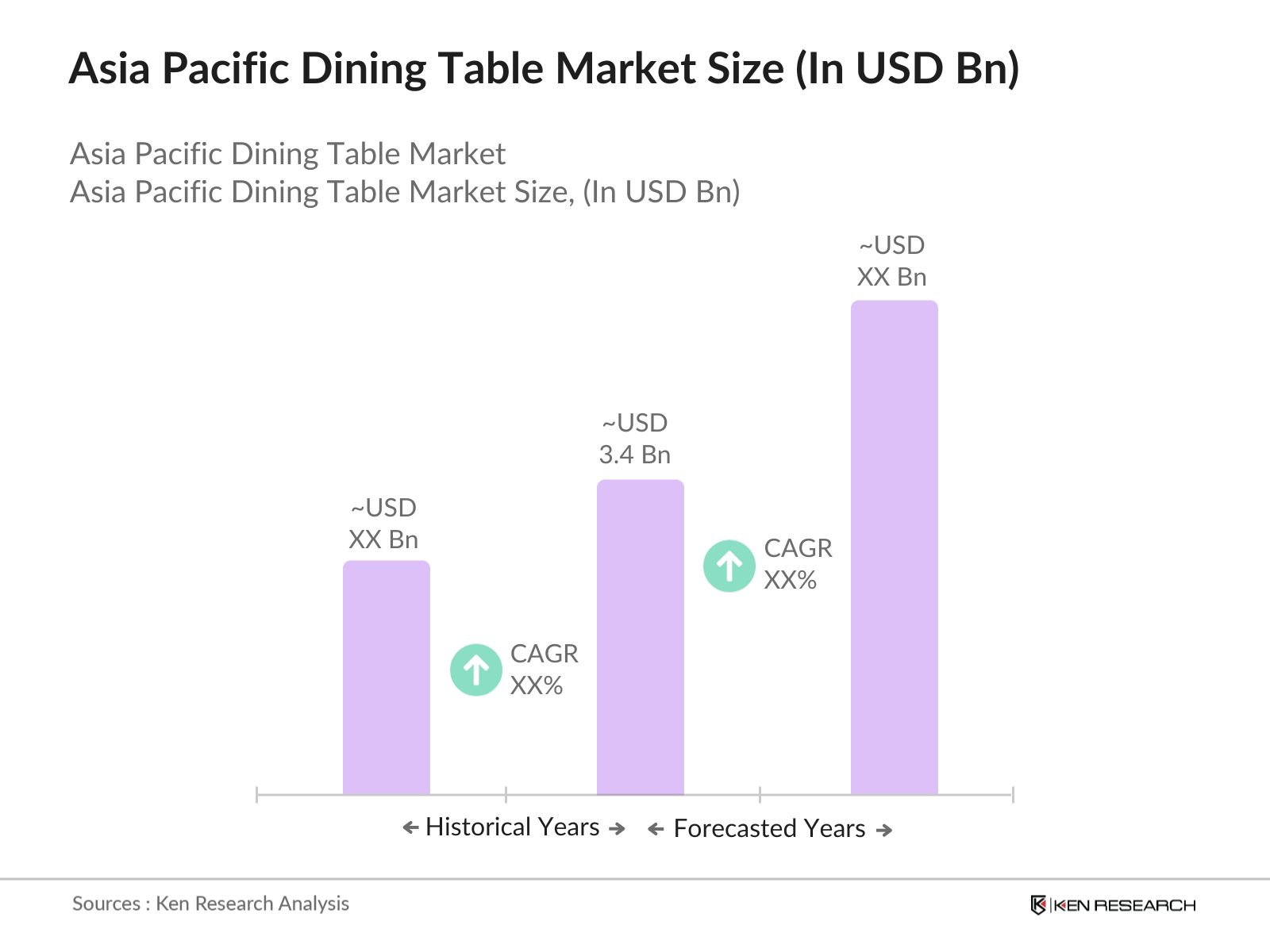
- The Asia Pacific dining table market, valued at USD 3.4 billion, is primarily driven by the rapid urbanization in the region and the increasing consumer shift toward aesthetic and functional furniture in modern homes. This growth is underpinned by the growing middle class, which has enhanced spending power, thus creating a robust demand for premium and customizable dining tables. The presence of robust e-commerce platforms further boosts market penetration, providing consumers with a wider range of styles and materials.
- China and India dominate the Asia Pacific dining table market, largely due to their large populations, rising disposable incomes, and evolving consumer preferences. These countries have significant urban centers that drive demand for contemporary furniture styles. Additionally, a surge in residential construction activities, especially in urban areas, supports the market in these nations, as consumers seek dining furniture that complements modern living spaces.
- The Asia Pacific dining table market is increasingly regulated to ensure safety and quality, with many countries mandating ISO certifications for furniture. In 2024, over 70% of furniture manufacturers in countries like South Korea and Japan adhered to ISO 9001 standards for quality management, according to the International Organization for Standardization. Compliance with these standards enhances product credibility and consumer trust.
Asia Pacific Dining Table Market Segmentation
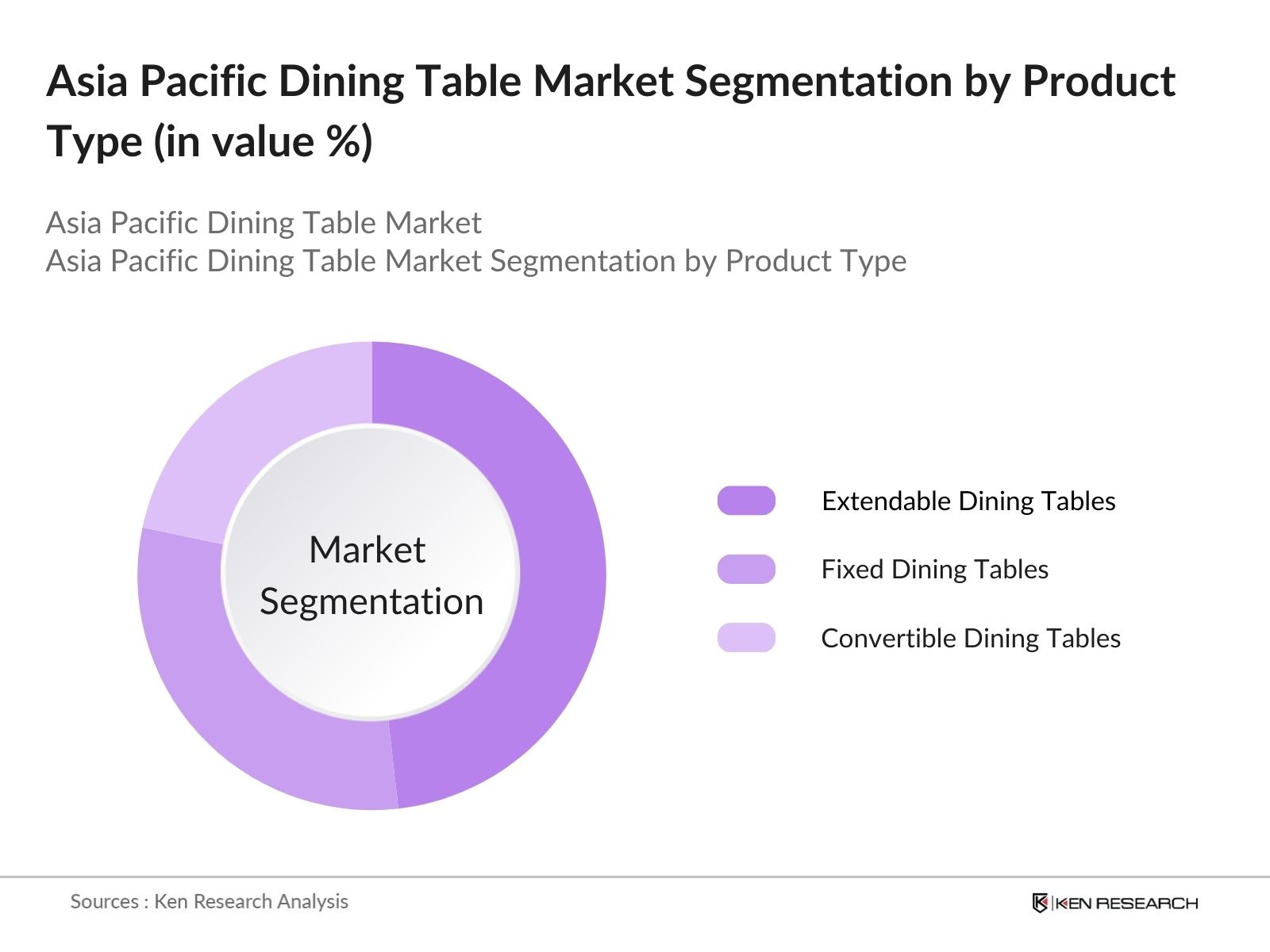
By Product Type: The Asia Pacific dining table market is segmented by product type into fixed dining tables, extendable dining tables, and convertible dining tables. Extendable dining tables hold a dominant market share in the region under this segmentation due to their flexibility in accommodating different space requirements, which is highly valued in urban settings. These tables allow consumers to maximize functionality in compact spaces, making them particularly popular among urban apartment dwellers.
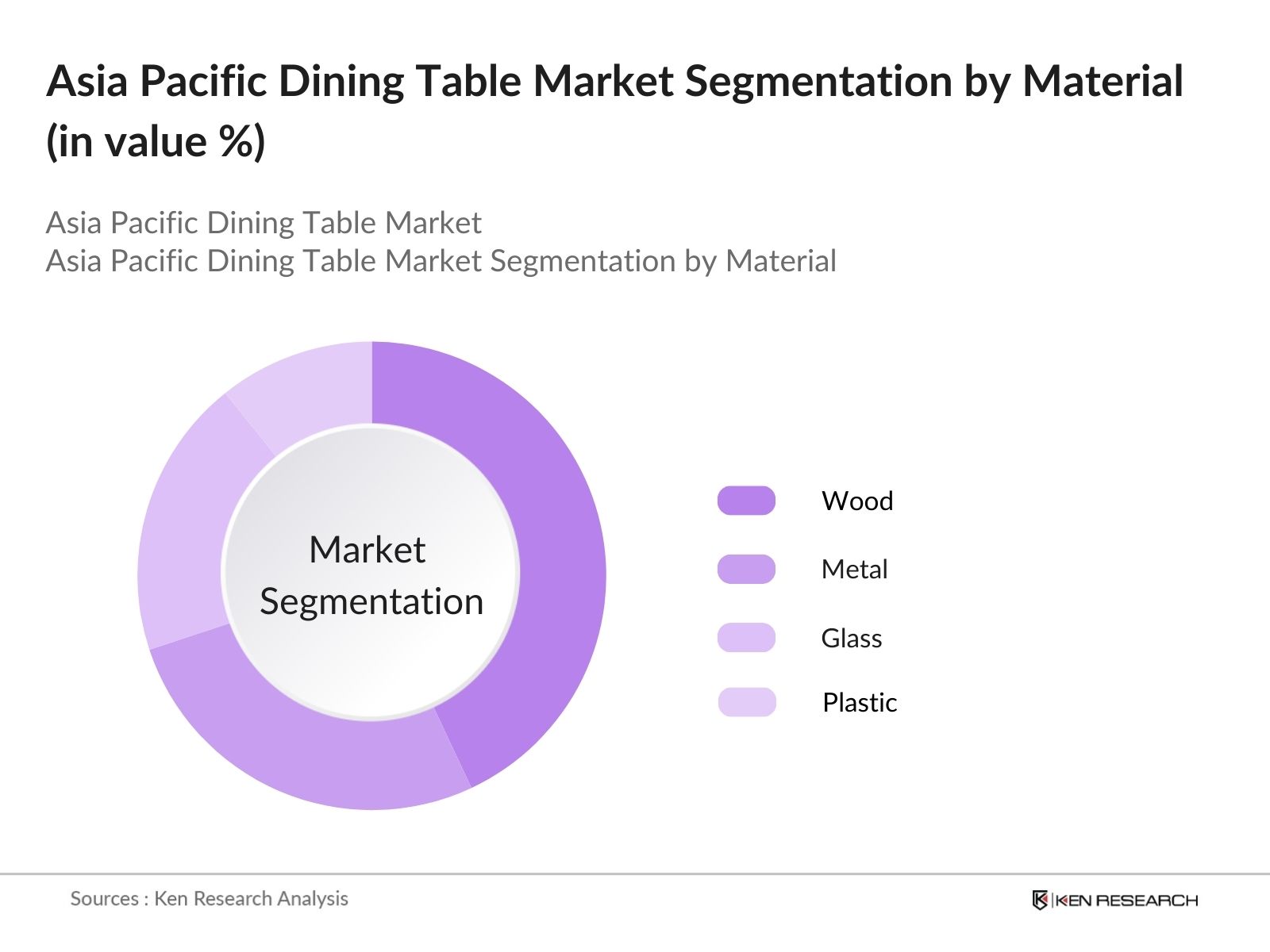
By Material: The market is segmented by material into wood, metal, glass, and plastic. Wooden dining tables lead in market share, reflecting consumer preference for durability and the premium feel that wood provides. Wood, especially solid wood variants, has remained popular due to its strength, longevity, and the premium aesthetic it adds to homes. Consumers also appreciate the diverse styles, from rustic to modern, that wood can achieve.
Asia Pacific Dining Table Market Competitive Landscape
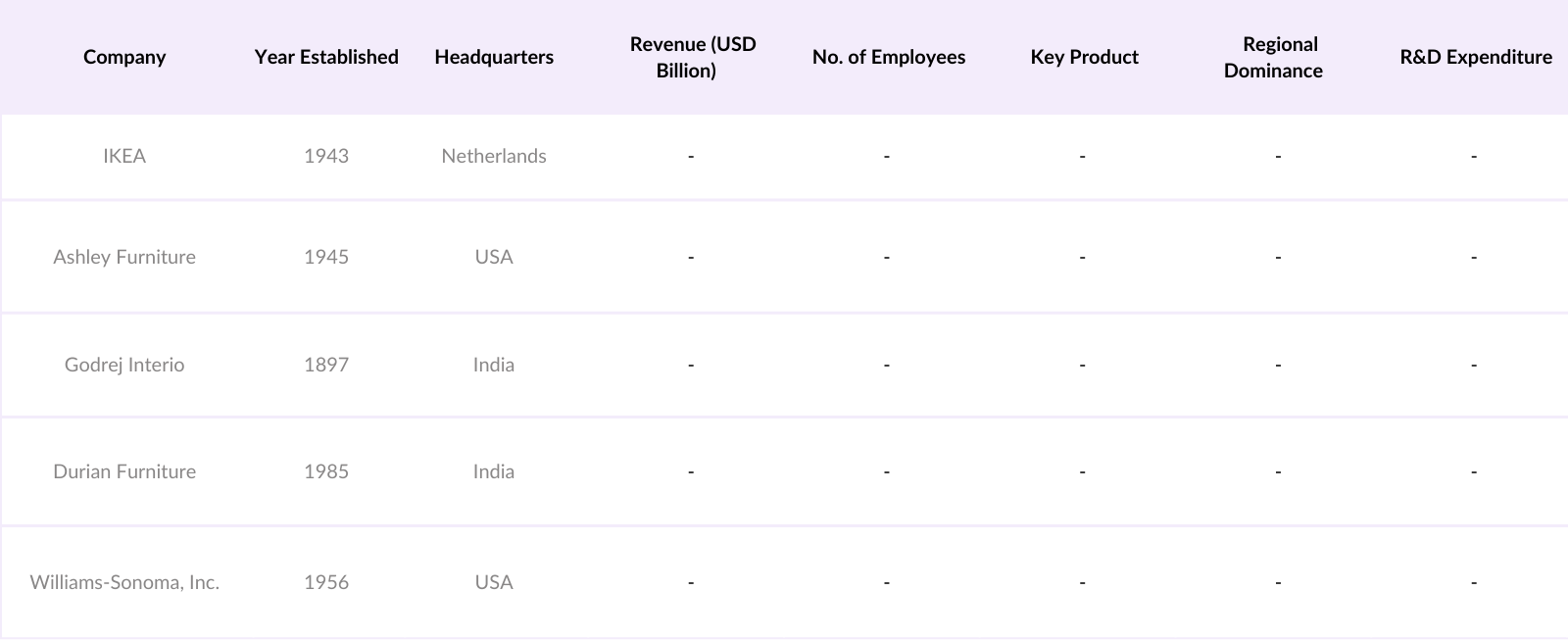
The Asia Pacific dining table market is dominated by a mix of local manufacturers and established global brands, highlighting the intense competition and variety of products available to consumers. Major companies leverage extensive distribution networks and innovative product designs to secure a competitive edge.
Asia Pacific Dining Tbale Market Analysis
Growth Drivers
- Technological Advancements in LED (e.g., Energy Efficiency, Longevity): LED technology advancements have led to significant energy savings and product longevity in the U.S. lamp market. LED lamps consume 75% less energy than incandescent bulbs and have a lifespan of 25,000 to 50,000 hours compared to only 1,000-2,000 hours for traditional incandescent options, as stated by the U.S. Department of Energy. In 2024, the shift towards LED technology is driven by increasing awareness of climate change, with lighting accounting for nearly 15% of U.S. residential energy consumption. The DOE has mandated energy-efficiency standards that are further propelling LED usage.
- Increasing Demand for Smart Lighting: Smart lighting in the U.S. lamp market is on the rise due to integration with smart home systems, driven by the adoption of IoT technologies. Over 120 million U.S. homes are connected to smart devices in 2024, with smart lighting leading the growth in IoT-based home automation products. This demand for connected lighting is propelled by energy savings, enhanced convenience, and compatibility with voice-assistants like Amazon Alexa and Google Assistant. According to the U.S. Energy Information Administration (EIA), such lighting systems are anticipated to reduce residential lighting energy consumption by an additional 10% annually.
- Shift Towards Energy-Efficient Solutions: The U.S. government's focus on sustainable development has incentivized energy-efficient lighting solutions. The Environmental Protection Agency's ENERGY STAR program notes that qualified lighting products, which use up to 90% less energy, are increasingly favored in the market. Energy-efficient lighting contributed to reducing the U.S. carbon footprint by approximately 2 million metric tons in 2023. With the Biden administrations target to cut greenhouse gas emissions by 50% by 2030, adoption of energy-efficient solutions is projected to continue accelerating.
Market Challenges
- High Initial Investment in Advanced Lamp Technologies: High upfront costs of LED and smart lighting systems deter lower-income households from adopting these technologies. The average cost for advanced lighting, such as LED smart lamps, is roughly $40 per unit in 2024, compared to $5 for traditional incandescent options. According to the EIA, while long-term savings are substantial, the initial expense remains a barrier, particularly for smaller enterprises and residential users who may prioritize immediate costs over future benefits.
- Limited Awareness in Certain Consumer Segments: Despite growth in energy-efficient lighting awareness, many U.S. consumers remain uninformed about potential long-term savings and environmental benefits. A 2024 survey by the U.S. Census Bureau found that 40% of American households still lack knowledge about energy-efficient lighting options. This limited awareness is notably higher in rural and low-income areas, impacting market adoption rates and slowing the overall growth of the energy-efficient segment within the U.S. lamp market.
Asia Pacific Dining Table Market Future Outlook
The Asia Pacific dining table market is projected to witness notable growth over the coming years, driven by a steady increase in consumer demand for functional, stylish furniture that complements smaller living spaces and reflects contemporary design trends. Moreover, the shift toward online retail and the rise of customization options are expected to further boost market expansion. The focus on sustainable materials and eco-friendly practices by manufacturers is likely to become an essential aspect of market growth, aligning with rising consumer environmental awareness.
Market Opportunities
- Expansion in Commercial and Industrial Sectors: Commercial and industrial sectors are increasingly investing in energy-efficient lighting. A report from the Bureau of Labor Statistics indicates that lighting upgrades accounted for over $3 billion in commercial spending in 2023, driven by energy-saving mandates. As U.S. companies work to meet sustainability goals, energy-efficient lighting installations in office spaces and warehouses are rising, aligning with the push for environmentally responsible business practices.
- Growth of E-commerce Distribution Channels: The rise of e-commerce has transformed lamp distribution channels in the U.S. With online lighting sales reaching nearly $1 billion in 2024, per the U.S. Census Bureau, e-commerce enables wider access to advanced lighting products, especially in rural areas. Online platforms facilitate consumer comparison of lamp features and energy savings, contributing to increased adoption of energy-efficient lighting solutions nationwide.
Products
Key Target Audience
Manufacturers of Residential Furniture
Interior Design Firms
Real Estate Developers
Furniture Retail Chains
E-commerce Platforms for Furniture
Investment and Venture Capitalist Firms
Government and Regulatory Bodies (such as the Ministry of Industry, Trade, and Small and Medium Enterprises in the Asia Pacific)
Suppliers of Raw Materials and Components
Companies
Players Mentioned in the Report:
IKEA
Ashley Furniture Industries
Godrej Interio
La-Z-Boy Incorporated
Williams-Sonoma, Inc.
Herman Miller
KOKUYO Co., Ltd.
Hooker Furniture
Steelcase Inc.
Inter IKEA Group
Table of Contents
1. Asia-Pacific Dining Table Market Overview
1.1. Definition and Scope
1.2. Market Taxonomy
1.3. Market Growth Rate
1.4. Market Segmentation Overview
2. Asia-Pacific Dining Table Market Size (In USD Billion)
2.1. Historical Market Size
2.2. Year-On-Year Growth Analysis
2.3. Key Market Developments and Milestones
3. Asia-Pacific Dining Table Market Analysis
3.1. Growth Drivers
3.1.1. Urbanization and Rising Disposable Incomes
3.1.2. Changing Consumer Preferences Towards Home Aesthetics
3.1.3. Expansion of E-commerce Platforms
3.2. Market Challenges
3.2.1. Intense Market Competition
3.2.2. Fluctuations in Raw Material Prices
3.2.3. Supply Chain Disruptions
3.3. Opportunities
3.3.1. Demand for Sustainable and Eco-friendly Furniture
3.3.2. Growth in Multifunctional and Space-saving Furniture Designs
3.3.3. Technological Integration in Furniture Design
3.4. Trends
3.4.1. Adoption of Minimalist and Contemporary Designs
3.4.2. Increasing Popularity of Customizable Furniture
3.4.3. Rise in Home Renovation and Remodeling Activities
3.5. Government Regulations
3.5.1. Environmental Standards for Furniture Manufacturing
3.5.2. Import and Export Policies
3.5.3. Labor and Safety Regulations
3.6. SWOT Analysis
3.7. Stakeholder Ecosystem
3.8. Porter’s Five Forces Analysis
3.9. Competitive Landscape
4. Asia-Pacific Dining Table Market Segmentation
4.1. By Material (In Value %)
4.1.1. Wood
4.1.2. Metal
4.1.3. Glass
4.1.4. Plastic
4.1.5. Others
4.2. By Shape (In Value %)
4.2.1. Rectangular
4.2.2. Square
4.2.3. Round
4.2.4. Oval
4.3. By Application (In Value %)
4.3.1. Residential
4.3.2. Commercial
4.3.3. Hospitality
4.3.4. Others
4.4. By Distribution Channel (In Value %)
4.4.1. Offline Retail
4.4.2. Online Retail
4.5. By Country (In Value %)
4.5.1. China
4.5.2. India
4.5.3. Japan
4.5.4. Australia
4.5.5. Rest of Asia-Pacific
5. Asia-Pacific Dining Table Market Competitive Analysis
5.1. Detailed Profiles of Major Companies
5.1.1. Ashley Furniture Industries Inc.
5.1.2. Inter IKEA Group
5.1.3. Herman Miller, Inc.
5.1.4. Steelcase, Inc.
5.1.5. Nitori Holdings Co., Ltd.
5.1.6. Godrej & Boyce Manufacturing Company Limited
5.1.7. Okamura Corporation
5.1.8. KOKUYO Co., Ltd.
5.1.9. HNI Corporation
5.1.10. Kimball International, Inc.
5.1.11. Williams-Sonoma, Inc.
5.1.12. Oppein Home Group Inc.
5.1.13. Rooms To Go
5.1.14. La-Z-Boy Incorporated
5.1.15. Sauder Woodworking Co.
5.2. Cross Comparison Parameters (Number of Employees, Headquarters Location, Year of Establishment, Annual Revenue, Product Portfolio Diversity, Market Presence, Recent Developments, Sustainability Initiatives)
5.3. Market Share Analysis
5.4. Strategic Initiatives
5.5. Mergers and Acquisitions
5.6. Investment Analysis
5.6.1. Venture Capital Funding
5.6.2. Government Grants
5.6.3. Private Equity Investments
6. Asia-Pacific Dining Table Market Regulatory Framework
6.1. Environmental Standards
6.2. Compliance Requirements
6.3. Certification Processes
7. Asia-Pacific Dining Table Market Future Size (In USD Billion)
7.1. Future Market Size Projections
7.2. Key Factors Driving Future Market Growth
8. Asia-Pacific Dining Table Market Future Segmentation
8.1. By Material (In Value %)
8.2. By Shape (In Value %)
8.3. By Application (In Value %)
8.4. By Distribution Channel (In Value %)
8.5. By Country (In Value %)
9. Asia-Pacific Dining Table Market Analysts’ Recommendations
9.1. Total Addressable Market (TAM), Serviceable Available Market (SAM), and Serviceable Obtainable Market (SOM) Analysis
9.2. Customer Cohort Analysis
9.3. Marketing Initiatives
9.4. White Space Opportunity Analysis
Disclaimer
Contact Us
Research Methodology
Step 1: Identification of Key Variables
The initial phase involves identifying critical variables impacting the Asia Pacific Dining Table Market by analyzing various stakeholders, including manufacturers, distributors, and retailers. Data gathering combines secondary research from proprietary databases to understand market structure, trends, and primary drivers.
Step 2: Market Analysis and Construction
This phase focuses on analyzing historical and current data regarding market penetration and product preferences across different regions. The goal is to understand the relationship between product types, materials, and regional demands, enabling accurate revenue forecasting.
Step 3: Hypothesis Validation and Expert Consultation
Market hypotheses are validated through interviews with industry experts across manufacturing and distribution channels, providing insights into consumer behavior, production trends, and material preferences. These interviews help refine data accuracy and relevance.
Step 4: Research Synthesis and Final Output
The final step synthesizes collected data with direct feedback from key manufacturers to gain insights into production volumes, market trends, and consumer preferences. The final output is a comprehensive, validated report that provides in-depth insights into the Asia Pacific Dining Table Market.
Frequently Asked Questions
01. How big is the Asia Pacific Dining Table Market?
The Asia Pacific dining table market is valued at USD 3.4 billion, driven by rapid urbanization and a rise in middle-class consumer spending on premium furniture options.
02. What are the challenges in the Asia Pacific Dining Table Market?
Challenges in the Asia Pacific dining table market include high competition, price sensitivity among consumers, and logistical complexities within the supply chain, which impact market stability and profitability.
03. Who are the major players in the Asia Pacific Dining Table Market?
Key players in the Asia Pacific dining table market include IKEA, Ashley Furniture, Godrej Interio, La-Z-Boy, and Williams-Sonoma. These companies dominate through strong brand presence, extensive distribution, and innovative product offerings.
04. What are the growth drivers of the Asia Pacific Dining Table Market?
The Asia Pacific dining table market is driven by increasing urbanization, consumer demand for aesthetically pleasing furniture, and growth in e-commerce, which has expanded accessibility to various furniture styles and options.
Why Buy From Us?

What makes us stand out is that our consultants follows Robust, Refine and Result (RRR) methodology. i.e. Robust for clear definitions, approaches and sanity checking, Refine for differentiating respondents facts and opinions and Result for presenting data with story

We have set a benchmark in the industry by offering our clients with syndicated and customized market research reports featuring coverage of entire market as well as meticulous research and analyst insights.

While we don't replace traditional research, we flip the method upside down. Our dual approach of Top Bottom & Bottom Top ensures quality deliverable by not just verifying company fundamentals but also looking at the sector and macroeconomic factors.

With one step in the future, our research team constantly tries to show you the bigger picture. We help with some of the tough questions you may encounter along the way: How is the industry positioned? Best marketing channel? KPI's of competitors? By aligning every element, we help maximize success.

Our report gives you instant access to the answers and sources that other companies might choose to hide. We elaborate each steps of research methodology we have used and showcase you the sample size to earn your trust.

If you need any support, we are here! We pride ourselves on universe strength, data quality, and quick, friendly, and professional service.