















USA VR Headsets Market Outlook to 2030
Region:North America
Author(s):Naman Rohilla
Product Code:KROD8663
December 2024
91
About the Report
USA VR Headsets Market Overview
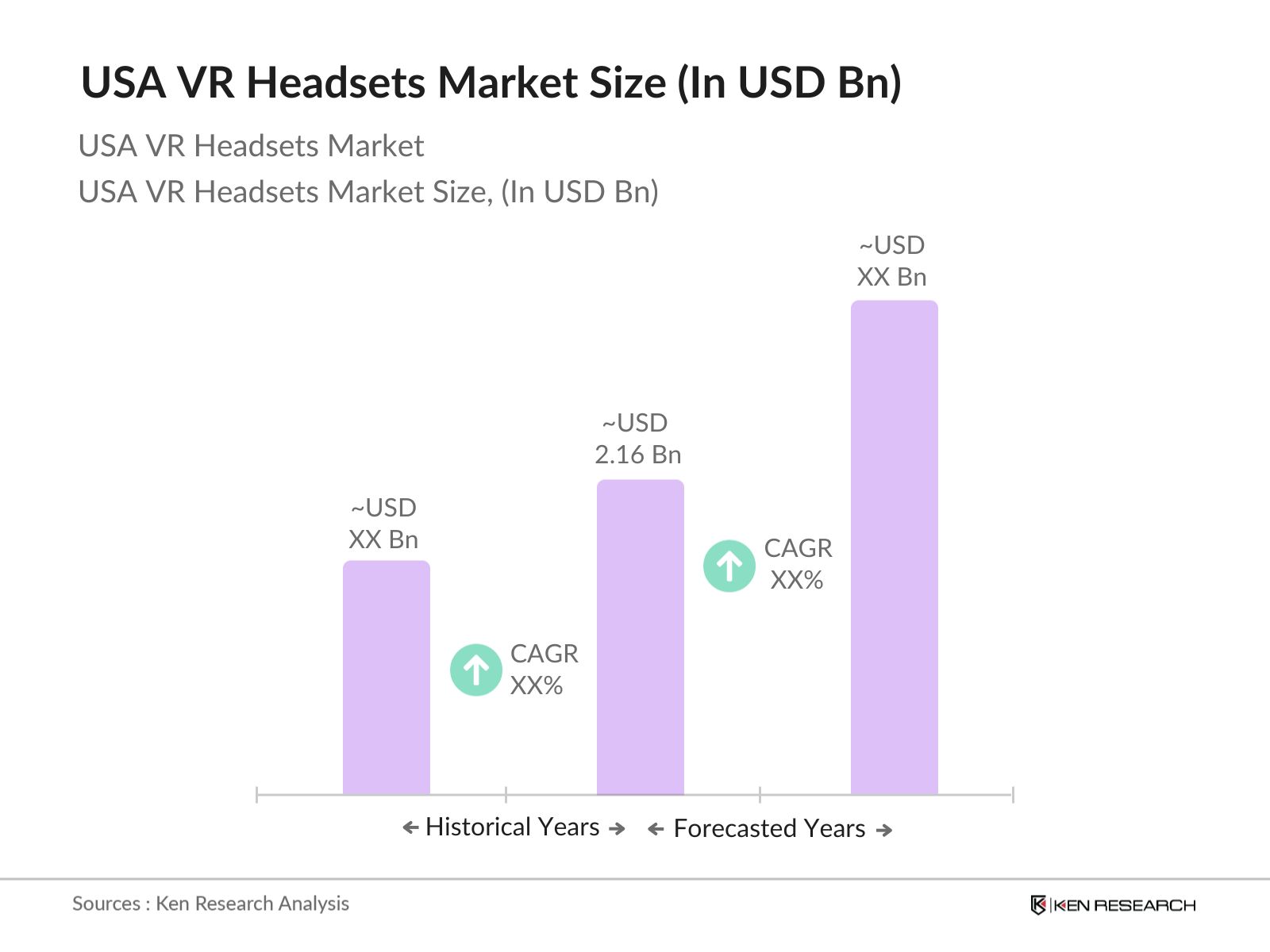
- The USA VR Headsets market is valued at USD 2.16 billion, reflecting strong growth, primarily driven by the gaming sector's popularity and a substantial increase in enterprise applications like training and simulation. Enhanced technological capabilities, such as improved visual resolution and 5G connectivity, have facilitated wider adoption in gaming, healthcare, education, and retail sectors. Additionally, as more industries recognize VR's potential for remote training and customer engagement, the demand for VR headsets continues to rise, supporting the markets steady expansion.
- Major metropolitan hubs like San Francisco, Los Angeles, and New York play dominant roles in the VR headset market due to their proximity to tech innovation centers and a high concentration of technology-adopting businesses. These cities attract VR companies through abundant venture capital funding, a highly skilled workforce, and a collaborative ecosystem of tech and entertainment. As such, these areas remain pivotal for the VR headset markets growth trajectory in the USA.
- With the CCPA in effect, VR headset developers in the U.S. must adhere to stringent data privacy regulations, impacting product design to safeguard user data. The Federal Trade Commission (FTC) enforces these standards, emphasizing the protection of user data, especially in VR where data tracking is extensive.
USA VR Headsets Market Segmentation
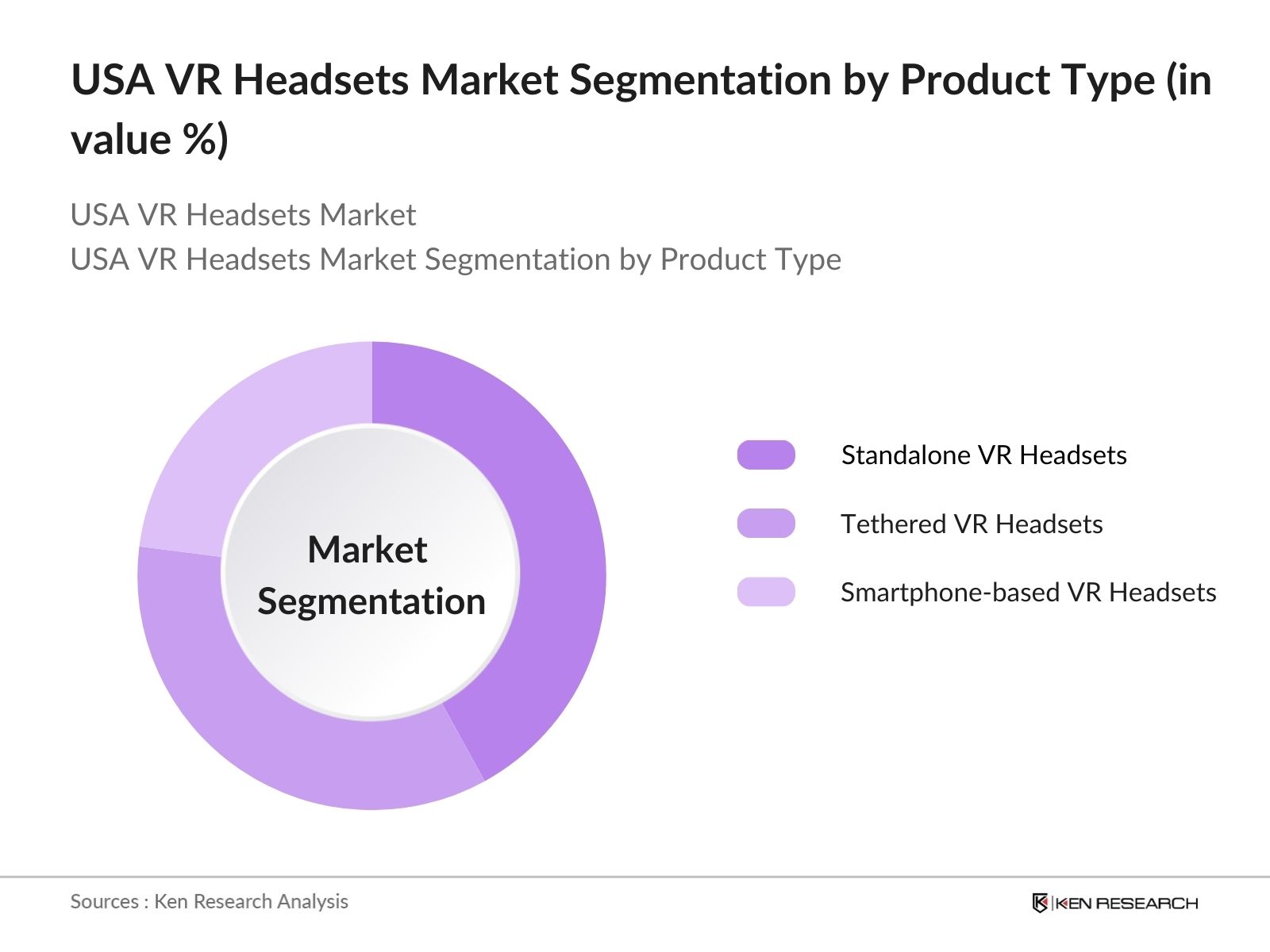
- By Product Type: The market is segmented by product type into standalone VR headsets, tethered VR headsets, and smartphone-based VR headsets. Standalone VR headsets currently hold the dominant market share in this segment due to their portability, wireless connectivity, and high-quality immersive experiences. With ongoing developments in lightweight design and high-resolution screens, standalone VR headsets have become increasingly popular across various applications, from gaming to enterprise training, as they offer a seamless user experience without the need for a PC or smartphone.
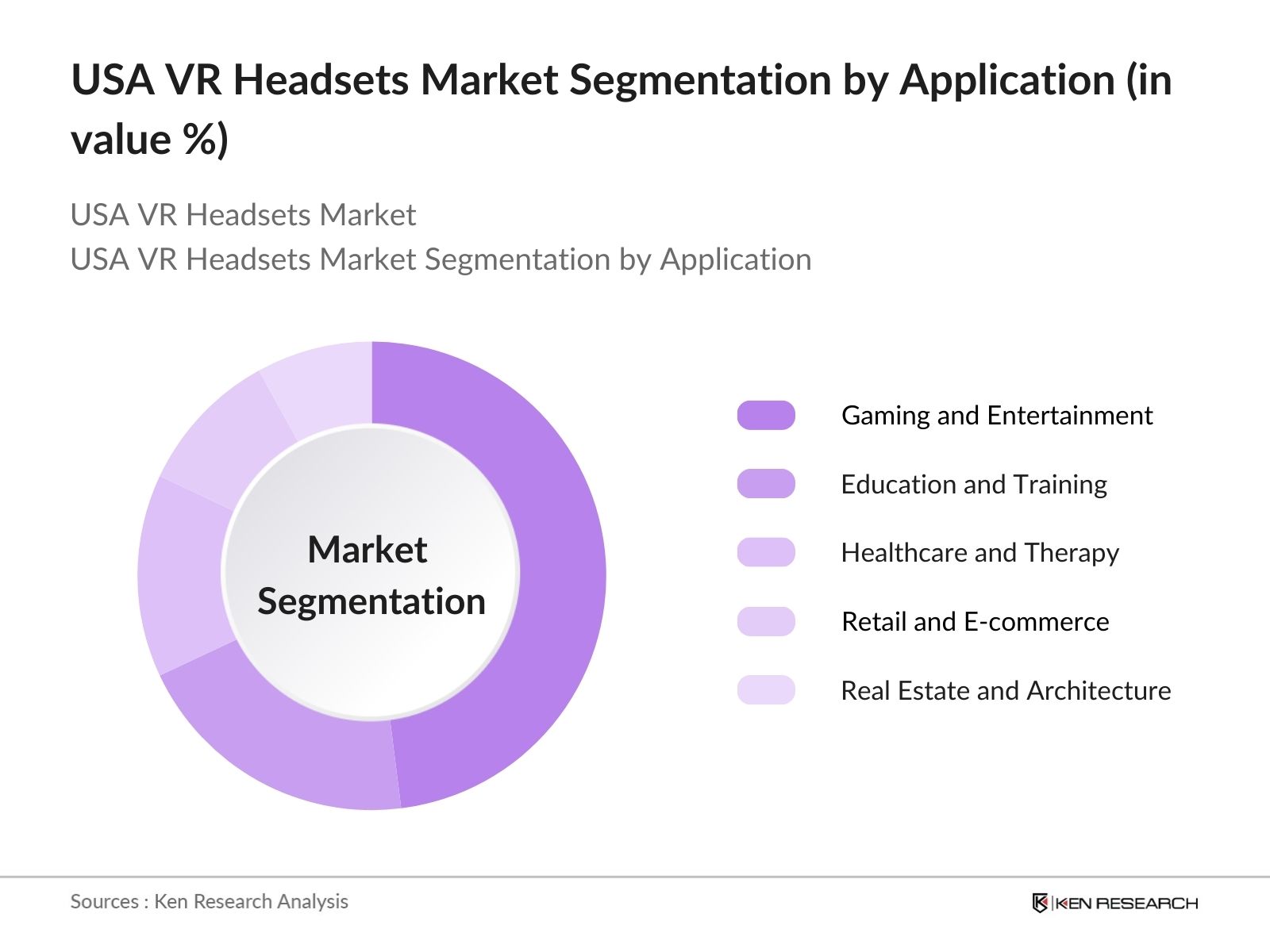
- By Application: The market is also segmented by application into gaming and entertainment, education and training, healthcare and therapy, retail and e-commerce, and real estate and architecture. Gaming and entertainment continue to dominate, driven by the extensive demand for immersive experiences, realistic gameplay, and VR-compatible content. In particular, gaming enthusiasts prioritize high-quality headsets for more engaging experiences, making gaming the most lucrative sub-segment within VR applications. The integration of VR with platforms such as Steam and PlayStation further propels this segment's growth.
USA VR Headsets Market Competitive Landscape
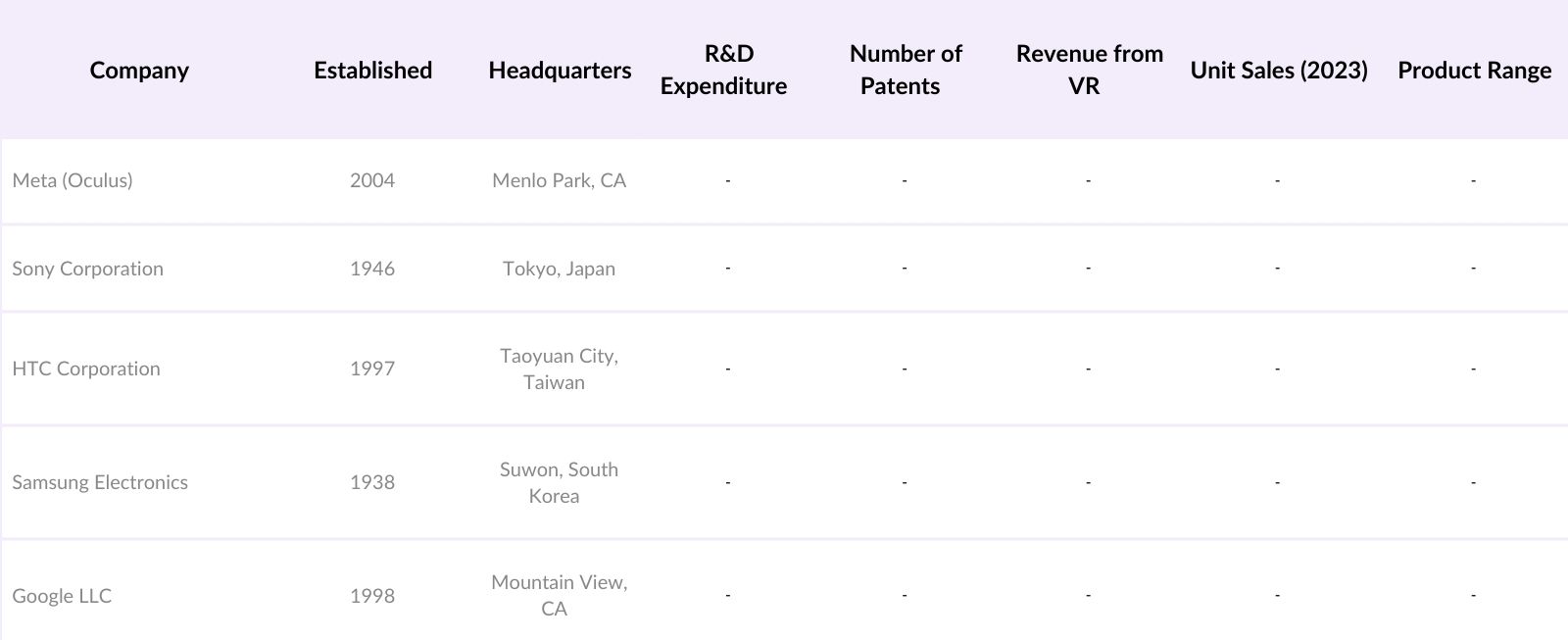
The USA VR Headsets market is dominated by several prominent players who are strategically positioned to leverage their technological expertise, strong brand presence, and extensive distribution networks. The competitive landscape includes both domestic and international players, with companies investing heavily in R&D to enhance VR headset capabilities. This competitive concentration, led by companies such as Meta, Sony, and HTC, illustrates the influence of these key players in advancing VR technology and application.
USA VR Headsets Market Analysis
Market Growth Drivers
- Increased Gaming Adoption: The rising demand for immersive gaming has fueled VR headset adoption in the U.S. According to Statista, the U.S. gaming industry generated a substantial revenue of $57 billion in 2024, with VR games being a major segment of growth. With over 64 million VR users in the U.S. this year, immersive technologies are key to next-gen gaming, directly driving VR headset sales. Gaming studios are increasingly launching VR-exclusive games, further enhancing this trend.
- Expanding Applications in Education and Training: Educational institutions and corporations have increasingly adopted VR headsets for training programs, enabling enhanced engagement and retention. The U.S. education sector saw $1.3 billion allocated to VR-based educational tools in 2024, with training and virtual simulations providing hands-on experiences that traditional methods lack. Over 500 universities and schools in the U.S. currently integrate VR into their curriculum, making VR headsets essential in the educational domain.
- Surge in 5G Connectivity: The proliferation of 5G networks across the U.S., with around 60% coverage in 2024, has enhanced VR headset performance, providing smoother streaming and lower latency in VR experiences. The Federal Communications Commission (FCC) reports that enhanced connectivity due to 5G is expected to support data-heavy applications like VR gaming and remote simulations, allowing VR headsets to operate more efficiently. This connectivity leap directly bolsters VR adoption across various sectors.
Market Challenges
- High Development Costs: VR technology development demands substantial R&D spending, with VR hardware costs in the U.S. projected to reach $7 billion in 2024, presenting a challenge for manufacturers. These expenses impact pricing and accessibility for consumers and corporations alike, leading to slower adoption rates in smaller businesses and education sectors.
- Technological Limitations: VR headsets face technical challenges like limited battery life, averaging only 23 hours, and a resolution gap relative to real-world clarity. The U.S. Consumer Product Safety Commission reported that these limitations have led to customer dissatisfaction and hindered extended VR use in professional settings like healthcare, where long battery life is crucial for training applications.
USA VR Headsets Market Future Outlook
The USA VR Headsets market is expected to show advancements driven by continuous technological improvements, increasing consumer demand, and wider enterprise applications. The incorporation of artificial intelligence and machine learning in VR is anticipated to enhance user experiences, while 5G deployment will improve connectivity and usability in untethered devices. As adoption accelerates across various sectors, the market is set for steady growth, with new players and startups likely to contribute to technological diversification and competitive dynamics.
Market Opportunities
- Enterprise Use in Training & Simulation: Corporate training through VR is seeing tractions, with over 35,000 VR headsets actively used in training simulations across U.S. enterprises. Industries such as manufacturing and defense employ VR for technical skill development, creating a promising market opportunity. The Occupational Safety and Health Administration reports that VR-based simulations have improved safety training effectiveness by 40% in high-risk industries.
- Expansion in Healthcare Applications: VR in healthcare has expanded, with the U.S. healthcare sector integrating over 20,000 VR headsets into physical therapy, surgical planning, and mental health treatment. The Centers for Medicare & Medicaid Services estimates that VR applications in rehabilitation and pain management programs contribute to improved patient outcomes, supporting the demand for medical VR applications.
Scope of the Report
|
By Product Type |
Standalone VR Headsets Tethered VR Headsets Smartphone-based VR Headsets |
|
By Application |
Gaming and Entertainment Education and Training Healthcare and Therapy Retail and E-commerce Real Estate and Architecture |
|
By Component |
Hardware (Sensors, Displays) Software (Platforms, VR Content) Services (Consulting, Maintenance) |
|
By Distribution Channel |
Online Retailers Brick-and-Mortar Retail Direct-to-Consumer (DTC) Enterprise Partnerships |
|
By Region |
Northeast USA Midwest USA South USA West USA |
Products
Key Target Audience
Virtual Reality Device Manufacturers
Gaming and Entertainment Companies
Healthcare Institutions (Hospitals, Rehabilitation Centers)
Educational Institutions and Training Organizations
Banks and Financial Institutions
Real Estate and Retail Sector Entities
Telecommunication Providers (5G Network Operators)
Investors and Venture Capitalist Firms
Government and Regulatory Bodies (Federal Communications Commission, National Telecommunications and Information Administration)
Companies
Players Mentioned in the Report
Meta (Oculus)
Sony Corporation
HTC Corporation
Samsung Electronics
Google LLC
Microsoft Corporation (HoloLens Division)
Apple Inc.
Valve Corporation
Qualcomm Technologies, Inc.
Magic Leap, Inc.
Table of Contents
1. USA VR Headsets Market Overview
1.1 Definition and Scope
1.2 Market Taxonomy
1.3 Market Growth Rate (User Adoption Rate, Device Compatibility)
1.4 Market Segmentation Overview (Consumer, Enterprise, Hardware, Software, Content)
2. USA VR Headsets Market Size (in USD)
2.1 Historical Market Size (Units Sold, Device Types)
2.2 Year-On-Year Growth Analysis
2.3 Key Market Developments and Milestones (Technology Innovations, User Interface Advances)
3. USA VR Headsets Market Analysis
3.1 Growth Drivers
3.1.1 Increased Gaming Adoption
3.1.2 Expanding Applications in Education and Training
3.1.3 Surge in 5G Connectivity
3.1.4 Government and Corporate Investments in Immersive Technology
3.2 Market Challenges
3.2.1 High Development Costs
3.2.2 Technological Limitations (Battery Life, Screen Resolution)
3.2.3 Limited Content Ecosystem
3.2.4 Health Concerns (Eye Strain, Motion Sickness)
3.3 Opportunities
3.3.1 Enterprise Use in Training & Simulation
3.3.2 Expansion in Healthcare Applications
3.3.3 Remote Collaboration Growth
3.3.4 Synergy with AR/MR Ecosystems
3.4 Trends
3.4.1 Lightweight and Wireless Headsets
3.4.2 Cloud-based VR Platforms
3.4.3 Augmented Social VR Spaces
3.4.4 Integration with IoT for Real-time Data
3.5 Regulatory Environment
3.5.1 Data Privacy Standards (GDPR, CCPA Impact)
3.5.2 Health and Safety Regulations
3.5.3 Accessibility Compliance (ADA Standards)
3.6 Competitive Dynamics
3.6.1 Product Differentiation by Technology
3.6.2 Strategic Alliances and Partnerships
3.6.3 Hardware vs. Software Dominance in the Value Chain
3.7 Market Ecosystem Analysis
4. USA VR Headsets Market Segmentation
4.1 By Product Type
4.1.1 Standalone VR Headsets
4.1.2 Tethered VR Headsets
4.1.3 Smartphone-based VR Headsets
4.2 By Application (In Value %)
4.2.1 Gaming and Entertainment
4.2.2 Education and Training
4.2.3 Healthcare and Therapy
4.2.4 Retail and E-commerce
4.2.5 Real Estate and Architecture
4.3 By Component
4.3.1 Hardware (Sensors, Displays)
4.3.2 Software (Platforms, VR Content)
4.3.3 Services (Consulting, Maintenance)
4.4 By Distribution Channel (In Value %)
4.4.1 Online Retailers
4.4.2 Brick-and-Mortar Retail
4.4.3 Direct-to-Consumer (DTC)
4.4.4 Enterprise Partnerships
4.5 By Region
4.5.1 Northeast USA
4.5.2 Midwest USA
4.5.3 South USA
4.5.4 West USA
5. USA VR Headsets Market Competitive Analysis
5.1 Detailed Profiles of Major Companies
5.1.1 Meta (Oculus)
5.1.2 Sony Corporation
5.1.3 HTC Corporation
5.1.4 Microsoft Corporation (HoloLens Division)
5.1.5 Samsung Electronics Co., Ltd.
5.1.6 Google LLC
5.1.7 Apple Inc.
5.1.8 Valve Corporation
5.1.9 Pimax VR
5.1.10 Qualcomm Technologies, Inc.
5.1.11 Magic Leap, Inc.
5.1.12 Varjo Technologies
5.1.13 FOVE, Inc.
5.1.14 DPVR
5.1.15 Vuzix Corporation
5.2 Cross Comparison Parameters (Revenue, Units Sold, AR/VR Integration, Sensor Capabilities, Display Resolution, Content Ecosystem, Market Penetration, Funding Received)
5.3 Market Share Analysis
5.4 Strategic Initiatives (Mergers, Partnerships, R&D Focus)
5.5 Product Launches and Technological Advancements
5.6 Market Positioning and Brand Strategies
6. USA VR Headsets Market Regulatory Framework
6.1 Data Privacy and Security Regulations
6.2 Health and Safety Standards
6.3 Certification and Compliance (FCC, CE)
7. USA VR Headsets Future Market Size (in USD)
7.1 Future Market Size Projections
7.2 Key Factors Driving Future Market Growth
8. USA VR Headsets Future Market Segmentation
8.1 By Product Type
8.2 By Application
8.3 By Component
8.4 By Distribution Channel
8.5 By Region
9. USA VR Headsets Market Analysts Recommendations
9.1 Total Addressable Market (TAM), Serviceable Available Market (SAM), Serviceable Obtainable Market (SOM) Analysis
9.2 Consumer Persona and Usage Patterns
9.3 Product Diversification and Localization Strategies
9.4 Marketing and Branding Recommendations
9.5 Identification of White Space Opportunities
Disclaimer Contact UsResearch Methodology
Step 1: Identification of Key Variables
The initial phase focuses on mapping the USA VR Headsets ecosystem, identifying all major stakeholders including device manufacturers, software providers, and distributors. Comprehensive desk research and proprietary databases support the collection of industry-level information, isolating critical variables that impact VR market trends.
Step 2: Market Analysis and Construction
Historical data is compiled to understand the USA VR market's growth trajectory, covering aspects like penetration rates, user adoption, and segment-specific revenue. Further assessment of quality standards ensures the reliability of our data.
Step 3: Hypothesis Validation and Expert Consultation
Market hypotheses are tested through telephone interviews with industry experts across VR-related companies, gathering practical insights on operational and technological trends that enhance the quality and depth of the data.
Step 4: Research Synthesis and Final Output
The final stage consolidates findings through direct interaction with VR headset manufacturers, examining sales metrics, consumer preferences, and segment performance to ensure a comprehensive market evaluation.
Frequently Asked Questions
01. How big is the USA VR Headsets Market?
The USA VR Headsets market is valued at USD 2.16 billion, driven by extensive use in gaming, training, and other enterprise applications, reflecting the rapid growth of VR adoption.
02. What are the challenges in the USA VR Headsets Market?
Challenges include high development costs, limited VR content for enterprise uses, and user concerns over health issues like eye strain and motion sickness, which can impact market growth.
03. Who are the major players in the USA VR Headsets Market?
Key players include Meta, Sony Corporation, HTC, Samsung, and Google. These companies lead due to their technological capabilities, strong distribution networks, and strategic market positioning.
04. What drives growth in the USA VR Headsets Market?
Growth is propelled by rising demand in gaming, increasing applications across industries, and technological advancements, especially with 5G-enabled wireless VR solutions gaining popularity.
Why Buy From Us?

What makes us stand out is that our consultants follows Robust, Refine and Result (RRR) methodology. i.e. Robust for clear definitions, approaches and sanity checking, Refine for differentiating respondents facts and opinions and Result for presenting data with story

We have set a benchmark in the industry by offering our clients with syndicated and customized market research reports featuring coverage of entire market as well as meticulous research and analyst insights.

While we don't replace traditional research, we flip the method upside down. Our dual approach of Top Bottom & Bottom Top ensures quality deliverable by not just verifying company fundamentals but also looking at the sector and macroeconomic factors.

With one step in the future, our research team constantly tries to show you the bigger picture. We help with some of the tough questions you may encounter along the way: How is the industry positioned? Best marketing channel? KPI's of competitors? By aligning every element, we help maximize success.

Our report gives you instant access to the answers and sources that other companies might choose to hide. We elaborate each steps of research methodology we have used and showcase you the sample size to earn your trust.

If you need any support, we are here! We pride ourselves on universe strength, data quality, and quick, friendly, and professional service.