About the Report
Base Year 2024Qatar Art Collectibles Retail Market Overview
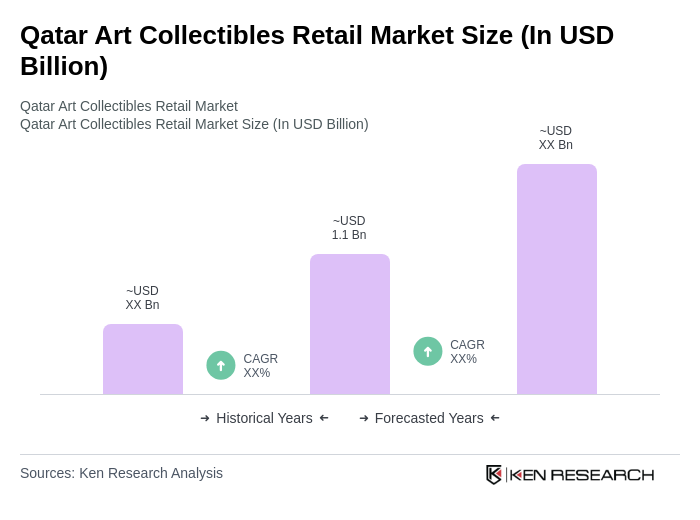
- The Qatar Art Collectibles Retail Market is valued at USD 1.1 billion, based on a five-year historical analysis. This growth is primarily driven by increasing disposable income, a rising population of high-net-worth individuals, and robust government initiatives to promote cultural heritage and tourism. The market has experienced a notable increase in both local and international art sales, reflecting a growing appreciation for art as an investment and a form of personal expression. The emergence of Qatar as a regional art hub, highlighted by the debut of Art Basel Qatar and the expansion of art-linked tourism, further supports this upward trend .
- Doha is the dominant city in the Qatar Art Collectibles Retail Market, largely due to its status as a cultural hub with numerous galleries, museums, and art fairs. The city's investment in cultural infrastructure, such as Qatar Museums and Katara Cultural Village, has attracted both local and international artists, making it a focal point for art collectors and enthusiasts. The presence of affluent expatriates and the government’s strategic partnerships with global art organizations contribute to the market’s vibrancy and international appeal .
- The Ministry of Culture issued the “Art Market Transaction Reporting Regulation, 2023,” which mandates that all art transactions exceeding QAR 10,000 must be documented and reported to the Ministry of Culture. This regulation aims to enhance transparency, combat art fraud, and ensure the provenance of artworks is verifiable, thereby increasing consumer confidence in the market. The regulation covers all licensed galleries, dealers, and auction houses, requiring compliance with documentation and reporting standards .
Qatar Art Collectibles Retail Market Segmentation
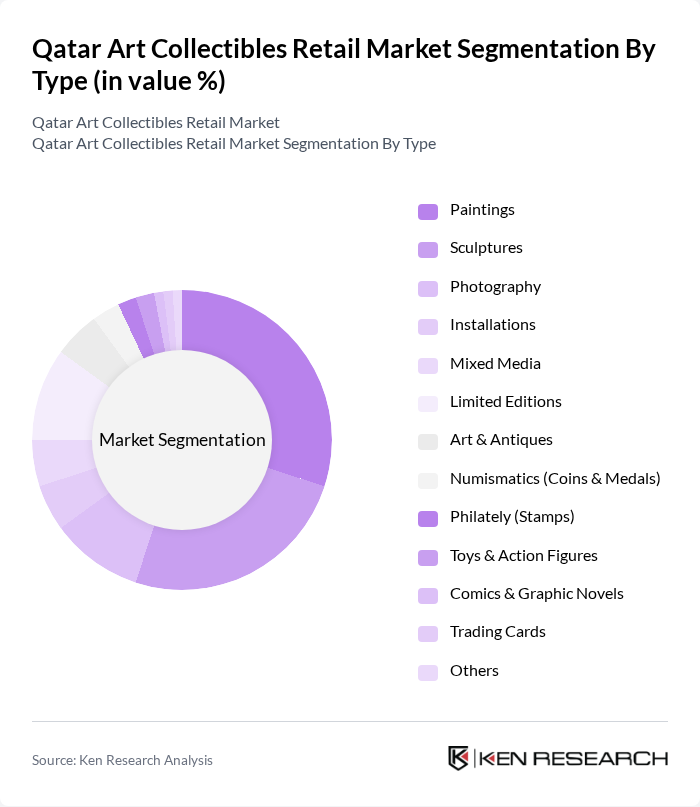
By Type:The market is segmented into various types of art collectibles, including paintings, sculptures, photography, installations, mixed media, limited editions, art & antiques, numismatics, philately, toys & action figures, comics & graphic novels, trading cards, and others. Among these, paintings and sculptures remain the most popular, driven by consumer preferences for traditional art forms and their perceived investment value. The growing trend of home decor, the influence of international art fairs, and the rise of new collector demographics have further fueled demand in these segments .
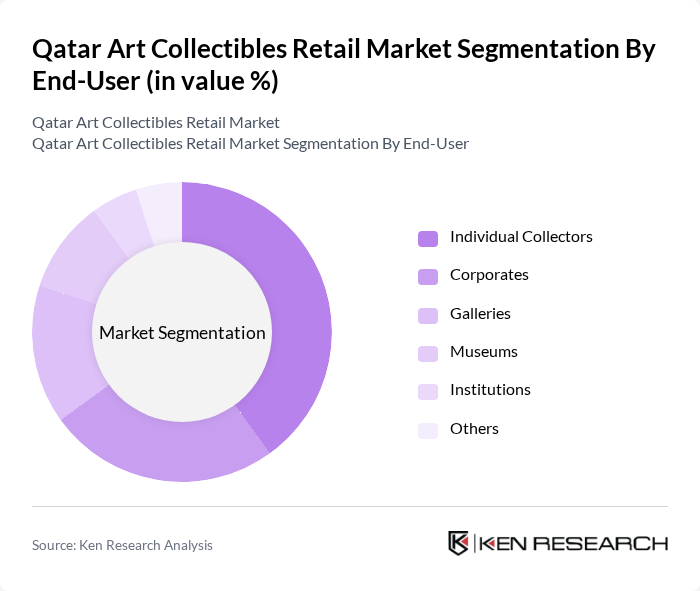
By End-User:The end-user segmentation includes individual collectors, corporates, galleries, museums, institutions, and others. Individual collectors continue to dominate the market, driven by a growing interest in art as a personal investment and a means of self-expression. Corporates also play a significant role, often purchasing art for office decor or as part of corporate gifting strategies. The increasing number of art fairs and exhibitions, along with the entry of younger collectors, has further encouraged participation from various end-users .
Qatar Art Collectibles Retail Market Competitive Landscape
The Qatar Art Collectibles Retail Market is characterized by a dynamic mix of regional and international players. Leading participants such as Qatar Museums, Katara Cultural Village, Al Markhiya Gallery, The Art Hub, Doha Art Gallery, Al Jazeera Art Gallery, Al Riwaq Art Space, Fire Station: Artist in Residence, Al Qattan Foundation, Art 29, The Pearl-Qatar, Souq Waqif Art Center, Museum of Islamic Art, Mathaf: Arab Museum of Modern Art, Qatar Fine Arts Association, Anima Gallery, Gallery Al Hosh, East Wing Gallery, W Doha Art Gallery contribute to innovation, geographic expansion, and service delivery in this space.
Qatar Art Collectibles Retail Market Industry Analysis
Growth Drivers
- Increasing Disposable Income:The average disposable income in Qatar is projected to reach QAR 15,000 per month in future, reflecting a 5% increase from the previous period. This rise in disposable income enables consumers to allocate more funds towards art collectibles, enhancing their purchasing power. As more individuals enter higher income brackets, the demand for unique art pieces is expected to grow, fostering a vibrant art market that attracts both local and international artists and collectors.
- Rising Interest in Art Investment:In future, the art investment market in Qatar is anticipated to grow by 10%, driven by an increasing number of investors recognizing art as a viable asset class. The total value of art transactions in the region is expected to exceed QAR 500 million, as more individuals seek to diversify their portfolios. This trend is supported by educational initiatives and workshops that promote art investment, further stimulating interest among potential buyers.
- Growth of Art Fairs and Exhibitions:Qatar is set to host over 15 major art fairs and exhibitions in future, attracting thousands of visitors and collectors. These events are projected to generate QAR 200 million in sales, showcasing local and international artists. The increased visibility and engagement fostered by these fairs enhance consumer interest in art collectibles, creating a dynamic marketplace that encourages both sales and cultural exchange.
Market Challenges
- Limited Awareness of Art as an Investment:Despite the growing interest in art, many consumers in Qatar remain unaware of its potential as an investment. A survey conducted in the previous period indicated that only 30% of respondents viewed art as a viable investment option. This lack of awareness hinders market growth, as potential buyers may overlook art collectibles in favor of more traditional investment avenues, limiting overall market expansion.
- High Competition from Online Platforms:The rise of online art marketplaces has intensified competition in the Qatar art collectibles market. In future, it is estimated that online platforms will account for 40% of art sales, drawing consumers away from traditional galleries. This shift poses a challenge for local retailers, who must adapt to the digital landscape to remain competitive, potentially impacting their sales and market share.
Qatar Art Collectibles Retail Market Future Outlook
The future of the Qatar art collectibles market appears promising, driven by increasing disposable incomes and a growing appreciation for art as an investment. As the market evolves, digital platforms will play a crucial role in reaching a broader audience. Additionally, the government’s commitment to cultural initiatives will likely enhance the visibility of local artists, fostering a supportive environment for art sales. Overall, the market is poised for growth, with significant opportunities for innovation and collaboration.
Market Opportunities
- Expansion of Online Art Marketplaces:The growth of online art marketplaces presents a significant opportunity for local galleries to reach a wider audience. By leveraging digital platforms, galleries can increase their visibility and sales, tapping into the growing trend of online shopping. This shift could potentially increase overall art sales in Qatar by QAR 100 million in future, enhancing market dynamics.
- Collaborations with Local Artists:Collaborating with local artists can create unique offerings that resonate with consumers. By promoting local talent, galleries can attract a dedicated customer base, fostering community engagement. This strategy not only supports local artists but also enhances the cultural landscape, potentially increasing sales by 15% as consumers seek to invest in homegrown art.
Scope of the Report
| Segment | Sub-Segments |
|---|---|
| By Type | Paintings Sculptures Photography Installations Mixed Media Limited Editions Art & Antiques Numismatics (Coins & Medals) Philately (Stamps) Toys & Action Figures Comics & Graphic Novels Trading Cards Others |
| By End-User | Individual Collectors Corporates Galleries Museums Institutions Others |
| By Sales Channel | Online Platforms Art Fairs Galleries Auctions Direct Sales Others |
| By Price Range | Below QAR 1,000 QAR 1,000 - QAR 5,000 QAR 5,000 - QAR 20,000 Above QAR 20,000 |
| By Artist Type | Established Artists Emerging Artists Local Artists International Artists |
| By Material | Oil on Canvas Acrylic Watercolor Digital Media Others |
| By Occasion | Home Decor Corporate Gifts Investment Events and Exhibitions Others |
Key Target Audience
Investors and Venture Capitalist Firms
Government and Regulatory Bodies (e.g., Qatar Museums Authority, Ministry of Culture and Sports)
Art Galleries and Exhibition Organizers
Art Auction Houses
Art Collectors and Enthusiasts
Interior Designers and Decorators
Art Advisors and Consultants
Online Art Marketplaces
Players Mentioned in the Report:
Qatar Museums
Katara Cultural Village
Al Markhiya Gallery
The Art Hub
Doha Art Gallery
Al Jazeera Art Gallery
Al Riwaq Art Space
Fire Station: Artist in Residence
Al Qattan Foundation
Art 29
The Pearl-Qatar
Souq Waqif Art Center
Museum of Islamic Art
Mathaf: Arab Museum of Modern Art
Qatar Fine Arts Association
Anima Gallery
Gallery Al Hosh
East Wing Gallery
W Doha Art Gallery
Table of Contents
Market Assessment Phase
1. Executive Summary and Approach
2. Qatar Art Collectibles Retail Market Overview
2.1 Key Insights and Strategic Recommendations
2.2 Qatar Art Collectibles Retail Market Overview
2.3 Definition and Scope
2.4 Evolution of Market Ecosystem
2.5 Timeline of Key Regulatory Milestones
2.6 Value Chain & Stakeholder Mapping
2.7 Business Cycle Analysis
2.8 Policy & Incentive Landscape
3. Qatar Art Collectibles Retail Market Analysis
3.1 Growth Drivers
3.1.1 Increasing disposable income among consumers
3.1.2 Rising interest in art investment
3.1.3 Growth of art fairs and exhibitions
3.1.4 Government support for cultural initiatives
3.2 Market Challenges
3.2.1 Limited awareness of art as an investment
3.2.2 High competition from online platforms
3.2.3 Economic fluctuations affecting consumer spending
3.2.4 Regulatory hurdles in art transactions
3.3 Market Opportunities
3.3.1 Expansion of online art marketplaces
3.3.2 Collaborations with local artists
3.3.3 Development of art education programs
3.3.4 Increased tourism boosting art sales
3.4 Market Trends
3.4.1 Growing popularity of digital art
3.4.2 Shift towards sustainable and ethical art practices
3.4.3 Rise of art leasing and rental services
3.4.4 Increased use of social media for art promotion
3.5 Government Regulation
3.5.1 Art ownership and provenance laws
3.5.2 Tax incentives for art purchases
3.5.3 Regulations on art exports
3.5.4 Compliance requirements for galleries and dealers
4. SWOT Analysis
5. Stakeholder Analysis
6. Porter's Five Forces Analysis
7. Qatar Art Collectibles Retail Market Market Size, 2019-2024
7.1 By Value
7.2 By Volume
7.3 By Average Selling Price
8. Qatar Art Collectibles Retail Market Segmentation
8.1 By Type
8.1.1 Paintings
8.1.2 Sculptures
8.1.3 Photography
8.1.4 Installations
8.1.5 Mixed Media
8.1.6 Limited Editions
8.1.7 Art & Antiques
8.1.8 Numismatics (Coins & Medals)
8.1.9 Philately (Stamps)
8.1.10 Toys & Action Figures
8.1.11 Comics & Graphic Novels
8.1.12 Trading Cards
8.1.13 Others
8.2 By End-User
8.2.1 Individual Collectors
8.2.2 Corporates
8.2.3 Galleries
8.2.4 Museums
8.2.5 Institutions
8.2.6 Others
8.3 By Sales Channel
8.3.1 Online Platforms
8.3.2 Art Fairs
8.3.3 Galleries
8.3.4 Auctions
8.3.5 Direct Sales
8.3.6 Others
8.4 By Price Range
8.4.1 Below QAR 1,000
8.4.2 QAR 1,000 - QAR 5,000
8.4.3 QAR 5,000 - QAR 20,000
8.4.4 Above QAR 20,000
8.5 By Artist Type
8.5.1 Established Artists
8.5.2 Emerging Artists
8.5.3 Local Artists
8.5.4 International Artists
8.6 By Material
8.6.1 Oil on Canvas
8.6.2 Acrylic
8.6.3 Watercolor
8.6.4 Digital Media
8.6.5 Others
8.7 By Occasion
8.7.1 Home Decor
8.7.2 Corporate Gifts
8.7.3 Investment
8.7.4 Events and Exhibitions
8.7.5 Others
9. Qatar Art Collectibles Retail Market Competitive Analysis
9.1 Market Share of Key Players
9.2 Cross Comparison of Key Players
9.2.1 Company Name
9.2.2 Group Size (Large, Medium, or Small as per industry convention)
9.2.3 Revenue Growth Rate
9.2.4 Customer Acquisition Cost
9.2.5 Average Transaction Value
9.2.6 Customer Retention Rate
9.2.7 Market Penetration Rate
9.2.8 Pricing Strategy
9.2.9 Brand Recognition Score
9.2.10 Inventory Turnover Ratio
9.2.11 Online Sales Ratio
9.2.12 Number of Exclusive Exhibitions Held Annually
9.2.13 Artist Representation Diversity
9.2.14 Customer Satisfaction Index
9.3 SWOT Analysis of Top Players
9.4 Pricing Analysis
9.5 Detailed Profile of Major Companies
9.5.1 Qatar Museums
9.5.2 Katara Cultural Village
9.5.3 Al Markhiya Gallery
9.5.4 The Art Hub
9.5.5 Doha Art Gallery
9.5.6 Al Jazeera Art Gallery
9.5.7 Al Riwaq Art Space
9.5.8 Fire Station: Artist in Residence
9.5.9 Al Qattan Foundation
9.5.10 Art 29
9.5.11 The Pearl-Qatar
9.5.12 Souq Waqif Art Center
9.5.13 Museum of Islamic Art
9.5.14 Mathaf: Arab Museum of Modern Art
9.5.15 Qatar Fine Arts Association
9.5.16 Anima Gallery
9.5.17 Gallery Al Hosh
9.5.18 East Wing Gallery
9.5.19 W Doha Art Gallery
10. Qatar Art Collectibles Retail Market End-User Analysis
10.1 Procurement Behavior of Key Ministries
10.1.1 Ministry of Culture and Sports
10.1.2 Ministry of Education and Higher Education
10.1.3 Ministry of Commerce and Industry
10.2 Corporate Spend on Infrastructure & Energy
10.2.1 Corporate Art Collections
10.2.2 Sponsorship of Art Events
10.2.3 Investment in Local Artists
10.3 Pain Point Analysis by End-User Category
10.3.1 High Costs of Authentic Art
10.3.2 Limited Access to Art Education
10.3.3 Difficulty in Art Valuation
10.4 User Readiness for Adoption
10.4.1 Awareness of Art Investment Benefits
10.4.2 Interest in Art as a Cultural Asset
10.4.3 Engagement with Art Communities
10.5 Post-Deployment ROI and Use Case Expansion
10.5.1 Increased Brand Value through Art
10.5.2 Enhanced Customer Experience
10.5.3 Opportunities for Art Collaborations
11. Qatar Art Collectibles Retail Market Future Size, 2025-2030
11.1 By Value
11.2 By Volume
11.3 By Average Selling Price
Go-To-Market Strategy Phase
1. Whitespace Analysis + Business Model Canvas
1.1 Market Gaps Identification
1.2 Business Model Development
2. Marketing and Positioning Recommendations
2.1 Branding Strategies
2.2 Product USPs
3. Distribution Plan
3.1 Urban Retail vs Rural NGO Tie-ups
4. Channel & Pricing Gaps
4.1 Underserved Routes
4.2 Pricing Bands
5. Unmet Demand & Latent Needs
5.1 Category Gaps
5.2 Consumer Segments
6. Customer Relationship
6.1 Loyalty Programs
6.2 After-sales Service
7. Value Proposition
7.1 Sustainability
7.2 Integrated Supply Chains
8. Key Activities
8.1 Regulatory Compliance
8.2 Branding
8.3 Distribution Setup
9. Entry Strategy Evaluation
9.1 Domestic Market Entry Strategy
9.1.1 Product Mix
9.1.2 Pricing Band
9.1.3 Packaging
9.2 Export Entry Strategy
9.2.1 Target Countries
9.2.2 Compliance Roadmap
10. Entry Mode Assessment
10.1 JV
10.2 Greenfield
10.3 M&A
10.4 Distributor Model
11. Capital and Timeline Estimation
11.1 Capital Requirements
11.2 Timelines
12. Control vs Risk Trade-Off
12.1 Ownership vs Partnerships
13. Profitability Outlook
13.1 Breakeven Analysis
13.2 Long-term Sustainability
14. Potential Partner List
14.1 Distributors
14.2 JVs
14.3 Acquisition Targets
15. Execution Roadmap
15.1 Phased Plan for Market Entry
15.1.1 Market Setup
15.1.2 Market Entry
15.1.3 Growth Acceleration
15.1.4 Scale & Stabilize
15.2 Key Activities and Milestones
15.2.1 Activity Planning
15.2.2 Milestone Tracking
Research Methodology
Phase 1: Approach1
Desk Research
- Analysis of market reports from local art institutions and galleries
- Review of government publications on cultural and economic contributions of the art sector
- Examination of online platforms and e-commerce data specific to art collectibles in Qatar
Primary Research
- Interviews with art collectors and investors in the Qatari market
- Surveys targeting gallery owners and art dealers to understand market dynamics
- Field interviews with curators and art consultants to gather qualitative insights
Validation & Triangulation
- Cross-validation of findings through multiple data sources including sales data and expert opinions
- Triangulation of qualitative insights from interviews with quantitative data from surveys
- Sanity checks through feedback from an advisory panel of art market experts
Phase 2: Market Size Estimation1
Top-down Assessment
- Estimation of total art market size based on national cultural expenditure reports
- Segmentation of the market by types of collectibles, including traditional and contemporary art
- Incorporation of tourism data to assess the impact on art sales and exhibitions
Bottom-up Modeling
- Collection of sales data from leading art galleries and auction houses in Qatar
- Estimation of average transaction values for various categories of art collectibles
- Volume estimates based on historical sales trends and current market activity
Forecasting & Scenario Analysis
- Multi-factor regression analysis incorporating economic indicators and consumer spending trends
- Scenario modeling based on potential changes in tourism and cultural policies
- Development of baseline, optimistic, and pessimistic forecasts through 2030
Phase 3: CATI Sample Composition1
| Scope Item/Segment | Sample Size | Target Respondent Profiles |
|---|---|---|
| Art Collectors | 100 | Private Collectors, Art Investors |
| Gallery Owners | 60 | Gallery Managers, Art Dealers |
| Art Auction Houses | 40 | Auctioneers, Sales Directors |
| Cultural Institutions | 50 | Curators, Museum Directors |
| Art Consultants | 40 | Art Advisors, Market Analysts |
Frequently Asked Questions
What is the current value of the Qatar Art Collectibles Retail Market?
The Qatar Art Collectibles Retail Market is valued at approximately USD 1.1 billion, reflecting significant growth driven by increasing disposable income, a rising population of high-net-worth individuals, and government initiatives promoting cultural heritage and tourism.
Which city is the hub for art collectibles in Qatar?
What types of art collectibles are popular in Qatar?
Who are the primary end-users in the Qatar Art Collectibles Market?
Other Regional/Country Reports
Indonesia Art Collectibles Retail Market
Malaysia Art Collectibles Retail Market
KSA Art Collectibles Retail Market
APAC Art Collectibles Retail Market
SEA Art Collectibles Retail Market
Vietnam Art Collectibles Retail Market
Other Adjacent Reports
KSA Art Auction Market
Bahrain Antiques Market
Kuwait Cultural Tourism Market
Japan Art Investment Market
Oman Online Art Retail Market
Germany Art Gallery Market
Philippines Museum Management Market
Philippines Art Education Market
Singapore Fine Jewelry Market
Why Buy From Us?

What makes us stand out is that our consultants follow Robust, Refine and Result (RRR) methodology. Robust for clear definitions, approaches and sanity checking, Refine for differentiating respondents' facts and opinions, and Result for presenting data with story.

We have set a benchmark in the industry by offering our clients with syndicated and customized market research reports featuring coverage of entire market as well as meticulous research and analyst insights.

While we don't replace traditional research, we flip the method upside down. Our dual approach of Top Bottom & Bottom Top ensures quality deliverable by not just verifying company fundamentals but also looking at the sector and macroeconomic factors.

With one step in the future, our research team constantly tries to show you the bigger picture. We help with some of the tough questions you may encounter along the way: How is the industry positioned? Best marketing channel? KPI's of competitors? By aligning every element, we help maximize success.

Our report gives you instant access to the answers and sources that other companies might choose to hide. We elaborate each steps of research methodology we have used and showcase you the sample size to earn your trust.

If you need any support, we are here! We pride ourselves on universe strength, data quality, and quick, friendly, and professional service.