About the Report
Base Year 2024Thailand Automotive Adhesives Sealants Market Overview
- The Thailand Automotive Adhesives Sealants Market is valued at USD 260 million, based on a five-year historical analysis. This growth is primarily driven by the increasing demand for lightweight materials in automotive manufacturing, coupled with the rising production of electric vehicles, which require advanced adhesive technologies for battery systems, body-in-white, and structural components.
- Key regions dominating the market include Bangkok and the Eastern Economic Corridor (notably Chonburi and Rayong), which are hubs for automotive manufacturing and innovation. The presence of major OEMs and tier suppliers in these areas, combined with extensive industrial estates and logistics infrastructure, fosters a competitive environment, driving advancements in adhesive technologies and increasing market demand.
- In 2022, the Ministry of Industry issued the Notification of the Ministry of Industry on Industrial Standard for Adhesives (TIS 2730-2565), which, together with the Enhancement and Conservation of National Environmental Quality Act B.E. 2535 and related subordinate regulations on volatile organic compounds, promotes the use of low-VOC and environmentally compliant adhesives in automotive and other industrial applications. This regulatory framework encourages manufacturers to adopt eco-friendly and sustainable adhesive systems, aligning with global environmental standards and supporting the competitiveness of the Thai automotive sector.
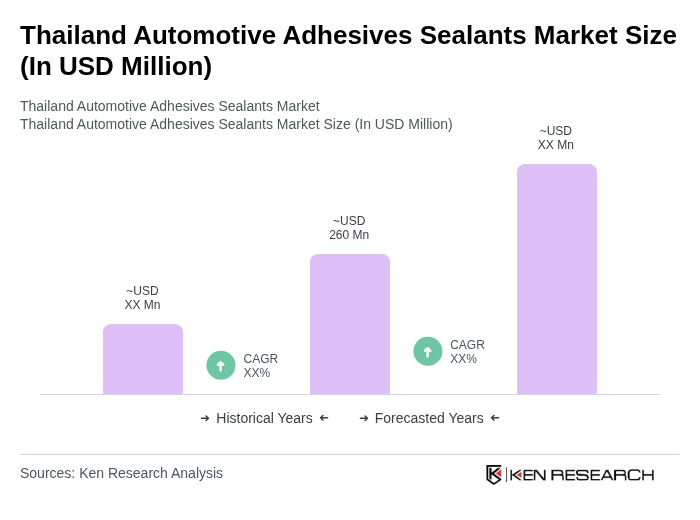
Thailand Automotive Adhesives Sealants Market Segmentation
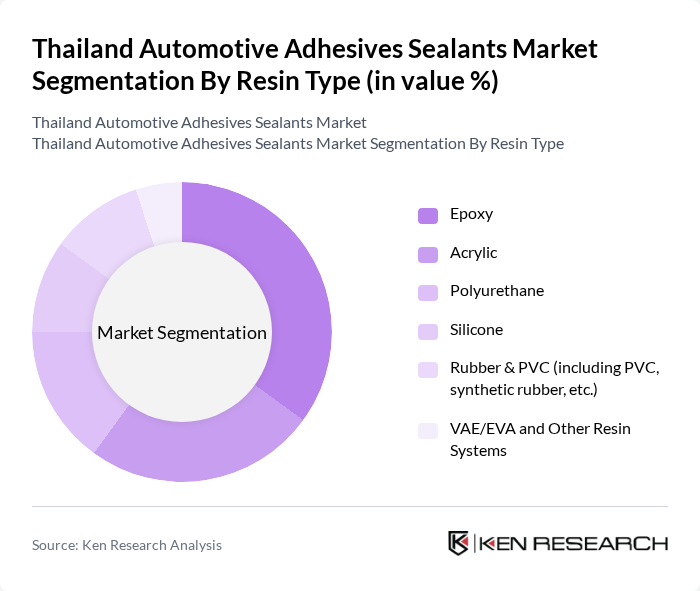
By Resin Type:The resin type segmentation includes various materials used in automotive adhesives and sealants, such as epoxy, acrylic, polyurethane, silicone, rubber & PVC, and VAE/EVA. Epoxy, polyurethane, and acrylic systems are widely used for structural bonding, body-in-white, and component assembly because of their high strength, durability, and compatibility with multi-material lightweight designs, while silicone and rubber-based systems are preferred for sealing, gasketing, and vibration damping. In the automotive context, epoxy and polyurethane chemistries hold a substantial share of demand due to their superior bonding performance on metals and composites and their suitability for crash-resistant and fatigue-resistant joints in vehicles.
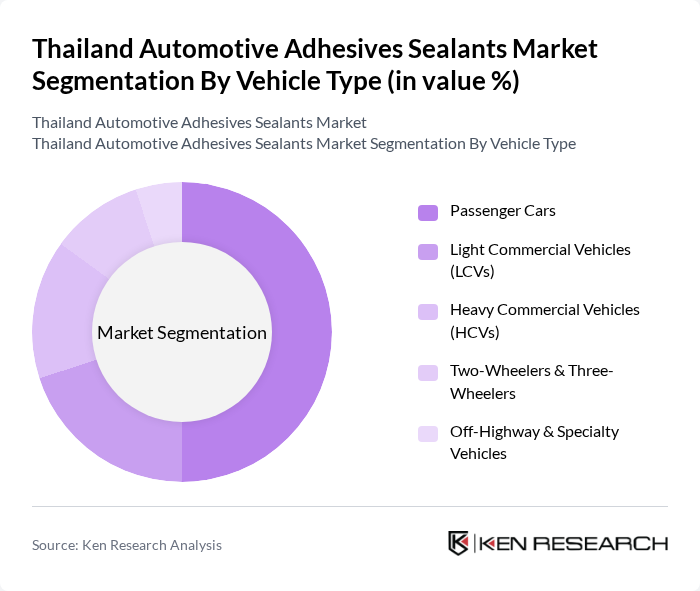
By Vehicle Type:The vehicle type segmentation encompasses various categories, including passenger cars, light commercial vehicles (LCVs), heavy commercial vehicles (HCVs), two-wheelers & three-wheelers, and off-highway & specialty vehicles. Passenger cars are the leading segment, supported by Thailand’s role as a major regional production base for passenger vehicles and the increasing integration of structural adhesives, NVH (noise, vibration, and harshness) damping materials, and glazing sealants to improve safety, comfort, and fuel efficiency. The growing focus on hybrid and battery electric vehicles in Thailand’s automotive roadmap further increases demand for specialized adhesive and sealant solutions for battery packs, thermal management, and lightweight body structures in this segment.
Thailand Automotive Adhesives Sealants Market Competitive Landscape
The Thailand Automotive Adhesives Sealants Market is characterized by a dynamic mix of regional and international players. Leading participants such as Henkel (Thailand) Ltd., 3M Thailand Ltd., Sika (Thailand) Ltd., Bostik (Thailand) Ltd. (Arkema Group), Dow Thailand Group (Dow Thailand Ltd. and affiliates), H.B. Fuller (Thailand) Co., Ltd., Jowat (Thailand) Co., Ltd., Momentive Performance Materials (Thailand) Ltd., ITW (Thailand) Ltd., RPM International Inc. (incl. Tremco, other relevant subsidiaries), Lord Corporation (Parker Lord – Thailand operations), Arkema (Thailand) Co., Ltd., Avery Dennison (Thailand) Ltd., tesa tape (Thailand) Co., Ltd., Wacker Chemie AG (Wacker Chemicals (Thailand) Co., Ltd.) contribute to innovation, geographic expansion, and service delivery in this space.
Thailand Automotive Adhesives Sealants Market Industry Analysis
Growth Drivers
- Increasing Automotive Production in Thailand:Thailand's automotive production reached approximately1.84 million unitsin future, with projections indicating a steady increase to1.6 million unitsby future. This growth is driven by both domestic demand and export opportunities, particularly in Southeast Asia. The automotive sector's expansion directly correlates with the rising need for adhesives and sealants, as these materials are essential for vehicle assembly and manufacturing processes, enhancing overall production efficiency.
- Rising Demand for Lightweight Vehicles:The Thai automotive market is witnessing a significant shift towards lightweight vehicles, with a projected increase in demand for such models by20%in future. This trend is largely influenced by consumer preferences for fuel efficiency and lower emissions. Lightweight vehicles require advanced adhesive technologies to bond materials effectively, thereby driving the demand for innovative adhesive solutions that meet these specific requirements in the automotive sector.
- Technological Advancements in Adhesive Formulations:The automotive adhesives sector in Thailand is experiencing rapid technological advancements, with investments in R&D reachingTHB 1.2 billionin future. Innovations such as high-performance adhesives that offer superior bonding strength and resistance to environmental factors are becoming increasingly prevalent. These advancements not only enhance product performance but also align with the industry's shift towards more sustainable and efficient manufacturing practices, further propelling market growth.
Market Challenges
- Fluctuating Raw Material Prices:The automotive adhesives market in Thailand faces significant challenges due to fluctuating raw material prices, which have increased by15%over the past year. This volatility is primarily driven by global supply chain disruptions and geopolitical tensions affecting the availability of key materials. Such price instability can lead to increased production costs for manufacturers, ultimately impacting profit margins and market competitiveness.
- Stringent Environmental Regulations:The Thai automotive adhesives industry is subject to stringent environmental regulations, particularly concerning VOC emissions. Compliance with these regulations requires manufacturers to invest in cleaner technologies and processes, which can increase operational costs. In future, the government is expected to enforce stricter standards, compelling companies to adapt quickly or face penalties, thereby posing a significant challenge to market players.
Thailand Automotive Adhesives Sealants Market Future Outlook
The future of the Thailand automotive adhesives sealants market appears promising, driven by the ongoing transition towards electric vehicles and the increasing emphasis on sustainability. As manufacturers adapt to new technologies and consumer preferences, the integration of smart adhesive solutions is likely to gain traction. Additionally, the growth of online sales channels will facilitate broader market access, enabling companies to reach a wider audience and enhance their competitive positioning in the evolving automotive landscape.
Market Opportunities
- Expansion of Electric Vehicle Production:The Thai government aims to increase electric vehicle production to1 million unitsby future, creating substantial opportunities for adhesive manufacturers. This shift necessitates specialized adhesives that can withstand the unique demands of electric vehicle components, thus opening new avenues for innovation and market growth.
- Rising Demand for Eco-Friendly Adhesives:With growing consumer awareness regarding environmental issues, the demand for eco-friendly adhesives is expected to rise significantly. The market for bio-based adhesives is projected to grow by30%in future, driven by both regulatory incentives and consumer preferences for sustainable products, presenting a lucrative opportunity for manufacturers to innovate and capture market share.
Scope of the Report
| Segment | Sub-Segments |
|---|---|
| By Resin Type | Epoxy Acrylic Polyurethane Silicone Rubber & PVC (including PVC, synthetic rubber, etc.) VAE/EVA and Other Resin Systems |
| By Vehicle Type | Passenger Cars Light Commercial Vehicles (LCVs) Heavy Commercial Vehicles (HCVs) Two-Wheelers & Three-Wheelers Off-Highway & Specialty Vehicles |
| By Application | Body-in-White & Structural Bonding Exterior Trim, Glass & Sealing (windshields, windows, sunroofs) Interior Assembly (seats, dashboards, trims) Powertrain & Under-the-Hood Paint Shop & Final Assembly (hem flanges, NVH, seam sealing) Electric & Hybrid Vehicle Components (battery pack, e-motors, thermal management) |
| By Technology | Water-borne Solvent-borne Hot-melt Reactive (including 1K/2K systems) UV/EB and Other Technologies |
| By Sales Channel | Direct Sales to OEMs Tier-1 & Tier-2 Supplier Channels Aftermarket / Replacement Channel Distributors and Traders |
| By Region | Central & Eastern Thailand (incl. Bangkok, Eastern Economic Corridor) Northern Thailand Northeastern Thailand Southern Thailand |
Key Target Audience
Investors and Venture Capitalist Firms
Government and Regulatory Bodies (e.g., Ministry of Industry, Department of Industrial Works)
Automotive Manufacturers
Adhesives and Sealants Manufacturers
Raw Material Suppliers
Automotive Component Suppliers
Trade Associations (e.g., Thai Automotive Industry Association)
Logistics and Supply Chain Companies
Players Mentioned in the Report:
Henkel (Thailand) Ltd.
3M Thailand Ltd.
Sika (Thailand) Ltd.
Bostik (Thailand) Ltd. (Arkema Group)
Dow Thailand Group (Dow Thailand Ltd. and affiliates)
H.B. Fuller (Thailand) Co., Ltd.
Jowat (Thailand) Co., Ltd.
Momentive Performance Materials (Thailand) Ltd.
ITW (Thailand) Ltd.
RPM International Inc. (incl. Tremco, other relevant subsidiaries)
Lord Corporation (Parker Lord Thailand operations)
Arkema (Thailand) Co., Ltd.
Avery Dennison (Thailand) Ltd.
tesa tape (Thailand) Co., Ltd.
Wacker Chemie AG (Wacker Chemicals (Thailand) Co., Ltd.)
Table of Contents
Market Assessment Phase
1. Executive Summary and Approach
2. Thailand Automotive Adhesives Sealants Market Overview
2.1 Key Insights and Strategic Recommendations
2.2 Thailand Automotive Adhesives Sealants Market Overview
2.3 Definition and Scope
2.4 Evolution of Market Ecosystem
2.5 Timeline of Key Regulatory Milestones
2.6 Value Chain & Stakeholder Mapping
2.7 Business Cycle Analysis
2.8 Policy & Incentive Landscape
3. Thailand Automotive Adhesives Sealants Market Analysis
3.1 Growth Drivers
3.1.1 Increasing automotive production in Thailand
3.1.2 Rising demand for lightweight vehicles
3.1.3 Technological advancements in adhesive formulations
3.1.4 Growing focus on vehicle safety and durability
3.2 Market Challenges
3.2.1 Fluctuating raw material prices
3.2.2 Stringent environmental regulations
3.2.3 Competition from alternative bonding solutions
3.2.4 Limited awareness of advanced adhesive technologies
3.3 Market Opportunities
3.3.1 Expansion of electric vehicle production
3.3.2 Increasing investments in automotive R&D
3.3.3 Growth in the aftermarket segment
3.3.4 Rising demand for eco-friendly adhesives
3.4 Market Trends
3.4.1 Shift towards sustainable manufacturing practices
3.4.2 Integration of smart technologies in automotive adhesives
3.4.3 Increasing collaboration between manufacturers and suppliers
3.4.4 Growth of online sales channels for automotive products
3.5 Government Regulation
3.5.1 Regulations on VOC emissions
3.5.2 Standards for automotive safety and performance
3.5.3 Incentives for using eco-friendly materials
3.5.4 Compliance requirements for manufacturing processes
4. SWOT Analysis
5. Stakeholder Analysis
6. Porter's Five Forces Analysis
7. Thailand Automotive Adhesives Sealants Market Size, 2019-2024
7.1 By Value
7.2 By Volume
7.3 By Average Selling Price
8. Thailand Automotive Adhesives Sealants Market Segmentation
8.1 By Resin Type
8.1.1 Epoxy
8.1.2 Acrylic
8.1.3 Polyurethane
8.1.4 Silicone
8.1.5 Rubber & PVC (including PVC, synthetic rubber, etc.)
8.1.6 VAE/EVA and Other Resin Systems
8.2 By Vehicle Type
8.2.1 Passenger Cars
8.2.2 Light Commercial Vehicles (LCVs)
8.2.3 Heavy Commercial Vehicles (HCVs)
8.2.4 Two-Wheelers & Three-Wheelers
8.2.5 Off-Highway & Specialty Vehicles
8.3 By Application
8.3.1 Body-in-White & Structural Bonding
8.3.2 Exterior Trim, Glass & Sealing (windshields, windows, sunroofs)
8.3.3 Interior Assembly (seats, dashboards, trims)
8.3.4 Powertrain & Under-the-Hood
8.3.5 Paint Shop & Final Assembly (hem flanges, NVH, seam sealing)
8.3.6 Electric & Hybrid Vehicle Components (battery pack, e-motors, thermal management)
8.4 By Technology
8.4.1 Water-borne
8.4.2 Solvent-borne
8.4.3 Hot-melt
8.4.4 Reactive (including 1K/2K systems)
8.4.5 UV/EB and Other Technologies
8.5 By Sales Channel
8.5.1 Direct Sales to OEMs
8.5.2 Tier-1 & Tier-2 Supplier Channels
8.5.3 Aftermarket / Replacement Channel
8.5.4 Distributors and Traders
8.6 By Region
8.6.1 Central & Eastern Thailand (incl. Bangkok, Eastern Economic Corridor)
8.6.2 Northern Thailand
8.6.3 Northeastern Thailand
8.6.4 Southern Thailand
9. Thailand Automotive Adhesives Sealants Market Competitive Analysis
9.1 Market Share of Key Players
9.2 Cross Comparison of Key Players
9.2.1 Company Name
9.2.2 Global Automotive Adhesives & Sealants Revenue (USD million)
9.2.3 Thailand Automotive Adhesives & Sealants Revenue (USD million)
9.2.4 Thailand Market Share (%)
9.2.5 3–5 Year CAGR in Thailand Automotive Segment (%)
9.2.6 Share of Sales to OEM vs Aftermarket (%)
9.2.7 Average Realized Price per kg (Thailand, USD/kg)
9.2.8 EBITDA Margin from Thailand Automotive Business (%)
9.2.9 R&D Intensity (% of Sales in Automotive Adhesives & Sealants)
9.2.10 New Product Launches / Year (Automotive-focused)
9.2.11 Installed Local Manufacturing Capacity (ktpa, Thailand)
9.2.12 OEM Programs / Platforms Served in Thailand (Number)
9.2.13 Regional Coverage within Thailand (Number of OEM / Tier-1 sites served)
9.2.14 Average Days Sales Outstanding (DSO) in Thailand
9.2.15 ESG / Low-VOC Product Share in Portfolio (%)
9.3 SWOT Analysis of Top Players
9.4 Pricing Analysis
9.5 Detailed Profile of Major Companies
9.5.1 Henkel (Thailand) Ltd.
9.5.2 3M Thailand Ltd.
9.5.3 Sika (Thailand) Ltd.
9.5.4 Bostik (Thailand) Ltd. (Arkema Group)
9.5.5 Dow Thailand Group (Dow Thailand Ltd. and affiliates)
9.5.6 H.B. Fuller (Thailand) Co., Ltd.
9.5.7 Jowat (Thailand) Co., Ltd.
9.5.8 Momentive Performance Materials (Thailand) Ltd.
9.5.9 ITW (Thailand) Ltd.
9.5.10 RPM International Inc. (incl. Tremco, other relevant subsidiaries)
9.5.11 Lord Corporation (Parker Lord – Thailand operations)
9.5.12 Arkema (Thailand) Co., Ltd.
9.5.13 Avery Dennison (Thailand) Ltd.
9.5.14 tesa tape (Thailand) Co., Ltd.
9.5.15 Wacker Chemie AG (Wacker Chemicals (Thailand) Co., Ltd.)
10. Thailand Automotive Adhesives Sealants Market End-User Analysis
10.1 Procurement Behavior of Key Ministries
10.1.1 Government procurement policies
10.1.2 Budget allocation for automotive projects
10.1.3 Supplier selection criteria
10.1.4 Contract management practices
10.2 Corporate Spend on Infrastructure & Energy
10.2.1 Investment trends in automotive infrastructure
10.2.2 Corporate budgets for adhesive procurement
10.2.3 Impact of economic conditions on spending
10.2.4 Future spending forecasts
10.3 Pain Point Analysis by End-User Category
10.3.1 Challenges faced by OEMs
10.3.2 Issues in the aftermarket segment
10.3.3 Supply chain disruptions
10.3.4 Quality control challenges
10.4 User Readiness for Adoption
10.4.1 Awareness of adhesive technologies
10.4.2 Training and support needs
10.4.3 Adoption barriers
10.4.4 Feedback mechanisms
10.5 Post-Deployment ROI and Use Case Expansion
10.5.1 Measurement of ROI
10.5.2 Case studies of successful implementations
10.5.3 Opportunities for scaling
10.5.4 Long-term benefits analysis
11. Thailand Automotive Adhesives Sealants Market Future Size, 2025-2030
11.1 By Value
11.2 By Volume
11.3 By Average Selling Price
Go-To-Market Strategy Phase
1. Whitespace Analysis + Business Model Canvas
1.1 Market gaps identification
1.2 Value proposition development
1.3 Revenue model exploration
1.4 Key partnerships and resources
1.5 Customer segments analysis
1.6 Cost structure evaluation
1.7 Channels and customer relationships
2. Marketing and Positioning Recommendations
2.1 Branding strategies
2.2 Product USPs
2.3 Target market identification
2.4 Communication strategies
2.5 Digital marketing approaches
2.6 Trade show participation
2.7 Customer engagement tactics
3. Distribution Plan
3.1 Urban retail strategies
3.2 Rural NGO tie-ups
3.3 E-commerce integration
3.4 Logistics and supply chain management
3.5 Distributor partnerships
3.6 Inventory management practices
3.7 Customer service enhancements
4. Channel & Pricing Gaps
4.1 Underserved routes
4.2 Pricing bands analysis
4.3 Competitor pricing strategies
4.4 Customer willingness to pay
4.5 Discounting strategies
4.6 Bundling opportunities
4.7 Price elasticity considerations
5. Unmet Demand & Latent Needs
5.1 Category gaps identification
5.2 Consumer segments analysis
5.3 Product development opportunities
5.4 Market entry barriers
5.5 Customer feedback incorporation
5.6 Future trends anticipation
5.7 Innovation opportunities
6. Customer Relationship
6.1 Loyalty programs
6.2 After-sales service enhancements
6.3 Customer feedback mechanisms
6.4 Relationship management strategies
6.5 Community engagement initiatives
6.6 Customer education programs
6.7 Personalization strategies
7. Value Proposition
7.1 Sustainability initiatives
7.2 Integrated supply chains
7.3 Cost-saving measures
7.4 Quality assurance practices
7.5 Innovation in product offerings
7.6 Customer-centric approaches
7.7 Competitive differentiation
8. Key Activities
8.1 Regulatory compliance
8.2 Branding efforts
8.3 Distribution setup
8.4 Market research activities
8.5 Training and development
8.6 Performance monitoring
8.7 Stakeholder engagement
9. Entry Strategy Evaluation
9.1 Domestic Market Entry Strategy
9.1.1 Product mix considerations
9.1.2 Pricing band analysis
9.1.3 Packaging strategies
9.2 Export Entry Strategy
9.2.1 Target countries identification
9.2.2 Compliance roadmap development
10. Entry Mode Assessment
10.1 Joint Ventures
10.2 Greenfield investments
10.3 Mergers & Acquisitions
10.4 Distributor Model
10.5 Risk assessment
10.6 Strategic fit evaluation
10.7 Long-term partnership considerations
11. Capital and Timeline Estimation
11.1 Capital requirements
11.2 Timelines for market entry
11.3 Financial projections
11.4 Funding sources identification
11.5 Budget allocation strategies
11.6 Cost management practices
11.7 Investment return expectations
12. Control vs Risk Trade-Off
12.1 Ownership considerations
12.2 Partnership dynamics
12.3 Risk management strategies
12.4 Control mechanisms
12.5 Exit strategies
12.6 Long-term sustainability planning
12.7 Stakeholder alignment
13. Profitability Outlook
13.1 Breakeven analysis
13.2 Long-term sustainability
13.3 Profit margin expectations
13.4 Revenue growth projections
13.5 Cost structure optimization
13.6 Financial health assessment
13.7 Market share growth potential
14. Potential Partner List
14.1 Distributors
14.2 Joint Ventures
14.3 Acquisition targets
14.4 Strategic alliances
14.5 Supplier partnerships
14.6 Research collaborations
14.7 Community engagement partners
15. Execution Roadmap
15.1 Phased Plan for Market Entry
15.1.1 Market Setup
15.1.2 Market Entry
15.1.3 Growth Acceleration
15.1.4 Scale & Stabilize
15.2 Key Activities and Milestones
15.2.1 Timeline for key activities
15.2.2 Milestone tracking
15.2.3 Performance evaluation
15.2.4 Adjustments and pivots
Research Methodology
Phase 1: Approach1
Desk Research
- Industry reports from the Thailand Automotive Industry Association
- Market analysis from government publications and trade journals
- Statistical data from the National Statistical Office of Thailand
Primary Research
- Interviews with product managers at leading automotive adhesive manufacturers
- Surveys with automotive assembly plant managers regarding adhesive usage
- Field interviews with R&D specialists in adhesive technology
Validation & Triangulation
- Cross-validation of data from multiple industry sources and reports
- Triangulation of market trends with expert insights and historical data
- Sanity checks through feedback from industry panels and focus groups
Phase 2: Market Size Estimation1
Top-down Assessment
- Analysis of total automotive production figures in Thailand
- Segmentation of adhesive usage by vehicle type and application
- Incorporation of growth rates from automotive sector forecasts
Bottom-up Modeling
- Volume estimates based on adhesive consumption per vehicle produced
- Cost analysis derived from supplier pricing and contract data
- Estimation of market share for key adhesive product categories
Forecasting & Scenario Analysis
- Multi-variable regression analysis incorporating economic indicators
- Scenario modeling based on potential shifts in automotive regulations
- Projections for market growth under various economic conditions through 2030
Phase 3: CATI Sample Composition1
| Scope Item/Segment | Sample Size | Target Respondent Profiles |
|---|---|---|
| Automotive OEMs | 100 | Product Development Managers, Procurement Officers |
| Aftermarket Suppliers | 80 | Sales Managers, Marketing Directors |
| Adhesive Manufacturers | 60 | Technical Directors, R&D Managers |
| Automotive Component Distributors | 70 | Operations Managers, Supply Chain Coordinators |
| Industry Experts and Consultants | 50 | Market Analysts, Industry Advisors |
Frequently Asked Questions
What is the current value of the Thailand Automotive Adhesives Sealants Market?
The Thailand Automotive Adhesives Sealants Market is valued at approximately USD 260 million, reflecting a five-year historical analysis. This growth is driven by the increasing demand for lightweight materials and the rising production of electric vehicles.
Which regions are key players in the Thailand Automotive Adhesives Sealants Market?
What are the main drivers of growth in the Thailand Automotive Adhesives Sealants Market?
What challenges does the Thailand Automotive Adhesives Sealants Market face?
Other Regional/Country Reports
Other Adjacent Reports
UAE Automotive Lightweight Materials Market
North America Electric Vehicle Battery Market Outlook to 2030: Size, Share, Growth and TrendsSaudi Arabia structural adhesives market Size, Share, Growth Drivers, Trends, Opportunities & Forecast 2025–2030Kuwait Polyurethane Resins Market
Middle East EMEA Epoxy Adhesives Market Report Size Share Growth Drivers Trends Opportunities & Forecast 2025–2030Indonesia Silicone Sealants Market
Kuwait Automotive Composites MarketBahrain Low-VOC Adhesives Market
Oman Vehicle Assembly Equipment Market
Saudi Arabia Automotive Coatings Market Size, Share, Growth Drivers, Trends, Opportunities & Forecast 2025–2030Why Buy From Us?

What makes us stand out is that our consultants follow Robust, Refine and Result (RRR) methodology. Robust for clear definitions, approaches and sanity checking, Refine for differentiating respondents' facts and opinions, and Result for presenting data with story.

We have set a benchmark in the industry by offering our clients with syndicated and customized market research reports featuring coverage of entire market as well as meticulous research and analyst insights.

While we don't replace traditional research, we flip the method upside down. Our dual approach of Top Bottom & Bottom Top ensures quality deliverable by not just verifying company fundamentals but also looking at the sector and macroeconomic factors.

With one step in the future, our research team constantly tries to show you the bigger picture. We help with some of the tough questions you may encounter along the way: How is the industry positioned? Best marketing channel? KPI's of competitors? By aligning every element, we help maximize success.

Our report gives you instant access to the answers and sources that other companies might choose to hide. We elaborate each steps of research methodology we have used and showcase you the sample size to earn your trust.

If you need any support, we are here! We pride ourselves on universe strength, data quality, and quick, friendly, and professional service.