About the Report
Base Year 2024APAC AI-Based Weather Modelling Market Overview
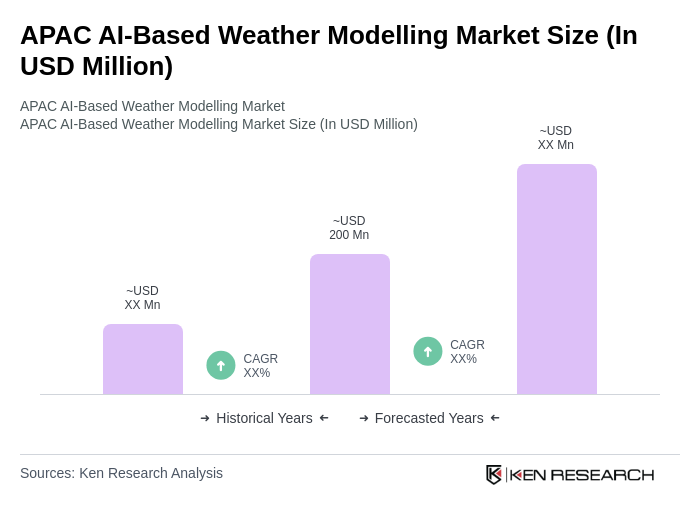
- The APAC AI-Based Weather Modelling Market is valued at USD 200 million, based on a five-year historical analysis. This growth is primarily driven by the increasing demand for accurate weather forecasting and climate modeling, which are essential for various sectors such as agriculture, transportation, and disaster management. The integration of advanced technologies like machine learning and big data analytics has further propelled the market, enabling more precise predictions and risk assessments.
- Countries such as China, India, and Japan dominate the APAC AI-Based Weather Modelling Market due to their significant investments in technology and infrastructure. China leads with its extensive meteorological network and government support for AI initiatives. India follows closely, leveraging AI for agricultural advancements, while Japan focuses on disaster preparedness and climate resilience, making these nations key players in the market.
- In 2023, the Indian government implemented the National AI Strategy, which emphasizes the use of AI in various sectors, including weather forecasting. This initiative aims to enhance the accuracy of weather predictions and improve disaster management capabilities, thereby fostering growth in the AI-based weather modeling sector.
APAC AI-Based Weather Modelling Market Segmentation
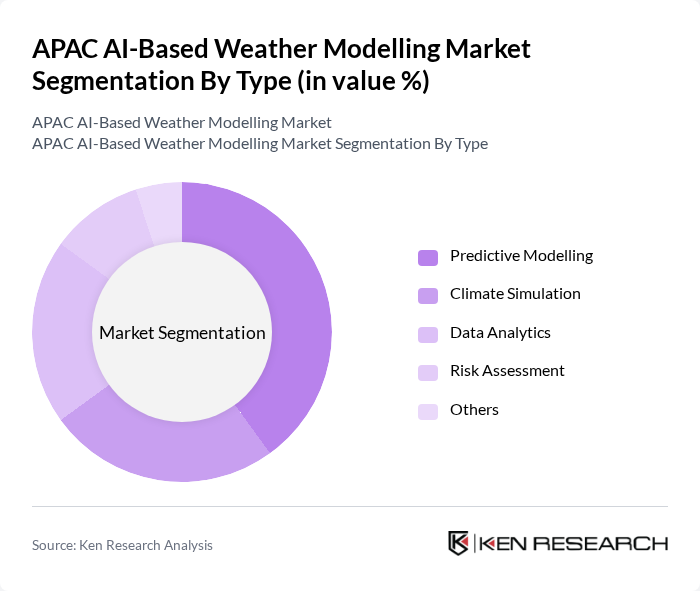
By Type:The market is segmented into Predictive Modelling, Climate Simulation, Data Analytics, Risk Assessment, and Others. Predictive Modelling is currently the leading sub-segment, driven by its critical role in providing accurate weather forecasts that are essential for various industries. The increasing reliance on data-driven decision-making in sectors like agriculture and transportation has further solidified its dominance. Climate Simulation is also gaining traction as organizations seek to understand long-term climate patterns and their implications.
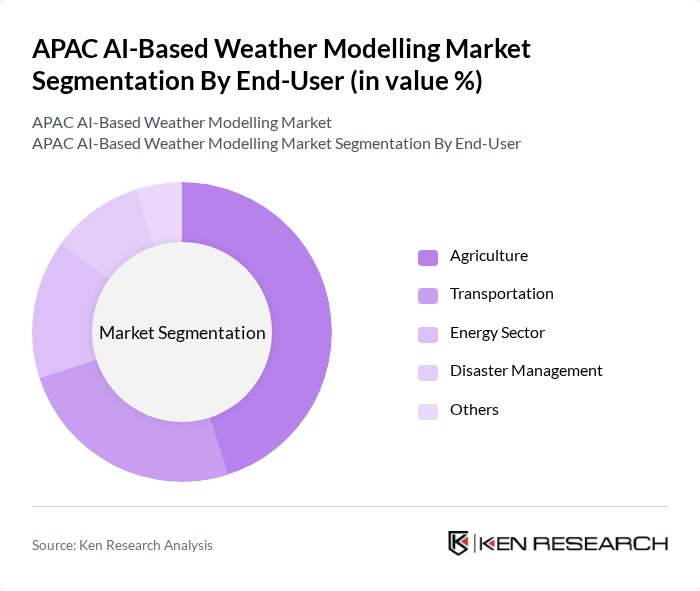
By End-User:The market is segmented into Agriculture, Transportation, Energy Sector, Disaster Management, and Others. Agriculture is the leading sub-segment, as farmers increasingly adopt AI-based weather modeling to optimize crop yields and manage resources effectively. The need for precise weather data to mitigate risks associated with climate change has made this sector a significant driver of market growth. Transportation is also a key user, utilizing weather data to enhance safety and efficiency in logistics and travel.
APAC AI-Based Weather Modelling Market Competitive Landscape
The APAC AI-Based Weather Modelling Market is characterized by a dynamic mix of regional and international players. Leading participants such as IBM Corporation, The Weather Company (IBM subsidiary), AccuWeather, Inc., Skymet Weather Services, MeteoGroup, DTN, LLC, Tomorrow.io, Climavision, ClimateAi, Open Climate Fix, Spire Global, Inc., Planet Labs PBC, Vaisala Oyj, Google LLC, Microsoft Corporation, NVIDIA Corporation, Jupiter Intelligence, EUMETSAT (European but active in APAC via partnerships), National Oceanic and Atmospheric Administration (NOAA) (US-based, but influential in APAC research collaborations), Local/Regional Players (e.g., China Meteorological Administration, India Meteorological Department, Japan Meteorological Agency, Australian Bureau of Meteorology—for context on public sector influence) contribute to innovation, geographic expansion, and service delivery in this space.
APAC AI-Based Weather Modelling Market Industry Analysis
Growth Drivers
- Increasing Demand for Accurate Weather Forecasting:The APAC region is experiencing a surge in demand for precise weather forecasting, driven by industries such as agriculture, aviation, and disaster management. For instance, the agricultural sector in India, which contributes approximately $500 billion to the economy, relies heavily on accurate weather predictions to optimize crop yields. This demand is further supported by the increasing frequency of extreme weather events, with the Asia-Pacific region witnessing over 250 natural disasters annually, necessitating advanced forecasting technologies.
- Advancements in AI and Machine Learning Technologies:The rapid evolution of AI and machine learning technologies is significantly enhancing weather modeling capabilities. In the near future, the AI market in APAC is projected to reach $60 billion, with a substantial portion allocated to weather-related applications. These advancements enable more accurate simulations and predictions, allowing meteorologists to analyze vast datasets efficiently. For example, Japan's Meteorological Agency has integrated AI algorithms that improved forecasting accuracy by 35%, showcasing the transformative potential of these technologies in weather modeling.
- Rising Awareness of Climate Change Impacts:The increasing awareness of climate change and its effects is driving investments in AI-based weather modeling solutions. In the near future, the APAC region is expected to allocate over $30 billion towards climate adaptation and mitigation strategies. Countries like Australia and South Korea are prioritizing climate resilience, leading to a heightened demand for sophisticated weather forecasting tools. This trend is evident as governments and organizations seek to understand and respond to climate-related challenges, further propelling the market for AI-driven weather solutions.
Market Challenges
- High Initial Investment Costs:One of the significant barriers to the adoption of AI-based weather modeling in the APAC region is the high initial investment required for technology implementation. For instance, setting up advanced weather modeling systems can cost upwards of $1.5 million, which poses a challenge for smaller organizations and developing nations. This financial hurdle limits access to cutting-edge technologies, hindering overall market growth and innovation in the sector.
- Data Privacy and Security Concerns:The increasing reliance on data for weather modeling raises significant privacy and security concerns. In the near future, it is estimated that data breaches in the APAC region could cost businesses over $4 billion. Organizations must navigate complex regulations regarding data protection, which can slow down the adoption of AI technologies. The fear of data misuse and the potential for cyberattacks create a challenging environment for companies looking to invest in AI-based weather solutions.
APAC AI-Based Weather Modelling Market Future Outlook
The future of the APAC AI-based weather modeling market appears promising, driven by technological advancements and increasing environmental awareness. As governments and industries prioritize climate resilience, investments in AI technologies are expected to rise significantly. The integration of AI with IoT devices will enhance real-time data collection and analysis, leading to more accurate forecasts. Additionally, the growing trend of subscription-based services will provide businesses with flexible access to advanced weather modeling tools, fostering innovation and collaboration across sectors.
Market Opportunities
- Expansion into Emerging Markets:Emerging markets in Southeast Asia, such as Vietnam and Indonesia, present significant opportunities for AI-based weather modeling solutions. With increasing agricultural activities and vulnerability to climate change, these countries are likely to invest in advanced forecasting technologies, creating a demand for tailored solutions that address local needs and challenges.
- Development of Customized Solutions for Specific Industries:There is a growing opportunity to develop customized weather modeling solutions for specific industries, such as agriculture, energy, and transportation. By leveraging AI technologies, companies can create targeted applications that enhance operational efficiency and decision-making, ultimately driving growth in sectors that are heavily impacted by weather conditions.
Scope of the Report
| Segment | Sub-Segments |
|---|---|
| By Type | Predictive Modelling Climate Simulation Data Analytics Risk Assessment Others |
| By End-User | Agriculture Transportation Energy Sector Disaster Management Others |
| By Region | North Asia Southeast Asia South Asia Oceania |
| By Technology | Machine Learning Neural Networks Natural Language Processing Others |
| By Application | Weather Forecasting Climate Research Environmental Monitoring Others |
| By Investment Source | Private Investments Government Funding International Grants Others |
| By Policy Support | Government Subsidies Tax Incentives Research Grants Others |
Key Target Audience
Investors and Venture Capitalist Firms
Government and Regulatory Bodies (e.g., Meteorological Departments, Environmental Protection Agencies)
Agricultural Producers and Cooperatives
Energy Sector Companies (e.g., Renewable Energy Firms)
Insurance Companies and Risk Management Firms
Transportation and Logistics Companies
Telecommunications Providers
Disaster Management Agencies
Players Mentioned in the Report:
IBM Corporation
The Weather Company (IBM subsidiary)
AccuWeather, Inc.
Skymet Weather Services
MeteoGroup
DTN, LLC
Tomorrow.io
Climavision
ClimateAi
Open Climate Fix
Spire Global, Inc.
Planet Labs PBC
Vaisala Oyj
Google LLC
Microsoft Corporation
NVIDIA Corporation
Jupiter Intelligence
EUMETSAT (European but active in APAC via partnerships)
National Oceanic and Atmospheric Administration (NOAA) (US-based, but influential in APAC research collaborations)
Local/Regional Players (e.g., China Meteorological Administration, India Meteorological Department, Japan Meteorological Agency, Australian Bureau of Meteorologyfor context on public sector influence)
Table of Contents
Market Assessment Phase
1. Executive Summary and Approach
2. APAC AI-Based Weather Modelling Market Overview
2.1 Key Insights and Strategic Recommendations
2.2 APAC AI-Based Weather Modelling Market Overview
2.3 Definition and Scope
2.4 Evolution of Market Ecosystem
2.5 Timeline of Key Regulatory Milestones
2.6 Value Chain & Stakeholder Mapping
2.7 Business Cycle Analysis
2.8 Policy & Incentive Landscape
3. APAC AI-Based Weather Modelling Market Analysis
3.1 Growth Drivers
3.1.1 Increasing demand for accurate weather forecasting
3.1.2 Advancements in AI and machine learning technologies
3.1.3 Rising awareness of climate change impacts
3.1.4 Government investments in smart infrastructure
3.2 Market Challenges
3.2.1 High initial investment costs
3.2.2 Data privacy and security concerns
3.2.3 Limited access to quality data
3.2.4 Resistance to technology adoption in traditional sectors
3.3 Market Opportunities
3.3.1 Expansion into emerging markets
3.3.2 Development of customized solutions for specific industries
3.3.3 Collaborations with tech companies for innovation
3.3.4 Integration of AI with IoT for enhanced services
3.4 Market Trends
3.4.1 Increasing use of big data analytics
3.4.2 Growth of subscription-based models
3.4.3 Focus on sustainability and eco-friendly solutions
3.4.4 Rise of mobile applications for weather updates
3.5 Government Regulation
3.5.1 Implementation of data protection laws
3.5.2 Regulations promoting renewable energy usage
3.5.3 Standards for AI technology in public services
3.5.4 Incentives for research and development in weather technology
4. SWOT Analysis
5. Stakeholder Analysis
6. Porter's Five Forces Analysis
7. APAC AI-Based Weather Modelling Market Market Size, 2019-2024
7.1 By Value
7.2 By Volume
7.3 By Average Selling Price
8. APAC AI-Based Weather Modelling Market Segmentation
8.1 By Type
8.1.1 Predictive Modelling
8.1.2 Climate Simulation
8.1.3 Data Analytics
8.1.4 Risk Assessment
8.1.5 Others
8.2 By End-User
8.2.1 Agriculture
8.2.2 Transportation
8.2.3 Energy Sector
8.2.4 Disaster Management
8.2.5 Others
8.3 By Region
8.3.1 North Asia
8.3.2 Southeast Asia
8.3.3 South Asia
8.3.4 Oceania
8.4 By Technology
8.4.1 Machine Learning
8.4.2 Neural Networks
8.4.3 Natural Language Processing
8.4.4 Others
8.5 By Application
8.5.1 Weather Forecasting
8.5.2 Climate Research
8.5.3 Environmental Monitoring
8.5.4 Others
8.6 By Investment Source
8.6.1 Private Investments
8.6.2 Government Funding
8.6.3 International Grants
8.6.4 Others
8.7 By Policy Support
8.7.1 Government Subsidies
8.7.2 Tax Incentives
8.7.3 Research Grants
8.7.4 Others
9. APAC AI-Based Weather Modelling Market Competitive Analysis
9.1 Market Share of Key Players
9.2 Cross Comparison of Key Players
9.2.1 Company Name
9.2.2 Group Size (Large, Medium, or Small as per industry convention)
9.2.3 Revenue Growth Rate (YoY)
9.2.4 Market Share (APAC Region)
9.2.5 Product/Service Innovation Index (e.g., patents, new model launches)
9.2.6 Customer Base Growth (Enterprise vs. Government)
9.2.7 Partnerships & Collaborations (with local governments, research institutes, or tech firms)
9.2.8 Data Source Diversity (satellite, IoT, ground stations)
9.2.9 Model Accuracy & Resolution (benchmarked against regional standards)
9.2.10 Regional Customization (local language support, region-specific risk models)
9.3 SWOT Analysis of Top Players
9.4 Pricing Analysis
9.5 Detailed Profile of Major Companies
9.5.1 IBM Corporation
9.5.2 The Weather Company (IBM subsidiary)
9.5.3 AccuWeather, Inc.
9.5.4 Skymet Weather Services
9.5.5 MeteoGroup
9.5.6 DTN, LLC
9.5.7 Tomorrow.io
9.5.8 Climavision
9.5.9 ClimateAi
9.5.10 Open Climate Fix
9.5.11 Spire Global, Inc.
9.5.12 Planet Labs PBC
9.5.13 Vaisala Oyj
9.5.14 Google LLC
9.5.15 Microsoft Corporation
9.5.16 NVIDIA Corporation
9.5.17 Jupiter Intelligence
9.5.18 EUMETSAT (European but active in APAC via partnerships)
9.5.19 National Oceanic and Atmospheric Administration (NOAA) (US-based, but influential in APAC research collaborations)
9.5.20 Local/Regional Players (e.g., China Meteorological Administration, India Meteorological Department, Japan Meteorological Agency, Australian Bureau of Meteorology—for context on public sector influence)
10. APAC AI-Based Weather Modelling Market End-User Analysis
10.1 Procurement Behavior of Key Ministries
10.1.1 Budget Allocation Trends
10.1.2 Decision-Making Processes
10.1.3 Preferred Procurement Channels
10.2 Corporate Spend on Infrastructure & Energy
10.2.1 Investment Priorities
10.2.2 Spending Patterns
10.2.3 Impact of Weather on Corporate Strategy
10.3 Pain Point Analysis by End-User Category
10.3.1 Challenges in Data Accuracy
10.3.2 Integration Issues with Existing Systems
10.3.3 Cost Constraints
10.4 User Readiness for Adoption
10.4.1 Training and Support Needs
10.4.2 Technology Familiarity
10.4.3 Perceived Value of AI Solutions
10.5 Post-Deployment ROI and Use Case Expansion
10.5.1 Measurement of Success Metrics
10.5.2 Case Studies of Successful Implementations
10.5.3 Future Use Case Opportunities
11. APAC AI-Based Weather Modelling Market Future Size, 2025-2030
11.1 By Value
11.2 By Volume
11.3 By Average Selling Price
Go-To-Market Strategy Phase
1. Whitespace Analysis + Business Model Canvas
1.1 Market Gaps Identification
1.2 Business Model Framework
2. Marketing and Positioning Recommendations
2.1 Branding Strategies
2.2 Product USPs
3. Distribution Plan
3.1 Urban Retail Strategies
3.2 Rural NGO Tie-Ups
4. Channel & Pricing Gaps
4.1 Underserved Routes
4.2 Pricing Bands
5. Unmet Demand & Latent Needs
5.1 Category Gaps
5.2 Consumer Segments6. Customer Relationship6.1 Loyalty Programs6.2 After-Sales Service7. Value Proposition7.1 Sustainability Initiatives7.2 Integrated Supply Chains8. Key Activities8.1 Regulatory Compliance8.2 Branding Efforts8.3 Distribution Setup9. Entry Strategy Evaluation9.1 Domestic Market Entry Strategy9.1.1 Product Mix Considerations9.1.2 Pricing Band Strategies9.1.3 Packaging Approaches9.2 Export Entry Strategy9.2.1 Target Countries9.2.2 Compliance Roadmap10. Entry Mode Assessment10.1 Joint Ventures10.2 Greenfield Investments10.3 Mergers & Acquisitions10.4 Distributor Model11. Capital and Timeline Estimation11.1 Capital Requirements11.2 Timelines for Implementation12. Control vs Risk Trade-Off12.1 Ownership Considerations12.2 Partnerships Evaluation13. Profitability Outlook13.1 Breakeven Analysis13.2 Long-Term Sustainability14. Potential Partner List14.1 Distributors14.2 Joint Ventures14.3 Acquisition Targets15. Execution Roadmap15.1 Phased Plan for Market Entry15.1.1 Market Setup15.1.2 Market Entry15.1.3 Growth Acceleration15.1.4 Scale & Stabilize15.2 Key Activities and Milestones15.2.1 Milestone Planning15.2.2 Activity TrackingDisclaimerContact Us``` ## Validation & Updates ### Section 8: Market Segmentation The original segmentation is comprehensive and relevant for the APAC AI-based weather modelling market. No structural changes are needed. The categories (Type, End-User, Region, Technology, Application, Investment Source, Policy Support) accurately reflect the market dynamics in APAC, where agriculture, energy, disaster management, and climate research are key drivers, and regional diversity (North Asia, Southeast Asia, South Asia, Oceania) is critical for tailored solutions[1]. The inclusion of both private and public investment sources, as well as policy incentives, aligns with the region’s mixed economy and government-led climate initiatives[1]. ### Section 9.2: KPIs for Cross Comparison of Key Players The original KPIs were generic and not fully aligned with the needs of investors and stakeholders in the APAC AI-based weather modelling market. The updated KPIs below are investor-relevant, measurable, and specific to this sector: - **Revenue Growth Rate (YoY):** Tracks annual growth, critical for assessing scalability and market traction. - **Market Share (APAC Region):** Measures competitive positioning within APAC, not just globally. - **Product/Service Innovation Index:** Captures R&D output (e.g., patents, new model launches), important in a tech-driven market. - **Customer Base Growth (Enterprise vs. Government):** Differentiates between commercial and public sector adoption, both significant in APAC. - **Partnerships & Collaborations:** Highlights alliances with local governments, research institutes, or tech firms—key for market access and credibility in APAC. - **Data Source Diversity:** Evaluates the breadth of data inputs (satellite, IoT, ground stations), crucial for model accuracy in diverse APAC geographies. - **Model Accuracy & Resolution:** Benchmarked against regional standards, as APAC faces unique weather challenges (monsoons, typhoons, etc.)[1]. - **Regional Customization:** Assesses localization (language support, region-specific risk models), vital for adoption in fragmented APAC markets. These KPIs enable meaningful cross-comparison of players in a market where technology differentiation, local partnerships, and government engagement are decisive[1]. ### Section 9.5: List of Major Companies The original list included several global players but missed key APAC-relevant and pure-play AI/weather tech firms. The updated list below reflects the current competitive landscape, including both multinationals and specialists active in APAC, with all names rendered correctly in UTF-8: - **IBM Corporation** - **The Weather Company (IBM subsidiary)** - **AccuWeather, Inc.** - **Skymet Weather Services** (India) - **MeteoGroup** - **DTN, LLC** - **Tomorrow.io** - **Climavision** - **ClimateAi** - **Open Climate Fix** - **Spire Global, Inc.** - **Planet Labs PBC** - **Vaisala Oyj** - **Google LLC** - **Microsoft Corporation** - **NVIDIA Corporation** - **Jupiter Intelligence** - **EUMETSAT** (European but active in APAC via partnerships) - **National Oceanic and Atmospheric Administration (NOAA)** (US-based, but influential in APAC research collaborations) - **Local/Regional Players:** For context, include major national meteorological agencies such as China Meteorological Administration, India Meteorological Department, Japan Meteorological Agency, and Australian Bureau of Meteorology, which play a significant role in public-sector weather modelling and often collaborate with private tech providers[1]. This list captures the mix of global tech giants, specialized weather/AI firms, and influential public agencies shaping the APAC market[3]. All company names are correctly encoded and free of garbled characters. --- **Summary of Changes** - **Section 8:** Retained original structure; validated as comprehensive and APAC-relevant. - **Section 9.2:** Replaced generic KPIs with investor-relevant, APAC-specific metrics for meaningful cros
Research Methodology
Phase 1: Approach1
Desk Research
- Analysis of meteorological data from national weather services across APAC countries
- Review of academic journals and publications on AI applications in weather forecasting
- Examination of industry reports and white papers from meteorological organizations and AI research institutes
Primary Research
- Interviews with meteorologists and climate scientists specializing in AI-based weather modeling
- Surveys with technology providers and software developers in the weather analytics space
- Field interviews with end-users such as agricultural firms and disaster management agencies
Validation & Triangulation
- Cross-validation of findings through multiple data sources including government reports and industry insights
- Triangulation of qualitative insights from interviews with quantitative data from surveys
- Sanity checks conducted through expert panel reviews and feedback sessions
Phase 2: Market Size Estimation1
Top-down Assessment
- Estimation of the overall APAC weather modeling market size based on regional economic indicators
- Segmentation of the market by application areas such as agriculture, disaster management, and urban planning
- Incorporation of government initiatives and funding for AI in meteorology
Bottom-up Modeling
- Collection of data on AI-based weather modeling solutions from leading technology providers
- Estimation of market share based on sales volume and pricing strategies of key players
- Volume x pricing analysis to derive revenue estimates for different segments
Forecasting & Scenario Analysis
- Multi-factor regression analysis incorporating climate change trends and technological advancements
- Scenario modeling based on varying levels of investment in AI technologies and regulatory changes
- Development of baseline, optimistic, and pessimistic forecasts through 2030
Phase 3: CATI Sample Composition1
| Scope Item/Segment | Sample Size | Target Respondent Profiles |
|---|---|---|
| Agricultural Weather Forecasting | 120 | Agronomists, Farm Managers |
| Disaster Management Applications | 110 | Emergency Response Coordinators, Policy Makers |
| Urban Planning and Development | 90 | Urban Planners, Environmental Consultants |
| Energy Sector Weather Analytics | 100 | Energy Analysts, Utility Managers |
| Transportation and Logistics | 80 | Logistics Managers, Transportation Planners |
Frequently Asked Questions
What is the current value of the APAC AI-Based Weather Modelling Market?
The APAC AI-Based Weather Modelling Market is valued at approximately USD 200 million, driven by the increasing demand for accurate weather forecasting and climate modeling across various sectors, including agriculture, transportation, and disaster management.
Which countries are leading in the APAC AI-Based Weather Modelling Market?
What are the key growth drivers for the APAC AI-Based Weather Modelling Market?
What challenges does the APAC AI-Based Weather Modelling Market face?
Other Regional/Country Reports
Indonesia AI Based Weather Modelling Market
Malaysia AI Based Weather Modelling Market
KSA AI Based Weather Modelling Market
SEA AI Based Weather Modelling Market
Vietnam AI Based Weather Modelling Market
Thailand AI Based Weather Modelling Market
Other Adjacent Reports
Mexico Disaster Management Technology Market
Brazil Climate Change Adaptation Market
Japan Big Data Analytics Market
Germany Machine Learning Platforms Market
Qatar IoT Environmental Monitoring Market
Philippines Renewable Energy Forecasting Market
Philippines Transportation Logistics Market
Malaysia Insurance Risk Assessment Market
South Korea Satellite Data Analysis Market
Why Buy From Us?

What makes us stand out is that our consultants follow Robust, Refine and Result (RRR) methodology. Robust for clear definitions, approaches and sanity checking, Refine for differentiating respondents' facts and opinions, and Result for presenting data with story.

We have set a benchmark in the industry by offering our clients with syndicated and customized market research reports featuring coverage of entire market as well as meticulous research and analyst insights.

While we don't replace traditional research, we flip the method upside down. Our dual approach of Top Bottom & Bottom Top ensures quality deliverable by not just verifying company fundamentals but also looking at the sector and macroeconomic factors.

With one step in the future, our research team constantly tries to show you the bigger picture. We help with some of the tough questions you may encounter along the way: How is the industry positioned? Best marketing channel? KPI's of competitors? By aligning every element, we help maximize success.

Our report gives you instant access to the answers and sources that other companies might choose to hide. We elaborate each steps of research methodology we have used and showcase you the sample size to earn your trust.

If you need any support, we are here! We pride ourselves on universe strength, data quality, and quick, friendly, and professional service.