Automotive Suppliers Enter Stagformation as EBIT Falls to 4.7% and EV Scale Slips
Ken Research
January 7, 2026 - 7 min read

January 7, 2026
by Ken ResearchThe global automotive supplier industry has entered a new structural phase marked by weak volume growth and rising transformation costs. This phase is described as “stagformation”, reflecting stagnant vehicle production combined with heavy investment needs in electrification, software, and digital manufacturing. Unlike past cycles, suppliers can no longer rely on volume recovery alone to restore profitability.
BEV lifecycle volumes are around 2.5 times lower than ICE vehicles. Lower lifetime volumes reduce scale benefits across supplier production programs. At the same time, investment needs in electrification and software remain high. This makes volume-led profitability recovery structurally less effective.
EBIT Margins at 4.7% Limit Suppliers’ Ability to Self-Fund Growth
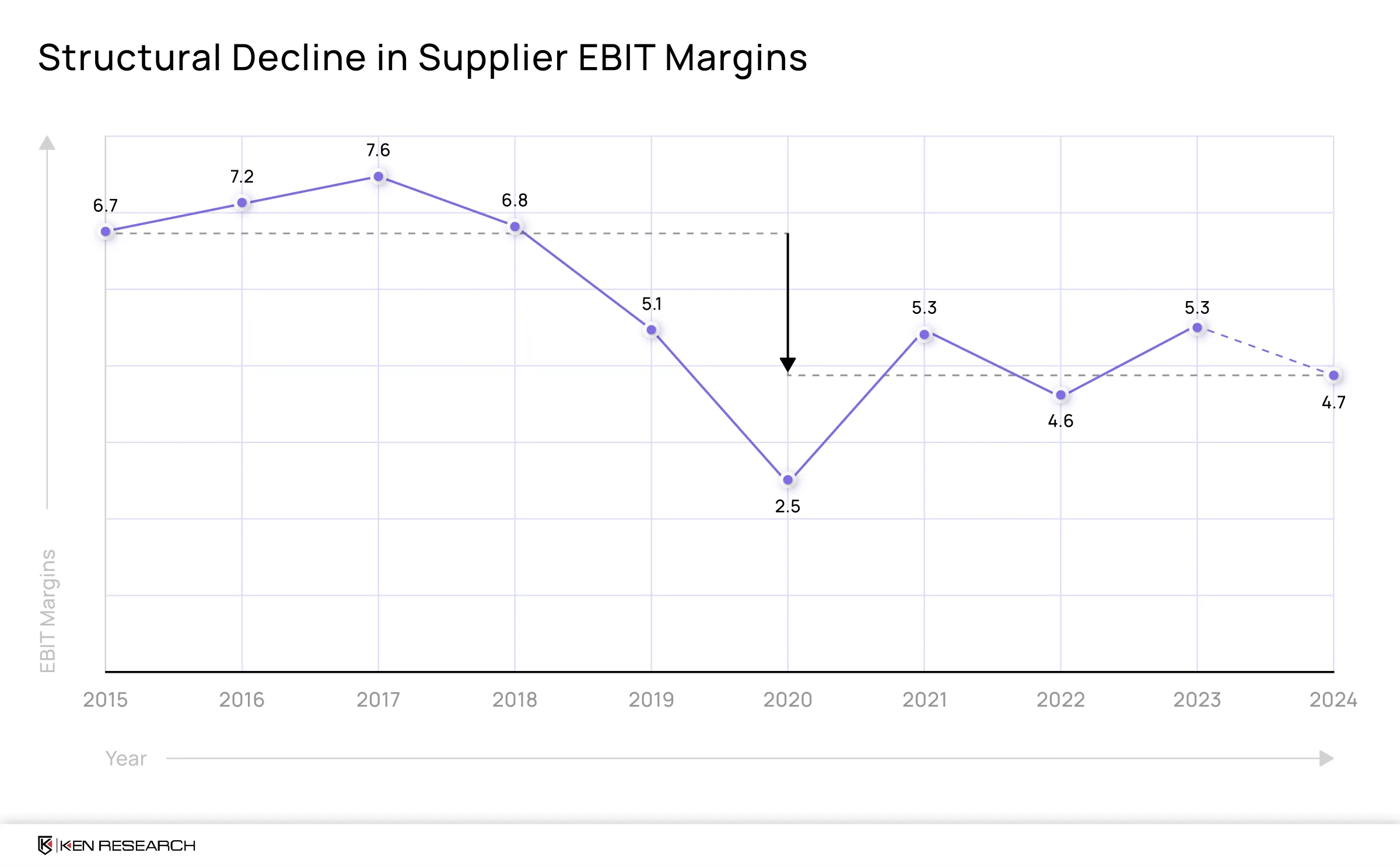
Financial pressure across the supplier base has now become persistent rather than cyclical. EBIT margins have continued to decline despite revenue stabilisation, highlighting a structural erosion in profitability. This margin compression reduces the industry’s ability to self-fund long-term innovation.
The following points highlight the depth of the margin reset:
- Average supplier EBIT margins declined to approximately 4.7% in 2024, down from around 7% before COVID.
- Margins during 2021–2023 averaged 5.3%, indicating a sustained downward shift.
- Current margins remain well below levels required to comfortably fund electrification and software investments.
- Cost inflation, higher financing expenses, and transformation spending continue to restrict margin recovery.
Slower BEV Adoption is Delaying Cost Absorption for Suppliers
The pace of battery electric vehicle adoption has slowed materially compared to earlier expectations. This slowdown directly impacts suppliers that invested based on faster EV scale-up assumptions. Lower volumes delay cost absorption and weaken return on invested capital.
The following developments explain why BEV adoption now poses a higher execution risk:
- BEV penetration is projected to reach 41% by 2030, revised down from 53% earlier.
- Reduced subsidies, charging infrastructure gaps, and affordability concerns are limiting adoption.
- Lower BEV volumes delay scale benefits, keeping powertrain costs elevated.
Suppliers are left with high fixed investment commitments but insufficient volumes to absorb costs, a challenge that is increasingly being reinforced by weak global vehicle production and suboptimal capacity utilisation. The next section examines how the slow recovery in global vehicle production is further limiting capacity utilisation and operating leverage for suppliers.
Global Vehicle Production Recovers Slowly After Falling to 73 million Units in 2020
Vehicle production has recovered from pandemic lows but remains below pre-COVID peaks. This limits operating leverage and keeps capacity utilisation suboptimal across regions. Persistent overcapacity further weakens supplier pricing power.
The following production trends illustrate slow recovery:
- Global vehicle production fell to 73 million units in 2020, reflecting severe pandemic disruption, which sharply reduced capacity utilisation across supplier plants and weakened operating leverage, creating a low base from which recovery has remained slow and uneven.
- Production is expected to exceed 96 million units only by 2030, indicating a slow and gradual recovery, which limits operating leverage for suppliers and delays normalisation of capacity utilisation across regions.
- Pre-COVID production levels are not expected to be surpassed before 2028, extending the period of underutilisation and keeping fixed-cost absorption and pricing power structurally weak.
These conditions continue to cap supplier profitability despite stable demand.
Vehicle Model Lifecycles Are Shortening, Raising Supplier Costs
OEMs are expanding their model portfolios to defend market share, but this strategy is structurally reducing production volumes per model and increasing cost pressure across the supplier ecosystem.
The following developments highlight how shorter vehicle lifecycles are reshaping supplier economics:
- Production volumes of the top 10 best-selling vehicle models are projected to decline to 672,000 units by 2027, down from 800,000 units in 2018, reducing scale benefits for suppliers.
- Lower volumes per model are increasing R&D costs per vehicle sold, as development expenses are spread over fewer units.
- The transition to BEVs is intensifying this trend, with BEV lifecycle volumes around 2.5x lower than those of ICE vehicles.
- As BEV adoption increases, average lifecycle volumes of the top 10 best-selling models are expected to fall from 5.4 million units in 2018 to 4.4 million units by 2027, shrinking the total revenue pool available to suppliers.
As a result, suppliers are facing intensified competition, forcing price adjustments, efficiency improvements, and tighter cost discipline, further reinforcing margin pressure across the industry.
BEV Profitability Remains Challenged by Low Volumes and Limited Pricing Power
Slower than expected BEV adoption is limiting production volumes compared to ICE models, restricting economies of scale and making profitability more difficult to achieve across vehicle segments.
The following factors illustrate how low BEV volumes are intensifying competition and cost pressure in the automotive value chain:
- BEV models are being produced at materially lower volumes than comparable ICE vehicles, reducing scale benefits needed to offset high fixed costs.
- A clear example is seen in the C-segment, where the ICE-powered Volkswagen Golf VII reached peak volumes of 1.06 million units, while the BEV equivalent, the Volkswagen ID.3, has achieved only 355,000 units.
- Similar dynamics are visible in the premium segment, where lower BEV production volumes result in a higher fixed-cost burden per vehicle, further compressing margins.
- BEVs also carry significantly higher direct product costs, with powertrain costs of approximately EUR 11,400 for a typical C-segment BEV, compared to around EUR 4,700 for an equivalent ICE vehicle.
- Consumer price sensitivity is limiting OEMs’ ability to fully pass on higher BEV costs through pricing, constraining revenue-led margin recovery.
As a result, restoring profitability in BEVs is increasingly dependent on product cost reduction, operational efficiency gains, and holistic cost optimisation, rather than further price increases.
Chinese Suppliers Outperform While Europe and Korea Lag
Supplier profitability differs sharply by region, with China remaining the strongest-performing market. However, rapid capacity expansion and aggressive pricing are pushing global price floors lower. This intensifies margin pressure for suppliers operating in higher-cost regions.
The regional margin gap highlights this divergence:
- Chinese suppliers recorded EBIT margins of 5.7% in 2024, supported by lower labour costs, strong domestic EV demand, and faster scale-up across new platforms.
- European suppliers generated margins of 3.6%, constrained by higher energy costs, rigid cost structures, and slower recovery in vehicle production volumes.
- South Korean suppliers reported margins of 3.4%, reflecting pressure from high export exposure and limited ability to offset cost inflation through pricing.
As Chinese suppliers expand globally, European and North American players face increasing difficulty defending margins.
Geopolitical Fragmentation, like EU Tariffs of 35.3% is Forcing Costly Localisation Strategies
Geopolitical fragmentation is accelerating structural changes in automotive supply chains. Trade barriers and regulatory differences are forcing suppliers to localise production across key markets. At the same time, suppliers face higher complexity in managing regional operations. As a result, supply chain flexibility is declining even as costs rise.
The following points highlight the key geopolitical factors driving localisation:
- The European Union has imposed tariffs on Chinese electric vehicles of up to 35.3%, raising cross-border trade costs.
- The United States has introduced restrictions on the use of Chinese vehicle software and hardware.
- Growing uncertainty around regional trade frameworks is increasing planning and investment risks for suppliers.
Local-for-local strategies are becoming essential for market access, but they continue to weigh on operational efficiency and profitability.
Over 40% of Large Suppliers Now Carry Non-Investment-Grade Ratings
Margin pressure is now directly impacting supplier balance sheets across global markets. Lower operating profits and higher interest rates are reducing financial headroom. As a result, many suppliers are losing access to low-cost funding. This weakens their ability to invest in electrification, software, and capacity upgrades.
The following points highlight the extent of rising financial pressure among large suppliers:
- More than 40% of large global suppliers are currently rated non-investment grade.
- Interest expenses now consume over 20% of EBIT, reducing net profitability.
- Higher borrowing costs are limiting funding available for transformation initiatives.
- Smaller and sub-scale suppliers face increased refinancing and liquidity challenges.
These conditions are expected to accelerate merger and acquisition activity as financially weaker players seek stability through consolidation.
Survival Now Depends on Portfolio Focus and Cost Discipline
Interest expenses consume over 20% of EBIT, making capital allocation discipline critical. In this environment, execution speed and portfolio focus are becoming key differentiators between resilient suppliers and stressed players.
The following actions highlight the key strategic priorities suppliers are focusing on:
- Divesting low-margin ICE and commoditised businesses, as sub-scale and legacy assets dilute returns in a sub-5% margin environment.
- Reallocating capital towards higher-value EV subsystems and aftermarket segments, where cash flow visibility and margin stability are stronger.
- Implementing structural cost reductions through automation, standardisation, and footprint optimisation to offset persistent cost inflation and localisation-related inefficiencies.
- Adopting region-specific operating models, reflecting rising trade barriers, tariff regimes, and uneven demand recovery across markets.
Execution across these areas will play a central role in determining long-term competitiveness and financial stability.
Conclusion
The global automotive supplier industry is no longer facing a cyclical slowdown but a structural reset in profitability. EBIT margins have stabilised around 4.7% in 2024, well below pre-COVID levels of approximately 7%, limiting suppliers’ ability to self-fund electrification, software, and capacity investments. Slower-than-expected BEV adoption is now projected at 41% penetration by 2030 versus earlier expectations of 53%, has delayed scale benefits and prolonged cost absorption challenges.
Ken Research highlights that the next phase for automotive suppliers will be defined by selectivity and financial discipline rather than expansion-led growth. With over 40% of large suppliers now rated non-investment grade and interest expenses consuming more than 20% of EBIT, preserving liquidity and balance-sheet flexibility has become critical.
Suppliers should prioritise portfolio rationalisation, exit structurally low-return ICE and sub-scale BEV programs, while reallocate capital towards higher-value EV subsystems, software with clear monetisation visibility, and resilient aftermarket segments. Cost structures must be reset through automation, footprint optimisation, and localisation strategies aligned with tariff regimes such as the EU’s 35.3% duties on Chinese EVs.
Get started
We've helped companies around the world future-proof
their businesses - and we can do the same for you.