The Influence Equation: How In-Store Staff Advisory & Brand Steering Are Reshaping Consumer Durables Retail in India
Ken Research
June 30, 2026 - 8 min read
June 30, 2026
by Ken ResearchIndia's Consumer Durables Market: A Floor That Sells, or Steers?
India's consumer durables sector has crossed a ₹2.9 trillion retail valuation threshold, with organized players commanding over 58% of total category sales as of 2025, a figure that would have been unthinkable a decade ago. Air conditioners, washing machines, refrigerators, LED televisions, and smartphones now move in volumes that mirror aspirational consumption at scale, fuelled by a rising middle class, aggressive EMI penetration, and the steady expansion of large-format electronics retail into Tier-2 and Tier-3 cities.
Yet beneath this growth story lies a dynamic that brands and retailers have long sensed but rarely quantified: the in-store advisor remains the single most consequential touchpoint in the consumer durables purchase journey. When a shopper walks into a Croma, Reliance Digital, or a regional multi-brand outlet carrying a loosely formed brand preference, the conversation at the display counter can, and frequently does, alter that preference before the billing counter is reached.
To decode this phenomenon, Ken Research conducted its Consumer Durables Retailer In-Store Advisory & Brand Steering Survey, a first-of-its-kind primary study tracking how store staff influence brand selection, how advisory quality varies across retail formats and product categories, and how brands can strategically engage this high-stakes human layer of the purchase funnel.
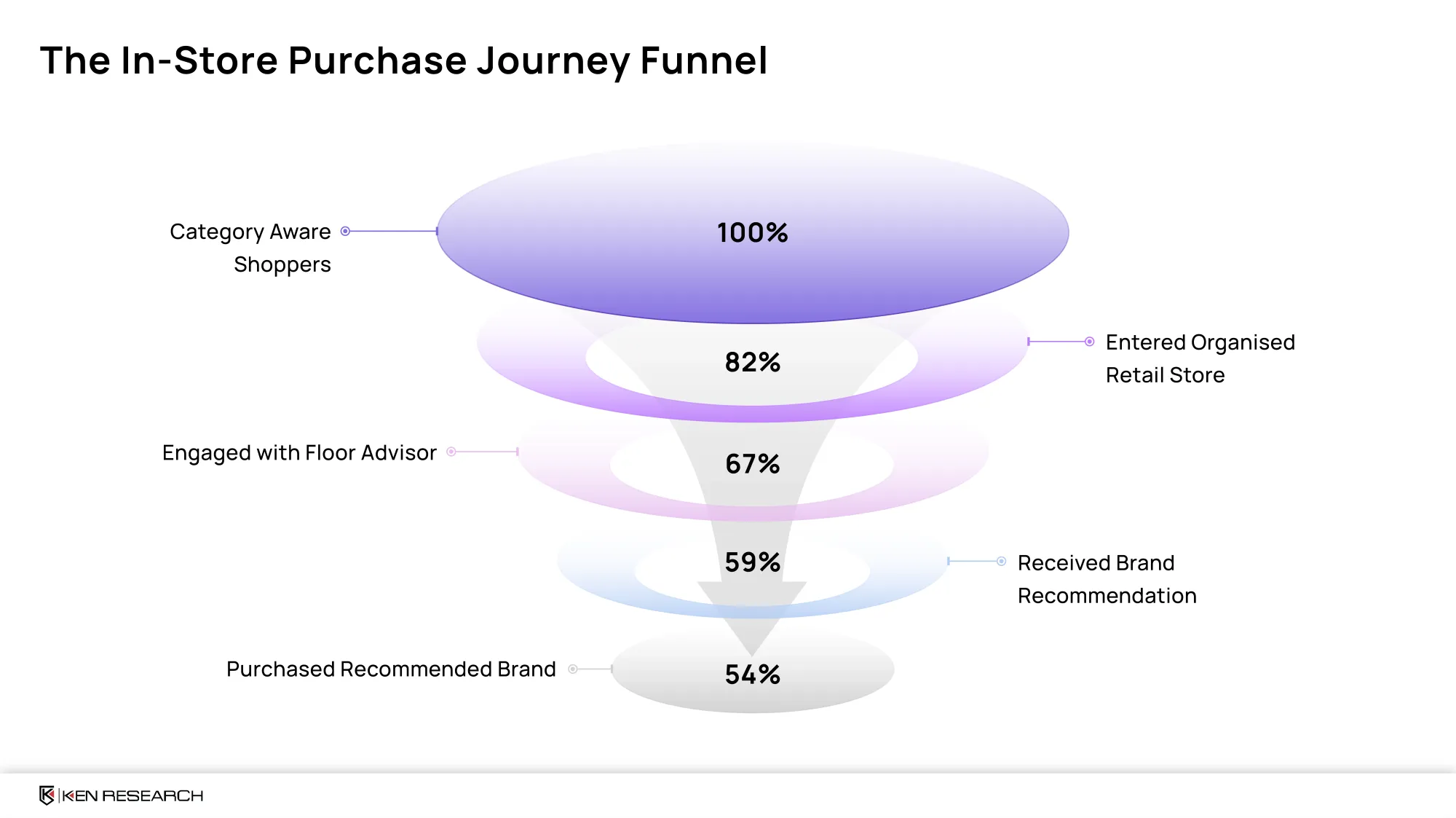
The findings are unambiguous. 54% of surveyed shoppers purchased the brand specifically recommended by the in-store advisor, even when they had arrived with a stated preference for a competing label. In a market where brand loyalty is proclaimed loudly in boardrooms and eroded quietly on the retail floor, this number demands a strategic response.
Survey Profile: Who We Studied, Where, and Why It Matters
Sample and Geography
The survey was conducted between Q4 2025 and Q1 2026 across a stratified sample of 3,800 verified purchasers and active in-store shoppers of consumer durables. Fieldwork spanned eight cities: Delhi-NCR, Mumbai, Bengaluru, Hyderabad, Pune, Ahmedabad, Lucknow, and Jaipur, collectively representing approximately 67% of organised consumer durables retail turnover in India as of 2025. Survey administration combined in-store intercept interviews at large-format electronics retailers, assisted digital surveys distributed through retail loyalty databases, and exit-intercept questionnaires at the point of billing.
Demographic Profile
- Age distribution: 41% Millennials (27-38), 26% Gen Z (18-26), 24% Gen X (39-50), 9% Boomers (51-62)
- Household income: 36% in ₹8-18 lakh annual income, 27% above ₹18 lakh, 37% in ₹4-8 lakh bracket
- Purchase occasion: 48% first-time category purchase, 52% replacement or upgrade decision
- Retail format visited: 61% large-format organised chains, 29% regional multi-brand dealers, 10% brand-exclusive stores
The Purchase Journey: Where Shoppers Enter, and Where Brands Win or Lose
Consumer durables purchase in India carry substantial financial weight, the average ticket size across our sample was ₹38,400, with LED televisions averaging ₹55,000 and smartphones ₹42,000 at the upper end. At this price point, shoppers do not simply browse, they seek validation. And in the absence of a trusted peer or a confident personal conviction, the store floor becomes the default advisory environment.
The funnel data tells a precise story. Of every 100 shoppers who were category-aware, 82 entered an organised retail store. Of those, 67% meaningfully engaged with a floor advisor, not a transactional query, but a guided comparison conversation. Of those who received a brand recommendation, a decisive 54% completed the purchase with the recommended brand. The drop-off points in this funnel represent billions in addressable influence, and most brands are leaving that influence unmanaged.
Staff product knowledge was cited by 72% of respondents as "important" or "very important" to their purchase confidence, ahead of price match assurance, brand demo access, and EMI clarity combined. The advisory layer is not a nice-to-have. It is the principal conversion driver in organised durables retail.
The Steering Reality: When the Floor Overrides the Funnel
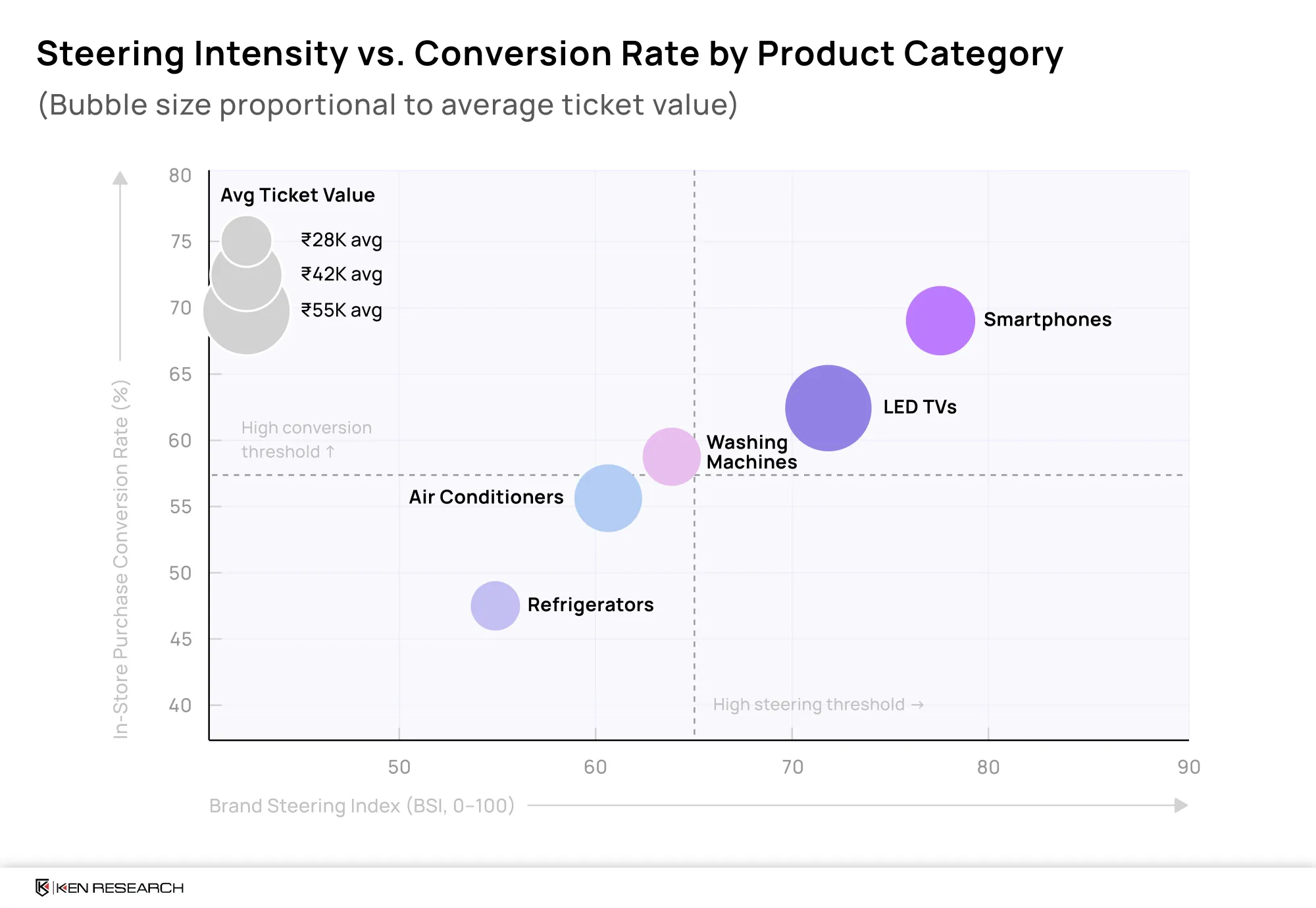
Brand steering, the measurable degree to which in-store staff direct shopper preference toward specific brands, follows a predictable pattern tied to category complexity and income sensitivity. Our bubble chart plots Brand Steering Index against in-store conversion rate across five product categories, with bubble size proportional to average ticket value. The pattern that emerges has direct implications for brand investment strategy.
Smartphones recorded the highest Brand Steering Index at 78, paired with a 68% in-store conversion rate, the strongest combined performance across all categories. This segment arrives with active brand research but remains highly susceptible to advisor influence during the last-mile comparison phase. LED televisions followed with a BSI of 71 and a 62% conversion rate, reflecting high staff influence in a category where specification complexity creates genuine advisory dependency.
By contrast, refrigerators posted the lowest BSI at 55 and the lowest conversion rate at 47%, consistent with a market where brand familiarity and price anchoring are established before the store visit. Washing machines (BSI 64, conversion 58%) and air conditioners (BSI 61, conversion 55%) sit at the mid-range, representing significant headroom for brands that invest in targeted advisory training for these categories.
The Four Advisor Archetypes, and What Each Means for Brands
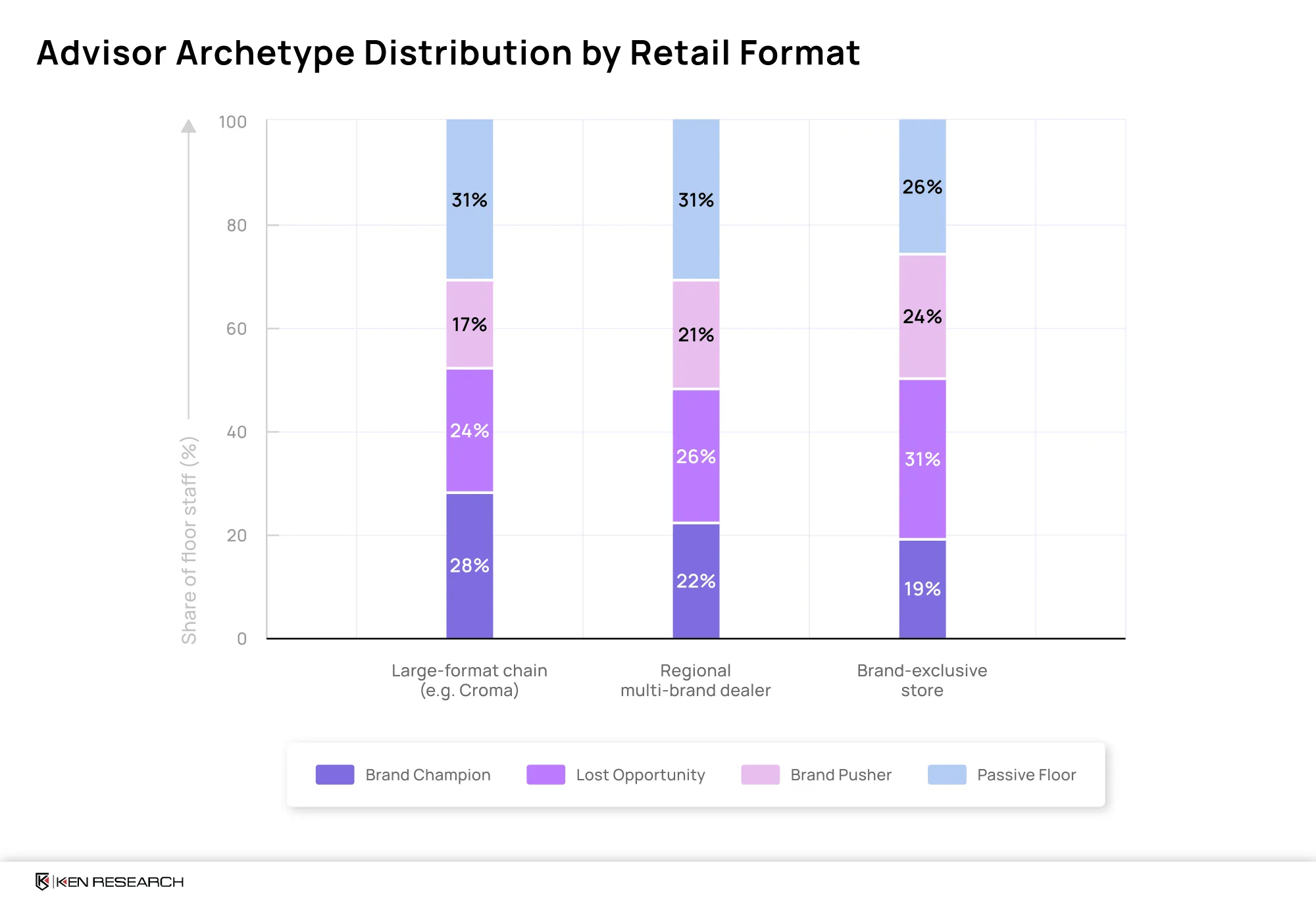
Ken Research's stacked bar analysis reveals that advisor archetype distribution varies meaningfully across retail formats, and the variance carries direct brand strategy implications. The Passive Floor archetype dominates across all three formats at 26-31% of floor staff. These advisors defer to self-service shoppers, absorb footfall without converting it, and represent the largest category of untapped retail productivity in the channel.
- Brand Champions (19-28% by format): The most commercially valuable archetype. They convert at the highest rate, generate the lowest return incidence, and build post-purchase satisfaction scores that translate directly into advocacy. Concentration is highest in large-format chains at 28% and lowest in brand-exclusive stores at 19%.
- Lost Opportunity (24-31%): Technically proficient advisors who default to shopper-led decisions rather than brand-directed guidance. Brands lose disproportionate recommendation share through this archetype even when their products are objectively superior on specification and price.
- Brand Pushers (17-24%): Staff who recommend specific brands aggressively but lack the product knowledge to sustain the recommendation under shopper questioning. This archetype generates the highest rate of post-purchase regret and return claims, a brand risk that routinely goes unmeasured in trade ROI reporting.
Brand-exclusive stores carry the highest concentration of brand pushers at 24%, suggesting that single-brand environments do not automatically produce higher advisory quality. Training investment, not retail format, is the principal determinant of advisor effectiveness.
What Lies Ahead: The Strategic Reckoning for Consumer Durable Brands
The data from this survey forces a difficult admission for brands that have invested heavily in above-the-line advertising, digital funnels, and e-commerce dominance: the retail floor remains the decisive arena, and the human advisor within it remains under-invested, under-trained, and under-leveraged.
Brands must now confront hard strategic questions:
Do they treat retail staff training as a cost line or as the highest-ROI brand investment available in the physical channel?
Do they design trade incentive structures that reward recommendation consistency or continue to measure sell-through without understanding what drives it?
Do they track the Brand Steering Index systematically across retail formats and geographies, or remain blind to the gap between brand preference built online and brand selection made on the floor?
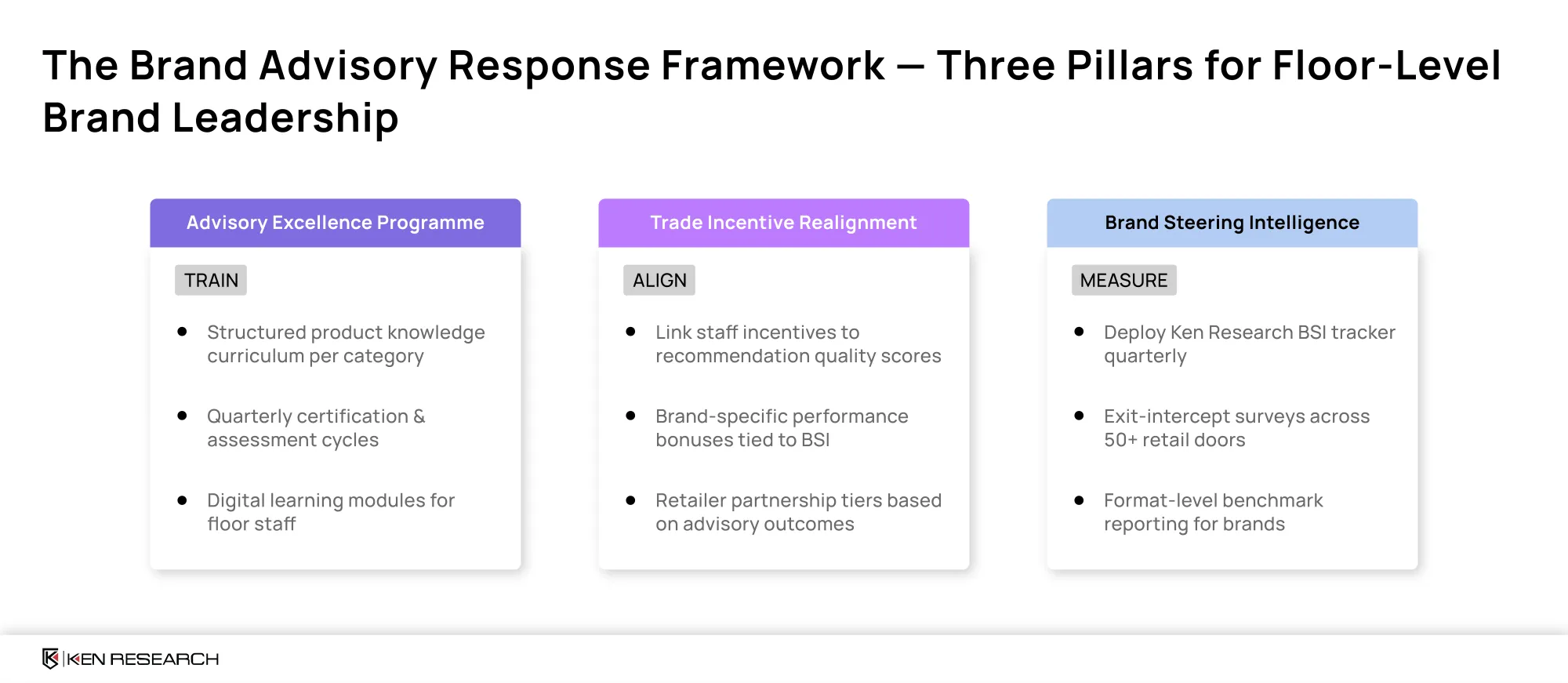
Ken Research's three-pillar Brand Advisory Response Framework, Train, Align, Measure, offers a deployable roadmap. Brands that implement structured advisory excellence programs, realign trade incentives toward recommendation quality, and instrument their retail doors with quarterly BSI tracking will build a competitive moat that no media campaign can replicate from the outside.
India's consumer durables shopper is ready to be guided. The question for brands is whether they are ready to guide. Those that will capture disproportionate share from a market where 54% of purchase decisions are still made not online, not on a specification sheet, but in a conversation at the display counter.
About the Author:
Sidhika Jain is a Survey Research Associate at Ken Research, specializing in market research and consumer insight analysis. She works on survey design, data analysis, and research-driven strategies to help organizations make informed business decisions.
From the Author:
"At Ken Research, we have been mapping the in-store advisory dynamic across India's organized electronics retail ecosystem, and the data reveals a striking paradox: brands spend aggressively on digital discovery and loyalty programs, yet the single most influential touchpoint, the floor advisor, routinely operates without structured brand engagement or measurable performance tracking. India's consumer durables market is not simply a distribution challenge; it is an advisory architecture challenge, and the brands that recognize this first will build a competitive moat that no media campaign can replicate."
About Ken Research:
Ken Research is a market intelligence and strategy consulting firm delivering actionable insights across the various sectors in dynamic markets. We support industry stakeholders with data-driven analysis on emerging trends, competitive benchmarking, pricing strategies, and shifting consumer preferences. Our expertise enables clients to refine market entry and penetration strategies, optimize product positioning, and respond effectively to evolving competitive landscapes.
Related tags
Retail
Consumer Products and Retail
Get started
We've helped companies around the world future-proof
their businesses - and we can do the same for you.