The Readiness Gap: How Enterprises in the UAE Are Navigating Cybersecurity Risk, and Where the Fault Lines Run
Ken Research
August 20, 2026 - 9 min read

August 20, 2026
by Ken ResearchThe UAE's Cybersecurity Inflection Point Has Already Arrived
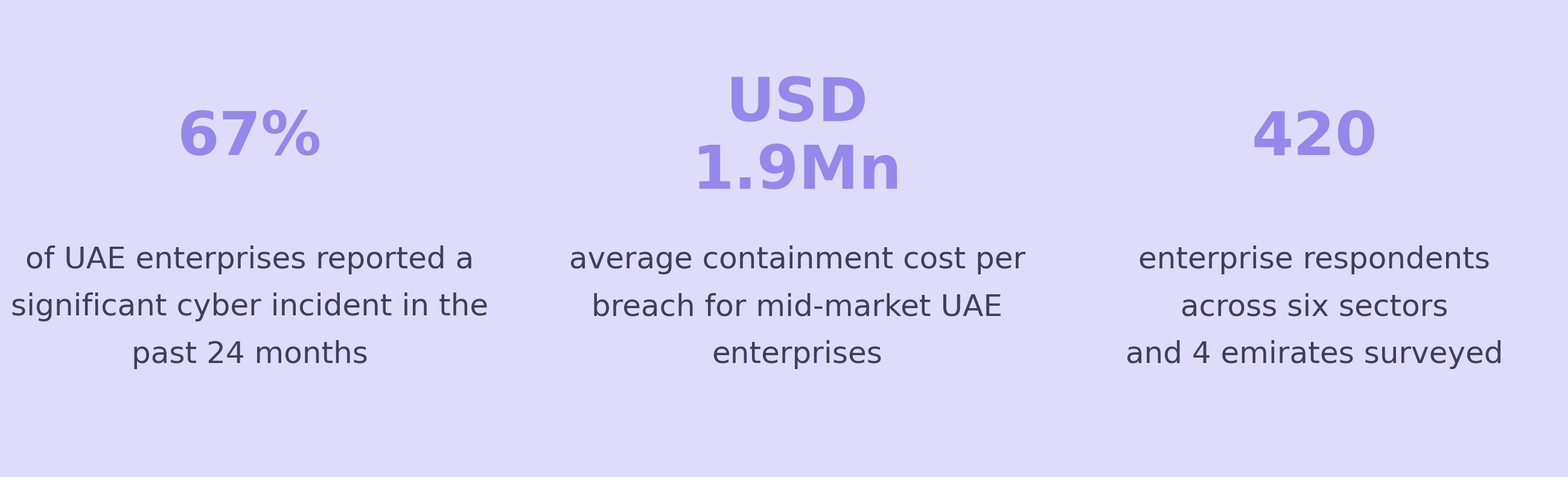
Sixty-seven percent of enterprises across the UAE experienced at least one significant cybersecurity incident in the 24 months preceding this study. That number alone would be striking in any market. In the UAE, a geography that has attracted USD 6.2 billion in cross-border digital investment since 2022 and hosts the regional headquarters of over 5,400 multinational corporations, it signals something more consequential than a threat statistic. It signals a structural gap between digital ambition and security readiness.
To map this gap precisely, Ken Research conducted its Enterprise Cybersecurity Readiness & Incident Experience Survey across six industry verticals and four emirates, a primary research study engaging 420 enterprise decision-makers and security professionals responsible for cybersecurity posture, procurement, and incident response across organisations with annual revenues exceeding AED 50 million. The result is not a compliance report. It is a diagnostic, one that reveals, in precise terms, where the UAE's enterprise security infrastructure is holding and where it is failing.
The UAE sits at a unique intersection: among the most digitally mature economies in the Middle East, subject to one of the region's most active regulatory reform agendas, from the UAE National Cybersecurity Strategy 2031 to ADGM's Cyber Risk Framework yet confronting a threat environment that has grown faster than the institutional response. Ransomware incidents targeting UAE critical infrastructure grew by 38% year-on-year between 2023 and 2024, while average containment costs for mid-market enterprises now exceed USD 1.9 million per breach. The data tells a confronting story: the UAE is more exposed, not less, precisely because of its digital leadership position.
Survey Profile: Who We Studied, Where, and Why It Matters
Sample and Geography
The survey was conducted between Q2 and Q3 of 2025, covering a stratified sample of 420 enterprise-level respondents across four emirates: Dubai, Abu Dhabi, Sharjah, and Ras Al Khaimah. These emirates collectively account for approximately 93% of the UAE's formal enterprise economy by revenue. The survey was administered through structured digital interviews, supplemented by in-person facilitated sessions for government and critical infrastructure respondents to ensure participation at the appropriate seniority level.
Sector Coverage
- Banking, Financial Services & Insurance (BFSI), 22% of sample
- Government & Defence, 17% of sample
- Energy, Oil & Gas, and Utilities, 15% of sample
- Telecom & Digital Media, 16% of sample
- Healthcare & Life Sciences, 14% of sample
- Retail, e-Commerce & Logistics, 16% of sample
Respondent Profile
- Seniority: 41% CISO or equivalent; 33% IT Director / Head of Security; 26% VP / C-Suite with security oversight
- Organisation size: 54% above AED 500 million annual revenue; 46% between AED 50-500 million
- Security maturity: 28% self-rated as "advanced"; 44% "developing"; 28% "foundational”.
- Cloud adoption: 71% operate hybrid or multi-cloud environments; 19% predominantly cloud native.
Readiness by Sector: The Five Dimensions That Separate Leaders from Laggards
Cybersecurity readiness is not a single variable. Our survey scored organisations across five operational dimensions: incident response planning, threat detection capability, staff training and awareness, recovery capability, and regulatory compliance posture. The variance across UAE industry sectors on these five dimensions is the most commercially actionable finding in this study.
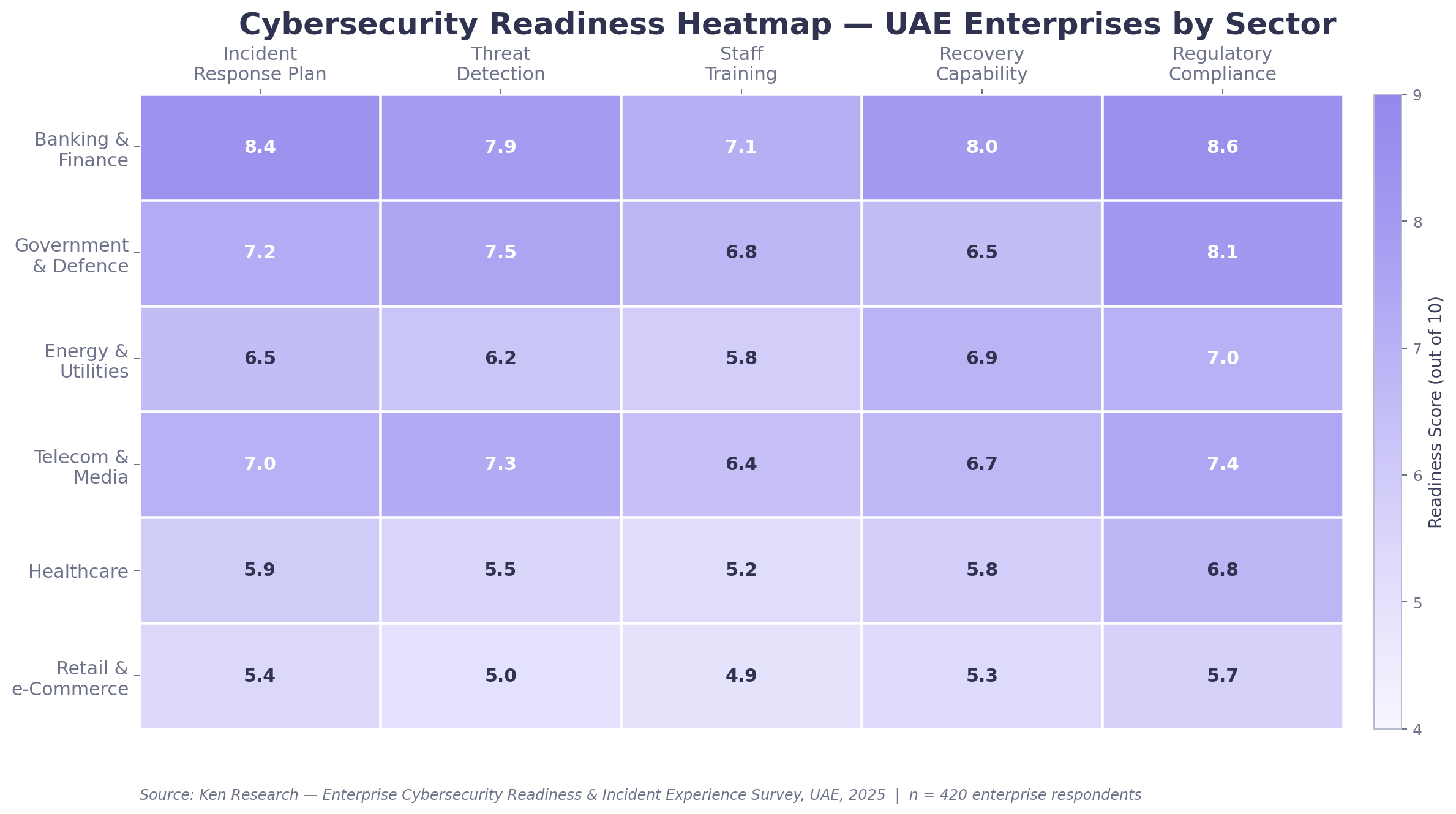
Banking and financial services leads on four of five dimensions, a finding consistent with the sector's sustained regulatory pressure from the UAE Central Bank's Technology Risk Standards and ADGM's Cyber Risk Framework. With a readiness score of 8.6 on regulatory compliance and 8.4 on incident response planning, BFSI respondents operate with the most mature security architectures in the study sample.
The contrast with healthcare is stark. Healthcare organisations scored 5.2 on staff training and 5.5 on threat detection, the two dimensions most directly linked to incident origination in clinical and administrative environments. This gap is not accidental: healthcare in the UAE has undergone rapid digitisation through initiatives such as the Emirates Health Services transformation programme, but security investment has not kept pace with the attack surface expansion. The sector's exposure profile is high; its readiness is not.
Retail and e-commerce record the weakest aggregate readiness score in the study, with a composite average of 5.3 across all five dimensions. This reflects a sector that has prioritised customer experience infrastructure over security architecture, a trade-off that is becoming increasingly untenable as UAE e-commerce fraud losses are estimated to have exceeded AED 1.1 billion in 2024.
Incident Experience: What Actually Happened, and What It Cost
Incident experience data from our survey reveals a pattern more nuanced than sector-level statistics suggest. Financial impact per incident is not linearly correlated with sector readiness, it is shaped by the intersection of containment speed and the nature of the systems targeted. Energy and utilities, for example, does not record the highest frequency of incidents but absorbs the highest average cost per event, at USD 4.2 million, due to the operational technology environments involved.
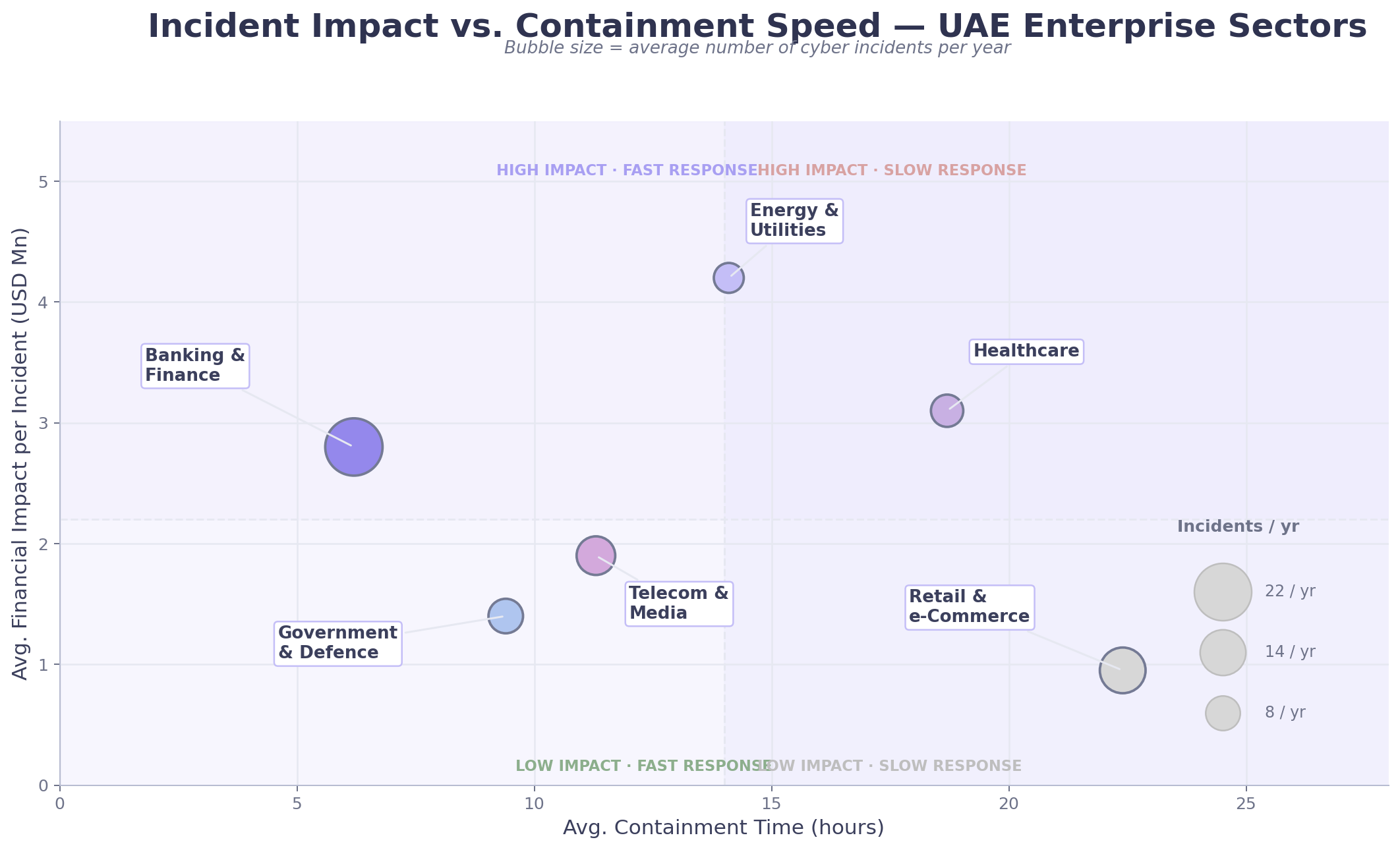
Retail and e-commerce carry the highest annual incident frequency at 22 events per year on average, with a mean containment time of 22.4 hours, the slowest in the study. For a sector operating on thin operating margins and high transaction volumes, this combination is commercially catastrophic. Each incident introduces not only direct loss but reputational risk in a market where consumer trust is built incrementally and lost instantaneously.
Banking, by contrast, resolves incidents in an average of 6.2 hours, less than a third of the retail sector's response time, with a well-defined incident command structure, pre-tested playbooks, and regulatory obligation to report material incidents to the UAE Central Bank within 72 hours. The speed differential is not incidental; it is the product of deliberate investment in detection infrastructure and rehearsed response protocols.
Where the Attacks Are Coming From: Threat Vectors and the Readiness Gap
Understanding which threat types of UAE enterprises have actually experienced, and how their current readiness compares to best-practice benchmarks for each, is where the policy and investment implications become concrete. Our survey asked respondents to identify incidents by attack vector and assess their organisations' current capability against that specific threat type.
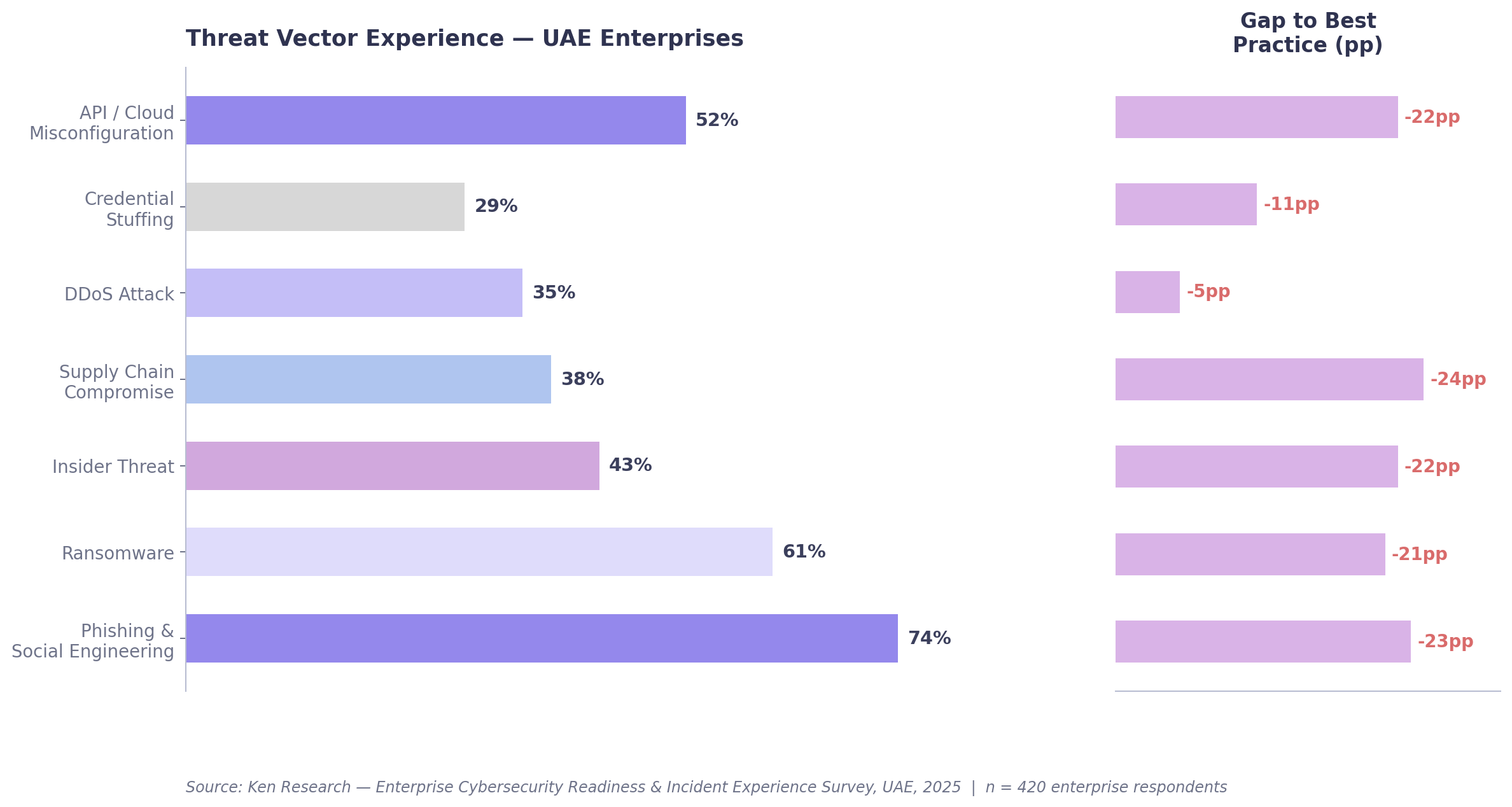
Phishing and social engineering remain the dominant entry point, experienced by 74% of surveyed enterprises, yet the readiness gap against best practice for this vector stands at 23 percentage points. This gap persists not because organisations do not train employees, but because training programmes are episodic rather than continuous, and because threat actors have industrialised credential harvesting at a pace that outstrips annual awareness cycles.
API and cloud misconfiguration, experienced by 52% of respondents, represents the fastest-growing threat category in the sample. As UAE enterprises migrate to multi-cloud architectures under Vision 2031's digital infrastructure agenda, the configuration attack surface expands faster than security teams can monitor. The gap to best practice for this vector, at 22 percentage points, reflects a skills deficit that cannot be resolved through policy alone, it requires structural investment in cloud security engineering talent, which remains critically short in the UAE market.
Ransomware, experienced by 61% of respondents, carries disproportionate strategic risk in critical infrastructure sectors. Three government-affiliated entities in our sample reported ransomware events that triggered national-level incident response coordination, underscoring that for certain sectors, cybersecurity is not an enterprise risk management question. It is a sovereignty question.
What Lies Ahead: The Strategic Reckoning for UAE Enterprise Security Leaders
The findings from this survey do not point toward a technology deficit as the primary problem facing UAE enterprise security. They point toward a structural misalignment between how organisations have invested in security and what the threat environment is actually demanding of them. What worked during the first wave of UAE digitalisation, perimeter defence, annual audits, and compliance-first posture, is no longer adequate in an environment where incidents are near-certain, recovery timelines define competitive outcomes, and regulatory consequences for inadequate response are becoming materially more severe.
Security leaders across UAE enterprises now confront three decisions that cannot be deferred:
- Do they invest in readiness depth across all five dimensions, or concentrate resources on their highest-exposure threat vectors?
- Do they treat regulatory compliance as the ceiling of their security ambition, or as the floor from which capability building begins?
- Do they build incident response capability in-house, or establish hybrid models that draw on managed security service providers to close the talent gap that the UAE market cannot resolve through hiring alone?
The answers will define not just individual enterprise resilience, but the UAE's broader credibility as a technology hub. Multinationals locating regional headquarters in Dubai and Abu Dhabi assess cyber risk as part of their operating environment evaluation. A market with demonstrably improving enterprise security posture is more attractive, more fundable, and more trusted than one where incident frequency is high and containment capability is slow. The strategic stakes are not limited to the boardroom. They extend to the economy.
A Framework for Action: The Enterprise Cybersecurity Strategic Response Matrix
Not all UAE enterprises are at the same inflection point. The most operationally useful output of this survey is a sector-level positioning framework that allows security leaders and their boards to calibrate the urgency and nature of their response. The matrix below positions UAE industry sectors across two axes: cybersecurity readiness (composite score across the five dimensions) and incident exposure (frequency combined with financial impact severity).
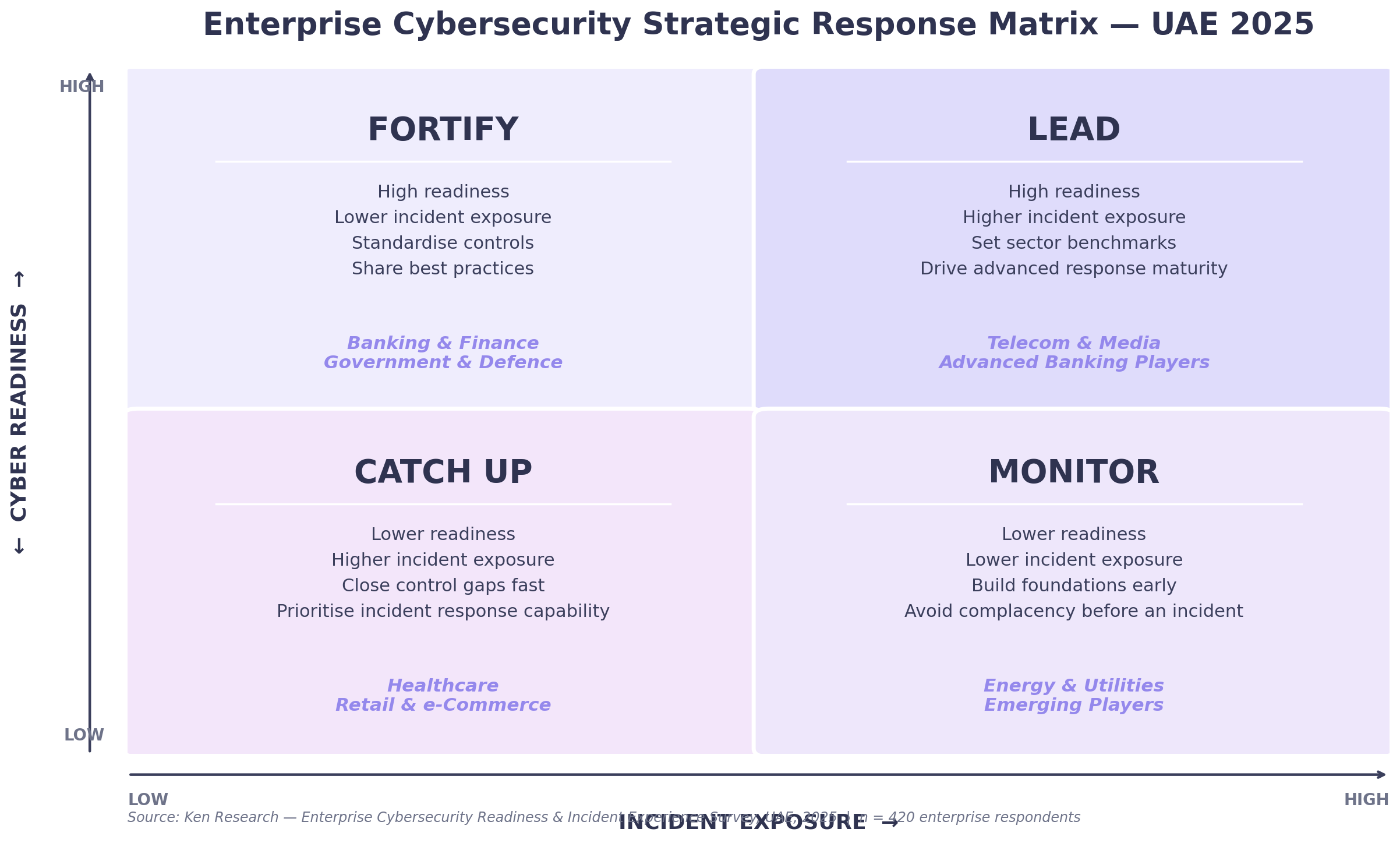
The matrix generates four response imperatives. LEAD quadrant organisations, primarily advanced banking and telecom players, must move from internal excellence to industry standard-setting, contributing to the UAE Cybersecurity Council's sector working groups and piloting shared threat intelligence platforms. FORTIFY quadrant organisations should resist complacency; their low exposure today is partly a function of their high readiness discouraging attackers who pursue easier targets, a position that can shift as peer organisations raise their own defences.
CATCH UP quadrant organisations, healthcare and retail, face the most urgent mandate. The combination of low readiness and high exposure creates a compounding vulnerability: each incident weakens recovery capacity for the next, and the cumulative effect on brand trust and customer retention is measurable. These sectors require a step-change in investment, not incremental improvement. MONITOR quadrant organisations must avoid the trap of low historical exposure generating strategic complacency. Energy sector players in this quadrant have already seen peers targeted internationally, the UAE market will not remain insulated indefinitely.
About the Author:
Siddharth Raj is a Survey Consultant at Ken Research with experience in primary market research, consumer insights, and survey analytics. He has worked on large-scale research and consulting engagements across multiple industries, supporting organisations with market assessment, strategic insights, and data-driven decision-making.
From the Author:
"The UAE has made extraordinary progress in digital infrastructure, but that progress has created an attack surface that is expanding faster than the enterprise security apparatus can track. What this survey tells us, at the most direct level, is that the gap between the UAE's digital ambitions and its cybersecurity readiness is not hypothetical. It is measurable, sector-specific, and urgent. The enterprises and policymakers who engage with that data precisely, rather than treating cybersecurity as a compliance checklist, are the ones who will define the UAE's security posture for the next decade."
About Ken Research:
Ken Research is a market intelligence and strategy consulting firm delivering actionable insights across the various sectors in dynamic markets. We support industry stakeholders with data-driven analysis on emerging trends, competitive benchmarking, pricing strategies, and shifting consumer preferences. Our expertise enables clients to refine market entry and penetration strategies, optimize product positioning, and respond effectively to evolving competitive landscapes.
Related tags
Technology and Telecom
Get started
We've helped companies around the world future-proof
their businesses - and we can do the same for you.