Is Market Fragmentation Holding Back the Growth of India’s Edible Oil Industry?
Ken Research
July 22, 2025 - 4 min read

July 22, 2025
by Mrityunjay SinghIndia has established itself as the world’s largest importer and second-largest consumer of edible oils, with total consumption exceeding 25 million metric tons in 2024. Demand is being driven by population growth, urbanization, and evolving food habits across both metropolitan and rural areas.
However, despite its massive scale, the market remains highly fragmented, especially in emerging regions like East India. A significant share of supply comes from unorganized and small-scale producers, resulting in inconsistent quality's to branded, reliable products.
This lack of structure inhibits scalability and undermines supply chain efficiency for the entire sector.
Importance of Edible Oils in India’s Agricultural and Economic Ecosystem
Edible oils are not only vital for daily consumption but also form a strategic part of India’s agricultural economy. The country is a leading producer of oilseeds globally, accounting for approximately 5-6% of global production.
According to the Second Advance Estimates (March 2025), oilseed production for 2024–25 is projected at 41.66 million metric tons across nine major crops.
This sector significantly contributes to rural incomes, employment in agro-processing, and national trade.
In FY 2023–24, India exported 5.44 million metric tons of oil meals, oilseeds, and minor oils, generating ₹29,587 crores in foreign exchange. These numbers underscore the sector’s critical role in promoting economic stability, rural development, and food security.
Government Push for Self-Reliance Through Major Policy Interventions
To reduce its dependency on edible oil imports, India has launched key policy initiatives under the Aatmanirbhar Bharat mission. The National Mission on Edible Oils Oilseeds (NMEO-Oilseeds) aims to raise oilseed output from 12.1 to 20.2 million tons by 2030–31, focusing on yield improvement and better oil extraction from crops like mustard, soybean, and groundnut.
Alongside this, the NMEO Oil Palm (NMEO-OP) targets expanding oil palm cultivation from 3.7 lakh hectares to 10 lakh hectares and boosting Crude Palm Oil (CPO) production to 11.2 lakh tons by 2025–26. These reforms are backed by a financial outlay of over ₹10,000 crores.
In September 2024, the government also raised import duties, up to 27% on crude oils and 35.75% on refined oils, to encourage domestic production and protect local producers. However, while these reforms are impactful, more support is needed to consolidate the fragmented SME segment within the edible oil supply chain.
Why East India Is the Next Big Opportunity in Edible Oils?
East India has emerged as a critical growth driver for India edible oil industry. The region’s increasing urbanization, evolving dietary habits, and rising consumer spending are fuelling a notable surge in edible oil demand, especially in states like West Bengal, Jharkhand, Bihar, and Odisha.
In West Bengal, total edible oil consumption crossed 793,585 metric tons in 2023, with mustard oil (over 240,000 tons) and soybean oil (around 180,000 tons) dominating consumer preference.
While leading brands like Adani Wilmar, Emami Agrotech, and Patanjali Foods hold a collective market share of approximately 45%, more than 35% of the market still belongs to unorganized players, indicating a significant opportunity for structured expansion.
In Jharkhand, the total market volume stood at over 702,380 metric tons, with palm oil leading in volume. However, the landscape remains highly fragmented more than 68% of the market occupied by unbranded or local suppliers.
This reflects a critical gap in brand penetration and supply chain integration that larger companies can strategically address.
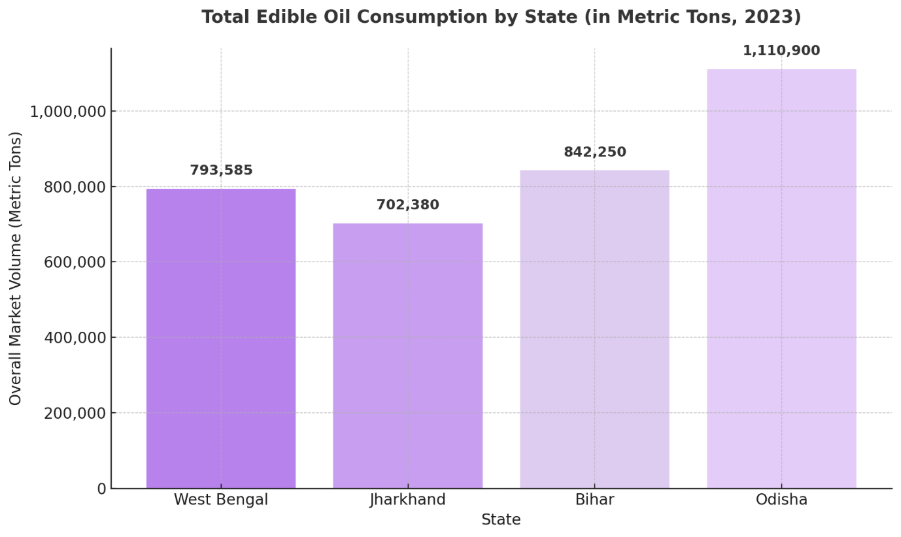
To explore detailed consumption insights and competitive analysis for Bihar and Odisha, including oil type breakdowns and brand performance, click here to read more.
India is Reducing Its Dependence on Edible Oil Imports
India continues to import over 60% of its edible oil requirements, with palm oil from Indonesia and Malaysia accounting for the majority of imports.
Ports like Haldia and Paradip play an important role in the logistics and distribution of these imports, especially for Eastern India.
To reduce this dependency, the government has implemented several supportive initiatives. Under the National Mission on Edible Oils–Oilseeds (NMEO-Oilseeds), the goal is to increase domestic edible oil production from 12.1 million tons to 20.2 million tons by 2030 –31.
The mission focuses on improving yields of key oilseed crops such as mustard, soybean, groundnut, and sesame, while also enhancing oil extraction from secondary sources like cottonseed and rice bran.
Complementing this is the NMEO–Oil Palm (NMEO-OP) scheme, which aims to expand oil palm cultivation from 3.7 lakh hectares to 10 lakh hectares by 2025–26.
The production of Crude Palm Oil (CPO) is expected to grow from 0.27 lakh tons to 11.2 lakh tons in the same period.
These reforms are designed to enhance self-sufficiency and reduce India’s reliance on edible oil imports, especially palm oil, which constitutes nearly 56% of total edible oil imports.
Fragmentation is a Challenge, But Also an Opportunity
While fragmentation across the edible oil industry poses operational and quality challenges, it also opens the door to strategic transformation.
Leading edible oil players can scale through regional brand acquisitions, creating vertically integrated supply chains that improve cost control and distribution efficiency.
By partnering with smaller producers and aligning with government schemes, companies can bridge the gap between unorganized supply and branded retail demand.
Tech-enabled platforms, farmer cooperatives, and contract farming models can help bring smallholders into the organized value chain, supporting both market development and rural employment.
With rising demand and targeted reforms, fragmentation is no longer just a limitation, it is a call to action for structured consolidation and capacity building.
Conclusion
The path forward for India’s edible oil sector lies in consolidation, technology adoption, and premium category expansion. Companies are streamlining operations through AI-driven logistics, digital procurement, and real-time inventory tracking.
Rising consumer demand for health-oriented oils such as cold-pressed, organic, and omega-rich variants presents strong margin opportunities, especially when paired with education and transparent labelling.
With import duties raised to 27% on crude and 35.75% on refined oils (as of September 2024), the sector is seeing a policy push toward local production and self-reliance.
Ken Research continues to track these developments, offering insights that help stakeholders navigate emerging opportunities with clarity.
Related tags
General Food
Get started
We've helped companies around the world future-proof
their businesses - and we can do the same for you.