India’s Mid-Scale Hotels Set to Add 3 million Rooms – Here Are the 6 Brands Leading the Way
Ken Research
September 25, 2025 - 5 min read
September 25, 2025
by Rebecca MaryIndia’s hospitality sector has reached a decisive turning point where mid-scale hotels are no longer a secondary option but the backbone of industry growth, positioned between luxury and budget segments while commanding the strongest momentum in the market.
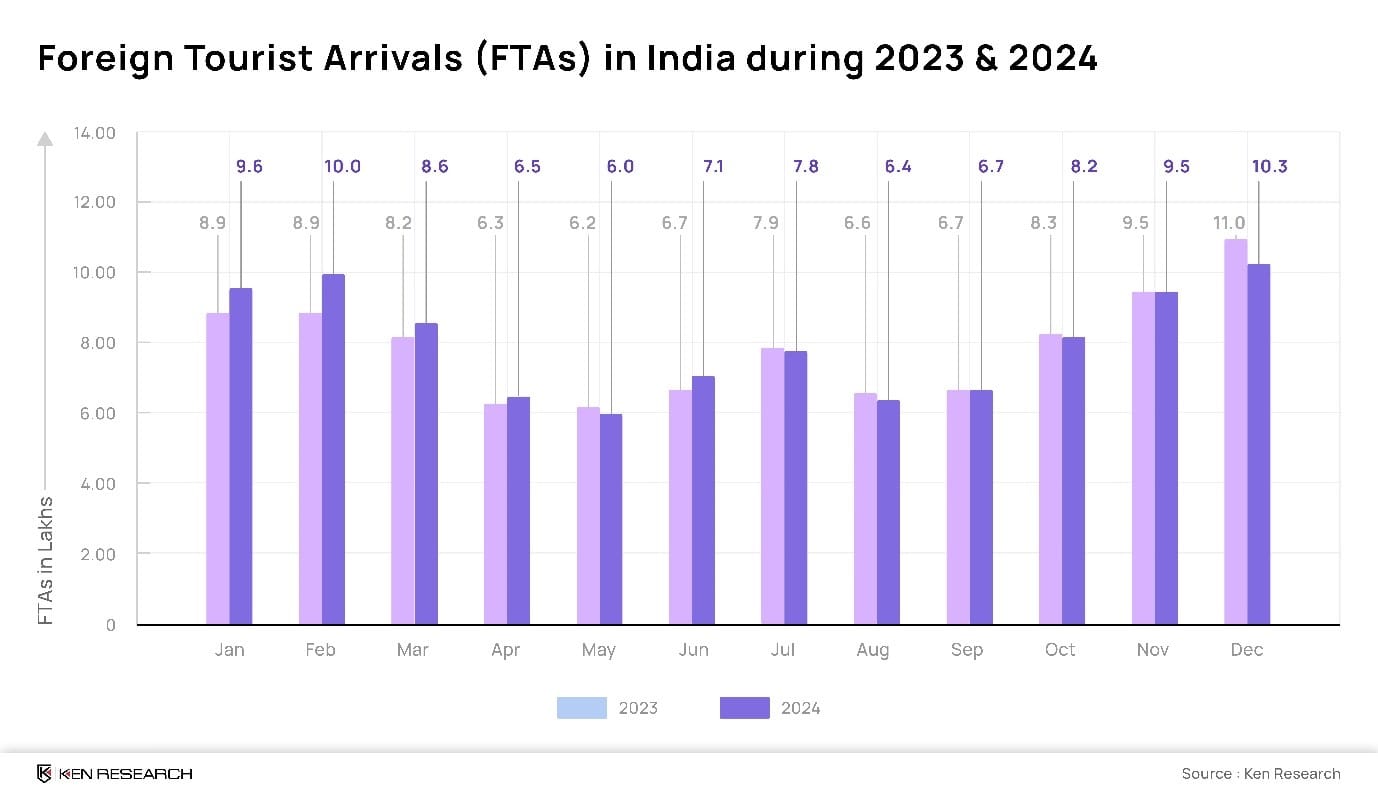
The rebound has been remarkable, with domestic tourist visits soaring to 1.73 billion in 2022, more than doubling from 677 million in 2021, while foreign arrivals climbed to 10 million in FY24.
The Federation of Hotel and Restaurant Associations of India (FHRAI) further highlights that the mid-scale segment is expanding at a rapid 13% CAGR, the fastest pace across Indian hospitality industry.
Performance indicators confirm this shift, as by FY25, mid-scale hotels recorded an ADR of ₹4,865, an occupancy rate of 63.7%, and a RevPAR of ₹3,099, all surpassing pre-pandemic levels. With NITI Aayog projecting that India will require as many as 3 million new hotel rooms by 2030, mid-scale operators are clearly positioned to deliver more than most of this supply.
What strengthens their appeal is the balance of scale and efficiency: average development costs range between ₹40–60 lakh per room, operating margins typically fall between 30–35%, and breakeven can often be achieved within six to eight years, considerably faster than luxury projects that usually stretch beyond a decade
Ginger Is Becoming India’s Most Reliable Mid-Scale Chain
Ginger Hotels demonstrates how established players can industrialize the mid-scale format, with Tata-owned IHCL offering nearly 6,000 rooms designed around reliable, no-frills service at prices that work for India’s corporate and mobile workforce. This approach directly targets Tier II and Tier III cities, which the National Sample Survey Office (NSSO) confirms generate over 60% of domestic tourism demand, exactly where Ginger is expanding most aggressively.
Reinforcing this momentum, IHCL recently entered a strategic partnership to develop 10 new Ginger hotels with more than 1,000 rooms across South India. The first will be a 75-room property in Genome Valley, Telangana, underscoring Ginger’s ability to scale rapidly in business and industrial hubs where functional, cost-efficient hospitality is in the highest demand.
By relying heavily on management contracts and asset-light models, Ginger has positioned itself for faster expansion while keeping capital intensity in check, a combination that strengthens its long-term growth profile in underserved markets.
Bloom Is Redefining Mid-Scale Hospitality with Design.
Bloom Hotels exemplifies how new-age operators are redefining the mid-scale experience by blending affordability with design-led spaces, seamless tech-driven check-ins, and lifestyle-focused sub-brands such as Bloom Suites and X by Bloom.
This resonates strongly with the Reserve Bank of India’s Currency and Finance report for 2022–23, which shows that business travel spending has already recovered to nearly 85% of pre-pandemic levels, exactly the segment Bloom is positioning itself to serve.
Building on this, Bloom Hotels has attracted strong investor interest and announced expansions into Tier II and Tier III cities, targeting younger professionals who prioritize efficiency and modern design. This strategy ensures Bloom captures the fast-recovering corporate travel segment while appealing to India’s lifestyle-conscious millennial traveler base.
Its design-first philosophy, coupled with a capital-efficient rollout, makes Bloom a scalable brand with the potential to expand rapidly across both business and lifestyle corridors.
Fortune Park Leverages ITC’s Network to Scale Mid-Range Hospitality
Fortune Park Hotels illustrates how legacy conglomerates can successfully dominate the mid-scale market by deploying a multi-brand approach. As part of ITC, Fortune now operates over 3,800 rooms under formats including Fortune Select, Fortune Inn, and Fortune Resort, serving both business and leisure travelers with tailored offerings.
Crucially, the brand benefits from being positioned within the revised GST framework, where rooms priced up to ₹7,500 attract only 5% GST (without input tax credit), keeping them affordable for mass-market demand, while rooms above ₹7,500 fall under the 18% slab with ITC benefits.
Strengthening this presence, ITC Hotels has recently expanded Fortune Park’s pipeline with new properties in both urban and leisure locations. This confirms Fortune’s role as ITC’s primary growth engine in the mid-market space, with scale and segmentation allowing it to capture demand across varied traveler categories.
Fortune’s steady growth path reflects the advantage of being backed by a diversified conglomerate, with strong distribution, loyalty programs, and real estate synergies supporting its mid-scale momentum.
Saj Competes with Giants in Leisure-Focused Destinations
Saj Hotels highlights how regional operators can carve out competitive advantages in leisure-driven markets, with its footprint across Maharashtra and Goa offering travelers locally embedded hospitality experiences.
The Ministry of Tourism’s Annual Report for 2022–23 notes that hotels and restaurants employ nearly 38 million people, accounting for over 12% of India’s tourism workforce. This underlines the economic weight of regional chains like Saj in creating jobs and sustaining local tourism ecosystems.
Adding to this relevance, Saj Hotels has been deepening collaborations with state tourism boards to strengthen eco-tourism and sustainable travel initiatives in Maharashtra. By anchoring itself in both leisure appeal and community engagement, Saj demonstrates how regional operators can remain vital players in a landscape dominated by national and global chains.
With its strong regional presence and community-focused initiatives, Saj illustrates how smaller chains can thrive independently while also representing potential acquisition opportunities for larger operators seeking deeper penetration into leisure hubs.
Regenta Is Expanding in Spiritual and Business Hubs
Regenta Hotels shows how Indian operators can match global service benchmarks while adapting to local demand, with Royal Orchid Hotels expanding across business and leisure corridors through international-style consistency, increasing loyalty programs, and service reliability.
This direction aligns with data from the Department for Promotion of Industry and Internal Trade (DPIIT), which records USD 16.8 billion in foreign direct investment flowing into Hotels and Tourism between 2000 and 2023.
The government’s expansion of the e-Tourist Visa program to 171 countries has further boosted inbound travel, directly benefiting mid-scale operators with global service alignment.
Reflecting this ambition, Royal Orchid has announced new Regenta hotels in pilgrimage and business hubs such as Ayodhya, Varanasi, and Bengaluru. By bridging spiritual tourism with corporate demand, Regenta is strategically positioning itself at the intersection of India’s fastest-growing hospitality drivers.
Its positioning as a listed operator with an expanding mid-scale footprint offers both transparency and growth visibility, combining long-term stability with scalable market reach.
Marriott, Hilton, Golden Tulip: Raising the Mid-Scale Bar in India
Global players are accelerating the evolution of mid-scale standards in India, with brands such as Grand Continent Hotels and Golden Tulip introducing loyalty-driven models, seamless app-based booking, and higher consistency in service delivery.
At the same time, government initiatives such as the Hospitality Development & Promotion Board (HDPB) are streamlining hotel project approvals, making India a more accessible and attractive market for international chains. International chains are scaling rapidly in Tier I and Tier II cities, raising the competitive bar for Indian operators.
Most recently, Marriott International and Brigade Hotel Ventures signed a deal to open six new hotels across India, adding nearly 940 rooms. This agreement demonstrates how global brands are pushing aggressively into Tier II and Tier III markets, competing head-on with Indian mid-scale operators and further elevating consumer expectations.
Related tags
Hotel
Consumer Services
Consumer Products and Retail
Get started
We've helped companies around the world future-proof
their businesses - and we can do the same for you.