Online Gifting Market Eyes USD 50B Future Amid Funding Resets
Ken Research
October 3, 2025 - 4 min read

October 3, 2025
by Khushi RastogiThe global online gifting market is projected to reach USD 50.4 billion by 2025, while the wider corporate gifting space is USD 920 billion in 2025.
Within this expanding landscape, the online gifting industry has already secured USD 1.8 billion in cumulative funding, sparking debate over whether recent declines in investment signal weakness or strategic maturity.
Younger consumers, especially Gen Z and Millennials, are setting the pace with expectations of instant, personalized experiences, while corporates are embedding digital gifting into employee engagement and client retention as meanwhile, investors are shifting toward selective bets on proven players. This article explores how funding trends, demographics, corporate adoption, and technology are reshaping the future of online gifting.
Is the Funding Decline a Red Flag or a Reset
The funding journey of the online gifting industry reflects its evolution from hype-driven growth to disciplined maturity. At its peak in 2021, startups in this sector raised almost 694 million dollars across 68 rounds. That period marked the land-grab phase, when winning market share mattered more than profitability and companies prioritized rapid expansion and heavy customer acquisition spending.
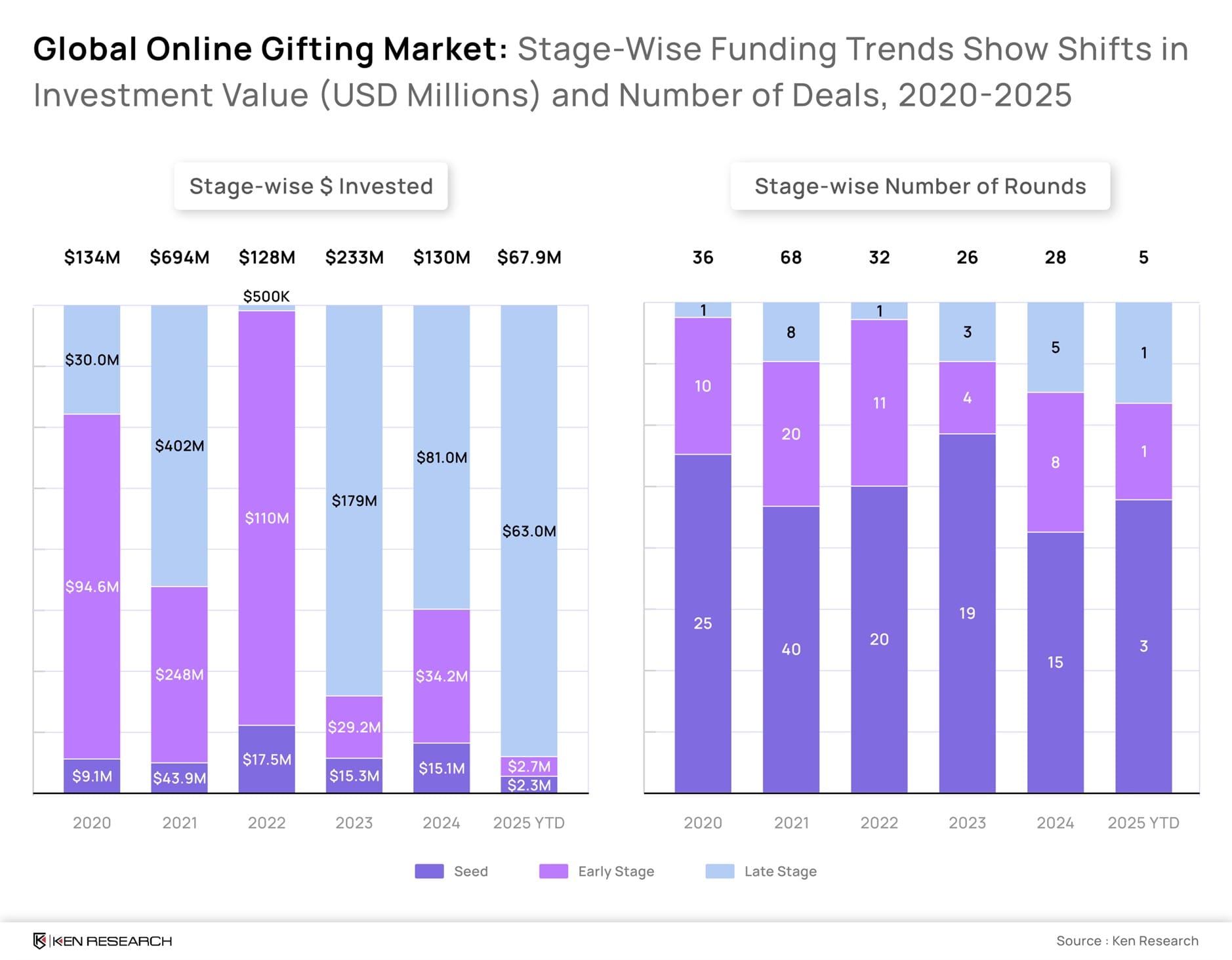
By 2023, however, funding volumes had dropped sharply to 223 million dollars, falling further to 130 million dollars in 2024, and reaching only 67.9 million dollars in 2025 year-to-date. Over the past five years, this translates to a negative funding CAGR of 13 percent. While these figures may appear concerning at first glance, they signal recalibration rather than collapse.
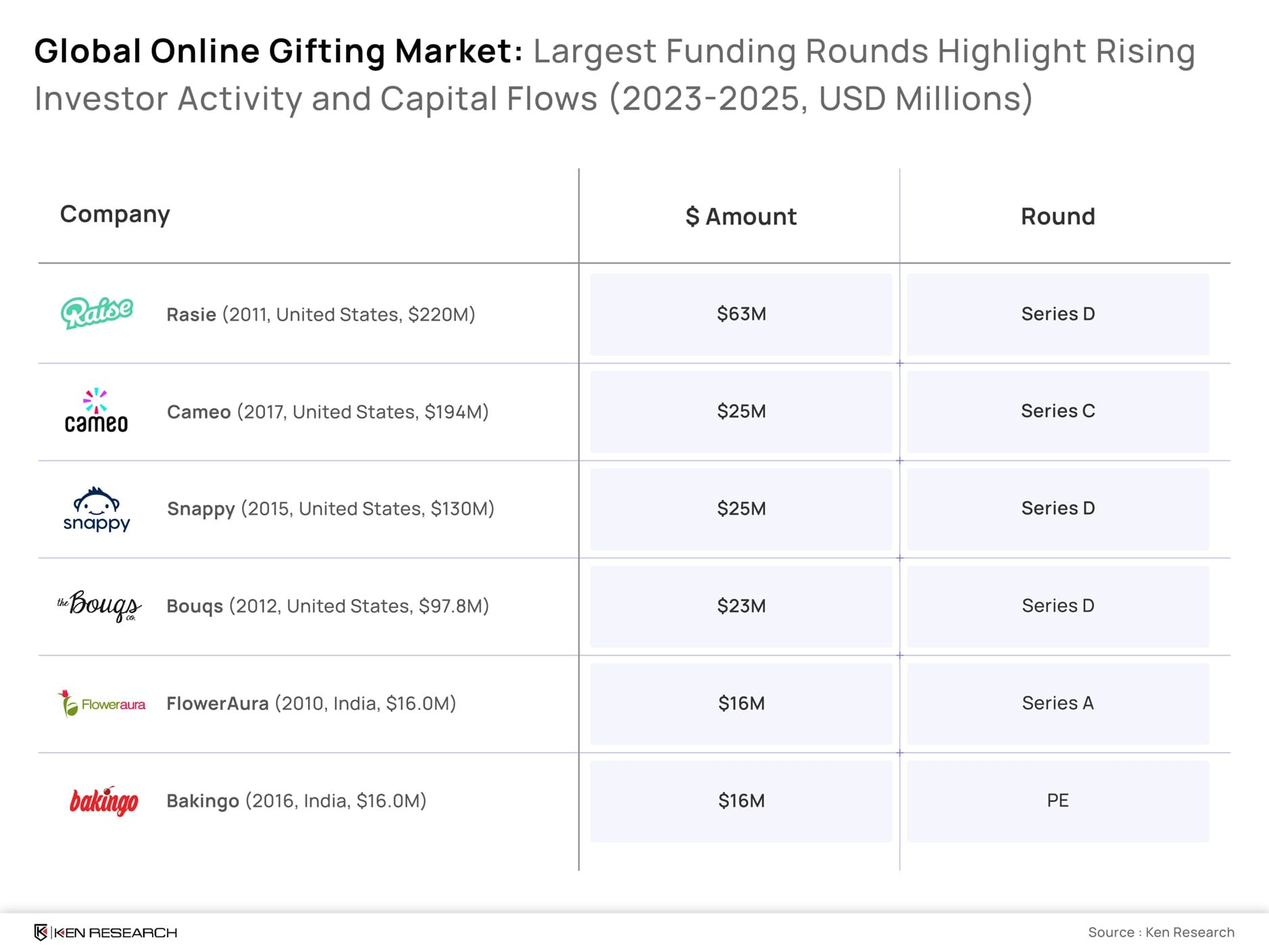
Investors today are choosing to back fewer but stronger players. Raise, which attracted 63 million dollars, Cameo with 25 million dollars, and FlowerAura with 16 million dollars are all examples of platforms that continue to secure meaningful investment. The shift is clear: speculative bets are being replaced by selective funding for companies with proven models and defensible positions.
Gen Z Sets the Pace While Corporates Secure the Market
The adoption of online gifting is being led by Gen Z and Millennials, who expect instant, mobile-first, and personalized experiences. Ken Research reports that 42% of Gen Z shoppers purchase gifts directly through social media, more than double the overall consumer average.
In addition, over 60% of Gen Z admit to self-gifting during the holiday season, compared with just 35% of Baby Boomers. These trends highlight how younger consumers are shaping the market, while older demographics remain more hesitant, leaving untapped potential among higher-income groups.
At the same time, corporates are proving to be the sector’s most stabilizing force. A survey found that over 70% of global companies increased recognition budgets in 2023, with a rising portion allocated to digital gifting. Leading enterprises such as Google, Accenture, Infosys, and Wipro have embedded digital gifting into employee rewards and client engagement, ensuring recurring revenues that balance out seasonal consumer demand.
Which Countries Are Emerging as Gifting Hotspots
The United States is the most mature online gifting market globally, supported by a strong consumer culture and advanced e-commerce infrastructure. The global online gifting sector has attracted cumulative funding of approximately 1.8 billion dollars, with a significant portion invested in large-scale U.S. market leaders known for their brand recognition and efficient logistics networks.
The United Kingdom, with 527 million dollars in investment, and Saudi Arabia, with 202 million dollars, show how cultural traditions amplify digital adoption. In these regions, gifting is deeply rooted in society, and digital platforms are simply making long-standing practices more convenient, accelerating uptake compared to peers at similar levels of digital maturity.
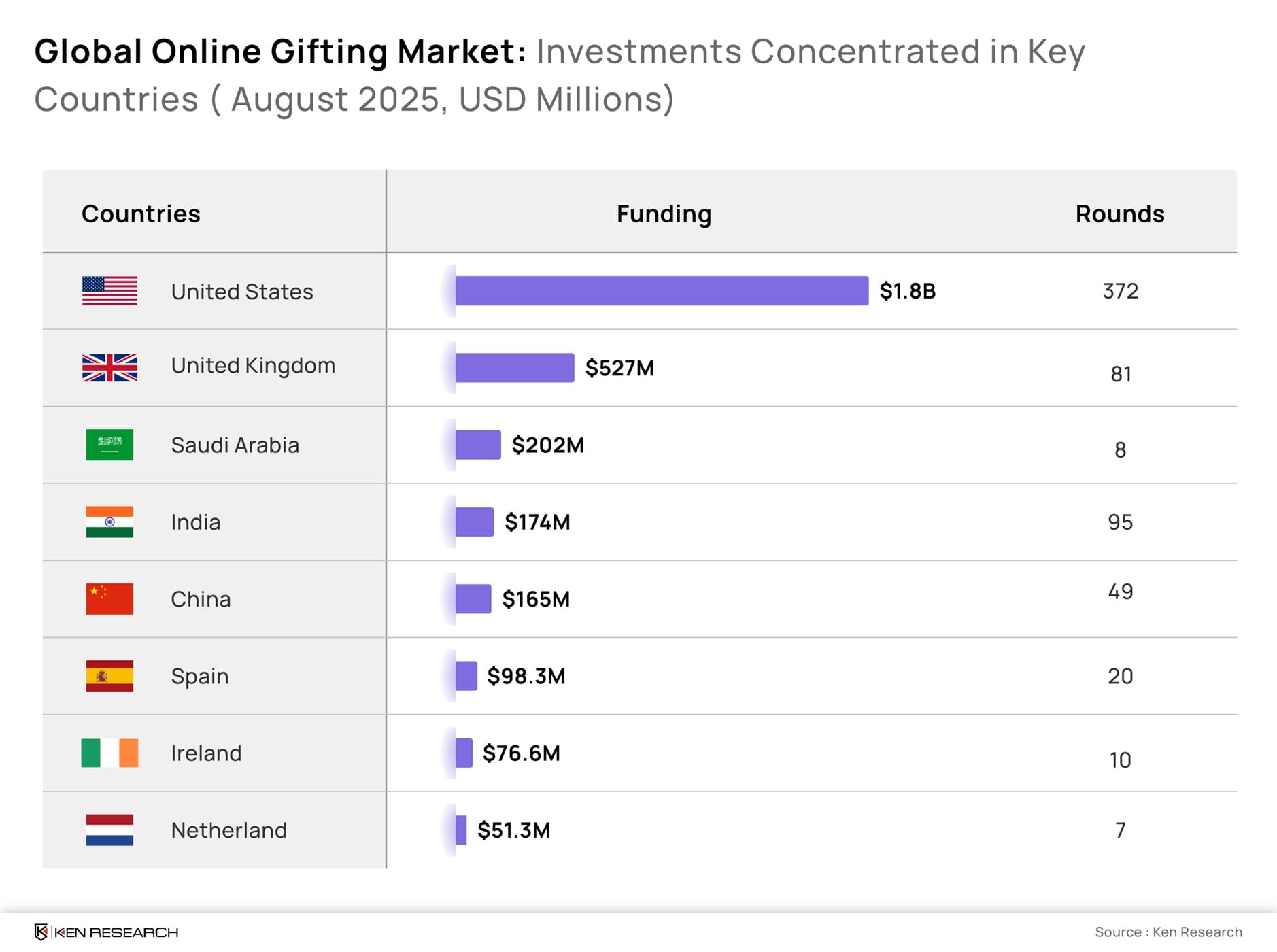
Emerging markets such as India and China highlight tremendous growth potential, with funding inflows of 174 million dollars and 165 million dollars respectively. These markets benefit from high smartphone penetration and young, digital-native populations, which create enormous demand. The real challenge, however, lies in building cost-efficient delivery systems capable of serving large populations at thin margins.
Will AI and Sustainability Redefine the Future of Gifting
The future of online gifting will be shaped by personalization and sustainability. Artificial intelligence is already enhancing recommendation engines, helping businesses tailor experiences that resonate with individual users. This deep level of personalization not only improves conversion rates but also drives repeat purchases, securing long-term loyalty in a competitive market.
At the same time, sustainability is emerging as a defining force. In Europe especially, where ESG regulations are tightening, eco-friendly gifting is evolving from a differentiator into a baseline expectation. Platforms that fail to adapt risk losing relevance in markets where compliance and brand responsibility drive corporate decisions.
What Keeps Margins Thin and Trust at Risk
Despite growing adoption, online gifting faces persistent structural challenges. Heavy competition has triggered discount wars, which compress margins and undermine long-term profitability. Without meaningful differentiation, many platforms risk becoming trapped in a race to the bottom.
Delivery reliability poses another major threat. A delayed or failed delivery is not simply a missed sale; it undermines the emotional trust that lies at the heart of gifting. Platforms that cannot guarantee operational excellence risk losing their most valuable asset: customer trust.
Retention is equally difficult in a market oversaturated with similar offerings. In a discount-driven environment, loyalty is fragile and often evaporates once promotions end. Building brand trust through consistent quality and reliability will be the true differentiator.
What Smart Businesses and Investors Should Do Next
The contraction in funding does not indicate a decline in demand but a transition from speculative expansion to sustainable operations. This marks the industry’s evolution from adolescence into maturity.
For businesses, the priority is clear: align with platforms that combine scale, efficiency, personalization, and trust. These partnerships will create resilience and long-term value. For investors, the outlook remains promising. While the hype cycle may have ended, the demand cycle is accelerating. The fundamentals of the online gifting industry remain strong, making it an attractive category for long-term bets.
Related tags
Consumer Products and Retail
Get started
We've helped companies around the world future-proof
their businesses - and we can do the same for you.