Why 38 million Indian Jobs Will Be Redesigned by Generative AI, Not Replaced?
Ken Research
January 13, 2026 - 8 min read

January 13, 2026
by Khushi GuptaBy 2030, Generative AI is expected to impact 38 million workers in India’s organised sector by changing how work is structured. GenAI operates at the task and decision level, shifting human effort away from repetitive cognitive activities toward higher-value judgment and problem-solving. As a result, productivity gains are coming from redesigning work itself.
Why Enterprises Are Replacing Labour Economics with AI Economics?
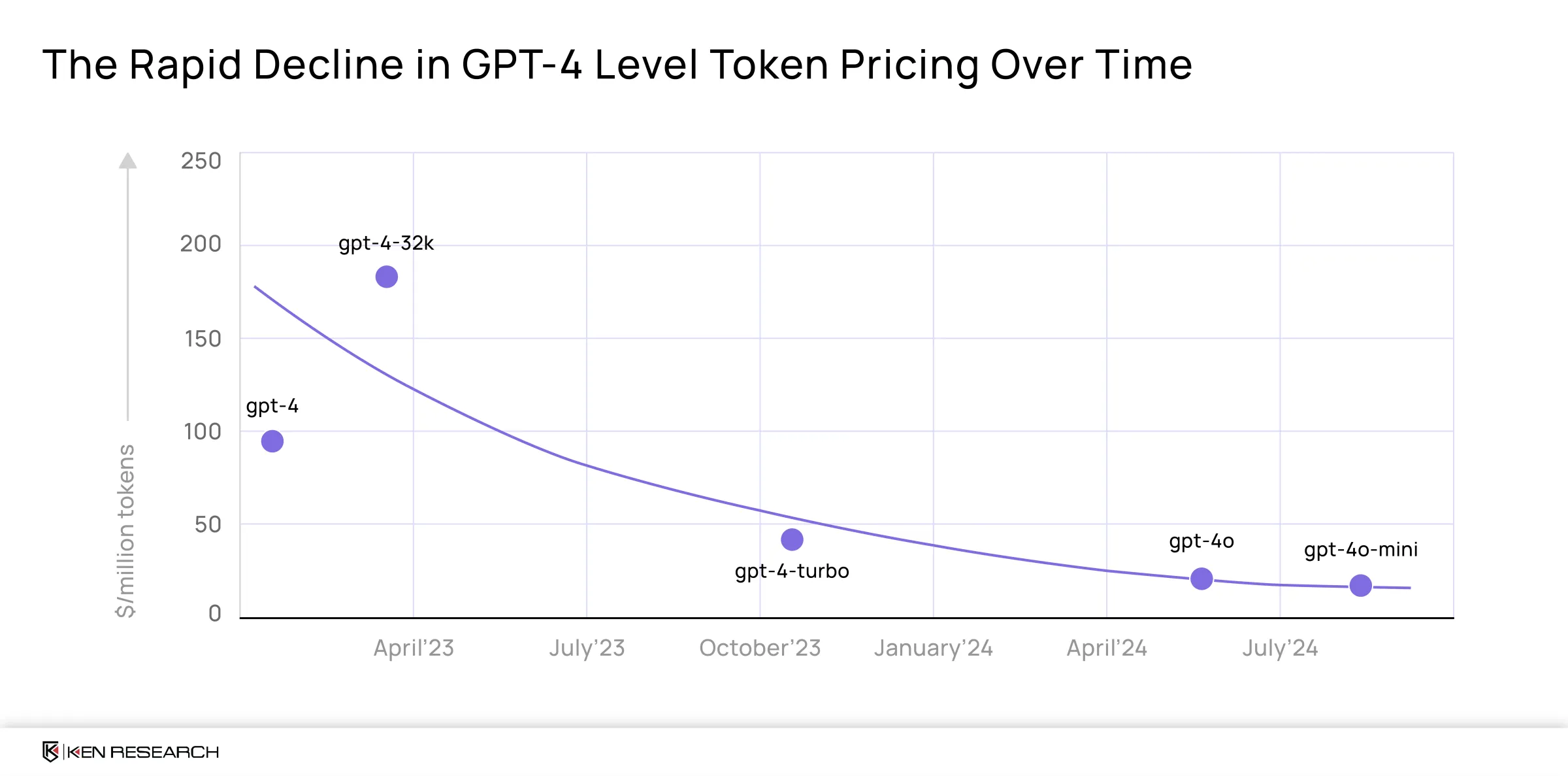
The cost of using GPT-4-level models has declined sharply, reshaping the economics of enterprise AI adoption. The cost of processing a million tokens fell significantly, making AI inference cheaper.
The following trends explain how declining token costs are accelerating GenAI adoption:
- The cost of running GPT-4-class workloads declined by nearly 80% over the last two years, significantly lowering barriers to enterprise adoption.
- GPT-4-32k, with its extended context window, was priced at the higher end around USD 180 per million tokens, limiting adoption to niche, long-context use cases due to high costs.
- Subsequent releases, such as GPT-4 Turbo, reduced costs to around USD 50 per million tokens, improving feasibility for broader enterprise experimentation.
- Newer models like GPT-4o and GPT-4o mini further lowered their pricing, significantly reducing the marginal cost of intelligence for routine tasks.
- Founder of DeepLearning AI and Andrew Ng highlighted that an AI application using 100 tokens per second costs about USD 1.44 per hour at USD 4 per million tokens, which is lower than the minimum wages in the U.S. and several other countries.
- In India, Sarvam AI’s pricing of USD 0.011 per minute reduces this cost further to around USD 0.67 per hour, making AI-led solutions highly competitive.
This cost compression has direct productivity implications. When AI inference becomes cheaper than human time for repetitive cognitive tasks, enterprises begin redesigning workflows around AI-first execution.
Why Redesigning Tasks Matters More Than Redefining Jobs?
Individual tasks differ in how easily they can be automated, augmented, or enhanced. Productivity gains arise when AI reshapes how tasks are executed. Tasks vary significantly in their exposure to GenAI, the degree of human judgment required, and how frequently they are performed.
Evaluating work through this lens provides a more accurate measure of real productivity impact than role-based assessments. As a result, organisations are shifting from redefining job titles to redesigning workflows. This task-first approach allows GenAI to be deployed where it delivers immediate and measurable value.
The report identifies three distinct ways through which task-level productivity gains are realised:
- Automation applies to tasks that are repetitive, rule-based, and require minimal human judgment, allowing them to be fully eliminated from human workflows and completed end-to-end by AI systems.
- Augmentation improves tasks that still require human oversight by reducing execution time and improving output quality, enabling workers to handle higher volumes without increasing effort.
- Amplification enhances complex or strategic tasks by supporting decision-making, analysis, and problem-solving, increasing the overall value generated from the same human input.
By focusing on how tasks are performed rather than who performs them, organisations can identify faster and more scalable productivity gains. This task-level approach also reduces execution risk by aligning AI adoption with clearly measurable outcomes.
Why GenAI Adoption in India Will Look Different from Other Large Economies?
India’s Generative AI adoption path is structurally different from other large economies. This difference is driven by the country’s scale, linguistic diversity, and strong digital public infrastructure. High internet penetration and low data costs allow AI solutions to reach users at scale.
At the same time, rapid progress in Indic language datasets is making GenAI more accessible to non-English users. Together, these factors are shaping a uniquely India-centric GenAI ecosystem.
India’s GenAI trajectory is structurally distinct due to:
- India has over 700 million connected users, among the lowest data costs globally, and a rapidly expanding base of Indic language datasets and models.
- AI4Bharat, a research lab at IIT Madras, has been instrumental in advancing Indian language technology. Their contributions include extensive open-source datasets like IndicCorp v2 and tools that underpin the growing Indic LLM ecosystem. Despite these advancements, challenges persist.
- BharatGen, the first government-funded multimodal LLM initiative, focuses on developing efficient and inclusive AI models tailored to Indian use cases.
- Tech Mahindra’s Project Indus further advances the development of Indic foundational models, beginning with Hindi and its over 37 dialects, bridging linguistic gaps for enterprises.
- TWO.ai’s SUTRA platform supports over 50 languages, including Hindi and Gujarati, expanding multilingual AI deployment.
Together, India’s scale, language diversity, and digital public infrastructure are lowering adoption barriers and enabling GenAI use cases that are difficult to replicate elsewhere. As a result, India is positioned to emerge not just as a large GenAI market but as a distinct model for inclusive and scalable AI deployment.
How Will India’s USD 1.154 Billion AI Push Shape the Speed and Safety of AI-Led Productivity Gains?
India’s AI policy framework is becoming a key enabler of how quickly and safely GenAI is adopted across the economy. The approach combines funding support, infrastructure creation, and governance to balance innovation with risk management.
Policy clarity is helping enterprises plan long-term AI investments with greater confidence. At the same time, a strong focus on responsible deployment aims to prevent misuse and systemic risks. Together, these measures will influence how evenly AI-led productivity gains are distributed.
The following points highlight the core pillars guiding India’s AI policy direction:
- In March 2024, the Cabinet approved a dedicated financial commitment of approximately USD 1.154 Billion for the IndiaAI Mission, aimed at catalysing AI innovation through structured programs and public-private partnerships across the ecosystem.
- A core pillar of the mission focuses on building a scalable AI compute infrastructure, including the deployment of over 10,000 GPUs through public-private partnerships, to support the needs of India’s expanding AI start-up and research community, alongside the development of sector-specific data platforms.
- The policy framework also places strong emphasis on Responsible AI, covering the development of indigenous tools and frameworks, Responsible AI projects, self-assessment checklists for innovators and governance guidelines to ensure safe and ethical deployment.
- IndiaAI Mission’s Future Skills initiative supports AI education at scale with structured backing for undergraduate, postgraduate, and PhD-level training, including 500 PhD fellows, 5,000 postgraduates, and 8,000 undergraduates, with over 200 students receiving fellowships by mid-2025, demonstrating measurable impact on the future talent pipeline in AI and data science.
Policy execution will play a critical role in determining how effectively GenAI translates into sustained productivity growth across sectors.
Why Are Services Industries Emerging as the Primary Winners of GenAI Adoption?
Services-led industries are capturing a larger share of GenAI-driven productivity gains because their work involves high levels of cognitive and decision-based tasks. Unlike manufacturing or construction, where gains are largely limited to efficiency improvements, the services sectors benefit from direct task-level automation and augmentation.
The following sectors are emerging as early beneficiaries due to their reliance on repetitive cognitive tasks and decision-intensive workflows:
- IT services, where GenAI improves coding support, documentation, testing, and client delivery processes.
- Financial services, where AI enhances research, risk analysis, reporting, and customer servicing tasks.
- Healthcare, where GenAI supports diagnostics, patient data analysis, and personalised care delivery.
- Media and content-driven industries, where AI accelerates content creation, editing, and distribution workflows.
Because these sectors operate at scale, small task-level improvements compound over time, resulting in disproportionately higher productivity gains.
How Small Language Models Are Removing Enterprise AI Adoption Barriers?
Large language models offer strong capabilities, but their high compute and energy requirements limit widespread enterprise adoption. For many organisations, especially mid-sized firms, cost and infrastructure constraints make full-scale LLM deployment difficult.
Small Language Models are increasingly filling this gap by offering focused intelligence at lower operational cost. They allow enterprises to deploy AI where it directly supports workflows rather than building broad, expensive capabilities. As a result, SLMs are becoming the preferred foundation for scalable enterprise AI use cases.
The following points highlight why SLMs are gaining enterprise adoption:
- SLMs use targeted fine-tuning, which reduces compute needs and enables deployment on edge devices and constrained systems.
- Models such as Microsoft Phi-4, DeepSeek v3, Google Gemma, Alibaba Qwen 2.5, Meta Llama 3.2, and Mistral’s SLM portfolio illustrate this shift.
- Smaller infrastructure requirements lower energy consumption and reduce dependence on high-end hardware.
- On-premises and private cloud deployments improve data security and reduce exposure to data leakage risks.
As enterprises prioritise efficiency, security, and cost control, SLMs are positioned to play a central role in the next phase of enterprise AI adoption.
Why Reskilling Matters More Than Job Security in India’s GenAI Era?
Generative AI is changing how tasks are performed, rather than eliminating jobs outright. Nearly 24% of tasks can be automated, and another 42% of task time can be reduced, freeing 8-10 hours per week for higher-value work. This means job security will increasingly depend on how individuals adapt their skills to work alongside AI rather than compete with it.
The following points highlight practical actions individuals can take to protect and upgrade their careers as GenAI adoption scales:
- Move from routine tasks to judgment-based work: As AI handles repetitive activities, human effort is becoming more valuable in review, validation, and decision-making roles.
- Learn to use AI tools effectively, not build them: Workers who know how to apply GenAI tools in daily workflows benefit more than those without basic AI fluency.
- Strengthen domain expertise alongside AI usage: Professionals combining sector knowledge with AI-assisted tools see higher productivity gains than those relying on generic skills alone.
- Invest in continuous reskilling: Large-scale reskilling is critical, as productivity gains depend on how quickly workers adapt to redesigned workflows rather than on job title changes.
In simple terms, GenAI rewards adaptability. Professionals who actively reskill and reposition themselves around higher-value tasks are more likely to benefit from AI-led productivity gains. At the same time, those tied only to repetitive work face a higher risk as task automation increases.
Conclusion
Generative AI is redesigning how work is done in India rather than replacing jobs, with 38 million organised-sector workers expected to be impacted by 2030. The biggest impact is already visible in services-led industries, where task-level automation and augmentation are delivering faster and more scalable productivity gains as costs fall and deployment becomes practical.
Ken Research highlights that enterprises should adopt the approach of using small language models for routine work and larger models for complex decisions to achieve better cost control, execution speed, and data security. Looking ahead, India’s policy support, digital infrastructure, and language ecosystem will accelerate adoption, making measurable task-level outcomes the key driver of long-term productivity growth.
Related tags
Defense and Security
Get started
We've helped companies around the world future-proof
their businesses - and we can do the same for you.