How to Reignite Growth in the Global Beer Market: 4 Bold Moves
Ken Research
August 8, 2025 - 4 min read
August 8, 2025
by Mrityunjay SinghThe global beer market has long been seen as a safe bet in consumer goods, offering predictable demand and steady returns. Yet global beer volumes rose only 1% in 2024 lowest since 2008, signaling a crossroads for all major brewers. Today, growth in the global beer market is stalling. Consumer tastes are shifting toward low alcohol, craft, and health conscious options, many big brands face shrinking, which leaves room for innovation. Despite its size and brand power, the beer industry faces an uphill battle to sustain relevance in a changing world.
For stakeholders, this raises a pressing question. Is the beer market a shrinking opportunity, or can the sector reinvent itself for long-term value creation.
A Market Running Out of Growth
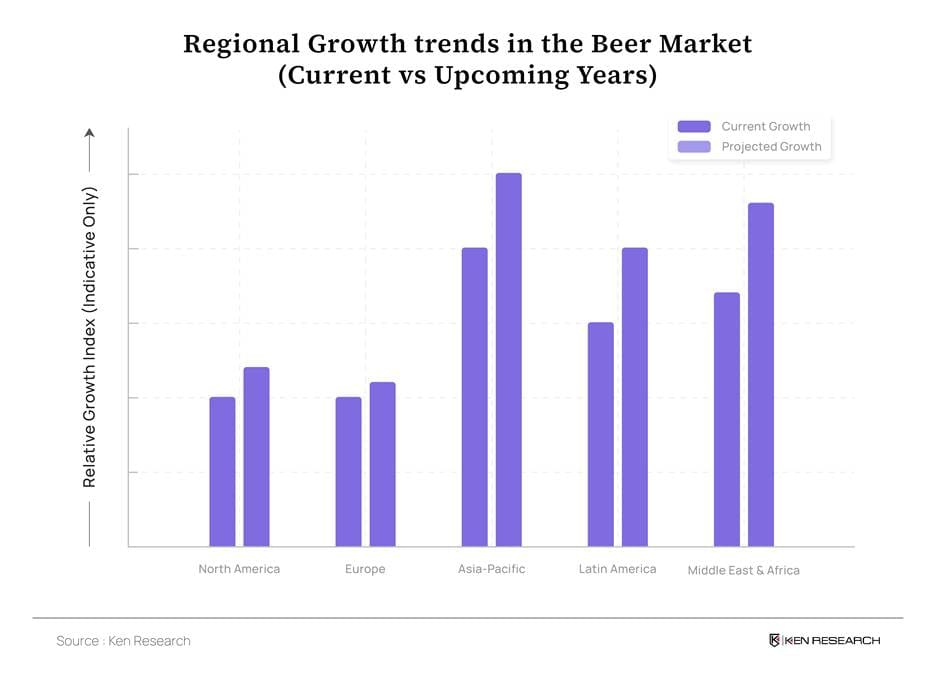
Growth in beer consumption has been slowing for years in developed economies. Europe and North America, once the bedrock of global beer volumes are now marked by declining per-capita consumption, driven by health conscious younger generations and growing interest in alternative beverages.
Regulatory measures around alcohol advertising, rising taxes, and stricter retail rules have further stifled demand. While emerging markets are often cited as the industry's next stop, their impact is less transformative than many expected. Asia Pacific remains the largest beer region, but volumes in China and Japan are plateauing. Africa and Latin America are growing faster but from smaller bases, contributing moderately to overall revenues.
This creates a tough picture the market is large but slow moving, driven more by price increases and cost control than by real growth in demand.
Scale and Consolidation at Peak
The beer industry is concentrated in the hands of a few giants. Companies like AB InBev, Heineken, and Asahi control the majority of global revenues, relying on across large brewery networks networks, hundreds of brands, and unmatched distribution logistics.
They've long driven growth in mature markets by scaling up, merging, and focusing on premium products.
But as those markets slow down, the game is changing. Smaller breweries and craft beer makers are stepping up, offering unique flavors, local appeal, and sustainable brewing.
They're growing fast, especially in places like Asia Pacific and Latin America, where younger consumers are looking for something different from the big name brands.
Most recent growth strategies have been acquisition driven rather than innovation-led, as global brewers buy craft breweries or regional brands to patch up slowing core markets.
The sector offers scale stability, but it is hardly a playing field for disruptive entrants or aggressive expansion bets.
Changing Market Narratives
Despite the structural challenges, the global beer market is not without opportunities. Leading brewers are restructuring their portfolios, adapting to changing consumer needs and reshaping the beer experience.
- Premiumization is gaining traction, as consumers trade up for craft style beers, unique flavor profiles, and branded experiences. This change supports higher margins, even in low growth markets.
- Non-alcoholic and low alcohol beers are emerging as significant categories, tapping into health conscious trends while retaining loyal beer drinkers. According to Wall Street Journal, Heineken’s non-alcoholic line grew 10% in early 2024, outpacing its alcoholic variants.
- Packaging formats, including sustainable cans and draft-on-the-go solutions, are broadening beer’s appeal, particularly among younger, urban consumers.
- Emerging markets, especially in parts of Africa and Southeast Asia, are expanding beer’s reach to new demographics as incomes rise and infrastructure improves.
These trends may not fully reverse the slowdown in global beer growth, but they are reshaping the value pools, allowing market leaders to stay profitable and carve out premium niches.
Future Diversification
The future of the beer market will not be driven by scale alone. For the industry to sustain relevance, leading players must pursue strategies that go beyond volume and price increases, focusing on value creation through:
- Portfolio diversification, expanding into adjacent beverage categories like hard seltzers, flavored alcohol, and functional drinks.
- Localized innovation, tailoring products and pricing strategies to capture demand in fast growing regions.
- Digital integration, using data-driven insights to personalize marketing, improve distribution, and build direct-to-consumer channels.
- Sustainability leadership, environmental impact reduction into production and packaging, aligning with global consumer and environmental shift.
These shifts represent a chance for reinvention, they create an opportunity to shift beer from a volume focused product to a more consumer focused, experience led offering.
Conclusion: Market in Search for Balance
The Global Beer Market stands at a crossroads. On one side, it faces undeniable structural challenges: saturated mature regions, slowing volumes, and fierce competition among a few dominant players. On the other, it holds untapped potential in premium segments, non alcoholic innovations, and new regional opportunities.
For stakeholders, this is not a high growth, high risk sector anymore. It is a stable and mature industry, where scalability requires volume today and reinvention tomorrow.
Established Giants will continue to protect profits through efficiency and pricing, but future success will belong to those who can create new demand, innovate beyond traditional lagers, and capture shifting consumer preferences.
The beer market may no longer promise unbounded growth, but with bold strategy and innovation, it can still offer selective and sustainable value creation in the years ahead.
Get started
We've helped companies around the world future-proof
their businesses - and we can do the same for you.