Global Energy Transition 2025: Why a USD 4 Trillion Investment Gap and 80% Fossil Dependence Are Creating Divergent Regional Pathways
Ken Research
December 1, 2025 - 5 min read

December 1, 2025
by Ken ResearchThe global energy transition in 2025 is entering its most decisive and most uneven phase yet. Despite record investments, the world added more renewable capacity in 2024 than in any year in history, yet still relies on fossil fuels for nearly 80% of its primary energy supply, exposing a widening gap between ambition and reality.
Emerging economies now account for over 85% of projected electricity-demand growth this decade (IEA) but attract less than 15% of global clean-energy investment, creating a structural financing divide that is reshaping global transition pathways. At the same time, electricity demand surged 4.3% in 2024, the fastest increase in over a decade, driven by industrial recovery, electrification, and digital infrastructure expansion.
These pressures, combined with grid bottlenecks, capital inefficiencies, and competing national priorities, mean the transition will not converge globally. Instead, it is fragmenting into distinct regional models, each defined by its own resource base, policy capacity, and industrial strategy.
The Four Archetypes Defining Global Transition Readiness
A global segmentation reveals which regions lead, which lag, and why.
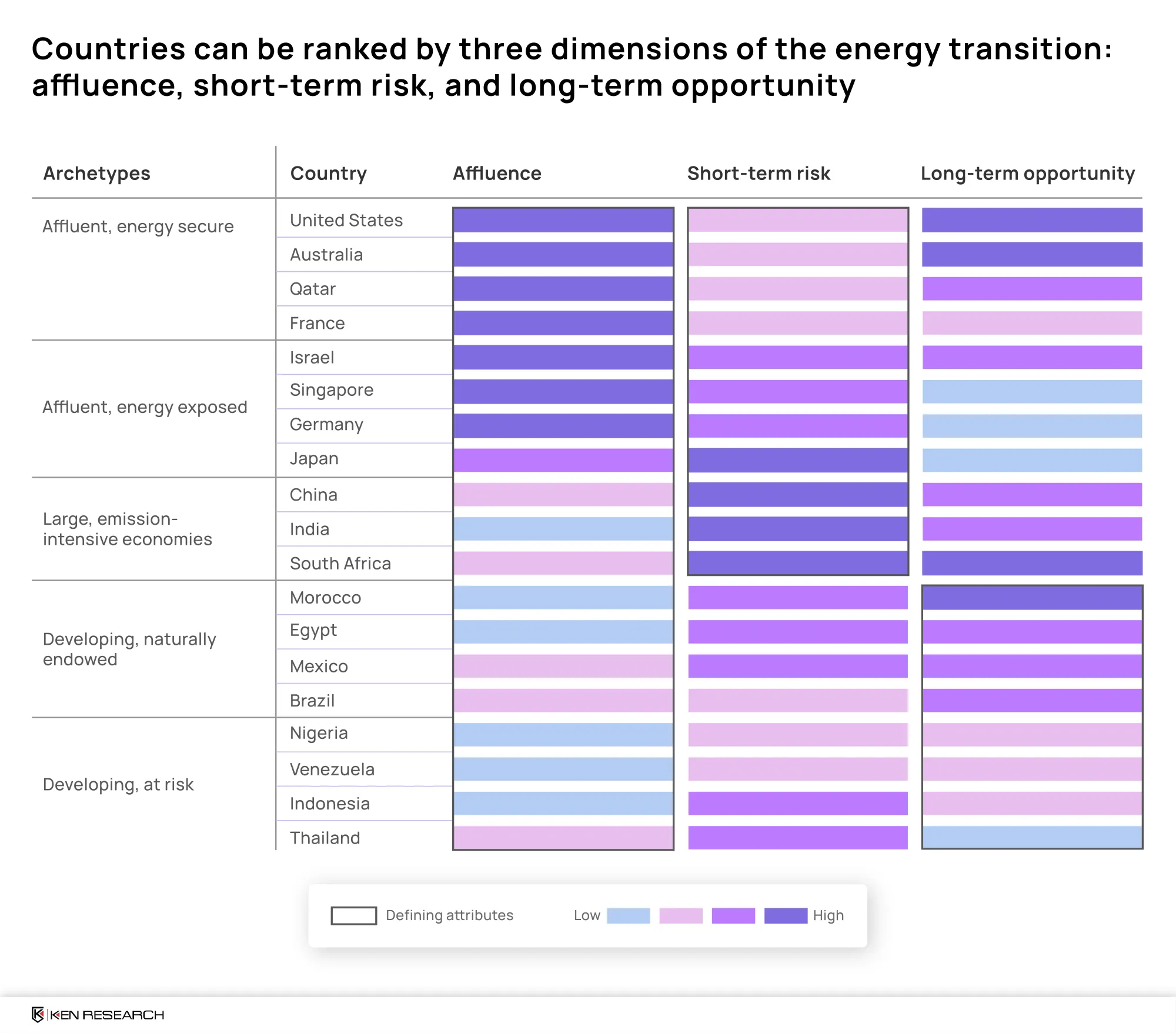
Countries fall into affluent energy-secure markets, energy-import dependent economies, resource-rich emerging regions, and diversified emerging markets.
This segmentation clarifies why some regions can prioritise rapid decarbonisation supported by mature grids, stable institutions, and deep capital pools, while others must first balance affordability, energy security, and fast-rising electricity demand before accelerating their transition.
Affluent energy-secure markets operate with the structural advantages needed for rapid renewable integration; energy-import dependent economies remain vulnerable to fossil price volatility and must manage system reliability; resource-rich emerging regions can leverage hydrocarbon revenues to finance large-scale clean energy projects; and diversified emerging markets expand both conventional and clean systems in parallel due to financing constraints and industrialization pressures.
- Affluent, energy-secure economies have mature grids, deep capital markets, and strong policy institutions, enabling faster integration of renewable energy.
- By contrast, emerging and energy-import-dependent markets face rising electricity demand, weaker financing channels, and higher exposure to fossil price volatility.
- This archetype structure not only reflects present-day realities but also signals how regions may evolve over the next decade, shifting investment priorities and competitive advantage as their energy systems mature.
- The EU’s early-2025 expansion of its Carbon Border Adjustment Mechanism increases pressure on emerging markets to accelerate readiness, reinforcing the disparities shown in the archetype map.
North America: Strong Innovation, Slow Permitting, Uneven Execution
Technology leadership meets structural bottlenecks.
- North America benefits from world-leading innovation ecosystems in renewables, batteries, hydrogen, and carbon management. However, permitting timelines and interconnection delays slow project deployment, creating a gap between ambition and execution.
- The region’s fuel-mix forecast, illustrated in the trajectories on pages 45–46, shows a steady rise in renewables, but gas continues to play a stabilising role, especially for industrial baseload and export commitments.
- Progress varies sharply across states. Some are moving toward electrification and storage deployment at scale, while others expand fossil capacity to support manufacturing and reliability needs. The U.S. Department of Energy’s 2025 grid-modernisation investment push, the largest in its history, directly targets these bottlenecks.
Europe: Policy Leadership Confronts Cost Pressures and Congested Grids
- Europe remains the policy frontrunner in the global energy transition, with renewables supplying 25.4% of final energy consumption and wind and solar reaching 29% of the electricity mix in 2024.
- However, structural constraints are tightening as average industrial electricity prices climbed to around USD 200 per MWh in 2024, eroding competitiveness for energy-intensive sectors. Grid congestion, slow permitting, and labor shortages continue to delay renewable deployment, widening the gap between climate ambition and practical execution.
- These challenges have prompted major policy responses, including Germany’s 2025 emergency power-market reforms aimed at accelerating transmission expansion and stabilising industrial tariffs to protect economic resilience as Europe advances its transition.
China: Scaling Renewables at Unmatched Speed While Balancing Coal for Stability
A dual-track system that enables rapid deployment but slows aggregate emissions cuts.
- China remains the global outlier in scale, speed, and industrial integration. Its renewable deployment, grid expansion, and battery manufacturing capacity exceed those of all other markets combined. The fuel-mix forecast shows a major rise in solar and wind penetration over the next decade.
- However, coal remains a stability anchor, supporting industrial output and grid reliability. This dual-track system allows massive renewable build-out but moderates the pace of emissions reduction.
- Centralised planning enables China to coordinate grid upgrades, industrial policy, and manufacturing scale, making it a structural accelerator of global energy transition technologies. China’s 2025 announcement of more than 300 GW of new renewable capacity continues the trajectory reflected in the report’s long-term projections.
India & Emerging Asia: The World’s Fastest-Growing Demand Centre
Dual-track transition: expanding both conventional and clean systems at once.
- India and Southeast Asia fall into the diversified emerging-market category, with strong economic growth and rising electricity demand. The archetype map clearly shows these markets balancing industrialisation with climate objectives.
- Fuel-mix projections indicate moderate fossil reduction in the near term due to baseload requirements, while solar, storage, and green hydrogen accelerate through the 2030s. Financing, land acquisition, and policy variability remain the region’s primary constraints.
- These markets represent the largest long-term investment opportunity in the energy transition, provided blended finance and risk-mitigation structures scale adequately. India’s 2025 expansion of its National Green Hydrogen Mission and ASEAN’s growth in cross-border power-trading initiatives confirm the region’s accelerating transition momentum.
Middle East & Resource-Rich Markets: Using Hydrocarbon Strength to Finance the Transition
High-revenue fossil exporters are pivoting strategically toward clean technologies.
- Countries in the resource-rich emerging-market category exhibit high emissions per capita but also have the capital strength to invest aggressively in renewables, hydrogen, and CCS. Their comparative advantage lies in low-cost solar resources, export infrastructure, and unified national strategies.
- The fuel-mix trajectories show a slower decline in fossil consumption compared to Europe or North America, but a rapid rise in large-scale solar and clean-molecule projects. These markets see the transition as an opportunity for industrial diversification, not simply decarbonization.
- Their long-term success will depend on whether clean fuel exports and renewable competitiveness can offset declining oil revenues. Saudi Arabia’s 2025 expansion of the NEOM green hydrogen program validates the structural shift shown in the regional energy-mix forecasts.
Conclusion: Regional Divergence Will Shape the Next Decade of Transition Investment
The energy transition is entering a period where structural readiness matters more than stated ambition. Even with accelerating deployment, fossil fuels are still projected to supply around 72% of global primary energy in 2030 (IEA), and closing the transition gap will require USD 4 trillion in additional annual investment through the end of the decade.
Meanwhile, global renewable-power capacity is set to increase by 4,600 GW by 2030, equivalent to adding the entire current generation capacity of China, the EU, and Japan combined, a scale that will reshape global cost curves and fuel-market dynamics (IEA). Emerging demand patterns will intensify this shift, with developing economies expected to account for over 85% of electricity-demand growth this decade.
According to Ken Research, these divergent structural conditions mean the transition will not converge globally; instead, regions will drift toward distinct energy systems with different investment profiles, risk exposures, and cost structures. For investors, the strategic imperative is clear: allocate to markets with credible policy pathways, scalable infrastructure, and financing depth. In a multi-speed transition, returns will accrue not to ambition alone but to regions equipped to execute at scale.
Related tags
Energy and Utilities
Get started
We've helped companies around the world future-proof
their businesses - and we can do the same for you.