India’s API Market: From Dependency to Dominance
Ken Research
June 13, 2026 - 9 min read

June 13, 2026
by Ken ResearchUnderstanding the Landscape: Scale vs Dependency
India’s Active Pharmaceutical Ingredient (API) industry accounts for ~35% of the country’s overall pharmaceutical sector, positioning it as a critical backbone of both domestic drug manufacturing and global generics supply. It reflects India’s long-standing strength in process chemistry, generics manufacturing, and export-oriented production, which has enabled the country to emerge as one of the largest suppliers of affordable medicines globally.
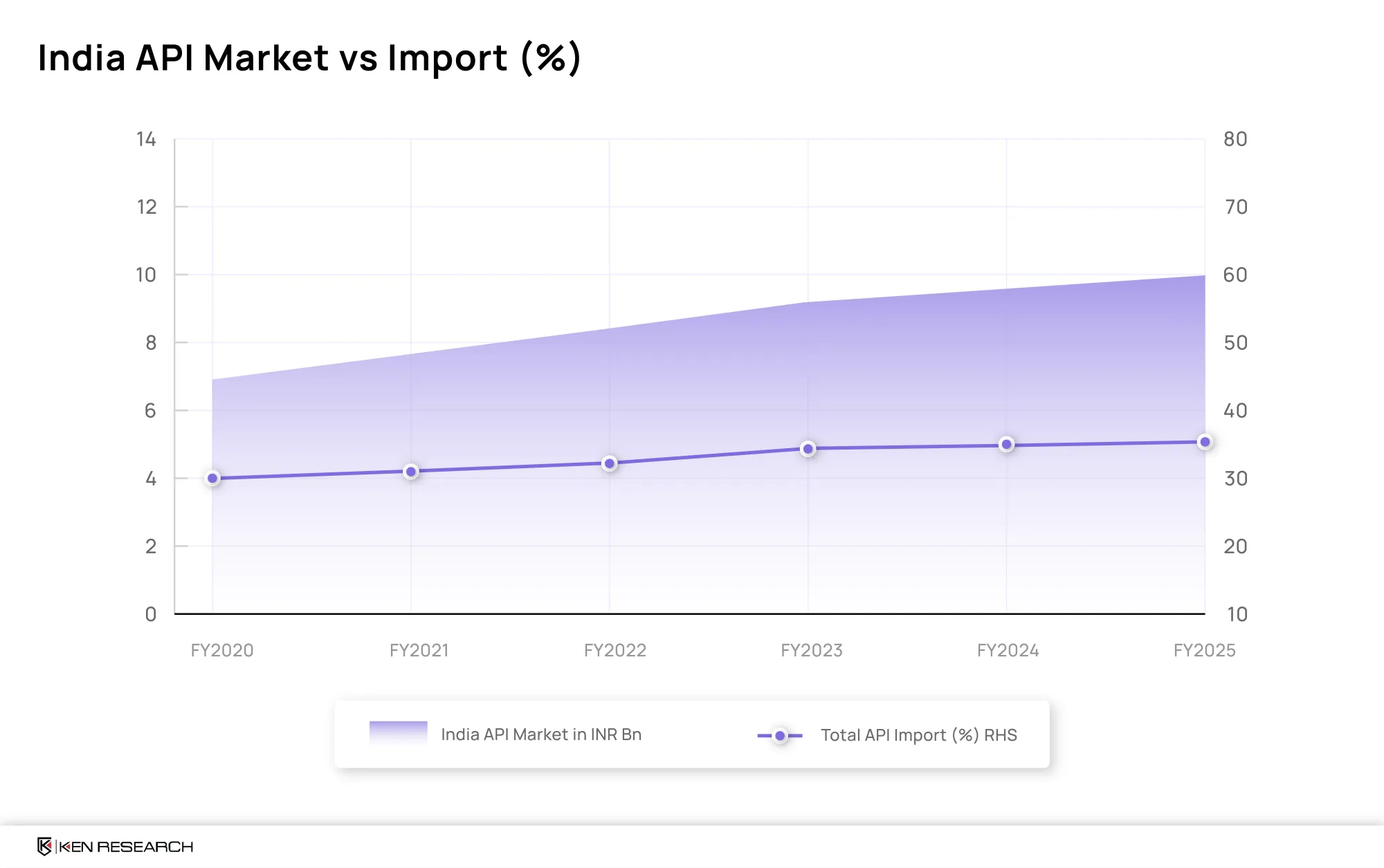
India’s API industry was USD 11.6 billion in FY25, is projected to grow at a CAGR of 7%, reaching nearly USD 18.7 billion by 2030. At an operational level, the market is both extensive and highly diversified. India operates 1,500+ API manufacturing facilities and produces 500+ distinct APIs. India supplies ~57% of APIs listed under the WHO prequalification program, underscoring its role in regulated and semi-regulated markets.
Despite its scale, India’s API industry continues to operate within a structurally fragmented landscape, characterised by a large base of small and mid-sized independent players with limited backward integration, hence India’s current manufacturing base remains insufficient to meet API demand independently, sustaining significant import dependence.
India imports ~35% of its API requirements, with nearly ~74% sourced from China, largely driven by cost advantages. The dependence is particularly acute across 58 critical APIs, of which 45 are entirely imported from China, and extends further upstream as China remains a key supplier of Key Starting Materials (KSMs) and Intermediates for many APIs manufactured domestically. This creates vulnerability across both fermentation and chemical synthesis value chains. Consequently, while India contributes meaningfully in terms of production volumes, it continues to function as a mid-stream manufacturing hub rather than a fully integrated value chain leader, resulting in a structural paradox where it is a major global pharmaceutical supplier yet reliant on China for foundational inputs exposing the industry to cost volatility, supply disruptions, and limited pricing control.
Why Has Reducing Dependence Become Critical Now? COVID Learnings, Price Volatility, and Geopolitical Realignment
The current inflection point in the API market was triggered during COVID-19, when global pharmaceutical supply chains faced sharp disruption. As China is dominant in API and key starting material (KSM) production, imposed lockdowns across major manufacturing regions, supply tightened rapidly, leading to significant price escalation in essential APIs. For instance, Paracetamol API, Azithromycin API and other API prices increased between 60%-190%, due to supply shortages and export restrictions. Similarly, Penicillin-G, a critical fermentation-based input, experienced sharp volatility, disrupting downstream antibiotic production globally.
For India, the impact was immediate and structural, domestic manufacturers faced rising input costs, production delays, and margin compression. This exposed a critical vulnerability. India’s strength in formulations was undermined by its reliance on external sources for upstream inputs.
This disruption has accelerated the adoption of the China+1 strategy, where global pharmaceutical companies continue sourcing from China but actively diversify supply chains to reduce concentration risk. India has emerged as a key alternative due to its manufacturing base, regulatory credibility, and established presence in global generics.
The shift is also geopolitical. Governments across the US, EU, and India now view pharmaceutical supply chains as a matter of health security, prompting policy interventions to reduce overdependence on a single geography.
The Policy Push: Strengthening India’s API Manufacturing Base
India's structural dependence on China for APIs has long been recognized as a systemic supply chain risk. The policy response, however, is now beginning to take tangible shape.
At the core of India’s self-reliance strategy lie two interlinked interventions: the Production Linked Incentive (PLI) Scheme for Bulk Drugs (KSMs DI and APIs) and the Scheme for Promotion of Bulk Drug Parks. The PLI scheme, running through FY 2029-30, targets self-reliance and reduced import dependence in critical KSMs, Drug Intermediates, and APIs by offering financial incentives tied to threshold investment and domestic sales. The financial firepower behind this effort is substantial, with a total budgetary outlay of INR 6,940 crore and Bulk Drug Parks and a broader INR15,000 crore earmarked under the PLI Scheme for Pharmaceuticals.
Early results signal momentum. As of September 2025, manufacturing capacity has been created for 26 KSMs/APIs under the Bulk Drugs PLI, resulting in cumulative sales of INR 2,315 crore, with imports worth INR 1,807 crore avoided. More notably, the scheme has spurred domestic production of 38 critical APIs previously almost entirely imported, including Penicillin G, Clavulanic Acid, Atorvastatin, and Metformin.
For industry players, the implications are direct and material. The Penicillin G project in Kakinada, Andhra Pradesh, for instance, represents a INR1,910 crore investment with expected annual import substitution of INR 2,700 crore, signalling the scale of opportunity for early movers. Companies anchoring operations in these parks benefit from shared infrastructure costs, streamlined compliance ecosystems, and proximity to supply chain nodes structural advantages that directly compress production economics.
On the infrastructure front, three Bulk Drug Parks have been approved in Gujarat (Jambusar, Bharuch), Himachal Pradesh (Haroli, Una), and Andhra Pradesh (Nakkapalli, Anakapalli), with a central grant-in-aid of INR 1,000 crore each, delivering world-class Common Infrastructure Facilities (CIF) including centralized effluent treatment, solvent recovery systems, advanced testing laboratories, and dedicated logistics. These are not peripheral locations they are emerging pharmaceutical corridors.
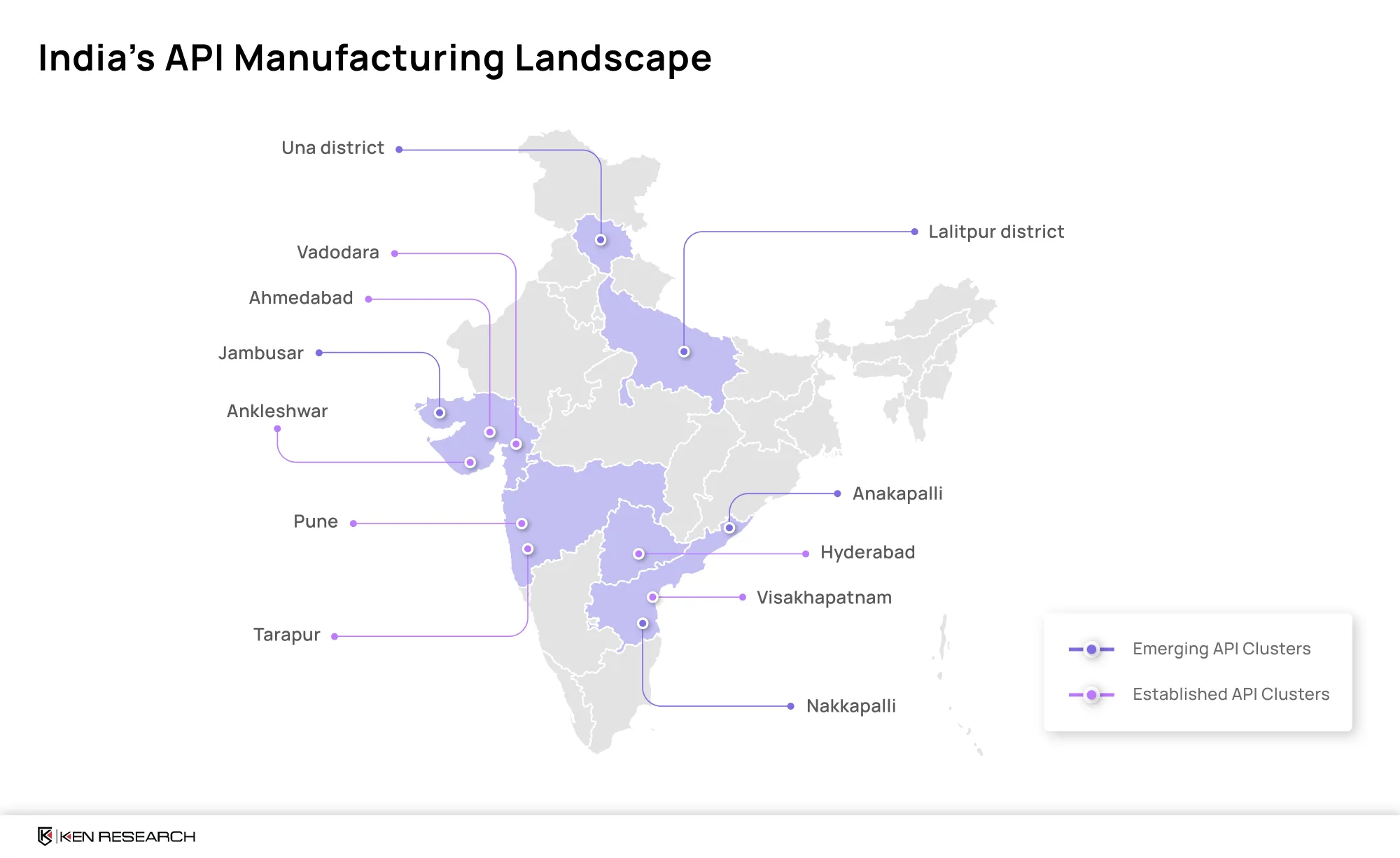
In the west, Gujarat (Ankleshwar, Vadodara, Ahmedabad) serves as the chemical backbone of API manufacturing, driven by deep integration into intermediates and cost-efficient production, while Maharashtra (Pune, Tarapur) complements this with export-oriented manufacturing.
The next phase of growth is policy-led. Under the Bulk Drug Parks scheme, regions such as Anakapalli, Nakkapalli (Andhra Pradesh) and Una (Himachal Pradesh), and Jambusar (Gujrat), along with the upcoming bulk drug park in Lalitpur district (Uttar Pradesh) are emerging as integrated API hubs.
Operating Model Shift: CRAMS/CDMO as a Strategic Lever
India’s next phase of API growth is unlikely to be driven by full backward integration alone. Instead, the operating model is shifting toward CRAMS/CDMO-led manufacturing, where scale, flexibility, and technical capability take precedence over asset-heavy expansion. This model allows Indian players to participate in global supply chains without replicating China’s integrated cost structure.
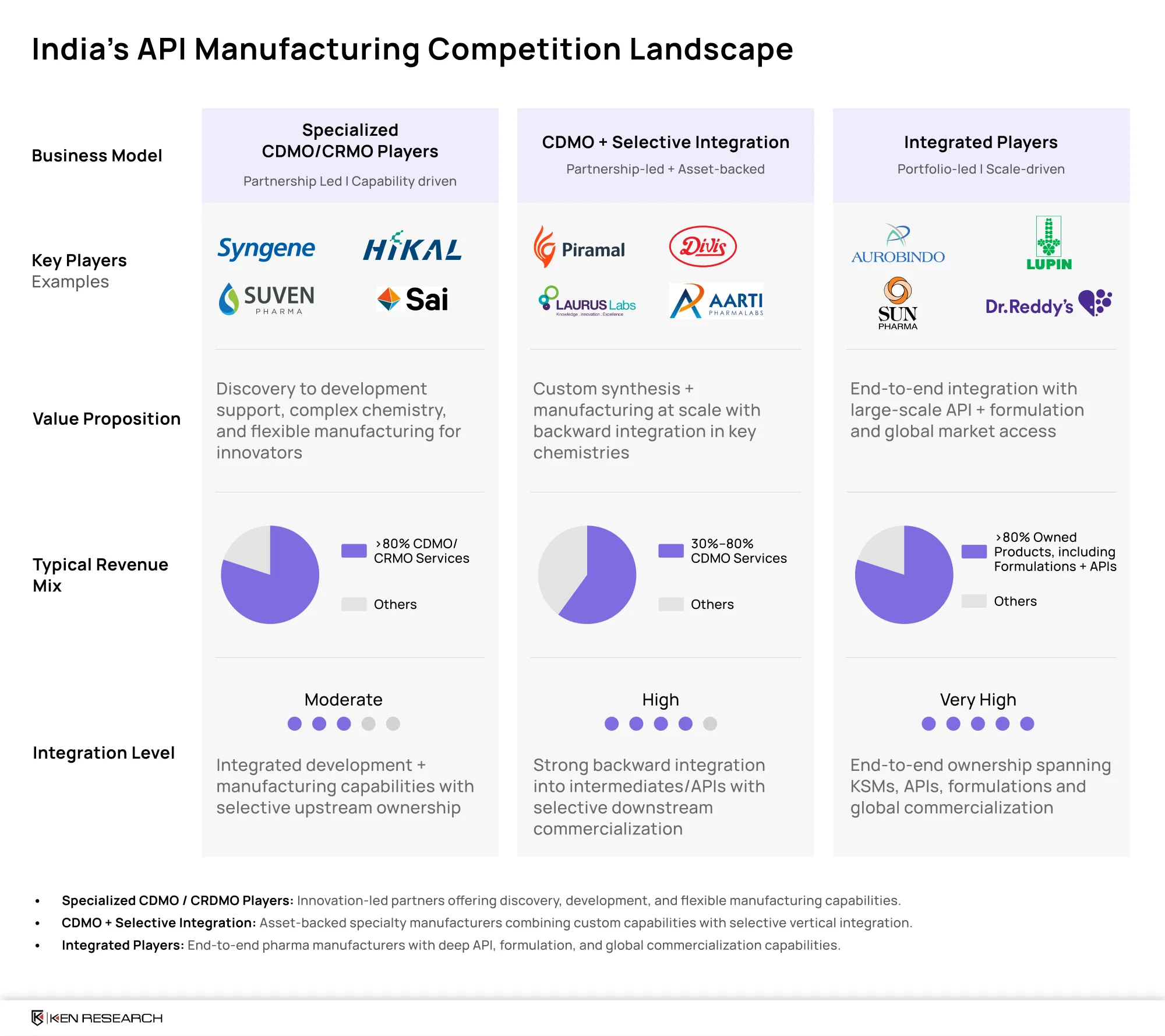
India’s Specialized CDMO / CRDMO and selective integration player archetypes offer the most capital-efficient pathway for manufacturers to approach China-competitive economics in regulated and complex APIs without replicating China’s heavily subsidised, fully integrated manufacturing model. The mechanism is straightforward: by leveraging shared manufacturing infrastructure, Indian pharma companies can convert fixed capex into variable operating cost, reduce idle capacity burden, pool GMP-compliant infrastructure, and materially compress per-unit production overhead. This is where India has a structural edge, with leading Indian CDMOs offering meaningful cost arbitrage versus Western manufacturing platforms, positioning them as globally competitive alternatives for complex chemistry manufacturing, particularly in regulated markets.
As capabilities mature, Indian CDMOs are moving beyond service-led models toward selective integration combining custom synthesis, targeted backward integration, and commercial-scale manufacturing. Players such as Divi's Laboratories, Laurus Labs, Syngene International, Sai Life Sciences, and Suven Pharmaceuticals are benefiting from rising China+1 demand. Laurus Labs scaled its small molecule CDMO business to 110+ active projects in FY25, Divi's Laboratories continues to secure long-term custom synthesis contracts while expanding capacity, and Syngene International is converting pilot programs into commercial-scale mandates. Together, they demonstrate how selective integration and high-complexity CDMO capabilities position India as a credible alternative to China’s commodity-heavy manufacturing model.
While fully integrated pharma remains capital intensive, the CDMO / selective integration model offers Indian manufacturers a faster, leaner, and commercially proven path to scale. More than an outsourcing model, CDMO is increasingly the bridge between India’s chemistry strength and China-competitive manufacturing.
Demand & Opportunity Engine: High-Potential API Segments
Not all APIs offer equal opportunity, for India, the real upside lies in segments where high import dependence, strong demand growth, and technical or regulatory barriers create durable competitive advantage. Two segments stand out.
Fermentation-Based Antibiotics remain India’s most immediate import-substitution opportunity. Critical molecules such as Penicillin G, Ciprofloxacin, and Norfloxacin continue to carry 80–100% import dependence, leaving domestic supply chains exposed to external pricing and geopolitical disruption. As India rebuilds fermentation capacity under the PLI-led manufacturing push, domestic production offers a clear strategic advantage lower supply-chain risk, stronger self-reliance, and a large guaranteed replacement market.
Oncology / High-Potency APIs (HPAPIs) represent the highest-value growth segment. Driven by rising cancer incidence, expanding specialty therapeutics, and a projected 8.79% CAGR, Demand is structurally driven: India reported approximately 1.46-1.57 million cancer patients annually. HPAPIs offer premium pricing, long-term supply contracts, and significantly higher margins than conventional APIs. More importantly, stringent containment requirements, complex chemistry, and heavy regulatory scrutiny create high entry barriers, limiting competition and making scale players in this segment structurally advantaged.
Fermentation APIs offer India the largest import-substitution upside, while HPAPIs offer the strongest value creation upside together forming the most compelling next wave of API growth.
Winning Playbook: How India Can Compete
Recognizing the opportunity is straightforward. Capturing it requires a disciplined, sequenced strategy one that channels capital toward India’s strongest structural advantages rather than diffusing effort across the value chain. The winning playbook can be summarized in four moves: Prioritize, Invest, Scale, and Leverage.
Prioritize- Focus on high-dependency, high-margin segments
Competing with China on commodity API pricing is structurally difficult, given its dominance in key intermediates such as 6-APA and 7-ACA. India’s stronger edge lies in HPAPIs, sterile injectables, complex peptides, and ADC-linked chemistries, where regulatory compliance, containment capability, and process sophistication create higher barriers to entry and more durable margins.
Invest- Selectively in backward integration.
Integration should focus only on critical KSMs and intermediates where import concentration creates supply or pricing risk, particularly in fermentation antibiotics and large chronic therapy molecules. This improves supply security while strengthening domestic cost competitiveness.
Scale- Through CDMO / CRAMS-led manufacturing
As global pharma accelerates its China+1 sourcing strategy, India’s CDMO sector is emerging as the fastest route to global competitiveness offering capital efficiency, sticky long-term contracts, and access to high-value innovation-led manufacturing. Players that build flexible multi-product manufacturing platforms rather than single-molecule capacity will be best positioned to capture this opportunity.
Leverage- Policy and cluster advantages
The PLI scheme and planned bulk drug parks in Andhra Pradesh, Gujarat, and Himachal Pradesh materially lower entry barriers through shared infrastructure and ecosystem support. Combined with established manufacturing clusters such as Hyderabad Genome Valley and Bharuch-Ankleshwar. New entrants should anchor to these clusters rather than building greenfield capacity in isolation the cluster's regulatory credibility, trained talent pool, and shared infrastructure compress both the time-to-market and the per-unit cost of compliance.
Imminent Implications
India’s API opportunity is no longer simply about expanding manufacturing capacity, it is about strategically redesigning the value chain. The structural shifts underway have several direct implications for the industry:
- Shift from Volume to Value Creation
India’s competitive advantage will increasingly come from complex, regulated, and high-margin APIs, rather than competing head-on in commoditized bulk APIs where China retains deep cost leadership. - Selective Backward Integration Will Become Core Strategy
Full value-chain integration across all APIs is economically inefficient. Instead, manufacturers will selectively integrate into critical KSMs and intermediates, particularly where import concentration creates supply vulnerability or pricing exposure. - CDMO / CRAMS Will Emerge as the Preferred Scale Model
Capital-light, shared infrastructure, and long-term contracted manufacturing models will become the most efficient pathway for Indian players to achieve scale while maintaining flexibility and margin resilience. - Bulk Drug Parks Will Create Cluster-Based Competitiveness
Manufacturing economics will increasingly favor players operating within integrated pharmaceutical clusters, where shared utilities, faster compliance, ecosystem depth, and logistics efficiency structurally lower cost of production. - Investment Flows Will Move Toward Specialty & High-Barrier Segments
Fermentation APIs, HPAPIs, peptides, sterile injectables, and ADC-linked chemistries are likely to attract disproportionate capital as they offer higher margins, stronger entry barriers, and long-term strategic relevance. - India’s Role in Global Pharma Supply Chains Will Deepen
Under China+1, India is no longer positioned merely as a low-cost supplier but increasingly as a trusted strategic manufacturing partner for global pharmaceutical innovators and generic manufacturers alike.
Related tags
Active Pharmaceutical Ingredient
Pharmaceuticals
Healthcare
Get started
We've helped companies around the world future-proof
their businesses - and we can do the same for you.