India Catering Market Outlook 2025: Regional Economics Behind a ₹210,400 Crore Industry
Ken Research
December 18, 2025 - 4 min read

December 18, 2025
by Khushi RastogiIndia’s catering industry reached ₹210,400 crore in 2025, driven by a 22% wedding Food & Beverage (F&B) spend share, approximately 12–15% corporate cafeteria outsourcing growth, and a 9 - 12% rise in institutional contracts.
Regional divergence is widening: North India leads with premium weddings; West India anchors corporate & institutional demand; South India grows fastest with tech-driven kitchens; East India shows the strongest penetration upside. Together, these micro-markets determine India’s catering growth map through 2030.
North India: The Largest Catering Economy With Wedding-Led Premium Spend
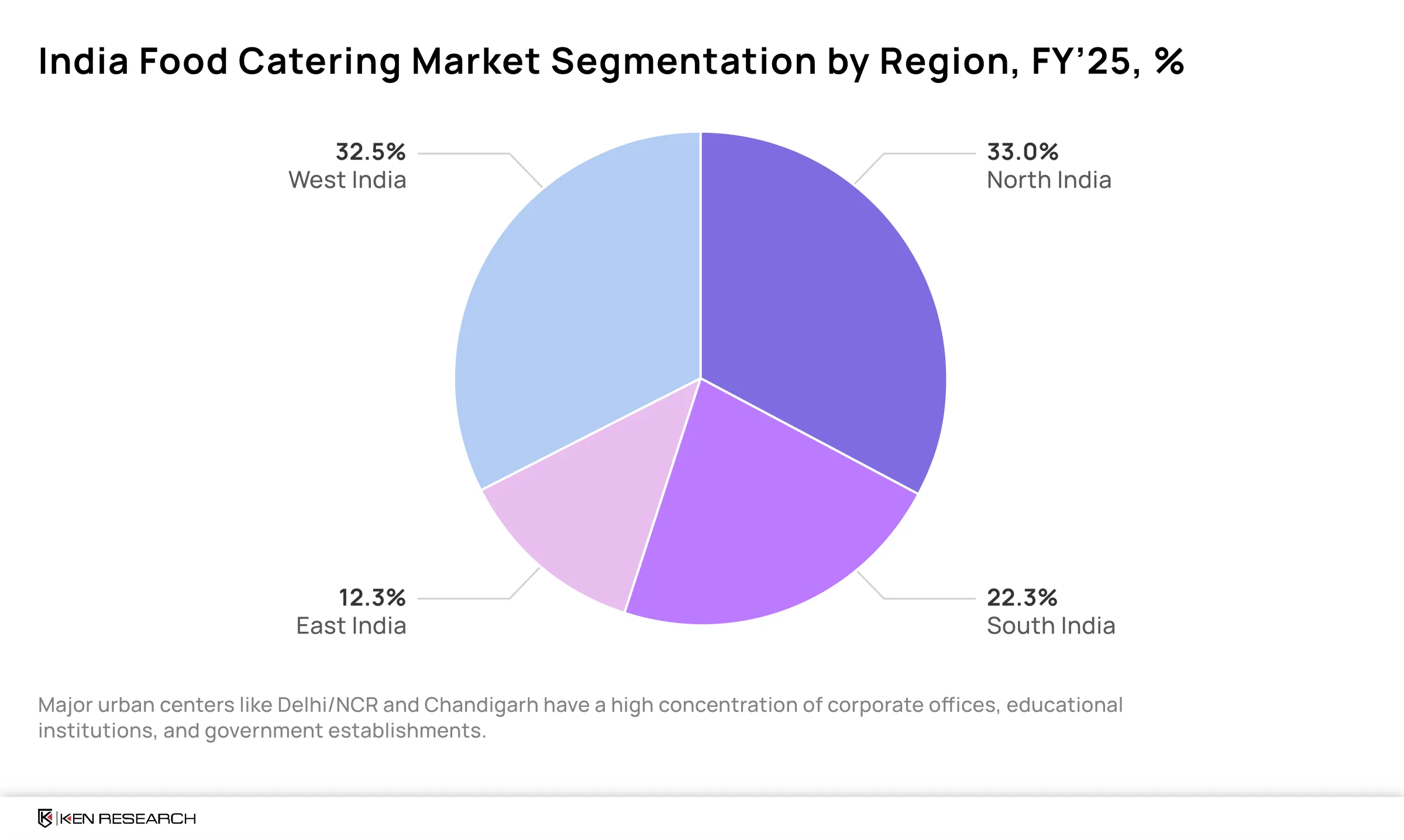
North India accounted for 33% of India catering market in 2025, driven by Delhi NCR, Punjab, and Haryana. India’s overall wedding economy hit ₹4.74 lakh crore in 2023, with catering representing 18–22% of total event expenditure making North India the highest-value wedding F&B market nationwide.
The region hosts 30–40% of India’s mega weddings (1,500+ guests), with banquet utilisation rates exceeding 70–75% in peak seasons. Reports in 2025 show luxury weddings averaging ₹4–₹10 crore, with premium caterers commanding 20–35% price premiums over national operators. This creates a structurally higher ARPU (average revenue per event).
Institutional demand is also expanding: government offices, universities, defence complexes, and public-sector establishments increased outsourced catering by 11–14% YoY in 2025. This dual engine—premium weddings + institutional feeding—keeps North India the largest and most defensible catering powerhouse.
West India: Corporate Catering Epicentre With High Recurring Revenue Density
West India accounted for 32–33% of catering demand in 2025, led by Mumbai, Pune, and Ahmedabad. Corporate dining rebounded sharply in 2024–25, with 85–90% recovery in cafeteria footfall across major financial and IT hubs, strengthening institutional meal contracts.
Corporate outsourcing grew 12–15% YoY in 2025 as enterprises replaced in-house kitchens with managed service operators (Compass, Sodexo, Elior). Daily institutional meal volumes in Mumbai–Pune corridors exceeded 2.5 million meals/day, the highest density in India. This positions West India as the most stable year-round demand market.
Lifestyle catering is also accelerating. Ahmedabad, Pune, and Mumbai saw 22–28% growth in boutique catering between 2023–25, driven by destination weddings, social events, and gourmet experiential menus. This mix of recurring B2B + premium B2C gives West India the most diversified revenue model in India’s catering landscape.
South India: Fastest-Growing Hub Powered by Tech Campuses & Cloud Kitchens
South India made up 22% of India’s catering revenue in 2025, supported by Bengaluru, Hyderabad, and Chennai home to India’s largest tech workforce. NASSCOM reported 5.4 million tech employees in 2025, driving institutional catering volumes through daily meal programs and nutrition-based cafeteria offerings.
Cloud kitchens accelerated regional growth. Bengaluru-led operators (Rebel Foods, EatSure, FreshMenu) expanded into catering with 30–40% YoY growth in corporate boxed meals, hybrid events, and small-format gatherings. Automated kitchens improved cost efficiencies by 12–18%, making South India the most tech-enabled catering ecosystem.
Event formats differ sharply from the North & West. South India has smaller, curated events but higher per-meal standardisation, reducing wastage and improving profitability. As per 2025 reports, digital F&B orders in Bengaluru rose 19% YoY, directly benefiting cloud-led catering models. South India remains India’s fastest-growing catering micro-market.
East India: India’s Underpenetrated but Fast-Formalising Catering Frontier
East India held 12–13% of catering demand in 2025, but market penetration remains the lowest nationally. However, Kolkata, Bhubaneswar, Guwahati, and Siliguri recorded 13–17% growth in banquet development and mid-scale hotel expansion in 2024–25, signalling a structural transition.
Institutional categories—hospitals, colleges, and public-sector offices—are driving formal catering adoption. Healthcare catering alone grew 15–18% YoY in Kolkata and Bhubaneswar in 2025, supported by new medical colleges and private healthcare expansion. This has made East India the strongest institutional upswing region.
Wedding and event catering is also rising. Tier-1 coverage in 2025 shows East India wedding budgets increasing 12–20%, with a sharp rise in multi-day ceremonies and professionalised caterers entering the region. This market remains the largest whitespace opportunity, with the highest long-term ROI for national catering chains.
Conclusion
India’s catering industry is now shaped by regional power clusters—not uniform national demand. North India dominates through premium weddings; West India leads institutional catering volumes; South India is the technological engine with the fastest growth; and East India is the high-upside frontier undergoing rapid formalisation.
FY30F projections suggest India’s catering market will expand from ₹210,400 crore (2025) to nearly ₹296,600 crore, but the distribution of this growth will be determined by regional micro-dynamics. Investors and enterprises that adapt their operating models to regional demand economics, digital procurement, central kitchen networks, and segment-specific pricing will define India’s next decade of catering leadership.
Related tags
Catering
Food Services
Food, Beverage and Tobacco
Get started
We've helped companies around the world future-proof
their businesses - and we can do the same for you.