India Confectionery Market Hits USD 4.8B but Owns Under 2% of Global Exports
Ken Research
January 14, 2026 - 5 min read
January 14, 2026
by Ken ResearchIndia's confectionery market reached USD 4.8 billion in 2024, expanding at 5.5% annually, well ahead of the 3-4% global average. Consumption is rising, retail networks are deepening, and demographics remain favourable. Yet India commands less than 2% of global confectionery exports, even as countries with far smaller home markets have built thriving international businesses.
Understanding why requires examining how India's confectionery system was architected and what trade-offs were embedded in its design.
Low Value Density Limits Scale Economics Despite Market Growth
The core challenge begins with consumption intensity. Indian consumers purchase less than 0.5 kg of confectionery per person annually, compared to 6.5 kg in North America and 8-10 kg across Western Europe. This fundamentally alters manufacturing economics, as higher per-capita consumption allows producers to distribute fixed costs across substantially larger revenue bases.
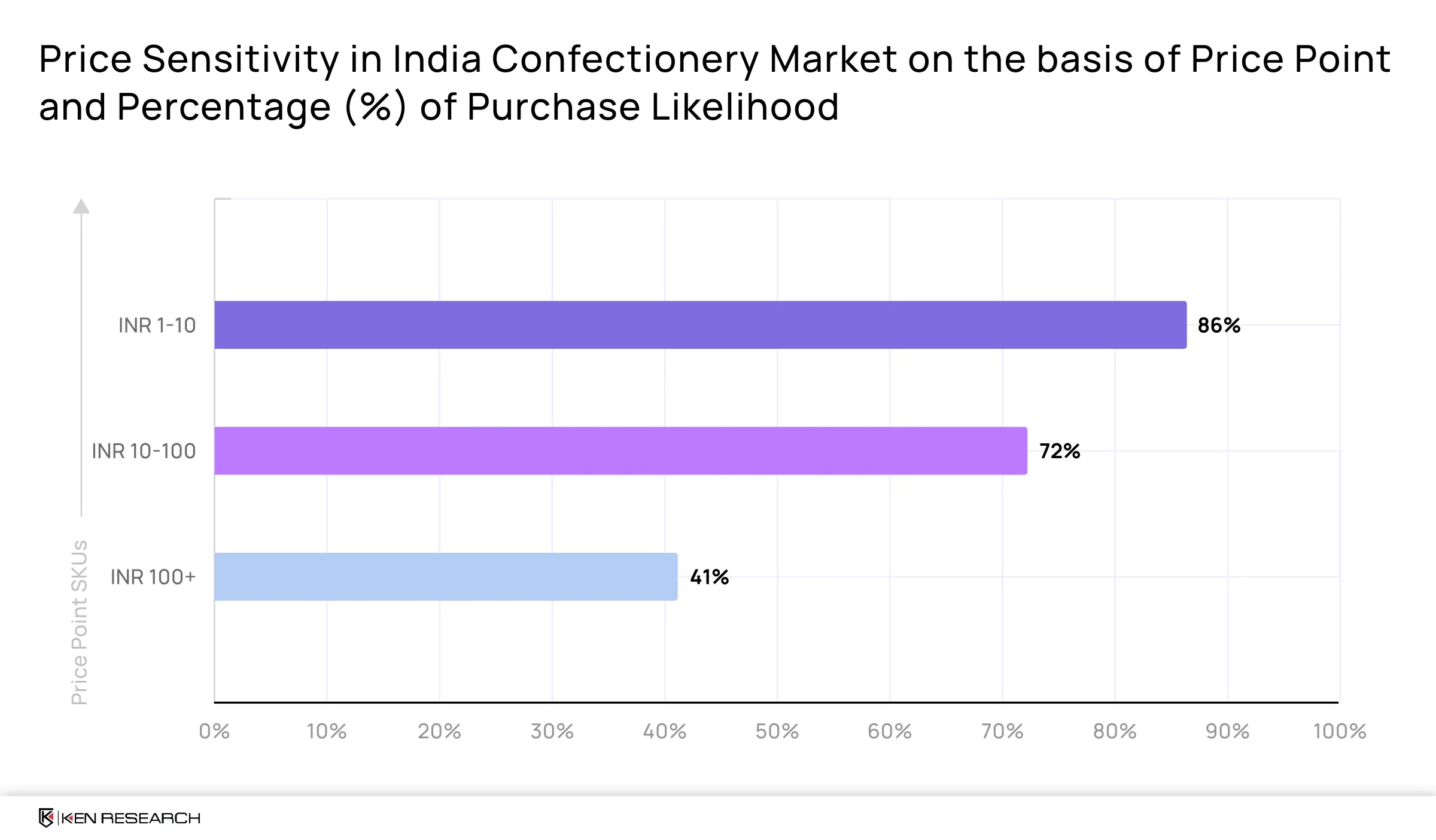
In India, demand patterns exacerbate this constraint, as confectionery dominates through impulse purchases at price points of USD 0.01-0.12 (₹1-₹10), accounting for nearly 86% of the volume share.
Chocolates, which account for approximately 60% of global confectionery value, remain confined to urban markets with rural penetration below 15%.
Between 2020 and 2024, India added 150 million new consumers, yet average transaction values remained static. This pattern expands the buyer base without deepening value per transaction, limiting pricing power and export viability.
Distribution Excellence Has Locked in Small-Batch Manufacturing Economics
India's confectionery manufacturers excel at reaching 13 million kirana outlets with minimal inventory costs. This demands manufacturing flexibility, short production runs, frequent changes, and proximity to distribution hubs. The sector operates 400+ manufacturing units running 50+ SKUs with batch sizes optimised for rapid market response rather than scale efficiency.
This enables remarkable domestic penetration but creates export friction. Short runs increase changeover time to 15-20% of production hours versus 5-8% in export-focused Chinese plants. Limited automation means labour costs account for 12-15% of manufacturing expenses versus 6-8% in comparator markets.
Batch-to-batch consistency, critical for international buyers, becomes harder to guarantee. Infrastructure optimised for domestic distribution dominance has created path dependencies that constrain export economics.
Export Winners Were Built for Scale, Not Domestic Agility
The contrast with export-successful markets is instructive, as China's confectionery sector reached USD 15 billion domestically in 2024 while exporting over USD 3 billion. This reflected the deliberate design of export-dedicated production lines with standardised SKUs, 24/7 operations, and OEM contracts providing baseline volumes.
Indonesia, with a USD 2.8 billion domestic market, exports over USD 800 million annually. Thailand's exports exceeded USD 500 million in 2023. The common thread isn't size, it's intentionality. Average production runs in Chinese export facilities exceed 72 hours, while in India, they average 18-24 hours. Chinese facilities operate with 8-15 core export SKUs; Indian manufacturers juggle 40+ variants. Per-unit manufacturing costs in Indian facilities run approx. 20-30% higher than comparable export-optimised plants.
Input Price Volatility Exposes the Fragility of Low-Price Models
Between 2023 and 2025, cocoa prices surged from USD 2,500 per tonne to peaks exceeding USD 10,000. Leading global players implemented aggressive pricing Mondelez raised prices by approximately 7-9% and Nestlé by 6-8% to protect margins. When products retail for USD 3-5 in developed markets, absorbing a 15-20% input increase preserves accessibility. When the same product sells for USD 0.12-0.24 (₹10-20) in India, equivalent increases can collapse demand.
Following the 2024 cocoa spikes, several Indian manufacturers reported volume declines of 8-12% in mass-market segments despite holding prices stable. Input volatility has become a structural test of value density. Markets built on ultra-low-price points lack the buffer to absorb shocks without sacrificing margins or volumes.
Freight Cold Chain and Compliance Costs Break Export Viability
India's limited export presence stems from the fact that when the per-kilogram product value is low, freight becomes prohibitive. For sugar confectionery averaging USD 2-3 per kilogram at ex-factory prices, ocean freight of USD 0.40-0.80 per kilogram consumes disproportionate margins. Indian manufacturing costs are 15-25% higher than China's, while ASEAN benefits from regional trade agreements eliminating tariff barriers.
Chocolate exports face compounded challenges. Ambient temperatures exceed 40°C across large parts of India, while cold-chain infrastructure covers less than 30% of the geography effectively.
Temperature-controlled containers add USD 800-1,200 per unit compared to standard shipping. Indian facilities average 40-50% automation versus 70-85% in Chinese plants, impacting consistency. International buyers demand a coefficient of variation below 3%, Indian facilities typically operate at 5-8%.
Fewer than 20% of Indian confectionery manufacturers maintain certifications required for European and North American markets. As global trade shifts toward contract manufacturing, OEM contracts now account for 45% of cross-border sugar confectionery trade, up from 28% in 2018. These capability gaps widen into competitive disadvantages.
Where the Real Opportunity Lies
Shelf-stable sugar confectionery reached USD 16.9 billion in global trade volume in 2023, growing at 14% year-on-year, with an export-orientated design: dedicated production lines running 12-15 core SKUs instead of 40+, compliance-ready packaging, and production runs measured in weeks rather than days.
OEM and private-label manufacturing offer the most pragmatic entry point, monetising cost advantages without requiring overseas brand development. Indian firms like Haria Food Products export confectionery to the Middle East and Africa, and Haldiram's is investing in UAE manufacturing facilities potentially worth AED 150-200 million (USD 40-55 million).
Three Strategic Paths Will Define India’s Confectionery Future
India confectionery market will continue growing domestically. The strategic question concerns international relevance. Three scenarios are emerging: manufacturers focusing exclusively on domestic premiumisation; companies building dedicated export capacity requiring USD 15-25 million investments per line, potentially capturing USD 300-500 million in incremental sector revenue within 5-7 years; or an erosion scenario where input volatility compresses margins faster than innovation can offset.
The next phase will reward execution discipline over scale. India's confectionery sector stands at an inflection point where future value creation depends on separating distribution-optimised domestic operations from export-manufacturing economics.
Markets that succeeded internationally recognised that export competitiveness requires a different architecture than domestic distribution dominance. For India, the window to establish export positioning remains open, but it's narrowing. The opportunity exists; capturing it demands intentionality, investment, and willingness to optimise beyond domestic circulation.
Get started
We've helped companies around the world future-proof
their businesses - and we can do the same for you.