The Protection Gap: How Health Insurance Purchase Decisions Are Reshaping India's Coverage Landscape
Ken Research
June 8, 2026 - 7 min read

June 8, 2026
by Ayush MathurIndia's Health Insurance Market: A Landscape Defined by Underinsurance and Shifting Expectations
India's health insurance sector, long operating at the edges of household financial planning, is now at the centre of one of the country's most urgent structural conversations. Post-pandemic risk awareness, rising out-of-pocket medical expenditure, and a rapidly expanding private hospital network have together pushed health cover from an afterthought to a declared priority, yet the numbers tell a more complicated story.
India's health insurance gross written premium crossed INR 1.08 lakh crore in FY 2024, growing at a ~17% CAGR between 2019 and 2024. Yet fewer than 38% of Indian households carry any form of private health cover, and among those who do, coverage adequacy remains critically low, with the average individual policy sum insured hovering below INR 5 lakh at a time when a single hospitalisation in a metro hospital routinely crosses INR 2–4 lakh.
To decode what drives, and what blocks, health insurance purchase decisions, Ken Research conducted its inaugural Health Insurance Purchase Decision & Coverage Selection Survey across seven Indian states, tracking attitudes, barriers, and coverage selection logic across 3,800 primary household decision-makers. What emerged is not simply a consumer sentiment report. It is a structural diagnostic, exposing the precise fault lines between what insurers offer, what distributors communicate, and what households actually need.
India's top five private health insurers account for approximately 61% of all individual health policies issued, yet renewal rates across the industry average just 67%, and claim denial rates continue to surface as a defining purchase deterrent. The real story is not premium growth. It is the persistent gap between insurance penetration and insurance adequacy, and the survey data makes the distinction impossible to ignore.
3,800+ Household Decision-Makers Surveyed | 7 States Across India, Tier-1 to Tier-3 | 38% Households With Active Private Cover |
Survey Profile: Who We Studied, Where, and Why It Matters
Sample and Geography
The survey was conducted between Q1 and Q2 of 2025, covering a stratified sample of 3,800 primary household financial decision-makers across seven states: Maharashtra, Delhi-NCR, Karnataka, Tamil Nadu, Telangana, Gujarat, and Rajasthan. These states collectively represent approximately 58% of all active individual health insurance policies in India as of FY 2025. The survey was administered through a combination of online panels, assisted in-home digital surveys, and community-intercept interviews to ensure representation across digital access levels, income tiers, and urban-rural gradients.
Demographic Profile
- Age distribution: 34% Millennials (26–35), 27% Gen X (36–45), 23% Gen Z (18–25), 16% Boomers (46–60)
- Income brackets: 31% in INR 6–12 lakh annual household income, 26% above INR 12 lakh, 43% in the INR 2–6 lakh bracket
- Geography split: 52% metro and Tier-1 cities, 31% Tier-2 cities, 17% Tier-3 and semi-urban locations
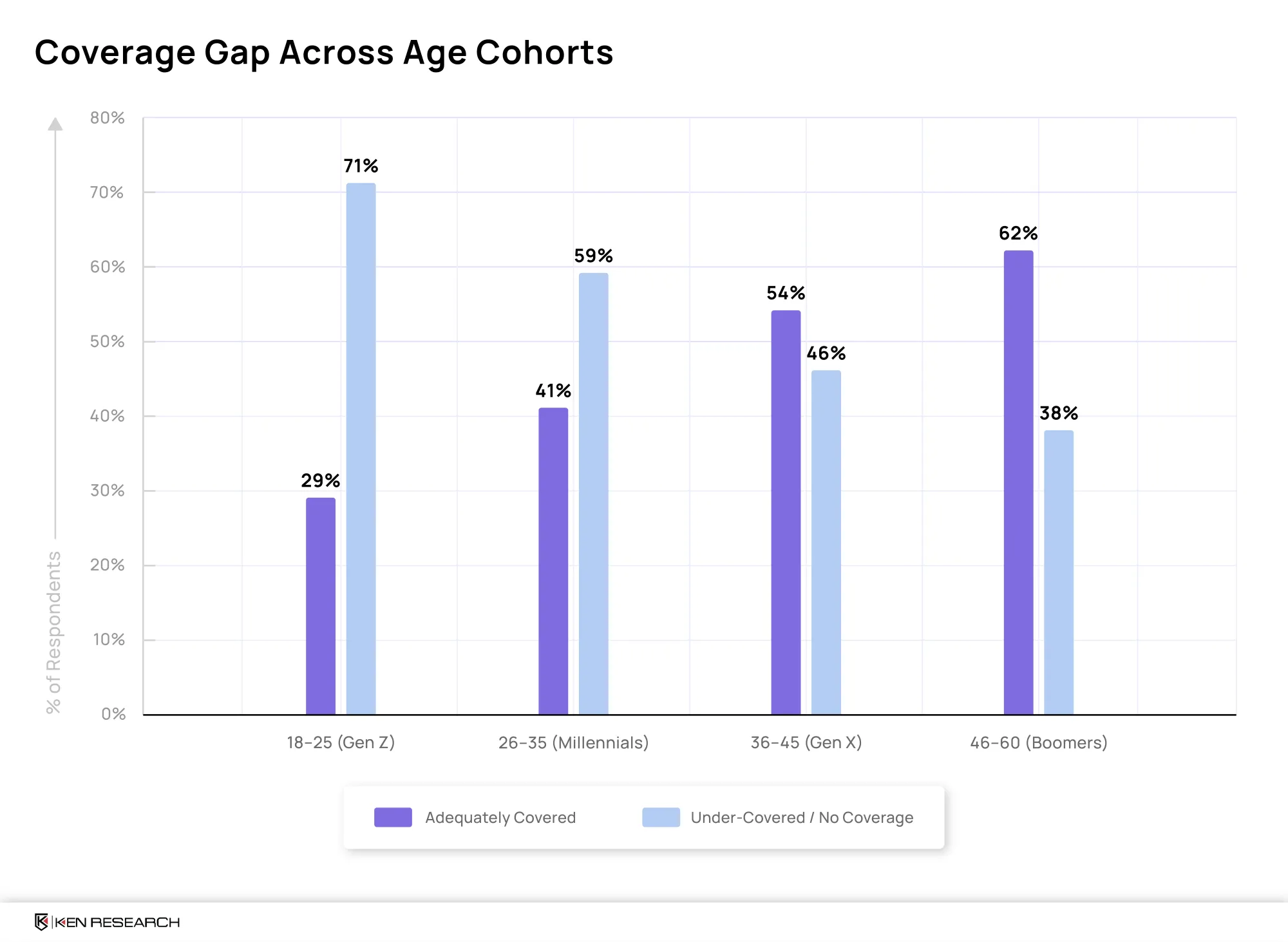
- Coverage status: 38% held active private individual or family floater policies; 29% relied exclusively on employer group cover; 33% reported no coverage beyond government schemes.
The Purchase Decision Divide: What Households Actually Weigh, and What Insurers Keep Missing
Over the past five years, India's health insurance purchase decision has grown more deliberate, more contested, and more influenced by peer experience than by distributor communication. Our survey data reveals a widening gap between the features insurers lead with and the criteria households actually use to select, or reject, a policy.
What Drives Purchase, and Where the Industry Loses the Buyer
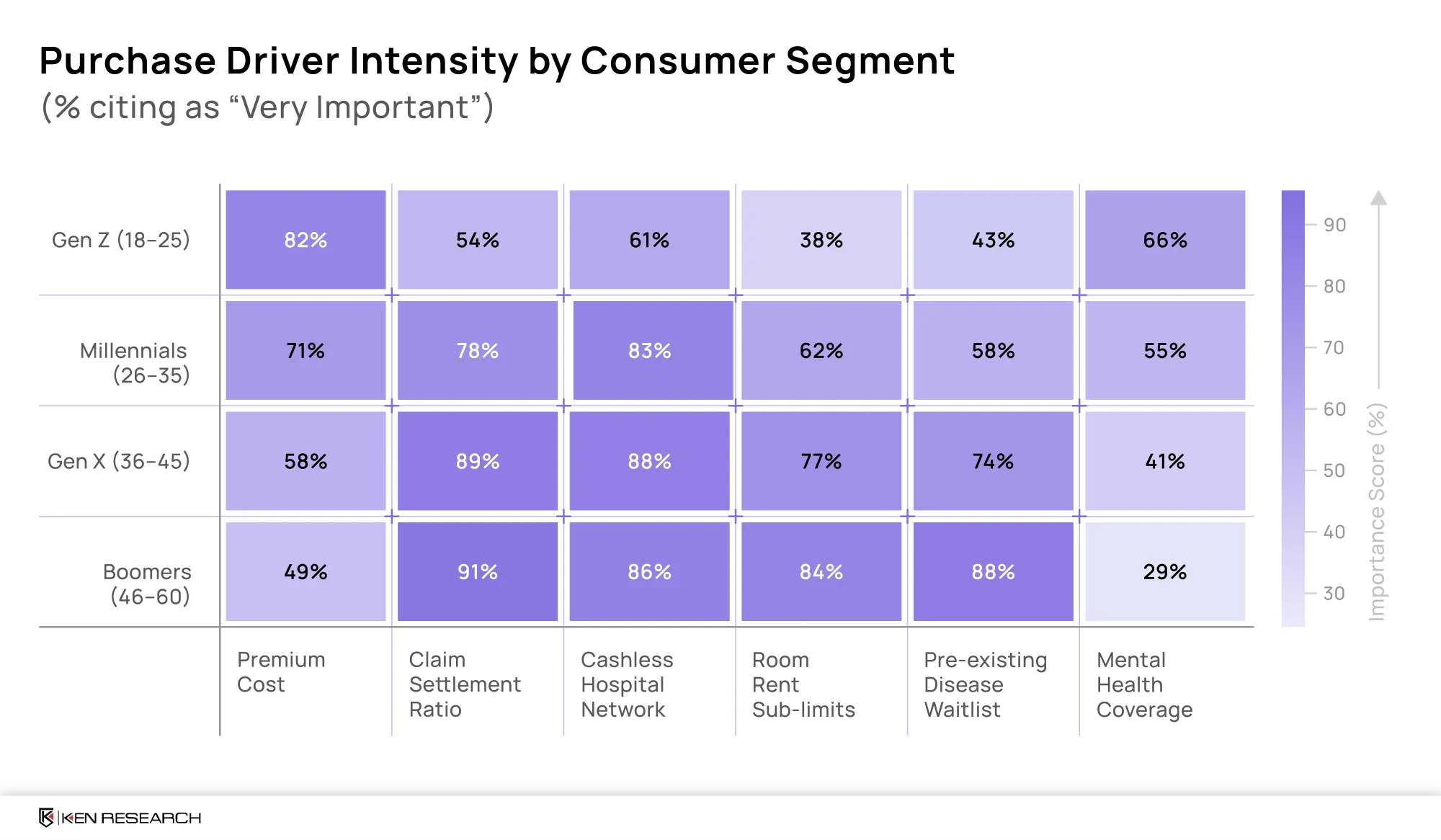
- Claim Settlement Ratio Dominates but Remains Opaque: 73% of respondents cited claim settlement ratio as "very important" in purchase decisions, yet only 31% could correctly identify their chosen insurer's settlement ratio within a 10-percentage-point range, signalling deep information asymmetry that erodes post-purchase trust.
- Cashless Network Coverage as a Table-Stakes Factor: Cashless hospital network breadth ranked as the second-most decisive criterion at 69% overall preference, with particularly high salience among Gen X and Boomer cohorts where hospitalisation frequency is rising. Insurers with networks below 5,000 empanelled hospitals reported measurably lower conversion in Tier-2 geographies.
- Sub-limits and Exclusions: The Invisible Deal-Breakers: 61% of respondents who had experienced a claim dispute cited room rent sub-limits and disease-specific caps as the primary source of out-of-pocket surprise, yet fewer than 22% of first-time buyers could define "sub-limit" before purchase. The gap between policy literacy and purchase confidence is not a consumer failure. It is a product communication failure.
- Mental Health Coverage: An Emerging and Underserved Criterion: 54% of Gen Z respondents ranked mental health and OPD coverage as a decisive selection criterion, making it the fastest-rising purchase driver among the 18–25 age cohort. Insurers who do not clearly communicate mental health coverage are structurally invisible to a generation that is actively purchasing.
The outcome: A market where purchase decisions are driven by word-of-mouth, aggregator-generated star ratings, and fear of claim denial, not by policy feature comparison. Insurers who continue to communicate on premium price alone are losing the consideration set before the conversation begins.
The Claims Experience Reckoning: Where Loyalty Is Won and Lost
If purchase drivers reveal what households seek, claims experience reveals how completely the industry fails to deliver it. Our survey identified claim friction, denial ambiguity, documentation burden, and post-discharge settlement delays, as the single largest driver of lapse and non-renewal, more consequential than premium affordability or competitor pricing.
The Renewal Deficit
- Claim Denial Experience Drives Permanent Exit: 44% of surveyed households that had experienced a partial or full claim denial reported discontinuing their policy within two renewal cycles, not switching but exiting the insured population entirely. This is not a competitive problem. It is a market contraction problem.
- Digital Claims Interfaces Accelerate Resolution Confidence: Policyholders who used insurer mobile applications for pre-authorisation and claims tracking were 2.6 times more likely to renew without price comparison than those navigating branch-based or call-centre-dependent processes, underscoring the compounding loyalty return from digital claims investment.
- Aggregator Influence Undermines Direct Channel Loyalty: Only 34% of policyholders holding individual health plans purchased directly from the insurer. Among those who renewed, 51% checked aggregator platforms before renewing, even with the same insurer. The distribution relationship is not protecting renewal rates. Insurers are renting customers, not building them.
Unlike legacy health insurance markets where premium price was the dominant retention lever, India's next-generation policyholder demands claims transparency, initiative-taking communication, and digital-first resolution. The product must justify itself at the moment of truth, not at the point of sale.
What Lies Ahead: The Strategic Reckoning for India's Health Insurers
The acceleration of health insurance awareness in India has surfaced more than a distribution opportunity, it has exposed a product design deficit that decades of group-policy dependence obscured. What worked before, broad network claims, standardised floater products, and agent-mediated sales, is no longer sufficient in a market segmenting by life stage, income tier, and care expectation faster than the industry can adapt.
Insurers must now confront decisions they have deferred for years:
Do they invest in product modularisation, chronic disease riders, OPD top-ups, mental health add-ons, or continue leading with base floater volume?
Do they treat claims as a cost to be minimised, or as the single most powerful retention investment available to them?
Do they architect for the 38% already in the market, or build propositions for the 62% who remain uninsured, a population that is watching the insured majority's claims experience before deciding whether to enter?
Pricing without product differentiation is no longer a viable market position. India's household is becoming a more deliberate insurance buyer, and the industry's communication architecture is failing to meet that deliberateness with equivalent clarity.
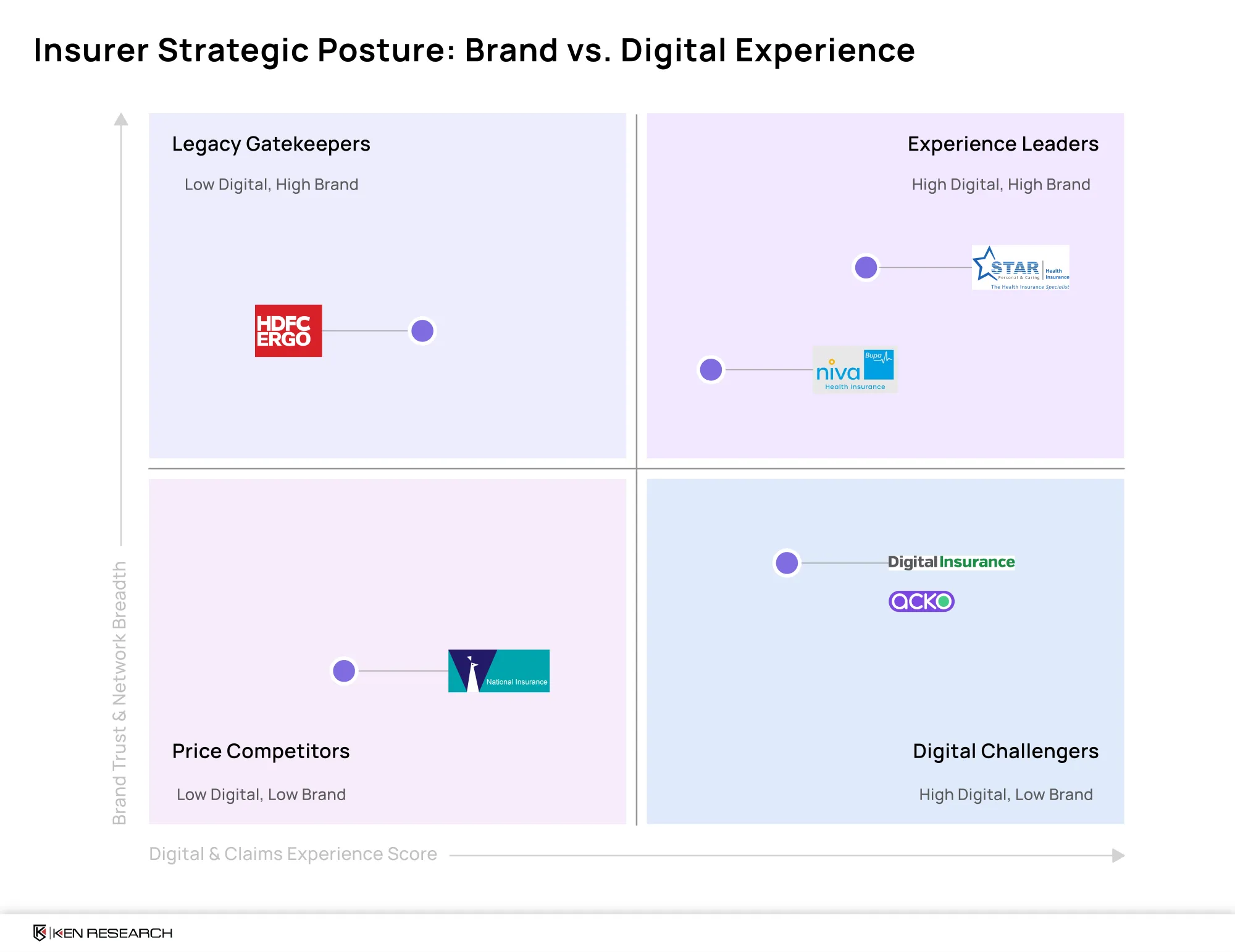
Insurtech challengers and direct-to-consumer platforms have demonstrated that distribution is no longer a moat, trust is. For established insurers, the strategic imperative is clear: simplify policy language, invest in claims experience, and communicate coverage terms before the moment of claim, or watch renewal rates and brand equity erode simultaneously.
About the Author:
Ayush Mathur is a Survey Research Analyst at Ken Research, specialising in market research and data-driven decision-making. He works with organisations to bridge the gap between primary data and strategic insight, with hands-on experience designing and analysing large-scale consumer surveys across multiple sectors and geographies.
From the Author:
"At Ken Research, we have been mapping health insurance purchase decisions at the household level across India's urban and semi-urban markets, and the data confronts a persistent industry assumption, that premium affordability is the primary barrier to penetration. It is not. The primary barrier claims distrust, and it is self-inflicted. Households that have watched a family member fight a claim denial do not return to the insurance market easily. India's health insurance industry does not have a demand problem. It has a credibility problem, and the survey data is unambiguous on this point."
About Ken Research:
Ken Research is a market intelligence and strategy consulting firm delivering actionable insights across the various sectors in dynamic markets. We support industry stakeholders with data-driven analysis on emerging trends, competitive benchmarking, pricing strategies, and shifting consumer preferences. Our expertise enables clients to refine market entry and penetration strategies, optimize product positioning, and respond effectively to evolving competitive landscapes.
Subscribe to Survey Results
Access the full Health Insurance Purchase Decision & Coverage Selection Survey dataset, segment-level cuts, and insurer benchmarking data.
Ken Research | Health Insurance Survey Series | 2025 | www.kenresearch.com
Related tags
Health Insurance
Banking
Banking Financial Services and Insurance
Get started
We've helped companies around the world future-proof
their businesses - and we can do the same for you.