The Completion Gap: Why India's EdTech Boom Is Failing Its Learners, and What the Data Actually Reveals
Ken Research
August 10, 2026 - 7 min read

August 10, 2026
by Ken ResearchIndia's EdTech sector, once the undisputed darling of pandemic-era venture capital, is confronting a reckoning that no funding round can paper over. The country now hosts over 57,000 registered EdTech entities, with the market valued at approximately USD 7.5 billion in 2024 and projected to exceed USD 30 billion by 2030. Yet beneath this headline optimism lies a structural problem that Ken Research's primary survey work has now quantified with uncomfortable precision: enrolment is booming, but learning is not.
To understand where the gap sits, and more importantly, what causes it, Ken Research conducted its inaugural EdTech Course Completion Satisfaction & Learning Outcome Perception Survey across seven Indian cities, tracking the experiences, dropout triggers, and outcome perceptions of over 3,800 active online learners. The findings do not simply describe what learners want. They expose a fundamental misalignment between how platforms are designed and how learning occurs.
The result is a crisis of completion masquerading as a success story. India's EdTech platforms are accumulating enrolments at a pace that disguises their failure to retain, engage, or meaningfully upskill the learners they acquire. That gap, between registration and realised outcome, is now a strategic liability for every platform, corporate L&D function, and policymaker invested in India's digital skills agenda.
Survey Profile: Who We Studied, Where, and Why It Matters
Sample and Geography
The survey was conducted between Q1 and Q2 of 2025, drawing on a stratified, nationally representative sample of 3,840 active online learners across seven cities: Mumbai, Delhi-NCR, Bengaluru, Hyderabad, Chennai, Pune, and Ahmedabad. These cities collectively account for an estimated 64% of India's active paid EdTech enrolments as of 2025. Data was collected through a combination of online panels, WhatsApp-assisted intercept surveys, and campus-based assisted digital interviews, to ensure representation across digital literacy levels.
Demographic Profile
- Age distribution: 41% Gen Z (18–24), 33% Millennials (25–34), 18% Gen X (35–44), 8% Boomers (45–55)
- Income brackets: 36% INR 4–8 lakh annual household income, 31% INR 8–15 lakh, 22% above INR 15 lakh, 11% below INR 4 lakh
- Course category: 44% were enrolled in upskilling or technical courses, 23% in soft-skill or leadership programmes, 19% in domain certification tracks, 14% in MBA or postgraduate online programmes
- Platform breadth: 57% had enrolled in more than one online course in the past 24 months, with an average of 2.1 enrolments per active learner
The Completion Paradox: Enrolment as a Vanity Metric
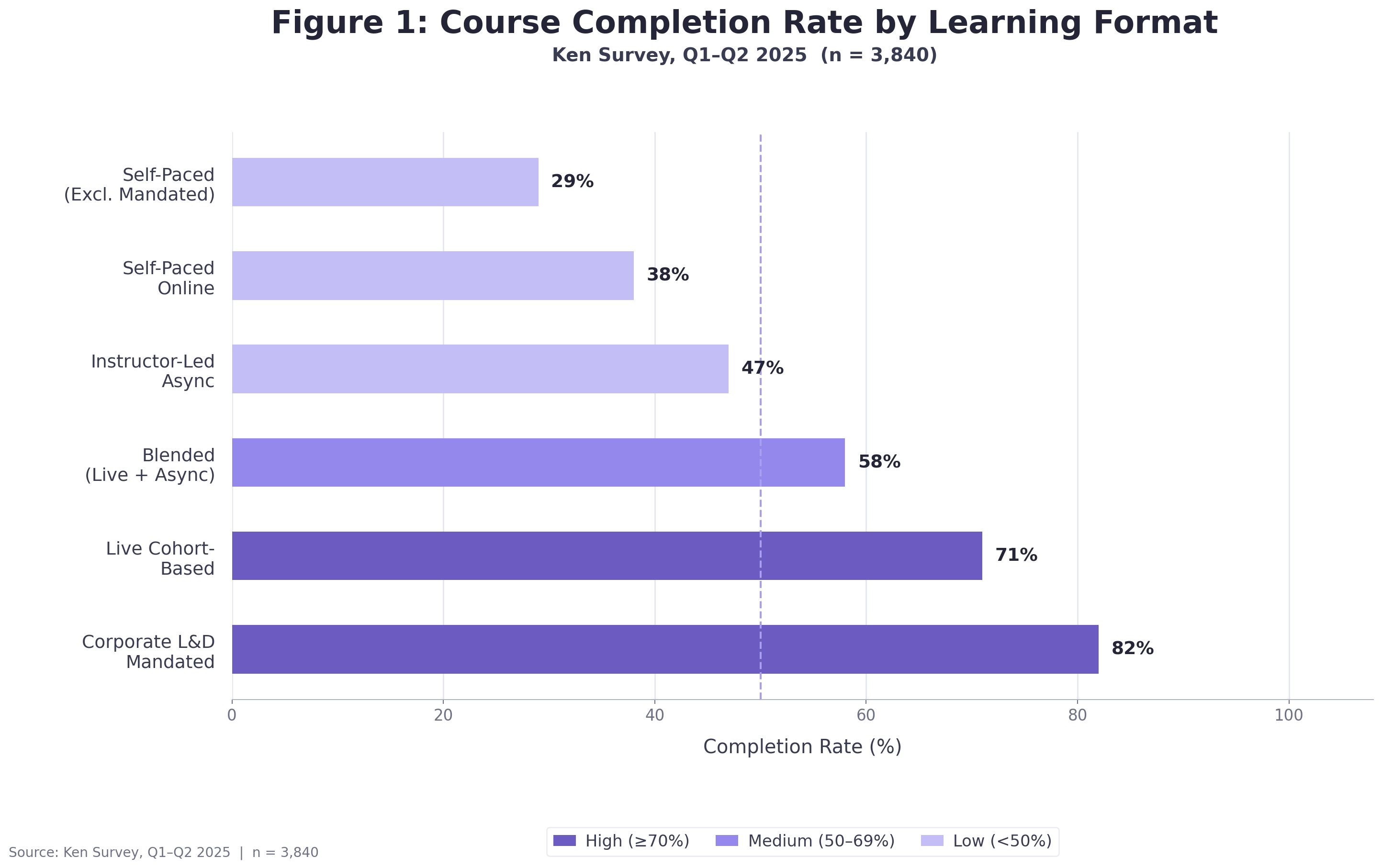
Across the full survey sample, the average course completion rate for self-paced online courses stood at 38%, a figure that drops to 29% when controlling for corporate-mandated enrolments, where participation is incentivised by employer policy rather than learner intent. Platforms and investors routinely cite enrolment figures as proxies for market penetration; our data suggests this conflation is analytically indefensible.
The format of delivery emerges as the single strongest predictor of completion, outweighing course topic, learner income, and even platform brand. Live cohort-based programmes, where learners progress through structured content alongside a peer group and an accessible instructor, achieved completion rates of 71%, nearly double those of equivalent self-paced content on the same topics. This is not a marginal difference. It is an architectural one.
Corporate L&D mandated courses recorded the highest completion rate in the survey at 82%, but this figure carries a critical asterisk: learner satisfaction scores in the same cohort were among the lowest recorded, with 61% describing the content as only "partially relevant" to their actual role. High completion without perceived relevance does not constitute learning success, it constitutes compliance.
The Completion-Satisfaction Disconnect
Completion rate and satisfaction with learning outcome are not the same metric, and India's EdTech ecosystem is systematically conflating them. Platforms optimise for the metric that investors track; learners experience the metric that matters.
Outcome Perception: Where Learners Feel the Value, and Where They Do Not
When surveyed on whether their most recent completed online course had a "meaningful positive impact" on their career or professional capability, only 54% of respondents answered affirmatively. Among those who had not completed their most recent course, the figure fell to 19%. The implication is direct: completion and perceived outcome are causally linked, but neither is guaranteed by enrolment alone.
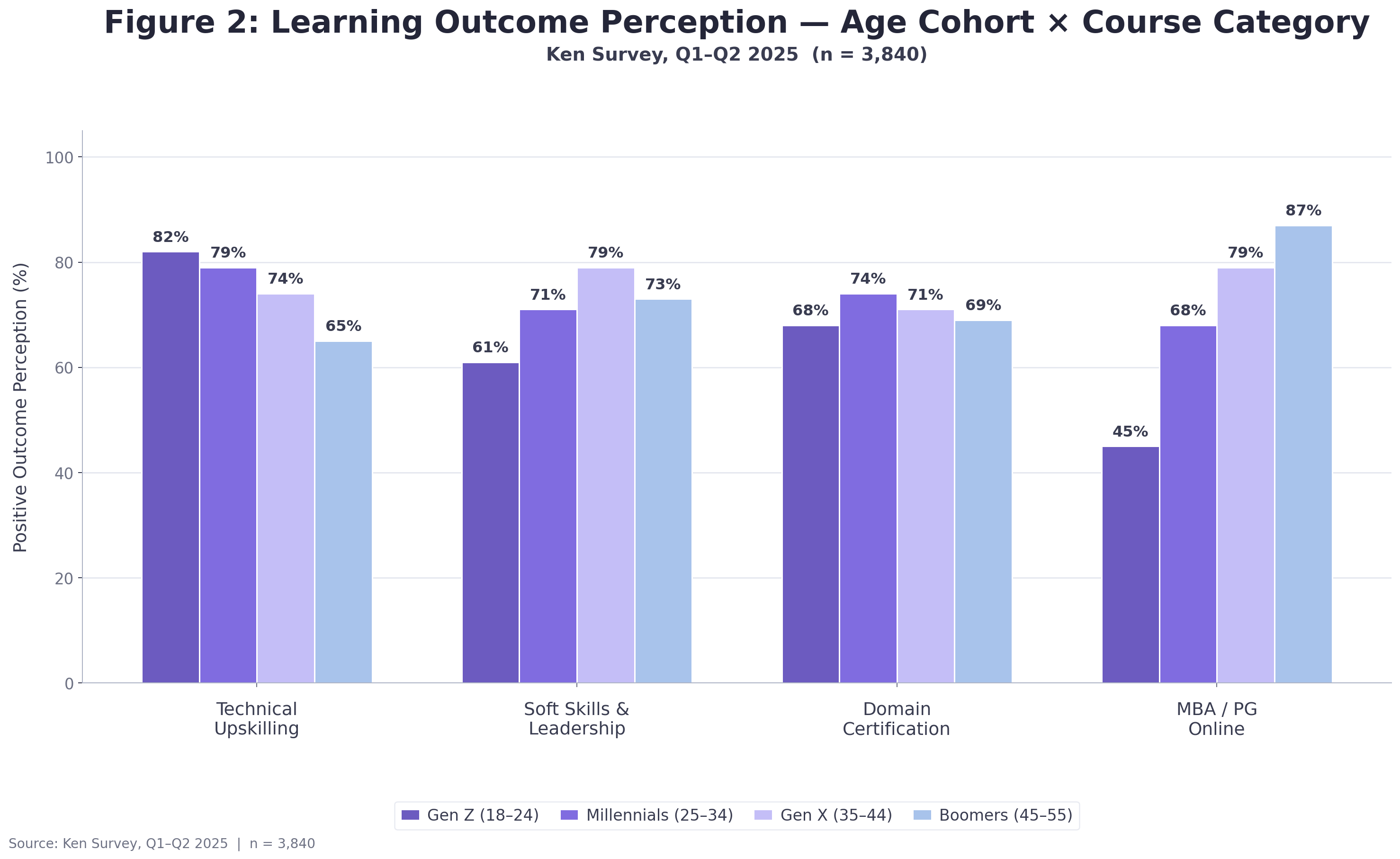
Technical upskilling courses, coding, data analytics, cloud infrastructure, and AI tooling, recorded the highest positive outcome perception scores across all age cohorts at 77% on average. Gen Z learners in technical programmes rated outcomes most positively of all sub-groups, at 82%. This reflects a job market reality: technical skills acquired through online certification have visible, fast-cycle validation through hiring outcomes, freelance project rates, and salary benchmarking, signals that learners can observe within months.
Soft skills and leadership programmes told a markedly different story. Despite strong enrolment numbers, particularly among Millennials and Gen X, positive outcome perception in these categories averaged just 71% and 79% respectively, dragged down by a common learner complaint: content that was too generic, too theoretical, and insufficiently calibrated to the learner's organisational context. The frameworks were sound; the application bridge was missing.
MBA and postgraduate online programmes achieved the highest outcome perception scores among Boomers (45–55) at 87%, reflecting this cohort's use of credentials for promotion decisions and performance reviews within established organisations. For Gen Z, the same programmes scored just 45%, a gap of 42 percentage points, suggesting that the credential calculus differs fundamentally across generations and career stages.
The Dropout Architecture: Friction Is Not a Product Failure, It Is a Design Choice
Across 3,840 surveyed learners, 62% reported abandoning at least one online course in the preceding 24 months before reaching the midpoint. The taxonomy of dropout reasons reveals a distribution that should concern product leaders, curriculum architects, and L&D heads in equal measure.
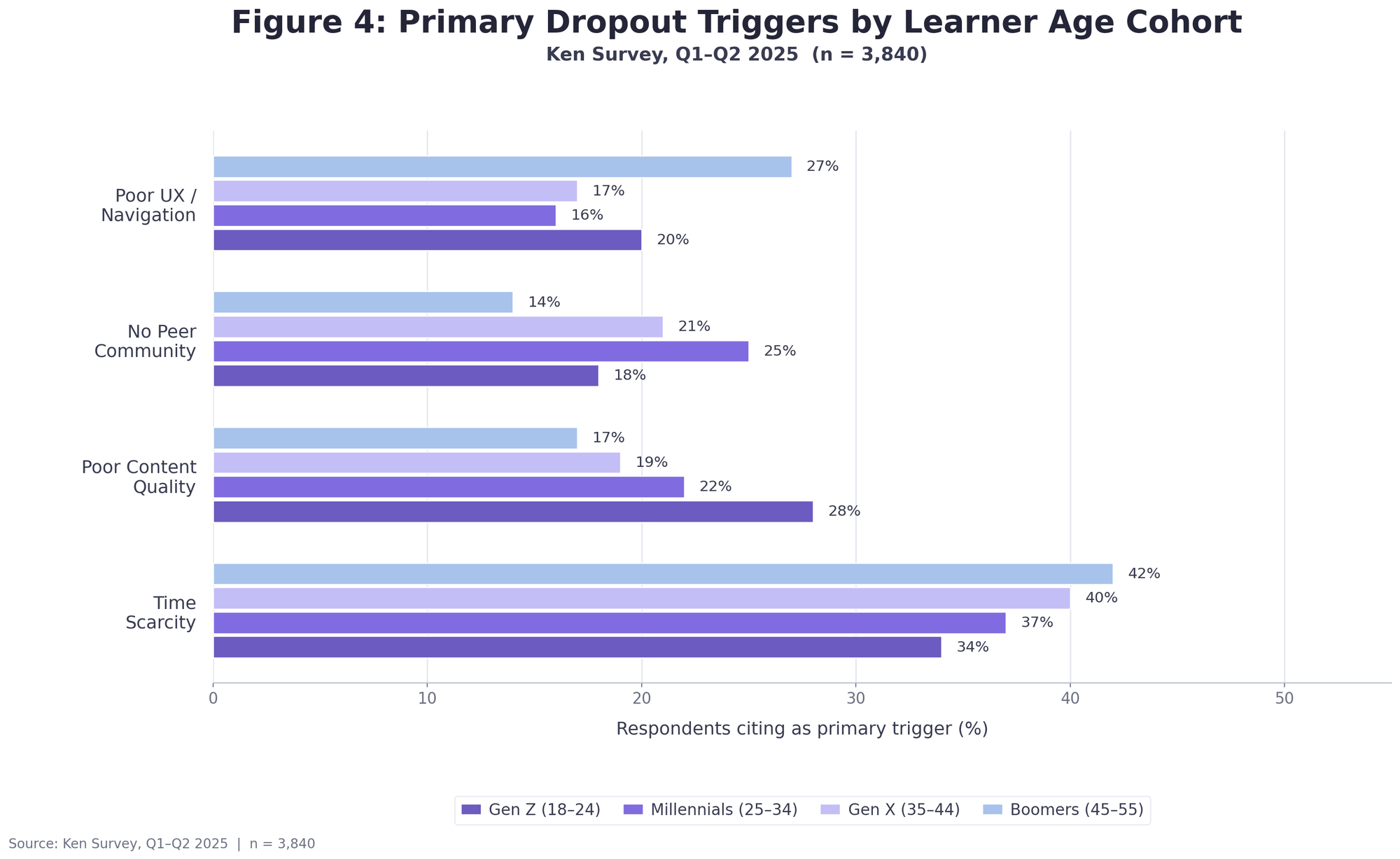
Time scarcity was the most commonly cited primary dropout trigger at 34% among Gen Z and 42% among Boomers. Yet time scarcity is not simply a personal failing, it is a product design signal. Courses designed without modular checkpointing, flexible pace resumption, and low-friction re-entry mechanisms impose a cognitive and scheduling burden that erodes intent. The platform bears responsibility for this architecture.
Poor content quality, rated as the primary dropout driver by 28% of Gen Z learners, manifested primarily as misalignment between course descriptions and actual content depth. Platforms that rely on keyword-laden course titles to drive enrolments, without delivering content of equivalent substance, are creating a systematic trust deficit that compounds across repeat purchases. This is an acquisition strategy that cannibalises retention.
Absence of a peer learning community was cited by 25% of Millennial learners as a primary dropout trigger, a finding that directly challenges the assumption that online learners prefer autonomy above all else. Learners who enrolled in programmes with structured cohort interaction, live Q&A, or peer project collaboration reported dropout rates 31% lower than those in pure async formats, controlling for course topic and duration.
What Lies Ahead: The Strategic Recalibration India's EdTech Cannot Defer
The survey data converges on a conclusion that is uncomfortable for platforms and investors alike: India's EdTech sector has built an extraordinarily efficient enrolment machine and a deeply inefficient learning machine. That gap, measured in dropout rates, unvalidated outcome claims, and declining repeat purchase intent, is now a structural risk, not a cyclical correction.
Platforms must confront strategic questions that their current product and revenue architectures are not designed to answer:
Do they invest in live cohort infrastructure that demonstrably improves completion, or protect gross margins by defaulting to async content that scales cheaply and fails predictably?
Do they design outcome measurement into their products, tracking salary outcomes, promotion rates, and skill application, or continue to report completion as a surrogate for learning?
Do they treat curriculum design as a core competency or as a commodity sourced from subject matter experts with no pedagogical scaffolding?
The market is beginning to answer these questions on behalf of platforms that do not. Learner churn is rising. Net Promoter Scores are declining. The refund-driven regulatory intervention from the Ministry of Education is already in motion. India's EdTech sector does not have a demand problem. It has a delivery credibility problem, and the data makes it impossible to ignore.
About the Author
Pranshu Mittal is a Survey Research Associate at Ken Research with expertise in primary research, survey analytics, and consumer behaviour studies. He supports organisations by converting research findings into actionable insights that drive strategic decision-making and market understanding.
From the Author
"At Ken Research, we have been tracking learner behaviour at the course level across India's top cities, and the pattern is consistent and confronting, platforms are capturing enrolment intent but not converting it into learning outcomes. The dropout architecture is not random. It is predictable, measurable, and addressable. India's EdTech sector is not short of ambition or capital. What it is short of is a credible answer to a simple question that every learner is asking: did this make me more capable? Until platforms can answer that with evidence, the growth story will remain structurally fragile."
About Ken Research
Ken Research is a market intelligence and strategy consulting firm delivering actionable insights across the various sectors in dynamic markets. We support industry stakeholders with data-driven analysis on emerging trends, competitive benchmarking, pricing strategies, and shifting consumer preferences. Our expertise enables clients to refine market entry and penetration strategies, optimize product positioning, and respond effectively to evolving competitive landscapes.
Related tags
Education and Recruitment
Get started
We've helped companies around the world future-proof
their businesses - and we can do the same for you.