Can India’s USD 940 Billion Consumption-Led Retail Market Compete with Manufacturing-Driven Economies Like China and Vietnam?
Ken Research
February 2, 2026 - 9 min read

February 2, 2026
by Ken ResearchIndia’s retail market reached ₹82.00 lakh crore (USD 952 billion) in 2024, employing approximately 75 million people, approx. 8% of the workforce (IBEF). While China and Vietnam built export-oriented manufacturing bases first and allowed consumption to follow, India inverted the sequence. Households spent, retailers expanded, and manufacturing grew largely to supply existing domestic demand rather than to create new markets through exports.
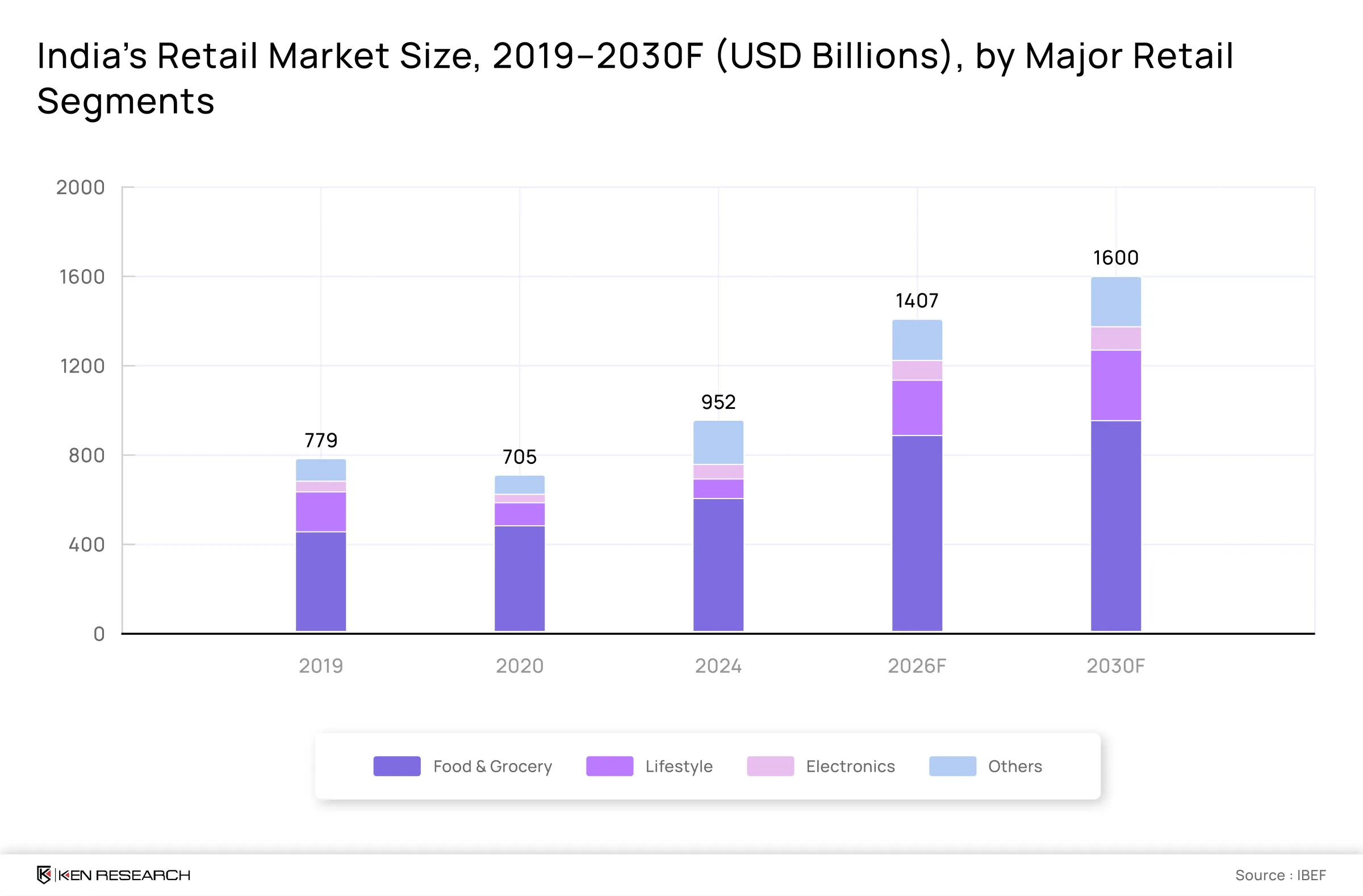
This consumption-first pathway creates an economy governed by different mechanics. Comparing India’s retail-led model with China’s or Vietnam’s manufacturing-export systems assumes these economies are pursuing the same objective. The evidence suggests otherwise. These three Asian giants are not competing along a single trajectory; they are operating on structurally different growth architectures.
Retail Demand Setting the Pace for Manufacturing Expansion in India
Private consumption accounted for approximately 61.8% of India’s GDP in FY2025 (provisional) the highest share recorded since FY2003, according to the Economic Survey 2024–25 published by the Ministry of Statistics and Programme Implementation (MoSPI). In absolute terms, household spending nearly doubled from about USD1.0 trillion in 2013 to USD2.1 trillion in 2024, growing at an annual rate of around 7.2%, outpacing consumption growth in the United States, China, and Germany over the same period.
China’s private consumption accounted for approximately 38% of GDP in 2023, while Vietnam recorded around 41% in 2023–24, based on World Bank and OECD data. This 20–24 percentage-point gap reflects fundamentally different growth mechanics. In India, household spending initiates retail expansion, which then pulls manufacturing capacity into place. Retailers place orders based on observed consumer demand, and factories respond accordingly.
Retail structure reinforces this logic. Traditional kirana stores handled approximately 82% of retail sales in FY2024, an efficient distribution system aligned with Indian consumption behaviour: frequent purchases, small basket sizes, and high price sensitivity. Organised retail accounted for 18% of the market, valued at ₹11.31 lakh crore (USD132 billion), and is projected to reach ₹20 lakh crore (USD 230 billion) by 2030. E-commerce contributed USD53.08 billion in 2024, with IBEF projecting growth to USD91.24 billion by 2029 at an 11.45% CAGR.
Manufacturing contributed approximately 15–17% of GDP in 2023–24, according to World Bank national accounts, placing India fifth globally with around 3.2% of world manufacturing output, per UNIDO. Industrial activity remains responsive rather than leading. The Index of Industrial Production (IIP) shows manufacturing growth of about 5.4% year-on-year in July 2025, while overall industrial growth stood at approximately 3.5%, according to MoSPI.
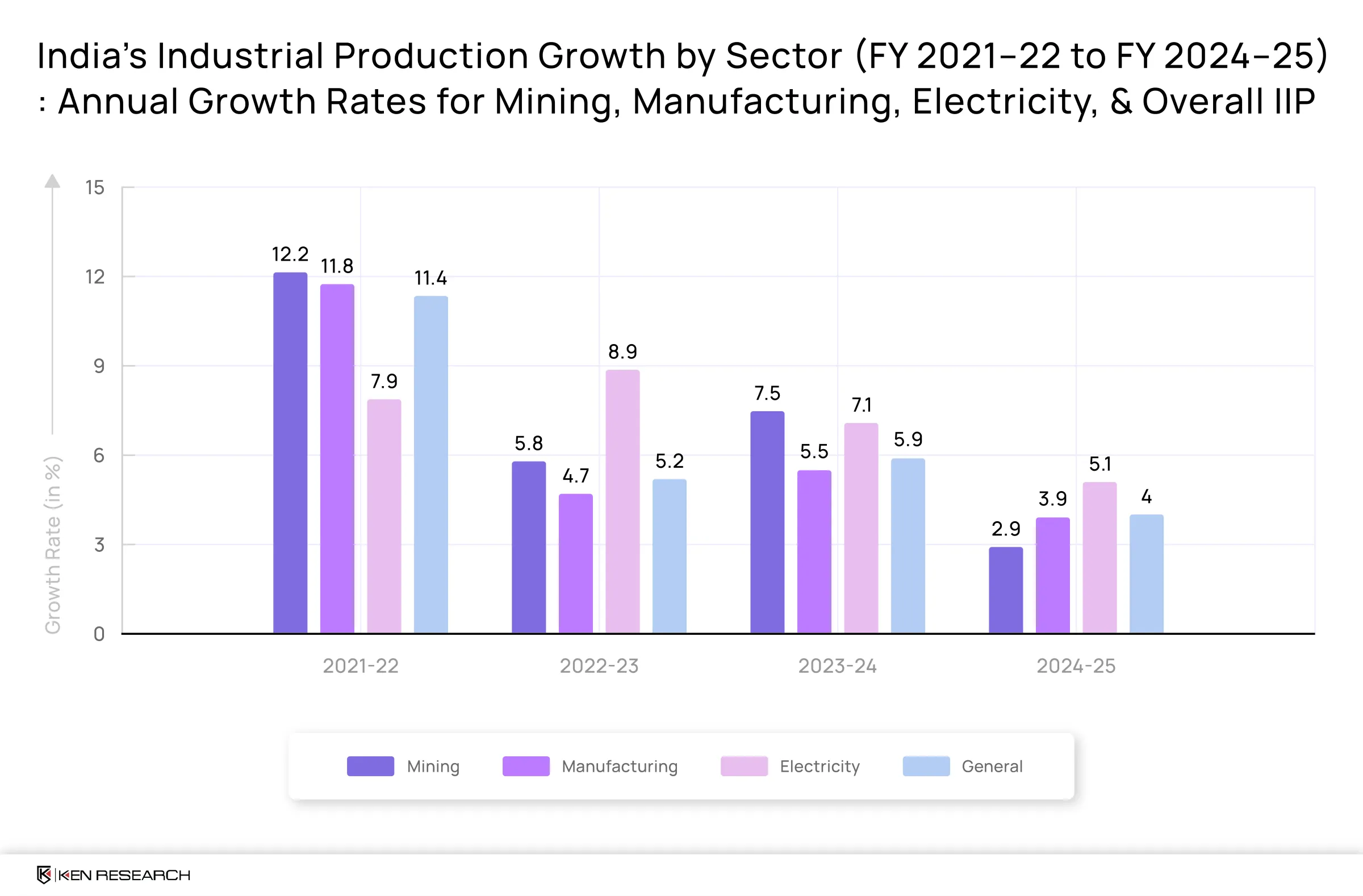
The IIP trend shows that while manufacturing, mining, and electricity output continue to expand, growth has moderated from double-digit levels in FY2021–22 to mid-single digits by FY2024–25. This pattern supports the structural conclusion that manufacturing in India is tracking domestic consumption conditions rather than acting as the primary engine of growth.
Production remains concentrated in consumer-facing segments—electronics, FMCG, textiles, and automotive—where retail demand is strongest. The Production-Linked Incentive (PLI) schemes accelerated smartphone assembly volumes; however, component localisation increased only marginally, from approximately 18% in 2023 to a projected 22% by 2025, according to IBEF. Manufacturing capacity continues to respond to retailer demand.
Manufacturing-Led Growth Driving Exports and Income Creation in China
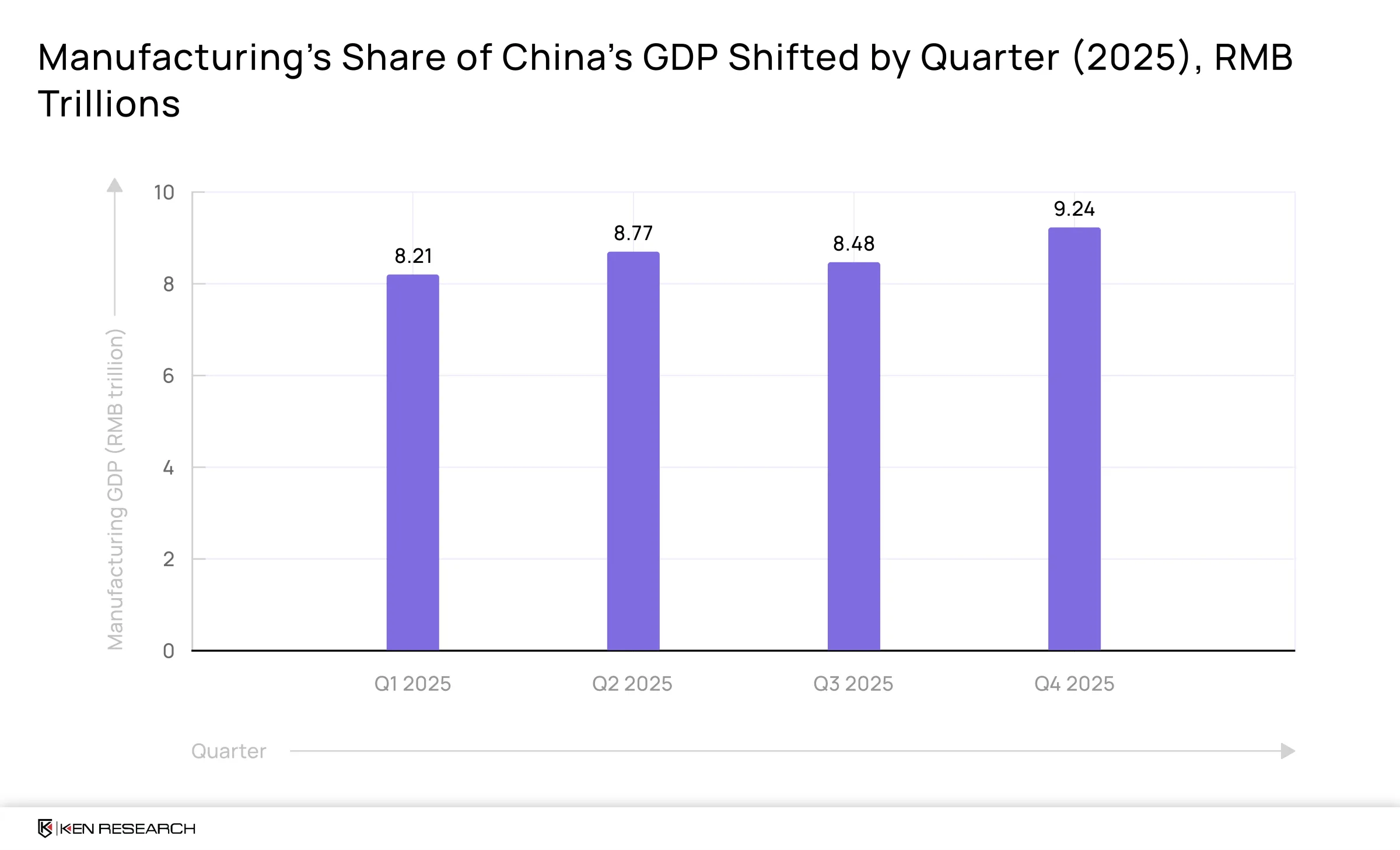
China's manufacturing GDP reached USD 4.85 trillion (RMB 34.67 trillion) in 2025, growing 6.1% and representing 24.7% of total GDP, according to the National Bureau of Statistics published in November 2025. That constitutes nearly 30% of global manufacturing output per UNIDO. China built vertically integrated industrial ecosystems spanning electronics, automotive, heavy machinery, and consumer goods, serving domestic and export markets simultaneously.
Export performance demonstrates this dominance. China exported USD3.77 trillion in 2025, up 5.5%, while imports stayed flat at USD2.58 trillion, producing a USD1.189 trillion trade surplus, the first economy to break the USD 1 trillion threshold, according to General Administration of Customs data released in January 2026. In the first 11 months of 2025, exports rose 5.4% while imports declined 0.6%, reaching a USD 1.08 trillion surplus per U.S.-China Economic and Security Review Commission reporting.
China's exports measured 19.7% of GDP in 2023 per WTO data, but translate to USD3.77 trillion on a USD17.8 trillion economy, more in absolute volume than most countries produce. Private consumption sits at 38% of GDP because gross capital formation and net exports absorb larger shares, funding infrastructure, industrial expansion, and technology development.
The causality runs opposite to India: factories produce for export markets, export revenues generate industrial employment, wages fund household purchases, and retail grows as a lagging indicator of industrial success. Industrial output creates income, and income enables consumption. Manufacturing doesn't respond to demand it creates the conditions for demand to exist.
Export-Driven Manufacturing Anchored by Foreign Investment in Vietnam
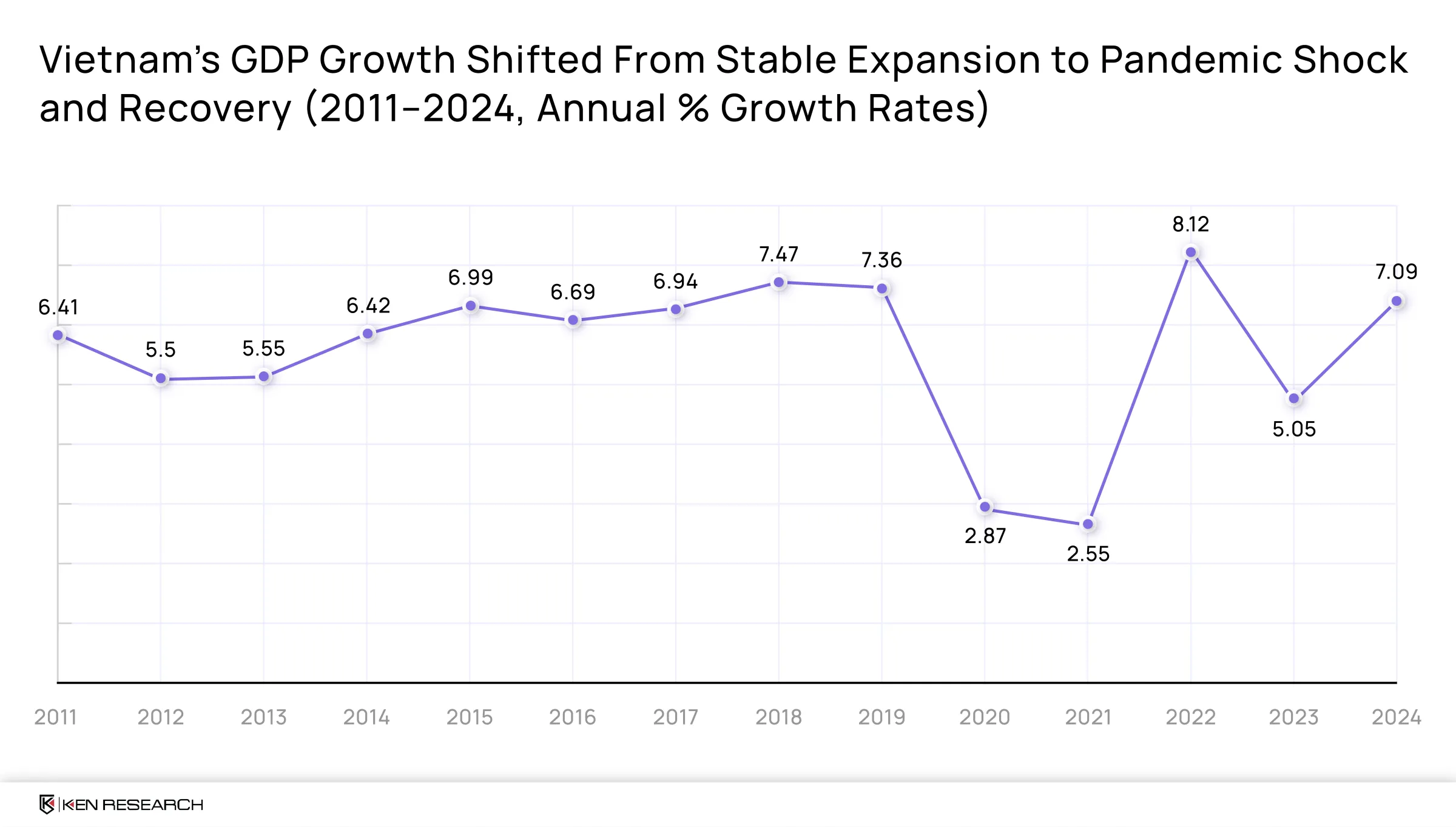
Vietnam's manufacturing reached 24.43% of GDP in 2024 per World Bank data—matching China's industrial intensity. GDP grew 7.09%, accelerating from 5.98% in Q1 to 7.55% in Q4, driven by manufacturing up 8.32% per Vietnam's General Statistics Office (GSO). What distinguishes Vietnam is extreme export concentration combined with foreign ownership of production capacity.
Exports hit USD405.53 billion in 2024, up 14.3%, representing 87% of GDP based on GSO figures showing USD786.3 billion total trade against USD476 billion GDP. Foreign-invested enterprises generated USD290.94 billion in exports, 71.7% of the total, while domestic firms contributed USD114.59 billion (28.3%) per GSO. Foreign Direct Investment disbursements reached USD 25.35 billion in 2024, up 9.4%.
Between 2015 and 2023, FDI averaged 4.8% of GDP annually, per OECD Economic Surveys: Vietnam 2025, higher than other ASEAN countries, China, and India. Multinational corporations use Vietnam as a manufacturing platform for global value chains in electronics, textiles, and footwear. Private consumption accounts for 41% of GDP per OECD, higher than China's 38% but far below India's 61.8%.
The growth model is straightforward: foreign companies build factories, produce for export markets, hire Vietnamese workers, pay wages, and those wages fund domestic consumption. Vietnam retail market grows when export factories expand employment, not from autonomous domestic spending patterns. External demand determines everything—output levels, employment rates, income growth, and consumption capacity.
Trade Exposure Defining Economic Resilience and Vulnerability Across India, China, and Vietnam
India's exports measured 22.8% of GDP in 2023, per WTO data moderate trade exposure that limits vulnerability to global demand shocks but constrains manufacturing-led income growth. When global demand drops, India's consumption-driven economy shows resilience a pattern IMF regional outlooks document repeatedly. The tradeoff is straightforward: India sacrifices export-driven income acceleration in exchange for demand stability and reduced exposure to external volatility.
China's 19.7% export-to-GDP ratio looks comparable but translates to USD3.77 trillion in absolute volume. When global demand contracts, China feels it immediately in factory employment and wages, but the sheer scale of domestic industrial capacity provides cushioning smaller economies lack. Manufacturing for both domestic and export markets creates diversification, if external demand weakens, domestic consumption can partially compensate.
Vietnam's 87% export-to-GDP ratio makes external demand the dominant force determining output, employment, and income formation. A global slowdown hits Vietnam harder and faster than either China or India. These profiles explain why direct competition doesn't apply. China competes on industrial concentration and technological sophistication. Vietnam competes on cost arbitrage and 'China+1' positioning. India competes on consumption volume, demographic scale (1.429 billion people, median age 28 per UN 2024 estimates), and demand stability. India serves as a destination market where products get consumed, not a manufacturing hub where they get exported.
What Would Be Required for India to Shift Toward Manufacturing-Led Growth?
Transitioning India from consumption-led to manufacturing-led growth demands crossing specific structural thresholds that would take decades to achieve. Manufacturing value added would need to exceed 22–25% of GDP consistently, currently at 15–17%, requiring nearly 50% sectoral expansion sustained over multiple economic cycles. This means adding approximately US 600–800 billion in annual manufacturing output at current GDP levels, equivalent to building Vietnam's entire manufacturing sector inside India.
Export intensity would need to surpass 40% of GDP from the current 22.8%, demanding a 75% increase in export volumes from approximately USD 776 billion in 2023 to over USD 1.36 trillion while maintaining competitiveness against established exporters. This requires securing preferential trade agreements providing tariff-free access to major markets comparable to what Vietnam enjoys through CPTPP, EVFTA, and RCEP frameworks.
Component ecosystems would need depth comparable to Guangdong's electronics clusters or Ho Chi Minh City's industrial zones, enabling multi-tier local sourcing that currently doesn't exist at scale. Infrastructure investments would need to prioritise dedicated manufacturing corridors with freight networks, industrial land banks, and reliable power supply, estimated at USD 500 - 700 billion over 15 - 20 years by industry assessments from organisations including the Confederation of Indian Industry and the National Manufacturing Competitiveness Council.
Labor productivity in manufacturing would need to reach levels justifying wage premiums versus Vietnam while maintaining cost advantages versus China. This requires massive skill development programs across technical education, vocational training, and apprenticeships affecting 100+ million workers. The National Skill Development Corporation estimates India needs to skill 400 million workers by 2030 to meet industrial demands, requiring coordinated efforts across 38 Sector Skill Councils and thousands of training centres.
Regulatory harmonisation across India's 28 states and 8 union territories would need to match China's centralised industrial policy or Vietnam's streamlined FDI approval processes currently fragmented with varying compliance requirements, tax structures, and labor regulations. The Goods and Services Tax represented a significant step, but industrial licensing, environmental clearances, and land acquisition remain state-controlled with significant variation. These are generational transformations requiring 20–30 years of coordinated policy, sustained investment, and political consensus across multiple administrations.
Conclusion
India's retail market operates on fundamentally different economics than manufacturing-export models. China's industrial concentration pathway produced USD4.85 trillion manufacturing output, representing 30% of global production. Vietnam's extreme trade-dependence approach achieved 87% export-to-GDP ratio through FDI-driven integration into multinational supply chains. India's demand-led model generated USD2.1 trillion in private consumption, driving 61.8% of GDP. These aren't variations, they're distinct architectures optimised for different competitive advantages.
Ken Research analysis indicates India retail sector will continue outperforming manufacturing-led economies on demand stability, transaction frequency, and consumption growth trajectory. The demographic dividend remains India's most durable competitive advantage: median age 28 ensures consumption momentum extends through 2040 and beyond, while China confronts demographic headwinds from population ageing and declining working-age cohorts projected to shrink by 200+ million by 2050 per UN Population Division forecasts.
Manufacturing investments in India generate sustainable returns when tightly aligned with domestic retail demand trajectories—targeting FMCG, consumer electronics, automotive, textiles serving local consumption patterns—rather than positioned as export-substitution strategies attempting to displace established manufacturing powerhouses. The automotive sector, contributing 7.1% to GDP and producing 31+ million units in FY2025 per NITI Aayog, demonstrates successful domestic demand-driven manufacturing at scale.
The strategic insight for executives and investors is recognising that multiple pathways to economic scale coexist in contemporary global markets. China proves industrial concentration works through four decades of coordinated export-oriented industrialisation. Vietnam proves extreme trade exposure drives rapid growth when integrated into multinational supply chains with supportive trade frameworks. India proves that consumption-led expansion reaches a comparable scale through demographic momentum and market depth. These aren't competing strategies converging toward identical endpoints, they're distinct models succeeding because each aligns with underlying structural conditions rather than attempting to replicate alternatives designed for entirely different economic contexts.
Related tags
Consumer Products and Retail
Get started
We've helped companies around the world future-proof
their businesses - and we can do the same for you.