GCC Insurance Market Outlook 2025: Low 1.5% Penetration Meets Mandatory Health Expansion, Digital Shift & 5.3% CAGR Growth
Ken Research
December 18, 2025 - 6 min read

December 18, 2025
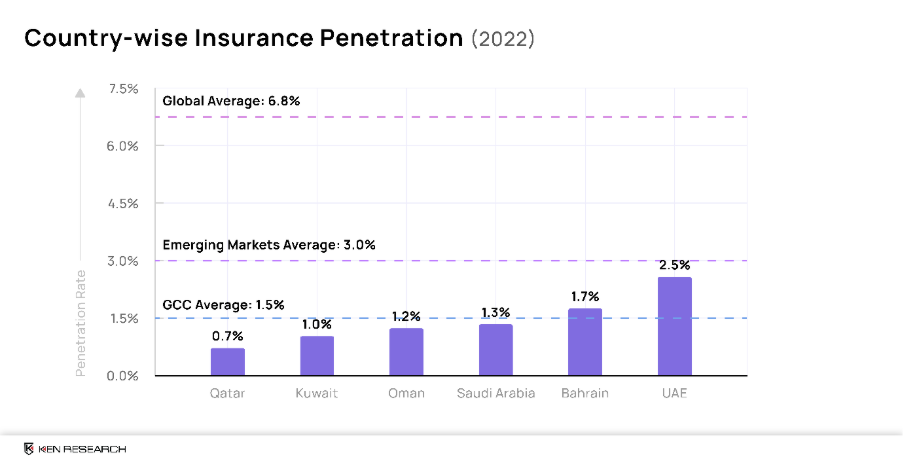
by Khushi RastogiThe GCC insurance industry is entering a new phase of maturity, supported by regulatory reforms, sustained economic growth, and rising consumer awareness. Despite premiums reaching USD 32.7 billion in 2022, penetration remains structurally low at 1.5%, far below the global benchmark of 6.8%.
Yet, the region is now positioned for steady multi-year expansion as governments broaden mandatory coverage, insurers adopt technology more aggressively, and mega-projects expand insurable assets.
With the GCC expected to maintain strong non-oil GDP momentum in 2025 (IMF forecasts 3–4% growth across the UAE and Saudi Arabia), the insurance sector is set to benefit directly from deeper economic activity and expanding working populations.
Insurance penetration in the GCC remains nascent, but fundamentals are strengthening
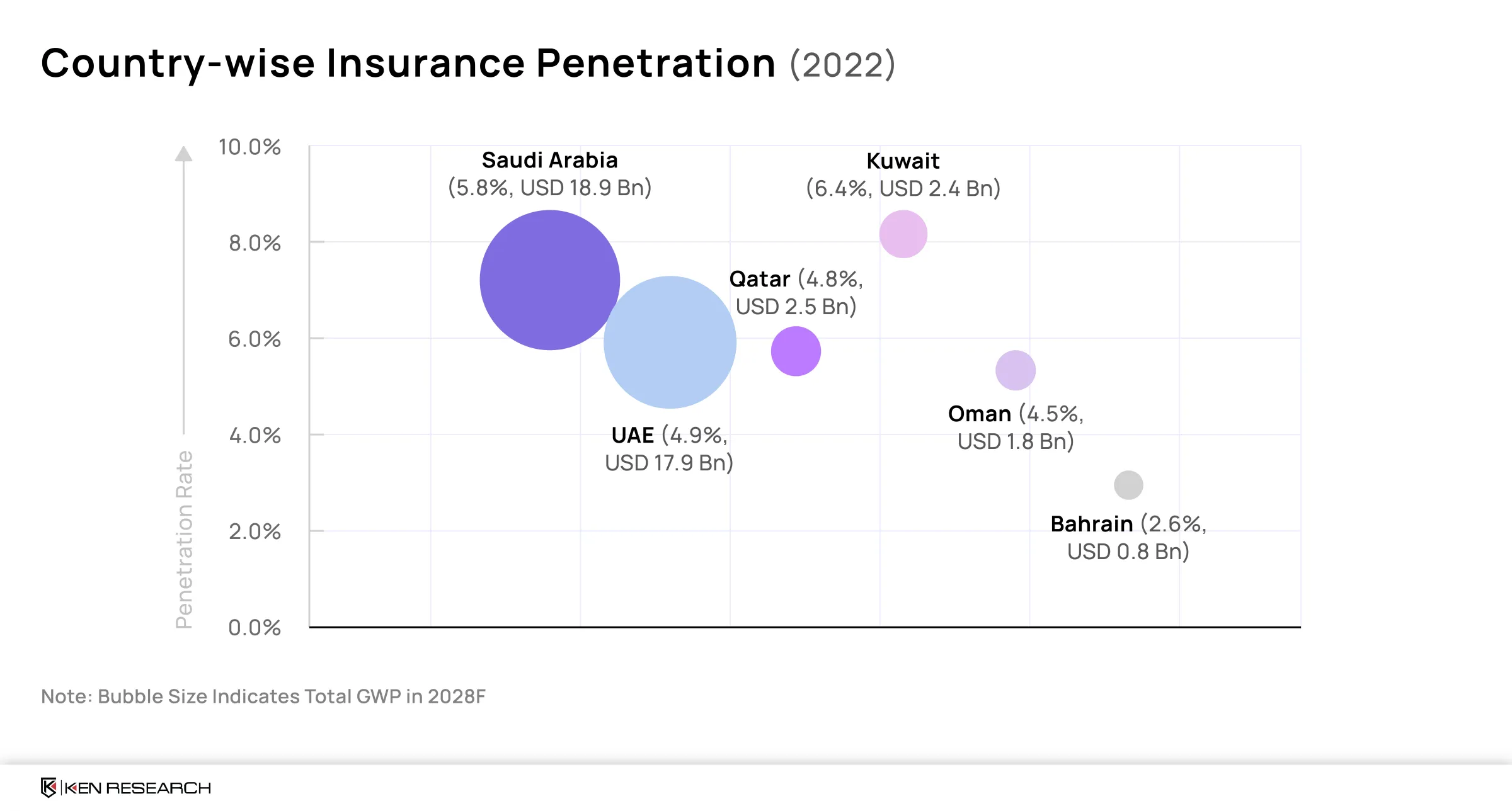
GCC insurance penetration (GWP as % of GDP) continues to lag global markets. The region averaged 1.5% in 2022—significantly below emerging-market levels (3%) and well below those of developed economies. UAE remains the most penetrated market at 2.5% in 2022, while Qatar sits at the lowest end at 0.7%, primarily due to limited life insurance uptake.
Non-life insurance constitutes 88.5% of total GCC premiums, driven by mandatory health and motor schemes. Life insurance remains underdeveloped at 11.5%, reflecting cultural preferences, low long-term savings behavior, and heavy expatriate populations who often hold policies abroad.
However, this dynamic is gradually shifting. Government-mandated health coverage expansion, improved enforcement systems (such as Saudi Arabia’s electronic motor compliance checks), and rising financial literacy are steadily improving adoption levels. Additionally, with the GCC population expected to reach 63.4 million by 2028, demand for both life and protection products will structurally rise.
Adoption momentum continues to build as mandatory schemes widen across the region
Across the GCC, insurance adoption is strengthening due to expanding compulsory lines and improved distribution infrastructure. Saudi Arabia surpassed the UAE to become the largest market, holding 43.5% of GCC premiums, supported by USD 14.2 billion GWP in 2022 (+26.9% YoY). The boom was led by health and motor insurance, which together accounted for nearly 80% of total premiums.
In the UAE, policy reforms, including the Involuntary Loss of Employment (ILOE) scheme introduced in 2023 have contributed to higher non-life demand. By November 2023, more than 6.6 million workers had enrolled, making it one of the most widely adopted labour protection schemes globally. Meanwhile, Kuwait recorded the region’s fastest five-year GWP CAGR at 8.7%, driven by the expansion of AFYA medical coverage for expatriates and retirees.
Qatar, Oman, and Bahrain also continue strengthening adoption through health insurance mandates. Qatar implemented the first phase of its mandatory visitor health policy in 2023, while Oman expanded compulsory health coverage for private-sector expatriates.
As 2025 begins, GCC-wide adoption is expected to accelerate further, supported by sustained employment growth, reforms in expatriate visa regulations, and increased private-sector hiring. Additionally, Saudi Arabia and the UAE are projected to maintain strong job creation through 2025, which directly expands the base of insured individuals.
Digital transformation and Insurtech collaboration are reshaping customer experience and operating models
The GCC is emerging as an early adopter of digital insurance models, with regulators actively pushing for technology-backed governance, reporting, and consumer protection. Saudi Arabia’s online insurance sales reached 9.9% of total premiums in 2022, up from 7.5% in 2021—reflecting a significant shift toward digital-first behavior.
Insurers across the region are deploying AI-driven underwriting, automated claims assessment, real-time risk scoring, and fraud analytics. UAE carriers are using algorithmic pricing and digital onboarding to improve accuracy and reduce turnaround times, while enablers like Democrance and Klaim help insurers digitize group health administration and claims reconciliation.
Regulatory ecosystems are also evolving. Saudi Arabia established its standalone Insurance Authority (IA) in late 2023, signalling a transition toward more unified, technology-oriented supervision in 2024–2025. Meanwhile, the UAE Central Bank continues to issue digital compliance guidelines, anti-money laundering frameworks, and solvency-based capital rules.
Consolidation is gaining momentum as IFRS 17 and solvency pressures reshape the competitive landscape
M&A activity has accelerated across the GCC as insurers adapt to tougher regulatory and capital requirements. In 2022, major mergers took place in Saudi Arabia (Walaa–SABB Takaful; Arabian Shield–Al Ahli Takaful) and the UAE (Dar Al Takaful–Watania). The Takaful segment-already the world’s largest in the GCC, representing 55.7% of global contributions, saw heightened consolidation due to pricing pressure and rising fixed costs.
This consolidation cycle is expected to continue through 2025 as IFRS 17 demands more sophisticated actuarial modelling, disclosures, and capital adequacy. Mid-sized insurers face operational strain, making mergers a strategic pathway to scale, diversification, and expense optimization.
At the same time, increasing reinsurance costs and a hardening global reinsurance market are pushing GCC insurers to strengthen balance sheets and retention ratios.
Insurable assets are expanding as mega-projects, demographics, and economic diversification accelerate
The GCC landscape is undergoing extensive transformation driven by large-scale infrastructure projects, renewable energy investments, and national diversification agendas.
Saudi Arabia’s NEOM, Red Sea, and Qiddiya megaprojects continue to create demand for engineering, liability, property, and specialty lines. UAE’s real estate development surge, combined with energy transition investments, is expanding corporate insurance requirements.
Tourism-led policies (visitor insurance mandates in Saudi Arabia, Qatar, and the UAE) are lifting travel health premiums. Rising personal mobility and vehicle registrations across KSA and UAE are supporting motor insurance growth. Young working populations forming the majority demographic in the GCC continue to drive interest in protection and life solutions.
Headwinds persist as claims inflation, reinsurance hardening, and compliance demands intensify
Despite favorable growth conditions, the GCC insurance sector continues to face structural challenges:
- Medical and motor claims inflation remains elevated due to rising treatment costs, parts inflation, and supply-chain pressures.
- Heavy dependence on global reinsurers exposes insurers to reinsurance price volatility.
- Price competition in motor and medical segments remains intense, limiting margin expansion despite premium growth.
According to the IMF’s 2025 inflation outlook, GCC countries will maintain relatively moderate inflation, but medical costs globally are expected to rise faster than headline inflation, a direct pressure point for health insurers.
Ken Insight
The GCC insurance ecosystem is shifting from a traditional, premium-volume market to a capability-led, digitally anchored model. Leadership teams must recognize three strategic imperatives:
1. Mandatory coverage and demographic expansion will remain the core engines of growth.
Health, motor, visitor health, and workforce protection schemes will account for most of the GCC’s premium additions through 2025 and beyond.
2. Profitability will hinge on technology, not scale alone.
AI-led underwriting, automated claims, improved fraud analytics, and digital distribution will determine competitiveness more than sheer GWP.
3. Consolidation cycles will redefine market structure.
As IFRS 17 and solvency requirements tighten, insurers with stronger balance sheets and integrated digital systems will outperform. Mid-sized Takaful and composite carriers are most likely to pursue mergers.
According to Ken Research, the GCC insurance market is moving toward a more transparent, regulated, digitally integrated structure. Those who invest early in analytics, capital resilience, and customer-centric digital models will capture disproportionate value in the next five years.
Related tags
Insurance
Banking Financial Services and Insurance
Get started
We've helped companies around the world future-proof
their businesses - and we can do the same for you.