KSA Waterproofing and Insulation: Secure Specifications Before Building Capacity
Ken Research
August 25, 2026 - 10 min read
August 25, 2026
by Ken ResearchIn Saudi Arabia’s waterproofing and thermal-insulation market, localisation creates value only when local capacity translates into technical eligibility, specification access and attractive delivery economics.
Localisation forms part of this competitive structure, but its commercial relevance varies by product technology, demand density, certification requirements and achievable capacity utilisation.
- Market value outpaces installed-volume growth
- Direct sales reach 43.1–48.1% by 2030
- Specifications determine access before procurement begins
- Compliance enables entry, not project access
- Local capacity requires proven demand utilisation
The central question is therefore: Under what conditions does localisation improve a supplier’s access to Saudi waterproofing and thermal insulation demand and when does it introduce more capital and execution risk than it offers in commercial advantage?
Market Growth Is Supported by Both Volume and Specification Intensity
Saudi Arabia’s waterproofing and thermal-insulation markets are both expanding through 2030, but the more important commercial signal is that market value is growing faster than installed volume. This points to a shift in project requirements, product specifications and application intensity rather than a simple increase in construction area.
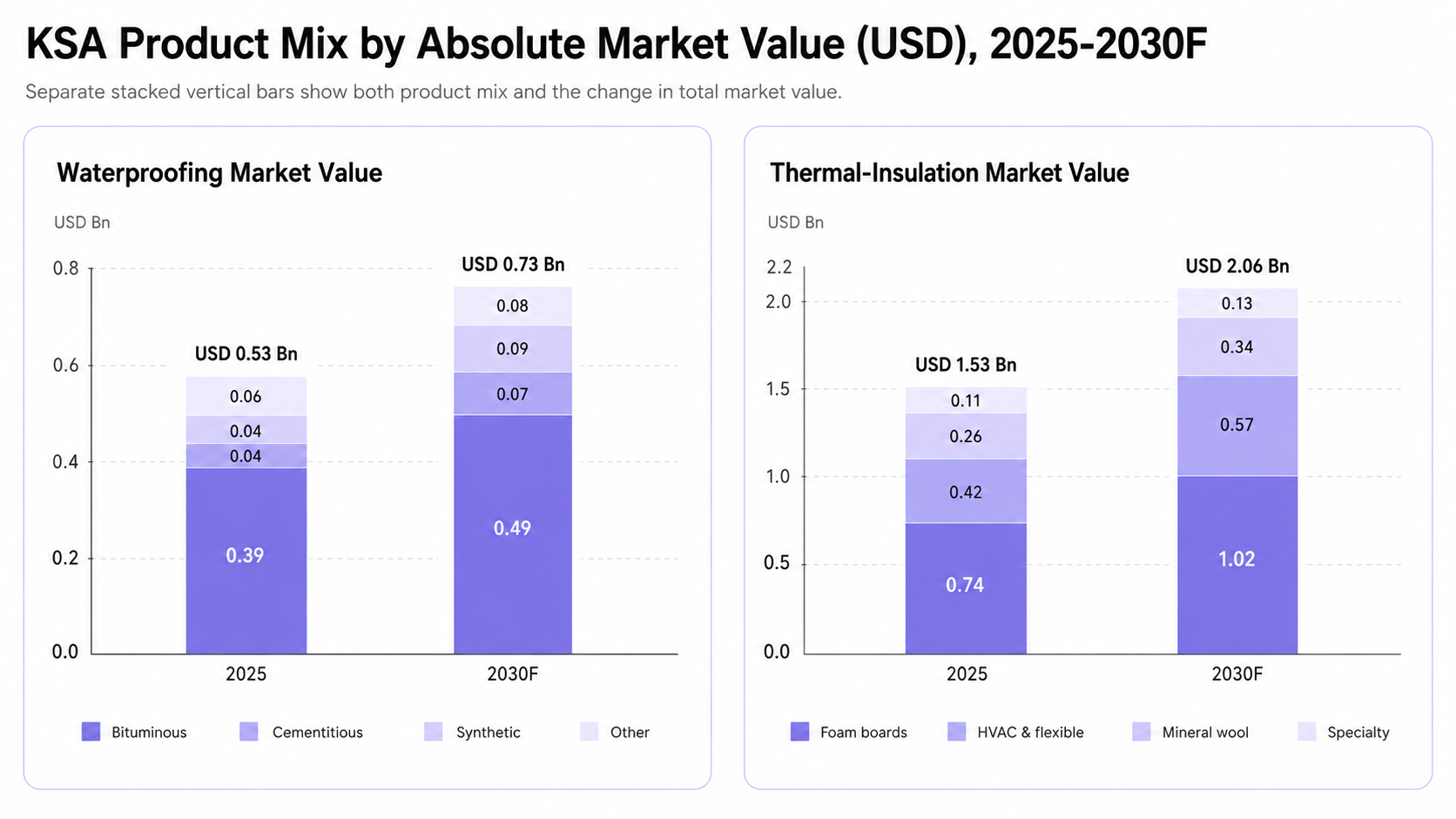
On an implied basis, waterproofing value per m² rises from approximately USD 3.12 in 2025 to USD 3.52 by 2030. Thermal insulation increases from approximately USD 6.67 per m² to USD 6.67 over the same period.
The product mix suggests evolution rather than wholesale substitution. Bituminous membranes will remain the foundation of the waterproofing market, but faster growth is shifting toward synthetic membranes and cementitious systems. These products are increasingly relevant where projects require greater durability, more specialised below-grade protection with demanding technical specifications.
Thermal insulation follows a somewhat different pattern. Foam boards and insulated panels retain their dominant position because they are closely aligned with building-envelope performance, prefabricated construction and energy-efficiency requirements. HVAC and flexible insulation also remain important as district cooling, chilled-water networks, ductwork and other MEP-intensive systems expand across major developments.
The strategic implication is that scale and growth will increasingly come from different parts of the portfolio. Established categories will continue to generate most market value, while specification-driven products are positioned to capture a disproportionate share of incremental demand. Suppliers will therefore need both efficient scale in conventional products and targeted technical capabilities in advanced systems to participate fully in the market’s expansion.
Demand Is Broad, but Its Material Intensity Varies by End User
Saudi construction activity creates demand across residential, hospitality, industrial, commercial and infrastructure applications. However, built-up area alone does not determine the addressable opportunity; coverage intensity and end-user market share materially change where waterproofing and insulation demand concentrates.
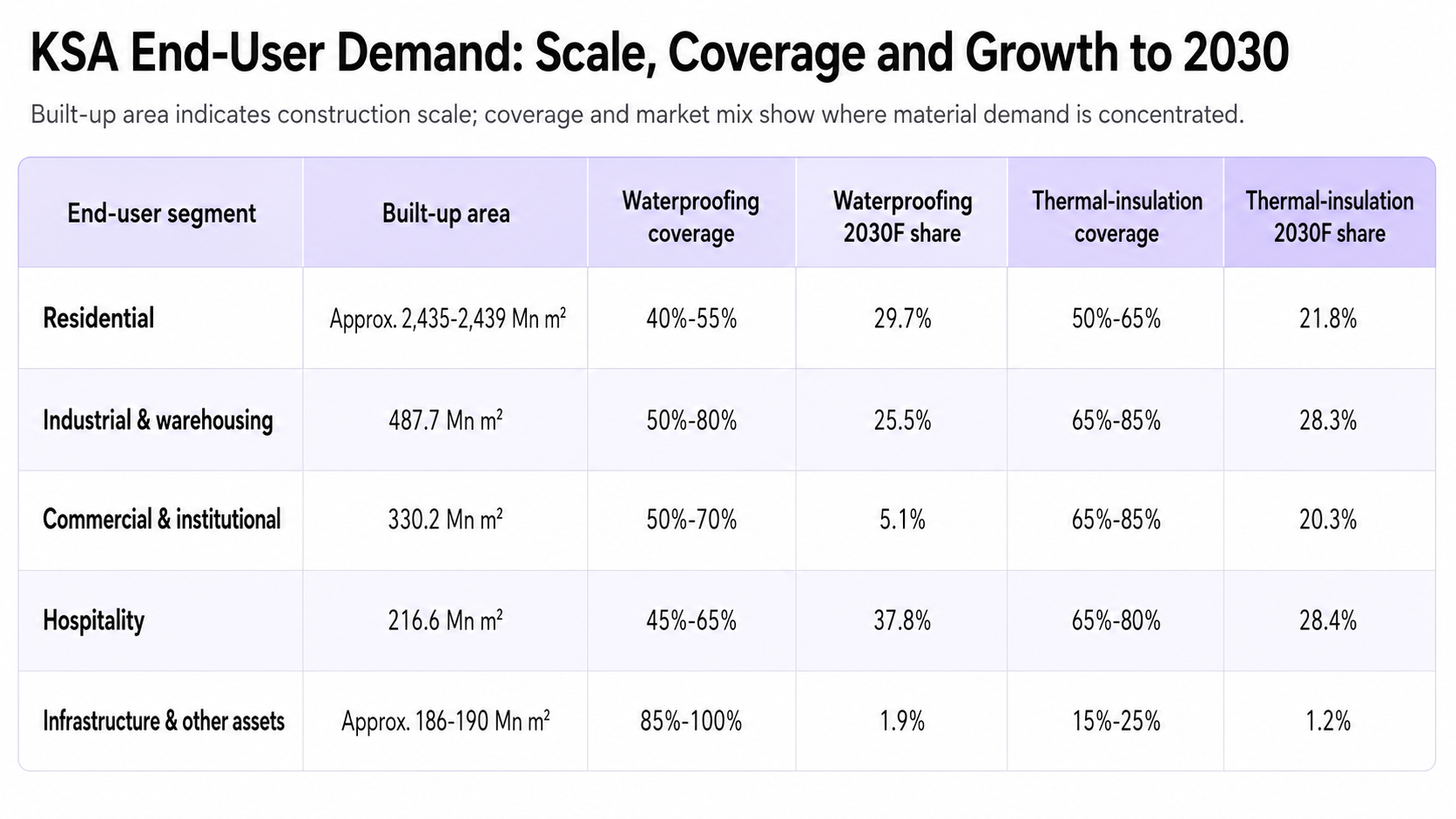
The end-user profile separates physical scale from material intensity. Residential provides the largest construction base but does not lead every value pool. Hospitality is forecast to account for 37.8% of waterproofing demand and 28.4% of thermal-insulation demand by 2030, making it important to both markets. Industrial and warehousing anchors insulation alongside hospitality, supported by thermal-control, logistics, cold-chain and MEP requirements.
Infrastructure presents the opposite pattern: waterproofing coverage reaches 85%–100%, while insulation coverage is only 15%–25%. Its opportunity is therefore concentrated in below-grade and water-resistance systems rather than broad building-envelope solutions.
Regulation Raises the Entry Threshold, but Compliance Does Not Guarantee Market Access
Thermal-insulation demand is increasingly shaped by Saudi Building Code requirements, including SBC 601/602, SASO-related conformity and progressively tighter U-value standards. The maximum wall U-value shown in the report declined from 0.53 in 2007 to 0.31 in 2024. Because lower U-values indicate reduced heat transfer, this trend points to stronger insulation-performance requirements.
Saudi Arabia’s operating environment further raises the performance threshold. Summer temperatures above 50°C, long-term warming and flash-flood exposure increase requirements for UV resistance, thermal stability, moisture protection, roof performance, drainage and below-grade waterproofing. LEED criteria, Environmental Product Declarations and low-VOC specifications add another layer of documentation and sustainability requirements.
These standards support demand for technically proven products, but they also increase participation costs through testing, certification, product development and periodic approvals. The critical distinction is between regulatory eligibility and competitive qualification.
Compliance allows a product to participate in the market; it does not guarantee inclusion in project specifications or approved-vendor lists. Developers and consultants may impose standards above regulatory minimums, particularly in hospitality, infrastructure and giga-projects. Suppliers must therefore demonstrate project-specific performance, system compatibility, technical documentation and reference credentials.
Local manufacturing does not remove these requirements. Localisation creates an advantage only when domestic capacity is supported by conformity, specification acceptance and the technical capability required to convert eligibility into project approval.
Direct Procurement Is Raising the Importance of Specification Access
Saudi Arabia’s waterproofing and thermal-insulation markets are served through direct-project sales, distributor and specialist subcontractors. All three channels are forecast to expand through 2030, but direct-project sales are expected to consolidate their position as the largest route to market in both categories.
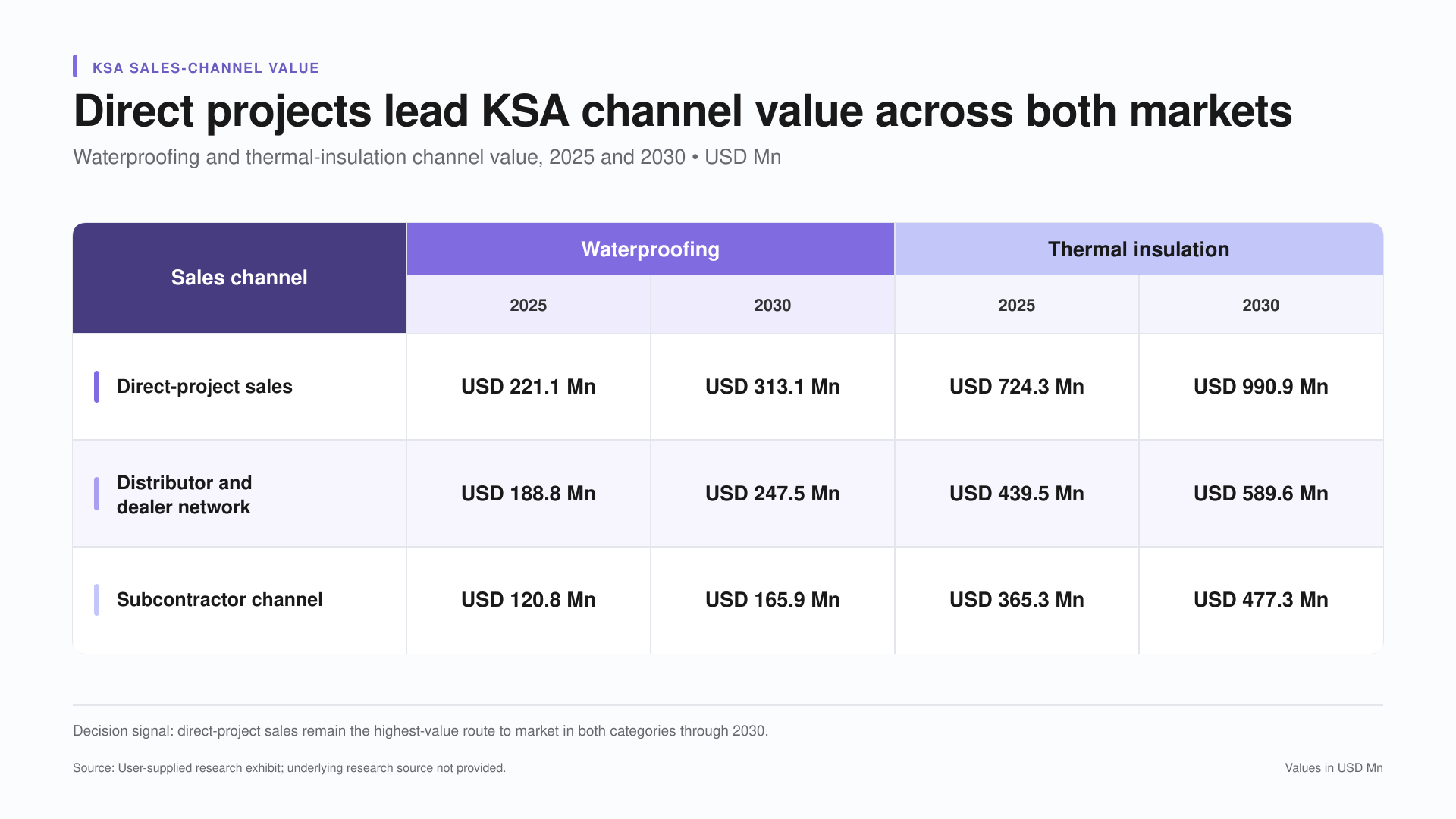
The channel outlook indicates a rebalancing rather than the displacement of distribution. Distributor and subcontractor sales continue to increase in absolute terms, preserving their importance in fragmented, smaller-scale and price-sensitive demand. Direct-project sales, however, capture the largest share of both markets by 2030, reflecting the increasing commercial importance of large and centrally procured developments.
Market access therefore depends on three thresholds:
- Technical access: The product satisfies applicable conformity, code and performance requirements.
- Specification access: The product or system is accepted for the targeted project.
- Commercial access: The supplier can meet pricing, delivery, service and execution requirements at an acceptable return.
Success at one threshold does not guarantee conversion at the next. A compliant product may remain outside a project specification, while an approved product may still lose the order because of substitution, pricing, availability or delivery risk.
This distinction is central to the localisation decision. Domestic manufacturing can reduce lead times, strengthen supply continuity and improve responsiveness to project requirements. It cannot, however, substitute for technical qualification, consultant engagement or approved-project access. Local capacity becomes commercially valuable only when it is connected to the specification process and can convert project approvals into profitable, collectable revenue.
Three Capabilities Determine the Commercial Relevance of Localisation
Technical eligibility
Technical eligibility determines whether a supplier’s products and supporting evidence are suitable for the targeted applications. Requirements may include Saudi conformity approvals, building-code compliance and thermal testing, U-value documentation, environmental credentials, system compatibility, installation procedures and project-specific warranties.
Two distinct thresholds apply:
- Regulatory eligibility: The product meets the requirements necessary to be sold or used in Saudi Arabia.
- Project eligibility: The product satisfies the more specific performance and documentation requirements imposed by an owner, consultant or developer. Local production improves availability but does not guarantee access to higher-value specifications. It creates value only when locally manufactured products qualify for targeted projects; specialist applications may be better served initially through imports or licensed technology.
Specification Access
Specification access is the ability to influence product selection before procurement becomes primarily price-driven. It depends on early project identification, engagement with developers and consultants, EPC account management, technical submissions, vendor registration, trials, reference projects and control of substitution risk.
Its importance is reinforced by the growth of direct procurement. By 2030, direct-project sales are forecast to represent 43.1% of waterproofing value and 48.1% of thermal-insulation value. In these channels, supplier access is often determined before the purchase order through specifications, approved-vendor lists, technical evaluations, warranties and applicator acceptance.
The addressable market is therefore a conversion funnel:
Relevant project → technical qualification → specification approval → defence against substitution → commercially viable order
Revenue potential narrows at each stage. A technically compliant supplier may not secure project approval, while an approved product may still fail to convert because of price, availability or execution risk.
Local production can strengthen this funnel through faster response, technical support and supply continuity. It cannot replace the capabilities required to secure and convert approvals. Without specification access, a local plant may create capacity before it creates demand.
Delivery economics
Delivery economics determines whether an approved product can be manufactured, supplied and supported at an acceptable return. The assessment should include production scale, capacity utilisation, raw-material sourcing, inventory, delivery schedules, technical support, warranty exposure, receivables, retentions, project delays and capital employed.
Direct-project sales can increase order size and strengthen customer access, but they may also raise working-capital and technical-service requirements. Revenue alone is therefore an insufficient measure of attractiveness.
The relevant commercial test is:
Gross margin less compliance, technical-service, installation-support and warranty costs, adjusted for working capital and capital employed.
A high-value contract can still produce weak cash returns when payments are delayed, inventory is committed early, input costs cannot be passed through or capacity remains underutilised.
Localisation can improve economics through shorter lead times, lower finished-product freight, customisation and greater supply reliability. These benefits must outweigh additional fixed costs, certification expenditure and underutilisation risk.
Localisation Models Should Be Assessed by Product and Application
Localisation is not a binary choice between importing and owning a Saudi factory. It covers a range of operating models.
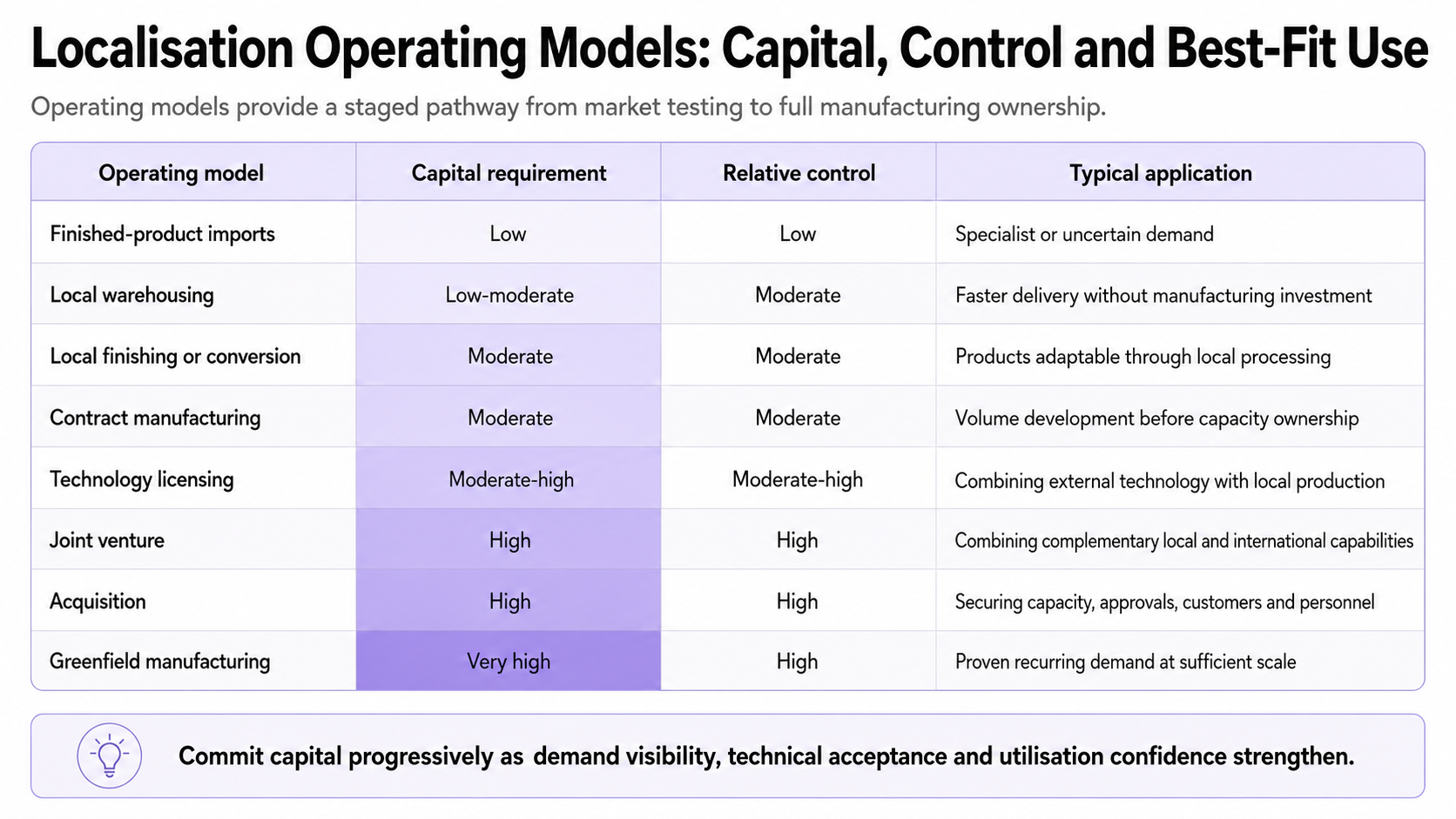
The appropriate model depends on product economics.
Bituminous membranes
Bituminous membranes provide the largest waterproofing revenue pool and continue adding substantial absolute value through 2030. Their mature technology and large demand base may support domestic manufacturing where scale, sourcing and utilisation are adequate.
The category is nevertheless competitive and forecast to lose relative share. A new facility would require a clear advantage in cost, distribution, project access or product performance.
Synthetic membranes
Synthetic membranes have the strongest forecast growth and share gains in waterproofing but require more specialised manufacturing and technical capabilities.
For suppliers without established technology, licensing, partnership or acquisition may offer a lower-risk route than independent product development. Local production becomes more relevant if addressable project demand is sufficient to support specialised capacity.
Cementitious and crystalline systems
These systems may benefit from local manufacturing because of product weight, formulation flexibility and broad construction applications. Their competitiveness remains dependent on product chemistry, technical support and application quality.
Foam boards and insulated panels
Foam boards and panels represent approximately half of thermal-insulation value and contribute more than half of forecast product-level growth. Their scale provides a potential basis for local capacity, but production economics depend on consistent quality, certification, access to building-envelope specifications and sustained utilisation.
Mineral wool
Mineral-wool manufacturing is capital-intensive and scale-dependent. Entry economics require strong volume visibility, raw-material access, certified performance and a credible route to project demand.
HVAC and flexible insulation
HVAC and flexible insulation is linked to district cooling, chilled-water pipes, ductwork and complex MEP packages. Access depends heavily on MEP consultants, contractors, product approvals and installer familiarity.
Commercial capability within the relevant MEP ecosystem may be as important as manufacturing location.
Regional Demand Adds Another Layer to the Localisation Decision
Waterproofing and insulation demand are geographically concentrated, but the regional patterns differ.
Waterproofing By Region
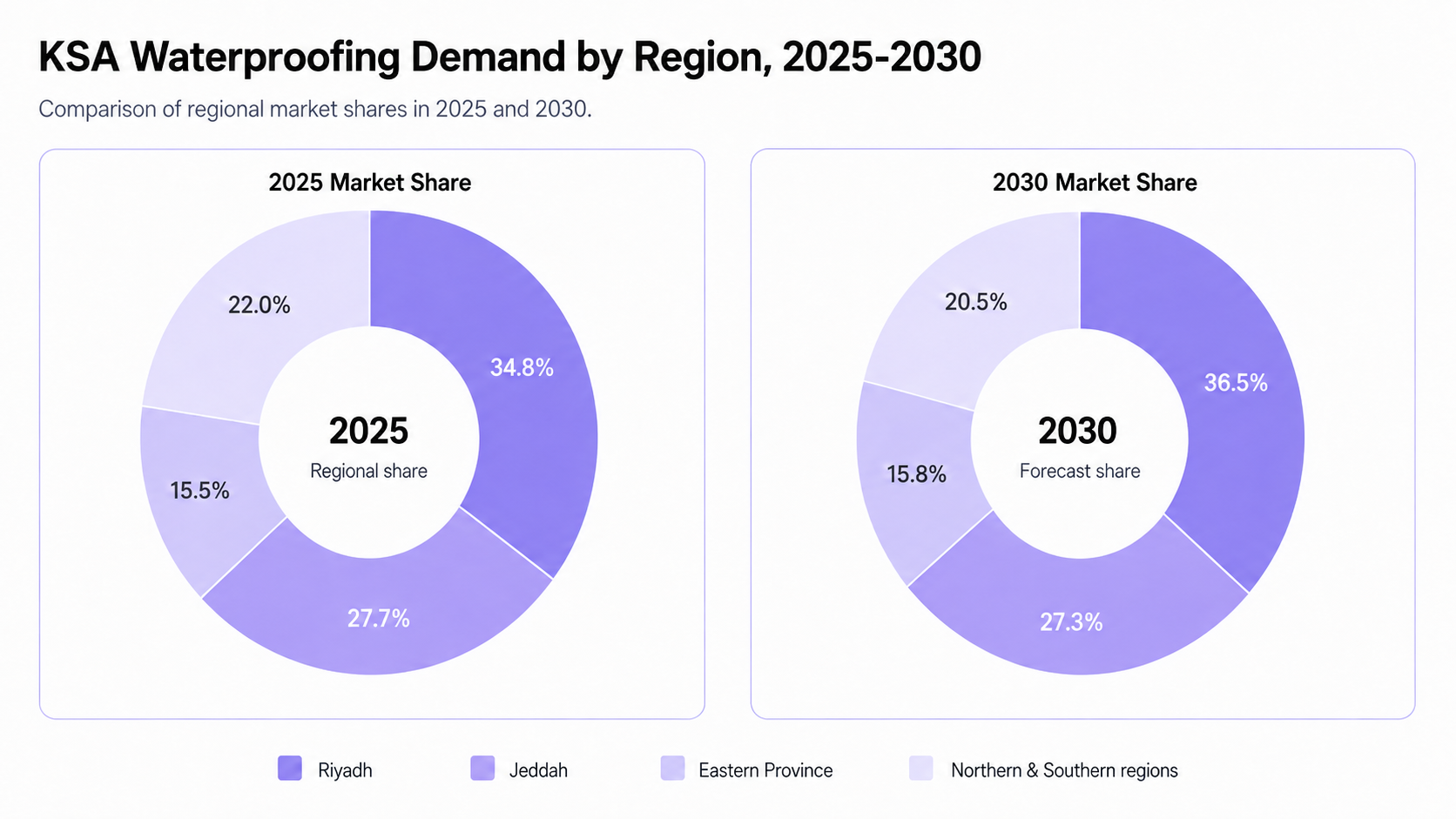
Riyadh provides the largest incremental waterproofing opportunity, supported by concentrated commercial, residential, hospitality and infrastructure development. Jeddah remains the second-largest market. Eastern Province demand is associated more strongly with industrial, petrochemical and logistics applications.
Thermal Insulation By Region
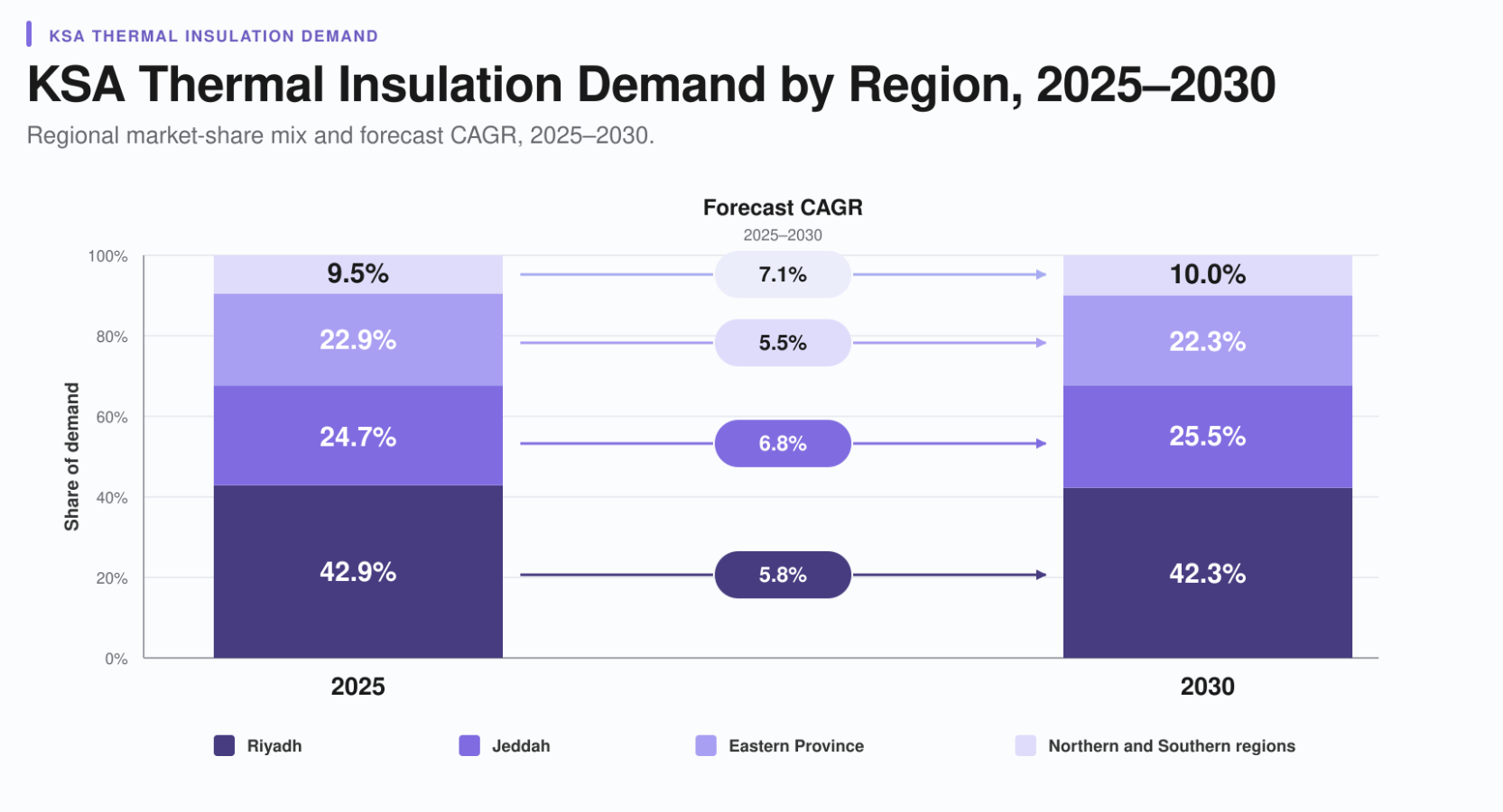
Riyadh remains the largest insulation market, although Jeddah and the combined Northern and Southern regions grow faster. The smaller Northern and Southern base includes demand connected with developments in Tabuk, NEOM and the Red Sea corridor.
For local operations, regional demand affects:
- Plant location
- Warehousing requirements
- Freight economics
- Technical-service coverage
- Applicator availability
- Project-response times
A national market-size estimate may therefore be insufficient for capacity-location decisions. Product demand needs to be mapped against regional project concentration and delivery costs.
Strategic Takeaway
Saudi Arabia’s waterproofing and thermal-insulation markets support a stronger local presence, but market growth alone does not justify manufacturing investment. Increasing specification intensity and the expansion of direct-project procurement create an attractive demand environment, yet accessible revenue remains contingent on technical qualification, consultant approval and commercial conversion. With direct sales forecast to account for 43.1% of waterproofing and 48.1% of thermal-insulation value by 2030, competitive advantage will increasingly depend on securing specification access before procurement begins.
The appropriate response is a staged, product-specific localisation strategy. Scale-led categories, including bituminous membranes and foam boards, may support domestic capacity where recurring demand and utilisation are demonstrable. Technology-intensive systems may favour licensing, contract manufacturing or joint ventures, while application-led categories require strong contractor relationships and installation capabilities. The investment test is therefore whether localisation materially improves project access, delivered economics and sustainable capacity utilisation. Where these conditions remain unproven, imports, local warehousing or partnerships represent more capital-efficient routes to market.
Get started
We've helped companies around the world future-proof
their businesses - and we can do the same for you.