Insights into India's Revitalizing E-Bike Ecosystem
Ken Research
September 24, 2024 - 6 min read
September 24, 2024
by Khushi RastogiThe shift towards electric mobility in India is gaining momentum, with the e-bike segment emerging as a key player in redefining urban transportation. The convergence of environmental concerns, technological innovation, and supportive government policies has set the stage for an e-bike revolution. As urban centers grapple with congestion and pollution, e-bikes offer a sustainable and efficient alternative, aligning with global trends towards greener mobility solutions.
The Indian e-bike market is witnessing rapid growth, with an estimated market size of 504,500 units in 2023. By 2029, it is projected to reach 4,042,220 units, reflecting a remarkable CAGR of 48.90%. This expansion is propelled by urbanization, technological advancements, and a rising demand for sustainable mobility solutions.
At a Glance
- Role of Urbanization: The Delhi government offers purchase incentives of 25% off the MRP on e-cycles.
- Technological Advancements: Lithium-ion batteries have extended e-bike ranges, making them more viable for longer commutes.
- Growth Drivers and Challenges: A 41% annual increase in sales, with 1.66 million EVs sold, highlights both opportunities and hurdles in the market.
Driving the India's E-Bike Market Growth Through Urbanization
- Demand from Urban Commuters: Urban centers such as Delhi, Mumbai, Pune, and Bangalore are leading e-bike adoption, driven by dense populations and significant commuting demands.
Case Study: In Bangalore, e-bike usage has reduced daily commute times by up to 25%, boosting adoption rates among urban professionals.
- Addressing Traffic Congestion: E-bikes provide a practical solution to severe traffic congestion in Indian cities, offering faster and more flexible commuting options.
Economic Impact: In Delhi, e-bike adoption has reduced travel times and eased traffic congestion. By lowering commuting costs, they enhance disposable income and contribute to economic productivity.
- Availability of Charging Infrastructure: The expansion of charging stations in urban areas alleviates "range anxiety," enhancing e-bike usability.
Data Insight: TVS Motor anticipates electric vehicles will constitute 25% of its total two-wheeler sales within the next three years, correlating with increased e-bike sales due to new charging infrastructure.
- Government Support in Urban Areas: Government incentives and subsidies are significantly boosting e-bike adoption in urban areas.
Data Insight: The Delhi government offers a 25% subsidy on the MRP of e-cycles, lowering the financial barrier for consumers.
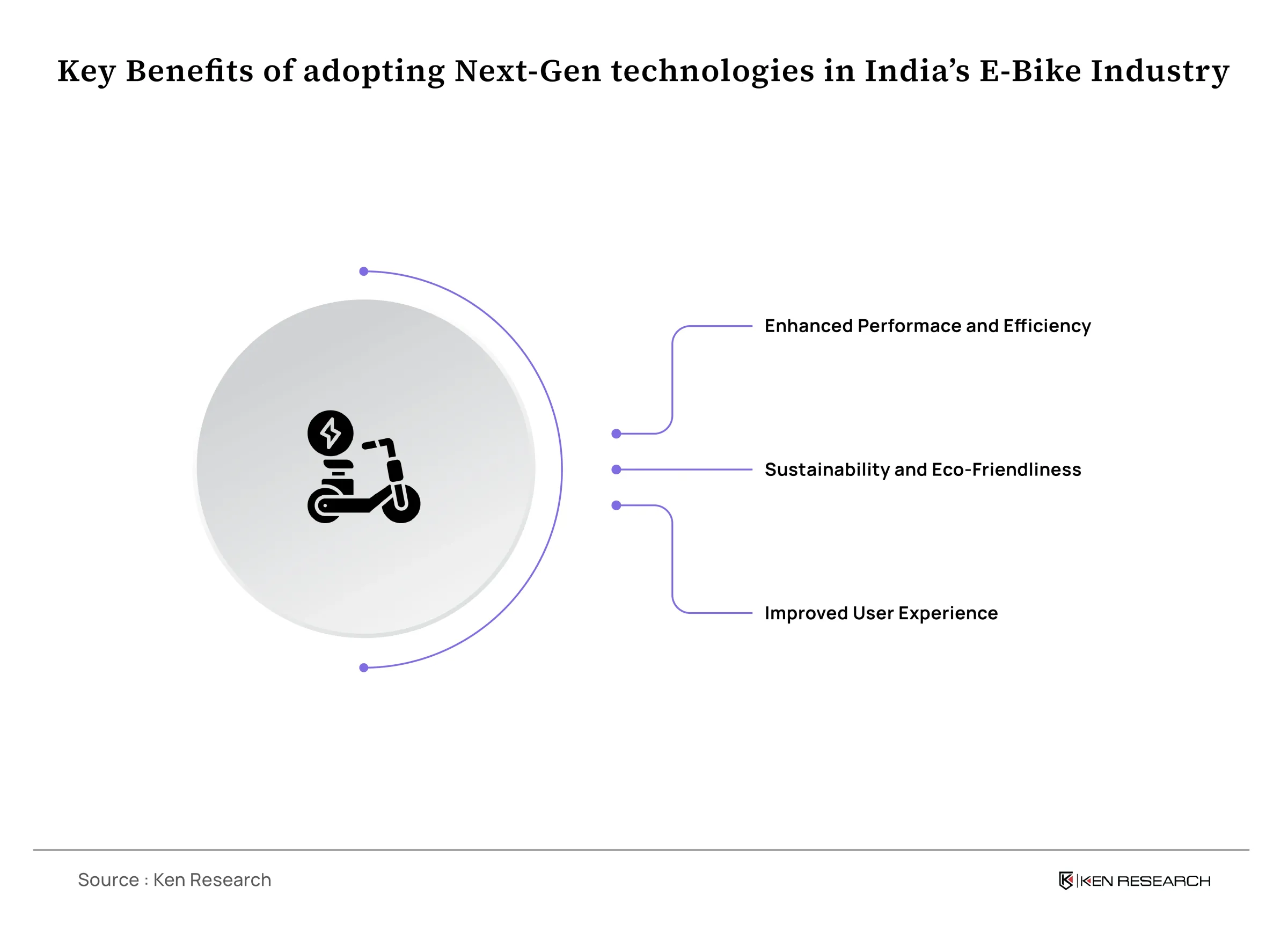
Adopting Next-Gen Technologies in India's E-Bike Industry
- Advancements in Battery Technology: Improved battery efficiency and affordability are added to e-bike performance and range.
Research: Lithium-ion batteries have increased the average e-bike range making them more viable for longer commutes.
- Charging Infrastructure: Government initiatives like the FAME scheme are expanding the network of charging stations across India.
Impact: The number of charging stations in India has doubled in the past two years, significantly supporting e-bike usage. This expansion addresses one of the main barriers to e-bike adoption.
- Efficiency and Performance: Modern e-bikes are designed to be eco-friendly, eliminating emissions and reducing pollution.
Environmental Benefit: E-bikes in Pune have contributed to reduction in urban air pollution levels over the past year. This reduction demonstrates the environmental benefits of switching to electric mobility.
- Government Support: Policies and incentives are encouraging e-bike adoption, reducing the overall carbon footprint.
Case Study: GST has been reduced from 12% to 5% on the sale of electric vehicles. These incentives help to lower the cost barrier for consumers.
Key Drivers for Scaling the Pedal-Assisted E-Bike Segment
- Easy Affordability: Pedal-assisted e-bikes are cheaper than throttle-assisted models, making them accessible to a broader audience.
Insight: The average cost of a pedal-assisted e-bike is significantly lower than throttle-assisted variants, boosting sales among budget-conscious consumers. This affordability is key to widespread adoption.
- No Fuel Cost: The elimination of fuel costs is a significant advantage over traditional vehicles, especially with rising fuel prices.
Data Insight: They are environmentally friendly and emit 50% less carbon than fuel-powered engines.
- High Commuting Demand: The suitability of pedal-assisted e-bikes for daily commuting is driving their popularity in urban areas.
Research: High usage of bikes by students and wage workers commuting daily, saving time and cheap maintenance, further increasing demand.
- Health Benefits: Pedal-assisted e-bikes offer exercise opportunities while commuting, appealing to health-conscious consumers.
Health Impact: One can improve their health and cardio respiratory capacity by riding electric bicycles 30 mins a day.
- Increasing Adoption of EVs: The broader acceptance of electric vehicles is boosting the demand for pedal-assisted e-bikes as a sustainable option.
Data Insight: There has been a 41% annual increase in sales, with 1.66 million EVs sold.
Exploiting the Demand Gap Between Major and Secondary Cities
- Tier 1 Cities: Major urban centers are leading e-bike adoption due to higher demand for eco-friendly mobility.
Initiatives: The Delhi EV Policy has been instrumental in promoting the adoption of e-bikes. The policy includes demand incentives for e-cycles, which have helped reduce the upfront cost and made e-bikes more accessible to commuters.
- Other Cities: Growth in smaller cities is slower due to limited infrastructure and lower demand.
Insight: Ather Energy's CEO stated that over 75% of India's population resides in Tier 2, Tier 3, and rural markets, underscoring the immense potential for electric two-wheeler adoption in these areas.
Overcoming Hurdles in Consumer Acceptance
- High Initial Costs: The upfront cost of e-bikes acts as a barrier for many potential users.
Economic Impact: A recent study found out that nearly 60% of the commuters are willing to adopt an e-bike.
- Limited Charging Infrastructure: The lack of widespread charging facilities hinders e-bike adoption.
Government Initiative: Uttar Pradesh state aims to attract investments for setting up at least 20 charging stations and swapping 5 stations per district over a period of five years.
- Public Awareness and Education: There is a need to educate the public about the benefits of e-bikes to drive adoption.
Government Initiative: Awareness campaigns in Pune increased e-bike inquiries, indicating the potential impact of education.
Reducing Carbon Footprints: Case Studies on the Adoption of E-Bikes Bottom of Form
Case Study - Japan
In Japan, cities like Tokyo and Osaka, they face heavy congestion due to the high population density and limited space to expand road infrastructure. The government invested in developing dedicated bike lanes and parking facilities for e-bikes. This ensured that e-bike users had safe and convenient routes to travel. Subsidies and tax breaks were offered to both manufacturers and consumers. These incentives made e-bikes more affordable and attractive to the public.
Result: Japan’s Traffic Congestion Index decreased by 10% over five years, indicating effective congestion management and a shift in transportation habits.
Case Study - Netherlands
Netherlands needed to maintain their reputation as a cycle-friendly country while addressing the issue regarding transportation congestion in major cities. This significant decrease in traffic not only improved commute times but also reduced the stress and environmental impact associated with traffic jams. Even companies were encouraged to support e-bike commuting for their employees through subsidies and the provision of e-bikes as part of corporate wellness programs.
Result: The adoption rate of e-bikes has increased to 58% and it is expected to grow to 90%.
Case Study - Taiwan
Taiwan sought to tackle transportation challenges and pollution while enhancing its manufacturing capabilities. The government introduced policies and incentives to boost the e-bike market, supporting local manufacturers and encouraging domestic adoption. The manufacturing sector produced high-quality e-bikes at competitive prices, ensuring affordability and economic support.
Result: Taiwan's e-bike market is projected to grow at a CAGR of 7.5% from 2021 to 2030.
Charting the Path for India's E-Bike Market
- Upgradation in Features: Indian consumers are increasingly interested in e-bikes due to shifting ownership preferences, evolving purchase journeys, and enhanced features like higher speeds and larger battery capacity.
Data Insight: Over 50% of consumers are willing to pay up to ₹12,000 extra to upgrade their electric two-wheelers from 80 km/h to 100 km/h.
- Advancements in Technology with Battery and Charging: Advancements in battery and charging technology will further enhance e-bike performance and appeal.
Data Insight: Emerging battery technologies could boost e-bike ranges by 50%, making them more competitive with traditional vehicles. Continued innovation is crucial for sustained growth.
- Increased Competition and Low Cost: New entrants could drive down e-bike prices, enhancing accessibility. Increased competition benefits consumers with improved products and lower prices.
Impact: The entry of new companies could reduce e-bike prices, making them more accessible. Increased competition typically benefits consumers through better products and lower prices.
Conclusion
The Indian e-bike market is poised for exponential growth, driven by urbanization, technological advancements, and a surging demand for sustainable transportation. As consumers increasingly recognize the benefits of e-bikes, future innovations will shape India's electric mobility landscape. Enhanced battery technology, expanded charging infrastructure, and sustained government support are critical for the market's evolution.
Get full report on India E-Bike Market, contact Ken Research today!
Related tags
Automotive and Automotive Components
Automotive, Transportation and Warehousing
Get started
We've helped companies around the world future-proof
their businesses - and we can do the same for you.