58% Export Decline, 37.59% US Anti-Dumping Rate: Can Mexico Replace Lost US Mattress Scale at Home?
Ken Research
September 22, 2026 - 8 min read
September 22, 2026
by Ken ResearchYes. The intro should set up the disruption and the decision, not resolve the article before the reader reaches the first section.
Use this instead:
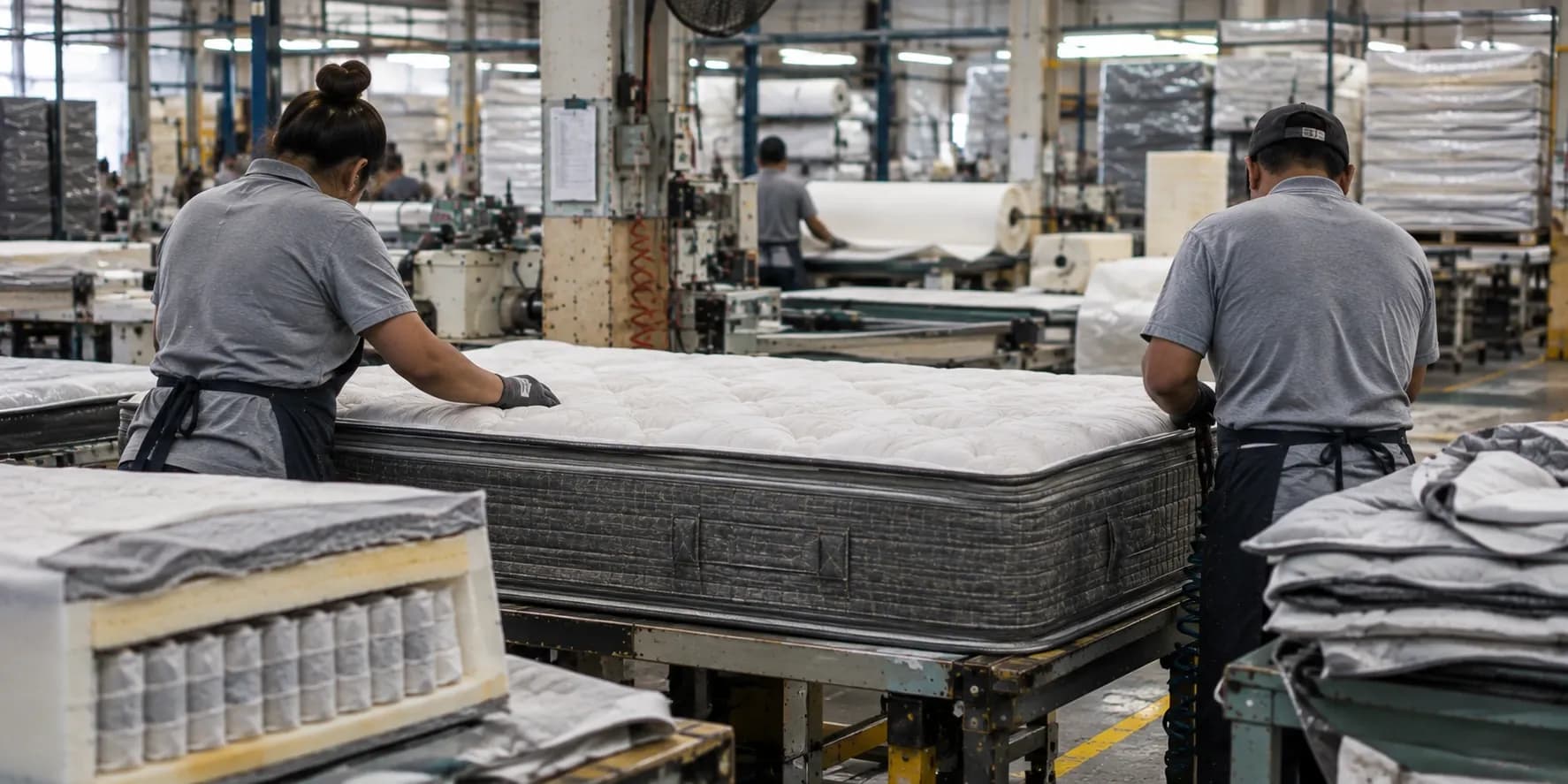
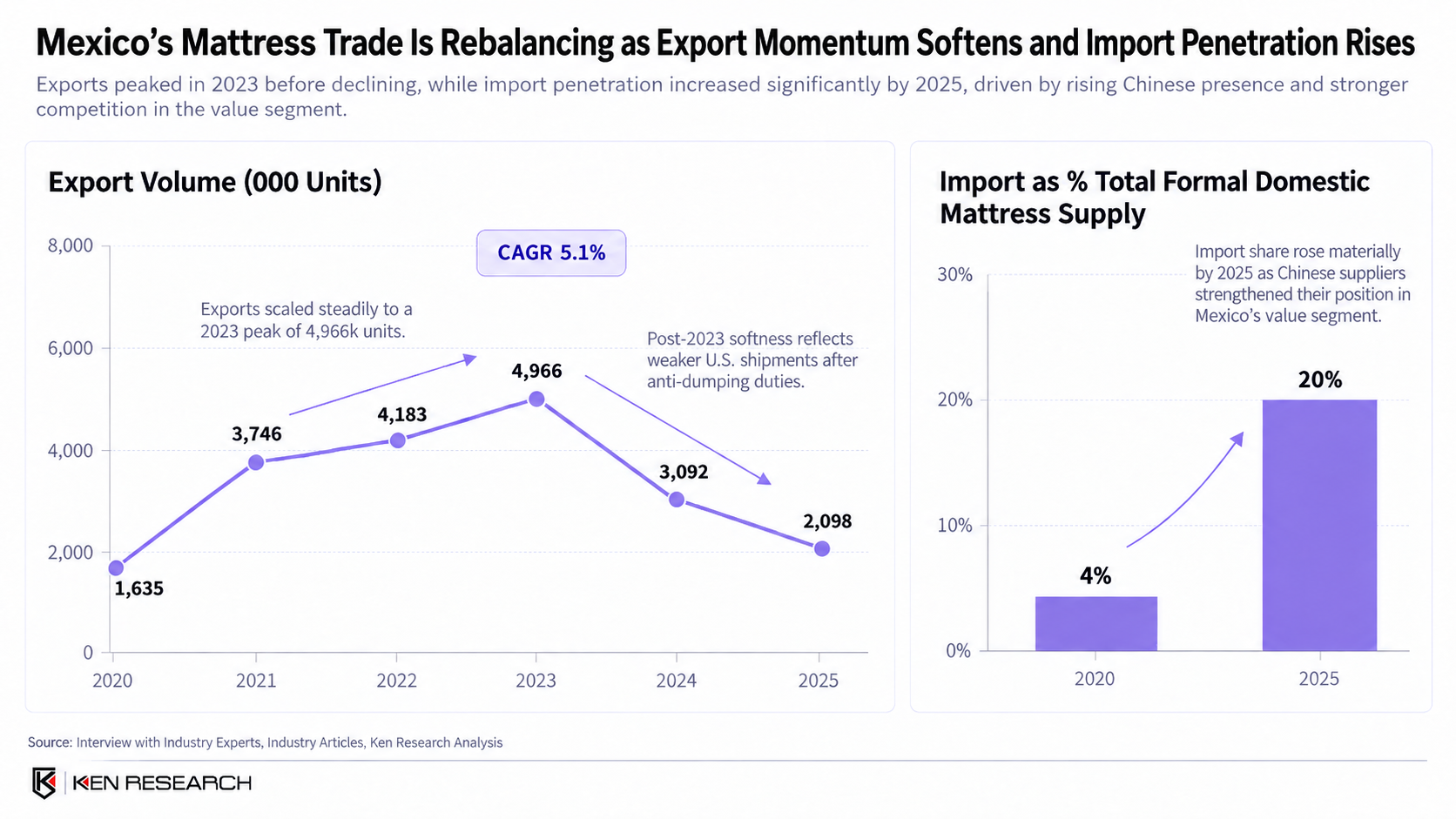
Mexico’s mattress manufacturing model scaled on a simple advantage: produce close to the US and serve the region’s largest mattress market across the border. By 2023, annual exports had reached 4.97 million units, more than three times the 2020 level.
Two years later, exports had fallen to 2.10 million units, while the trade environment around Mexican mattress production had become materially more complex.
That changes the question for manufacturers. The issue is no longer how far Mexico can push the same export model, but what role Mexican capacity should play next as companies reassess finished exports, cross-border production structures and the domestic market.
Mexico remains relevant to North American mattress manufacturing. The harder question is whether the model that drove the last growth cycle can still support the next one.
Mexico Built a 4.97 Million-Unit Export Platform, Then Lost 2.87 Million Units in Two Years
Mexico’s export volume increased by more than 200% between 2020 and 2023, establishing the country as a serious regional production base.
US demand was central to that growth. US imports of mattresses from Mexico increased from 1.31 million units valued at USD 106 million in 2020 to 3.36 million units valued at USD 367 million in 2022. US-bound volume increased by 156% in two years, while import value increased by approximately 246%.
The direction changed after 2023. Mexican mattress exports fell to 3.09 million units in 2024 and 2.10 million units in 2025. Annual export volume in 2025 was therefore 58% below its 2023 peak.
US concentration remained high even after export volumes began to weaken. In 2024, the US accounted for approximately 86% of Mexico’s export value in cellular rubber and plastic mattresses and 85% in spring and other stuffed mattresses, underscoring how dependent the export model remained on US demand.
With roughly 85–86% of export value still tied to the US across these two major mattress categories, the next investment cycle cannot be built around restoring export volume alone. New capacity must also address destination concentration, trade exposure and the resilience of the underlying Mexico-to-US production model.
A 37.59% “All Others” Dumping Margin Changes the Economics of Finished Mattresses Shipped to the US
In 2024, the US Department of Commerce imposed a materially higher trade burden on Mexican mattress exports, setting a 37.59% weighted-average dumping margin for Ureblock/Espumas de Oriente and applying the same 37.59% “all others” rate to other Mexican producers and exporters covered by the order without a separate company-specific rate.
GAIM Regiomontana and Colchones Wendy were assigned higher company-specific margins of 61.97%. The September 2024 antidumping duty order effectively reset the economics of the Mexico-to-US finished-mattress model, turning trade exposure into a central variable in pricing, landed cost and future capacity allocation.
That changed how US-facing capacity should be tested. Factory cost, labour and proximity matter only if the advantage survives applicable duties, freight, inventory and selling economics. New capacity therefore requires product-level post-duty margin resilience, not a country-level cost advantage.
Mexico-US Split Production Emerged After 2023; 2026 Scrutiny Is Testing Its Viability
Mexico’s inclusion in the July 2023 antidumping petition changed the economics of supplying completed mattresses to the United States. Manufacturers subsequently increased the role of US assembly while retaining selected manufacturing activity in Mexico.
Manufacturers Responded to Antidumping Risk by Shifting Final Assembly to the US
Kuka Sleep, part of KUKA Home, a group with approximately USD 2.7 billion in 2023 revenue, had acquired 90 acres in Nuevo León in 2022 for a planned mattress and upholstery manufacturing complex.
Its US manufacturing plan already existed, but the antidumping case accelerated the timetable. In January 2024, Kuka opened a 504,500-square-foot mattress assembly facility in Dallas.
Artaban Group, a vertically integrated Mexican mattress manufacturer with a 630,000-square-foot production facility in Mexico, adopted a more clearly divided cross-border production structure:
Springs, foam and sewn mattress covers are produced in Mexico and moved to a 210,000-square-foot facility in Mesquite, Texas, for final assembly. The Texas operation was planned to reach approximately 2,000 finished mattresses per day and employ more than 200 people.
These moves marked the first adjustment to higher trade exposure: selected manufacturing capabilities remained in Mexico, while final assembly for US customers moved north.
2026 US Scrutiny Has Expanded From Finished Mattresses to Mexican Foam, Springs and Covers Used in US Assembly
The operating environment changed again in February 2026, when the US Department of Commerce initiated a country-wide circumvention inquiry into mattress components exported from Mexico and completed into mattresses in the United States. The inquiry has not established circumvention, but it places the split Mexico-US production model itself under regulatory review.
Scrutiny subsequently moved further upstream. Kuka filed a scope application in April 2026 concerning foams produced in and exported from Mexico, followed by another application in July 2026 covering specified polyurethane foams.
By August, the trade question was no longer confined to where a mattress was finally assembled. It had extended to which components crossed the border, where substantive processing occurred and how value was created across the two-country production structure.
For manufacturers, that materially raises the bar for future footprint decisions. A split-production model now has to work commercially at the component, processing and final-assembly levels rather than rely on US assembly alone to support the investment case.
Ken Research can support mattress manufacturers and component suppliers with production-footprint assessment, landed-cost and trade-scenario modelling, supplier benchmarking and location analysis to compare alternative configurations across Mexico and the United States before capital is committed.
Mexico’s USD 950 Million Mattress Market Is Growing in Value, but It Cannot Replace Lost US Export Scale
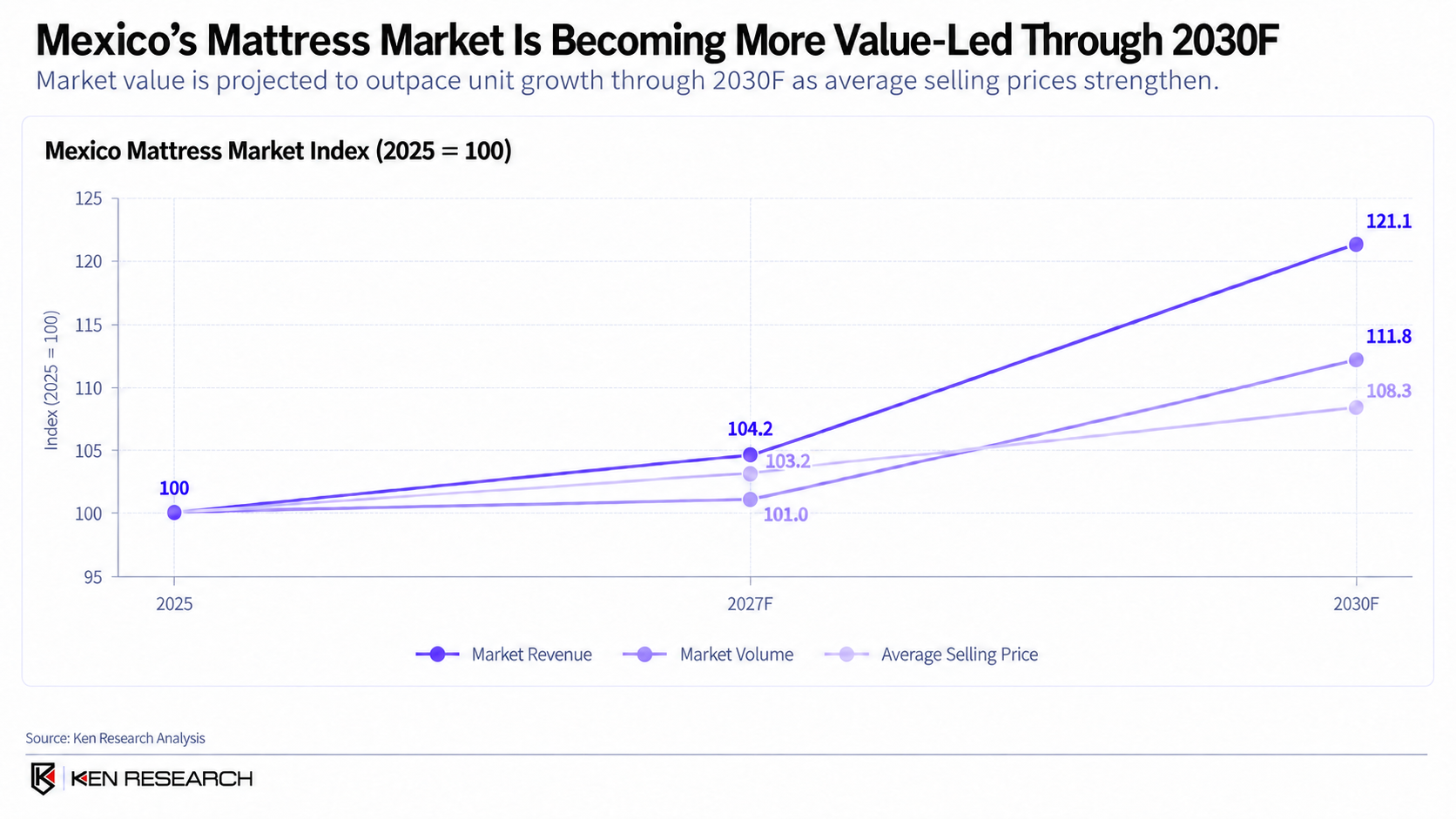
Mexico’s domestic mattress market is moving into a more valuable phase of growth. Market revenue is projected to rise from USD 950 million in 2025 to USD 1.15 billion by 2030, while unit growth remains comparatively moderate. Average selling prices are expected to increase from approximately USD 281 per mattress to more than USD 300, pointing to a market where value growth is increasingly supported by product mix, replacement demand and premiumisation.
Household mattress penetration is also projected to rise from 89% in 2025 to 92% by 2030. With penetration already high, future growth will depend less on first-time ownership and more on replacement purchases, product upgrades and higher-value categories.
That opportunity, however, is materially smaller than the export scale Mexico has lost. Mattress exports are already 58% below their 2023 peak, while the US remained the dominant destination even after export volumes began to weaken. In 2024, the US accounted for approximately 86% of Mexico’s export value in cellular rubber and plastic mattresses and 85% in spring and other stuffed mattresses.
The policy shift therefore affected a manufacturing model that remained highly concentrated on US demand. Domestic growth can support higher-value sales and a stronger product mix, but it cannot replace the scale of the previous export engine. For manufacturers reassessing Mexican capacity, the domestic market is better viewed as a margin, mix and share-capture opportunity, not as a direct substitute for lost US-bound volume.
Chinese Suppliers Are Reshaping Competition as Imports Reach 20% of Mexico’s Formal Mattress Supply
Import penetration has increased sharply in Mexico’s mattress market, rising from 4% of formal domestic supply in 2020 to 20% in 2025. Imported products now represent one-fifth of formal supply, increasing the competitive pressure on manufacturers looking to capture more domestic demand.
Chinese suppliers are particularly strong in cellular rubber and plastic mattresses. In 2024, China supplied approximately USD 50.6 million of Mexico’s USD 67.6 million imports in this category, equivalent to roughly 75% of import value.
The competitive challenge is therefore not uniform across the market. Chinese pressure is substantially stronger in selected mattress categories. For manufacturers targeting domestic growth, this raises the importance of category-level competitive strategy. Product positioning, pricing, channel execution and differentiation will matter more as imported supply takes a larger share of the market.
Download the complimentary Mexico Mattress Market sample report from Ken Research for the full market outlook, product and material segmentation, channel development, competitive landscape and demand trends.
Mexico’s 2026–2030 Mattress Investment Case Now Hinges on Three Distinct Risks
Mexico enters the next investment cycle with a very different proposition from the one that supported its export expansion through 2023. Mattress exports are now 58% below their peak, finished-mattress trade costs have increased, the split-production model is under regulatory scrutiny, and domestic growth is becoming more competitive.
For manufacturers allocating capital through 2030, the decision now depends on which of three risks their operating model is best positioned to absorb.
1. US-Bound Finished Mattresses: Margin Risk Is Now Structural
The 2024 antidumping order has made trade cost part of the base case for covered finished mattresses entering the US. With a 37.59% “all others” rate applying to covered Mexican producers and exporters without a separate company-specific rate, the investment test has shifted from manufacturing cost to post-duty profitability.
Mexico may still work for selected products and customer programmes where manufacturing advantages remain large enough to protect margins. But broad US-facing capacity expansion can no longer be justified on production cost and proximity alone.
2. Mexico-US Split Production: Regulatory Risk Remains Unresolved
Moving final assembly to the US emerged as one response to the 2023 antidumping case, while retaining selected component manufacturing in Mexico.
The February 2026 country-wide circumvention inquiry has made that configuration less certain. Scrutiny now extends to how production, processing and value addition are divided across Mexico and the US, while subsequent scope applications involving Mexican foam have pushed the issue further upstream.
Through 2030, the viability of split production will therefore depend not only on operating economics, but also on how the cross-border manufacturing structure is ultimately treated under the evolving trade regime.
3. Domestic Mexico: Growth Depends on Winning Profitable Share
Mexico’s domestic mattress market offers the clearest demand-growth opportunity, with market value projected to rise from USD 950 million in 2025 to USD 1.15 billion by 2030.
But this is increasingly a value and mix opportunity rather than a volume replacement strategy. Imports already account for 20% of formal domestic supply, while Chinese suppliers have built strong positions in selected categories. Domestic investment must therefore be supported by premiumisation, differentiated products, pricing discipline and the ability to take profitable share.
The Next Question Is Not How Much Capacity Mexico Can Support, but Which Role Can Still Earn the Required Return
The three models now face different constraints: margin pressure in finished-mattress exports, regulatory uncertainty in split production, and competitive intensity in the domestic market.
Mexico remains relevant to North American mattress manufacturing, but its next phase will not be driven by rebuilding the export model that worked before 2023. Through 2030, the stronger investment case will come from placing Mexican capacity only where its manufacturing advantage remains defensible after trade costs, regulatory exposure and domestic competition are fully reflected in returns.
Get started
We've helped companies around the world future-proof
their businesses - and we can do the same for you.