Saudi Arabia’s Residential Market: Jan 2026 Foreign Ownership Laws, Mortgage Growth, and Rising Housing Supply
Ken Research
January 6, 2026 - 6 min read

January 6, 2026
by Khushi GuptaSaudi Arabia’s residential market is steadily evolving beyond the early excitement around giga projects and moving towards a more stable, buyer-led environment.
In H1 2025, overall real estate transaction value declined by 2.4%, yet housing continued to support market activity, accounting for 63% of total real estate value. Homeownership reached 65.4% by the end of 2024, showing sustained demand from local buyers.
Foreign ownership reforms are expected in January 2026; the residential market is gradually opening to wider institutional and international participation.
Residential Housing Constitutes 63% of Total Transaction Value in H1 2025
Residential real estate remained the key driver of the market, capturing approximately 63% of the total transaction value.
The following points highlight how residential transactions contributed to overall market performance during the first half of 2025:
- Transaction Activity: Residential transaction volumes increased by 7% year on year, reaching more than 93,700 transactions in H1 2025. This indicates that buyer demand has remained stable despite broader economic uncertainty.
- Transaction Value: The total value of residential transactions rose by 4%, reaching SAR 77.5 billion. This shows that the market is absorbing gradual price increases without a sharp decline in demand.
- Housing Supply Pipeline: The National Housing Company plans to deliver 300,000 housing units by end-2025 and 600,000 units by 2030. This pipeline represents an estimated project value exceeding SAR 250 billion and reflects the scale of government-backed supply entering the market.
Mortgage Lending Increased by 18% as Demand Supports Housing Supply
The expansion of mortgage lending is ensuring that new housing supply is backed by actual purchasing capacity rather than speculative demand.
The following points outline key developments in mortgage lending and refinancing during early 2025:
- Mortgage Issuance: The number of homeownership mortgages issued increased by 15% between January and May 2025, indicating stronger participation from end buyers.
- Mortgage Value: The total value of mortgages issued during this period reached SAR 44.4 billion, representing an 18% year-on-year increase. This reflects higher lending activity from banks supporting residential purchases.
- Refinancing Framework: In early 2025, the Saudi Real Estate Refinance Company introduced Residential Mortgage-Backed Securities. This step supports the development of a secondary mortgage market and helps banks free up capital for further lending.
Rising Prices in Riyadh Trigger a 31% Drop in Residential Transactions
Riyadh remains the country’s main economic centre, but higher housing prices are beginning to influence buyer behaviour. After several years of strong price growth, the market is becoming more selective as affordability pressures increase.
The following points summarise recent trends in prices, buyer focus, and transaction activity in Riyadh:
- Long-Term Price Growth: Since 2019, apartment prices in Riyadh have increased by 82%, while villa prices have risen by 50%.
- Recent Price Movement: In Q2 2025, average apartment prices increased by 10.6% year-on-year, with demand concentrated in areas connected to major transport infrastructure such as the Riyadh Metro.
- Transaction Activity: Residential transaction volumes declined by 31% in H1 2025 as higher entry prices reduced buyer participation, particularly among price-sensitive segments.
Jeddah’s Residential Market Gains Strength from Apartment-Led Activity
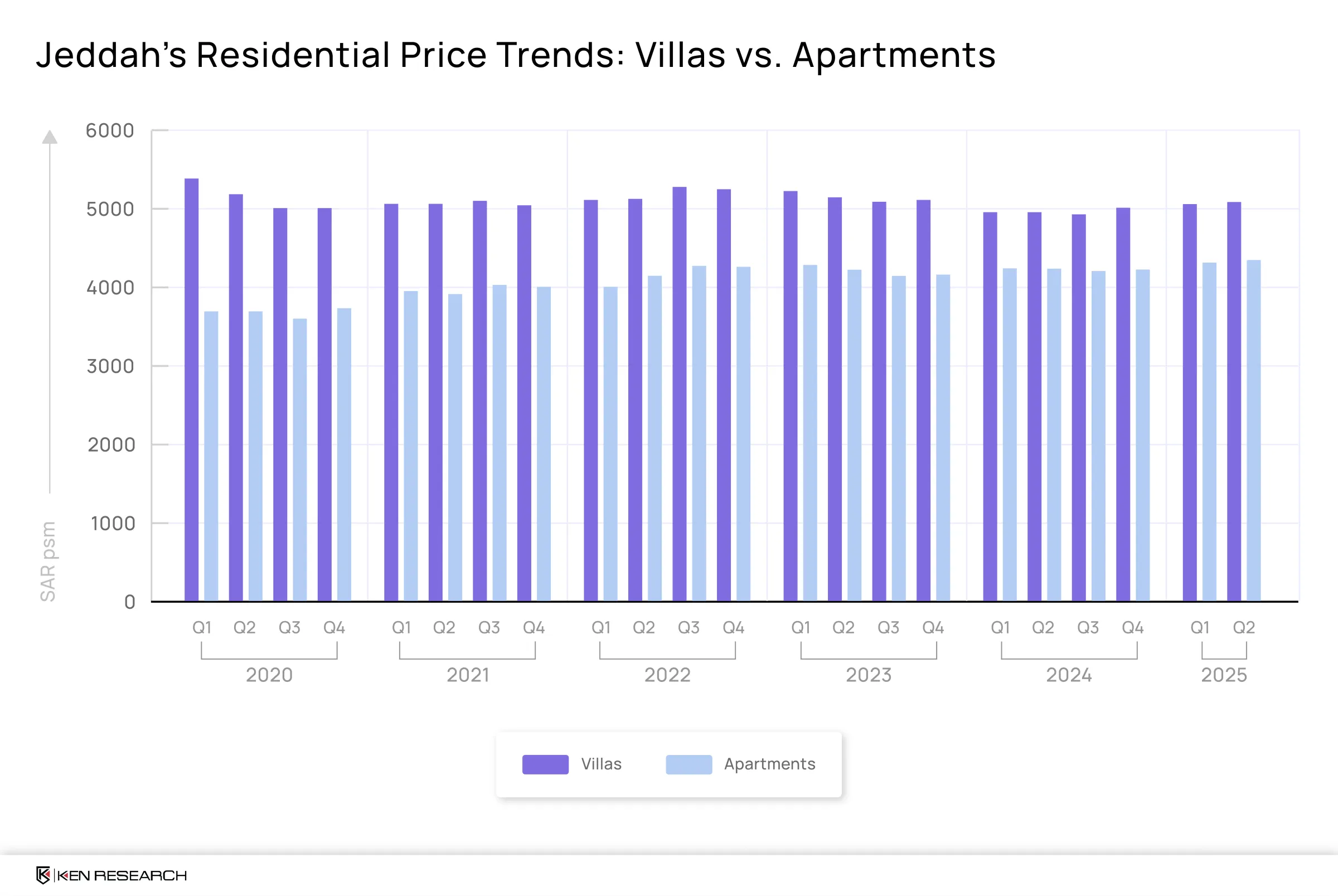
Residential demand is gradually shifting away from standalone villas towards apartment-led developments that offer better connectivity and shared amenities. This shift is supporting both transaction volumes and pricing in selected parts of the city.
Jeddah’s residential sector demonstrated significant resilience and growth through the first half of 2025, with total transaction values surging by 28%. This upward trajectory is supported by a 19% increase in transaction volumes, signalling strong demand even as other major cities enter a period of market recalibration.
The following points outline recent changes in pricing trends and buyer preferences in Jeddah:
- Villas: Sale prices rose by 3.2% annually, reaching an average of SAR 5,040 per square metre. Demand remains high in the northern districts, where average prices are increasing by 5.4%.
- Apartments: The apartment market saw an average price rise of 2.7%, settling at SAR 4,324 per square metre. Growth was most concentrated in central and western Jeddah, which recorded a 6% jump.
- Buyer Preferences: Integrated apartment developments are gaining traction, particularly among younger buyers who prioritise access to amenities, services, and employment hubs.
89% HNWI Interest Aligns with Madinah’s 49% Transaction Value Growth
Makkah and Madinah are no longer just religious hubs; they are emerging as high-value investment frontiers.
The following points highlight recent transaction trends and investor interest in Makkah and Madinah:
- Madinah Transaction Growth: Residential transaction value in Madinah increased by 49% in H1 2025, making it the fastest-growing city by value during the period.
- Makkah Transaction Activity: Residential transaction volumes in Makkah increased by 16%, while transaction value rose by 14%, indicating steady demand despite new supply.
- Investor Interest: Around 86% of Global Muslim HNI’s have shown interest in owning property in Makkah and Madinah, with demand expected to convert following the implementation of foreign ownership laws in January 2026.
DMA’s 176,900 New Homes Support Long-Term Residential Stability in the Eastern Province
The Eastern Province continues to perform as a more stable residential market compared to the capital. Housing demand in the region is closely linked to industrial activity and corporate employment.
The following points highlight recent pricing trends and upcoming housing supply in the Dammam Metropolitan Area:
- Pricing Trends: Villa prices in the Dammam Metropolitan Area increased by 3%, while apartment prices rose by 2.5%, indicating gradual price growth.
- Supply Pipeline: More than 176,900 residential units are planned for delivery in the DMA by 2030, providing long-term housing support for the region’s industrial and corporate workforce.
January 2026 Foreign Ownership Law Will Unlock Foreign Capital Flood into Saudi Housing
The January 2026 Law of Real Estate Ownership will allow non-Saudis to own property. It also signals a shift towards attracting long-term capital.
The following points outline how the new ownership rules may influence market participation and investment patterns:
- Designated Investment Areas: Foreign individuals and companies will be allowed to purchase residential property in the selected high-growth zones across Riyadh, Jeddah, Makkah, and Madinah.
- The Muslim HNWI Opportunity: The opening of the Holy Cities to international investors is expected to trigger a capital flood.
Rising Housing Supply Signals that 'Easy Money' Era is Ending
Saudi Arabia’s residential market is entering a mature phase as large-scale housing supply enters major cities, and the scope for “easy money” from rapid price increases is gradually narrowing.
The following points highlight how expanding supply is reshaping investor returns:
- Supply Expansion: Riyadh is projected to continue its expansion, while Makkah's stock will reach 914,500 units by 2030 and Madinah is expected to add 98,500 units over the same period.
- Yield Stabilisation: As the market matures, investors should expect yields to stabilise. The "easy money" from capital appreciation is slowing, the new era will favour those with high-quality assets and efficient property management.
Conclusion
The Saudi Arabian residential market dominance accounts for 63% of all transactions. The market is no longer uniform. We are witnessing a healthy geographic diversification where Riyadh’s 31% transaction volume recalibration is being offset by explosive growth in Jeddah (19% volume increase) and the Holy Cities, with Madinah recording a Kingdom-leading 49% surge in value. Backed by a SAR 44.4 billion mortgage market and the National Housing Company’s commitment to deliver 600,000 units by 2030, the Kingdom is successfully bridging the gap between national homeownership targets and market liquidity.
Ken Research suggests that stakeholders shift their perspective from "broad-market exposure" to a highly targeted "designated investment zones" and “Giga project-led developments”, which are expected to attract stronger demand following upcoming foreign ownership reforms. Makkah and Madinah are the high-potential markets, where strong religious tourism and housing shortages create long-term opportunities for residential developments.
Related tags
Manufacturing and Construction
Get started
We've helped companies around the world future-proof
their businesses - and we can do the same for you.