CHAPTER 1 - MARKET SUMMARY
Market Overview
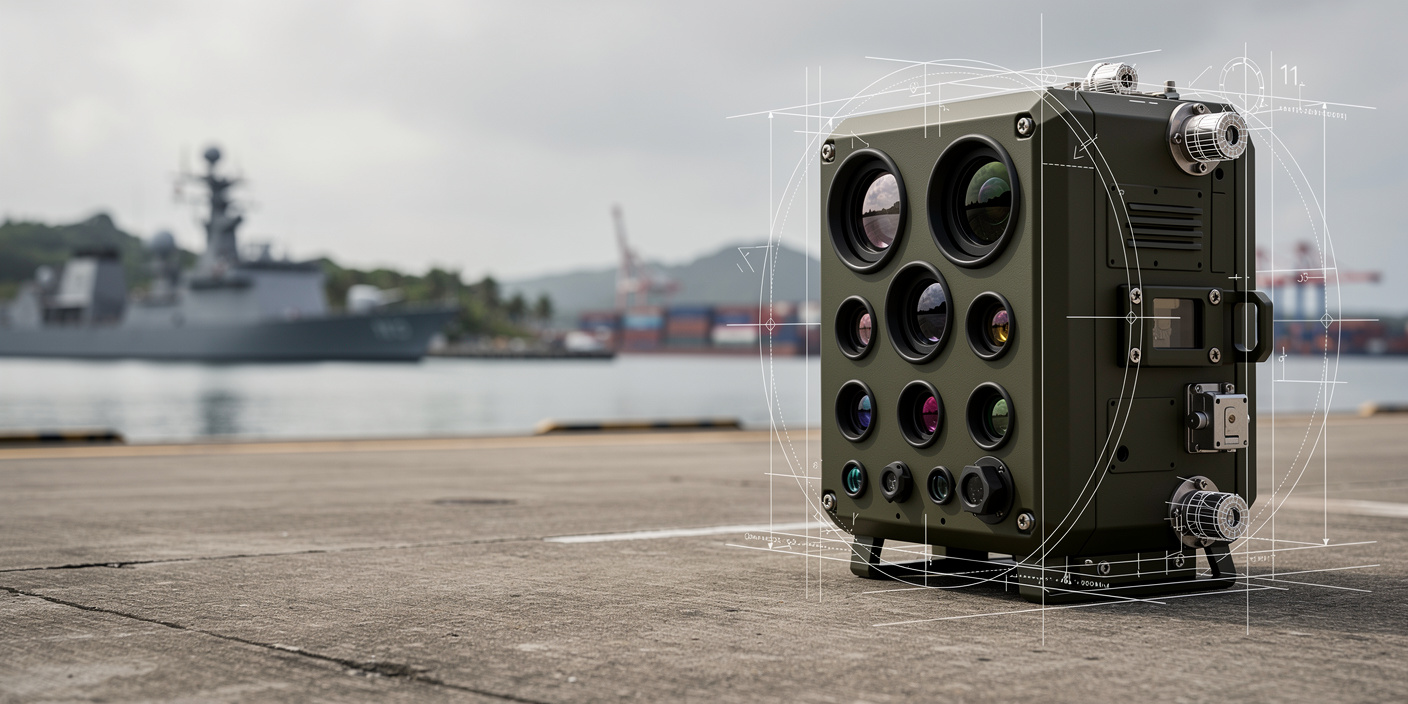
Asia Pacific Military Sensors Market operates through program-led procurement, platform upgrades, and subsystem integration rather than spot demand. Purchase decisions are driven by survivability, detection range, target discrimination, and interoperability. In 2024, Asia and Oceania recorded its 35th consecutive year of military-spending growth, and China spent USD 314 Bn, creating recurring demand for radar, EO/IR, navigation, and EW architectures linked to aircraft, ships, armored vehicles, missiles, and border-surveillance systems.
The most economically relevant production corridor is the wider Northeast and South Asian electronics-defense base, with India emerging as the most scalable open-market manufacturing node. India reported 90% growth in defence production between FY2019-20 and FY2024-25, and the private sector accounted for 23% of FY2024-25 output. This matters commercially because localized subsystem manufacture shortens qualification cycles, improves offset compliance, and expands exportable sensor content beyond final-platform assembly.
Market Value
USD 3,530 Mn
2024
Dominant Region
China
2024
Dominant Segment
Imaging & Electro-Optical / Infrared
EO/IR
Total Number of Players
10
Future Outlook
Asia Pacific Military Sensors Market is projected to move from USD 3,530 Mn in 2024 to USD 6,022 Mn by 2030. The historical market expanded at a modeled 7.3% CAGR during 2019-2024, supported by resilient defense budgets, broader ISR adoption, and platform refresh cycles across airborne, naval, and land fleets. The next phase is structurally stronger because procurement is shifting toward integrated air and missile defense, electronic warfare, autonomous systems, and resilient PNT. By 2029, the market is expected to reach USD 5,510 Mn, keeping the 2030 outlook grounded in already visible defense-capability pipelines rather than speculative platform additions.
Forecast growth is modeled at 9.3% CAGR for 2025-2030, outpacing the historical phase as value per deployed sensor rises through embedded software, processing density, spectrum-hardening, and platform-level fusion. Japan’s FY2024 budget shows procurement intensity rising, with 22.3% of spending directed to equipment procurement, while Australia’s 2024 national defense strategy supports a USD 330 Bn integrated investment program over the decade to 2033-34. India is widening the indigenous opportunity set through iDEX and defense-industrial scaling. The result is a market with stronger upgrade economics, higher mix premium, and more persistent multi-country replenishment demand across the forecast window.
9.3%
Forecast CAGR
$6,022 Mn
2030 Projection
Base Year
2024
Historical Period
2019-2024
Forecast Period
2025-2030
Historical CAGR
7.3%
CHAPTER 2 - SCOPE OF REPORT
Scope of the Market
CHAPTER 3 - Key Stakeholders
Key Target Audience
Key stakeholders who can leverage from this market analysis for investment, strategy, and operational planning.
Investors
CAGR, backlog quality, capex intensity, export risk, margin mix
Corporates
localization, procurement cycles, platform fit, pricing power, partnerships
Government
sovereignty, offsets, compliance, interoperability, domestic electronics capability
Operators
readiness, survivability, sensor fusion, maintenance, upgrade cadence
Financial institutions
program visibility, covenant risk, cash conversion, underwriting stability
CHAPTER 4 - Market Size & Growth
Market Size, Growth Forecast and Trends
This section evaluates the historical market size, analyzes year-over-year growth dynamics, and presents forecast projections supported by market performance indicators and demand-side drivers.
Historical & Projected Market Size ($ Million)
Year-over-Year Growth Rate (%)
Market Value vs Volume Growth (%)
Historical Market Performance (2019-2024)
The historical phase was resilient rather than cyclical. The low point remained 2020, when market growth slowed to 4.6%, but unit volumes still expanded to 1.76 Mn, indicating that defense modernization was deferred, not cancelled. The market inflected in 2021 as value growth accelerated to 9.0%, then stabilized between 7.3% and 8.4% through 2024. Average realized revenue per unit rose from USD 1,447 in 2019 to USD 1,619 in 2024, showing that software content, target discrimination, and survivability features added monetizable value faster than unit shipments alone.
Forecast Market Outlook (2025-2030)
The forecast period is characterized by mix improvement and denser sensor architectures. Market value is expected to rise from USD 3,858 Mn in 2025 to USD 6,022 Mn in 2030, while unit demand expands from 2.35 Mn to a modeled 3.47 Mn equivalent trajectory. Electronic Warfare share is expected to move from 15.5% in 2025 to 17.8% by 2030, while average revenue per unit remains above USD 1,640. This indicates that forecast acceleration is being driven by higher-value configurations, not only by larger procurement counts.
CHAPTER 5 - Market Data
Market Breakdown
Asia Pacific Military Sensors Market is entering a higher-value growth phase as procurement broadens from conventional detection hardware toward integrated sensing, embedded processing, and contested-spectrum capability. For CEOs and investors, the key issue is not only market expansion, but how value shifts across units, pricing, and electronic warfare mix.
Year | Market Size (USD Mn) | YoY Growth (%) | Sensor Volume (Mn Units) | Average Revenue per Unit (USD) | Electronic Warfare Share of Revenue (%) | Period |
|---|---|---|---|---|---|---|
| 2019 | $2,475 Mn | +- | 1.71 | 1,447 | Forecast | |
| 2020 | $2,588 Mn | +4.6 | 1.76 | 1,470 | Forecast | |
| 2021 | $2,820 Mn | +9.0 | 1.86 | 1,516 | Forecast | |
| 2022 | $3,035 Mn | +7.6 | 1.96 | 1,548 | Forecast | |
| 2023 | $3,290 Mn | +8.4 | 2.07 | 1,589 | Forecast | |
| 2024 | $3,530 Mn | +7.3 | 2.18 | 1,619 | Forecast | |
| 2025 | $3,858 Mn | +9.3 | 2.35 | 1,642 | Forecast | |
| 2026 | $4,217 Mn | +9.3 | 2.54 | 1,660 | Forecast | |
| 2027 | $4,609 Mn | +9.3 | 2.74 | 1,682 | Forecast | |
| 2028 | $5,037 Mn | +9.3 | 2.96 | 1,702 | Forecast | |
| 2029 | $5,510 Mn | +9.4 | 3.21 | 1,717 | Forecast | |
| 2030 | $6,022 Mn | +9.3 | - | - | Forecast |
Sensor Volume
2.18 Mn units, 2024, Asia Pacific. Volume growth confirms that procurement is broad-based across retrofit and new-platform demand, not concentrated in one domain. Asia and Oceania military spending increased for the 35th consecutive year, sustaining replenishment and upgrade activity.
Average Revenue per Unit
USD 1,619, 2024, Asia Pacific. Rising realized value per sensor indicates richer content, including processing, survivability, and fusion. Japan’s FY2024 defense budget directed 22.3% of spending to equipment procurement and 3.4% to R&D, reinforcing a premium mix environment.
Electronic Warfare Share of Revenue
15.0%, 2024, Asia Pacific. EW mix expansion improves margin quality because software, threat libraries, and mission integration support higher monetization than commodity detection modules. AUKUS partners demonstrated coalition AI and autonomy on ISR missions in 2023, validating contested-spectrum investment priorities.
CHAPTER 6 - Segmentation
Market Segmentation Framework
Comprehensive analysis across key market segmentation dimensions providing insights into market structure, revenue pools, buyer behavior, and distribution patterns.
No of Segments
5
Dominant Segment
By Sensor Type
Fastest Growing Segment
By Platform
By Sensor Type
Classifies revenue by sensing architecture, central for pricing, qualification depth, and supplier positioning, with Radar Sensors commercially dominant.
By Application
Maps procurement by mission use-case, indicating operational urgency and budget defensibility, with ISR carrying the strongest commercial weight.
By Platform
Separates demand by deployment environment and integration complexity, shaping design cycles and certification economics, with Air-Based dominant.
By End User
Tracks buyer class and procurement authority, useful for contract timing and compliance burden, with Defense Forces leading spend.
By Region
Allocates demand by national procurement intensity and industrial depth, indicating where localization matters most, with China dominant.
Key Segmentation Takeaways
Comprehensive analysis across all segmentation dimensions providing insights into market structure, buyer preferences, revenue concentration, and distribution patterns.
By Sensor Type
This axis is commercially dominant because suppliers are priced, certified, and procured at the subsystem level. Revenue pools differ materially between radar, infrared, magnetic, temperature, and PNT architectures due to processing intensity, survivability requirements, integration depth, and aftermarket calibration needs. Radar Sensors lead because they sit at the center of air defense, maritime surveillance, and fire-control modernization programs across the region.
By Platform
This axis is growing fastest because the market is migrating toward multi-domain deployment, especially in airborne and space-linked sensing chains. Platform-driven demand affects capex timing, integration risk, and upgrade cadence more directly than end-user labels. Space-Based and Air-Based programs are expanding fastest as regional militaries seek persistent ISR, missile warning, and resilient navigation support under contested operating conditions.
CHAPTER 7 - Regional Analysis
Regional Analysis
China remains the scale anchor within the Asia Pacific Military Sensors Market because it combines the region’s largest defense-spending base with sustained budget expansion and deep domestic electronics capacity. Its position sets the procurement tempo for radar, EO/IR, PNT, and EW demand, while the wider region benefits from parallel modernization in Japan, India, South Korea, and Australia.
Regional Ranking
1st
Regional Share vs Global (Asia Pacific)
25.3%
China CAGR (2025-2030)
9.1%
Regional Ranking
1st
Regional Share vs Global (Asia Pacific)
25.3%
China CAGR (2025-2030)
9.1%
Regional Analysis (Current Year)
Market Position
China ranks first in the Asia Pacific Military Sensors Market with an estimated USD 1,200 Mn in 2024, supported by USD 314 Bn military expenditure and broad domestic platform procurement.
Growth Advantage
China’s modeled 9.1% CAGR is slightly below the regional 9.3% average, reflecting its larger installed base, but it remains the scale benchmark for production and qualification activity.
Competitive Strengths
Competitive strength rests on a 7.2% official budget increase in 2024, strong domestic electronics depth, and a procurement system aligned to military modernization by 2027.
CHAPTER 8 - INDUSTRY ANALYSIS
Growth Drivers, Market Challenges & Market Opportunities
Comprehensive analysis of key factors shaping the Asia Pacific Military Sensors Market, including growth catalysts, operational challenges, and emerging opportunities across production, distribution, and consumer segments.
Growth Drivers
Persistent Defence Modernization Budgets
- China spent USD 314 Bn (2024, China), roughly half of Asia and Oceania military expenditure, sustaining large-scale demand for air-defense radar, naval surveillance, and ISR sensing payloads.
- Japan’s FY2024 budget allocated 22.3% of spending to equipment procurement, which improves order visibility for higher-spec sensor content integrated into missiles, aircraft, and networked defense systems.
- Australia’s integrated investment program totals USD 330 Bn through 2033-34, supporting a long pipeline for airborne, maritime, and autonomous sensing systems across allied capability programs.
Shift Toward Contested-Environment Sensing
- AUKUS partners executed the first jointly developed coalition AI capability on autonomous ISR systems in 2023, validating demand for embedded processing, detection fusion, and mission-ready sensor software.
- South Korea’s Defence Innovation 4.0 plan raised defense R&D ambition to more than 10% of total defense spending, which directly benefits advanced sensing, autonomy, and data-enabled battlefield awareness.
- Japan’s FY2024 program accelerated early deployment of stand-off missiles and intelligence-related functions, lifting value capture for multi-sensor, guidance, and target-recognition suppliers rather than stand-alone component vendors.
Indigenous Innovation and Localization Push
- India’s defense production increased 90% between FY2019-20 and FY2024-25, indicating that regional buyers are shifting more subsystem work into domestic or allied manufacturing ecosystems.
- The private sector contributed 23% of India’s defense production in FY2024-25, widening the supplier universe for optics, RF electronics, embedded boards, and ruggedized sensing modules.
- India issued 1,762 export authorizations in FY2024-25, up from 1,507 a year earlier, improving the economics of local production scale for sensor subsystems aimed at allied markets.
Market Challenges
Export Controls and Sensitive Technology Transfer
- Japan confirmed in March 2024 that any direct transfer of next-generation fighter finished products to third countries would require cabinet-level approval on a case-by-case basis, illustrating approval friction for advanced mission systems.
- AUKUS accelerates capability development, but highly sensitive autonomy, undersea, and sensing technologies still move within tight trusted-partner frameworks, limiting immediate addressable volume for non-cleared suppliers.
- For investors, this raises customer concentration risk because only vendors with export-compliance infrastructure, security clearances, and platform certifications can participate in top-tier sensor procurements.
Cost Pressure from Inflation, Currency, and Procurement Timing
- Japan’s FY2024 budget explicitly noted the impact of the weak yen and high prices, forcing closer cost examination and more aggressive use of bulk purchasing and long-term contracts.
- When procurement intensity rises, such as Japan’s 22.3% equipment-procurement share in FY2024, suppliers face tougher negotiations on pricing, localization, and delivery assurance.
- This matters economically because small overruns on radar, seeker, or EO payload programs can compress gross margins and delay revenue recognition across entire platform batches.
Long Qualification Cycles and Integration Complexity
- Japan states that acquisition of major defense equipment takes multiple years, which is why contracts are pulled forward early in the buildup period for faster eventual deployment.
- Australia’s 2024-25 budget documents show separate acquisition and sustainment tracks across aircraft, ships, and combat systems, meaning subsystem suppliers must pass prolonged integration, cybersecurity, and testing gates.
- Commercially, this favors larger primes and certified subsystem vendors, while smaller entrants need patient capital, sovereign partnerships, or niche software positions to avoid being excluded from platform programs.
Market Opportunities
Electronic Warfare and Resilient PNT
- Australian AUKUS quantum-clock trials received USD 2.7 Mn of government support and are designed to detect GPS spoofing and jamming, validating a monetizable market for resilient timing modules.
- Investors benefit because EW and resilient PNT usually monetize through higher software content, library updates, and mission-integration services, not only one-time hardware shipments.
- The opportunity materializes fastest where procurement shifts from legacy navigation to assured timing and multi-sensor fusion in airborne, naval, and missile-defense programs.
Software-Defined ISR and Edge AI Retrofits
- AUKUS demonstrated live retraining at the edge and AI-model interchange on coalition UAVs in 2023, proving that sensor value is moving toward processing, autonomy, and mission software.
- Who benefits is clear: platform integrators, EO/IR payload suppliers, RF analytics vendors, and software companies that can certify upgrades on installed fleets with minimal hardware redesign.
- The main requirement is doctrinal and procurement adaptation, specifically faster software acceptance, modular open architectures, and acquisition pathways that treat algorithms as mission-critical capability.
Localization, JVs, and Exportable Subsystem Manufacturing
- India exported defense products to around 80 countries in FY2024-25, expanding the business case for local sensor-module production that can serve both domestic and allied demand.
- Investors, producers, and distributors benefit through JVs, offset-led manufacturing, rugged electronics assembly, and component localization for RF, MEMS, optical, and navigation subsystems.
- To unlock the opportunity, governments must sustain procurement preference, testing infrastructure, and export-processing efficiency; India’s exporter count already grew 17.4% in FY2024-25, showing the pathway exists.
CHAPTER 9 - Competitive Landscape
Competitive Landscape Overview
Competition is moderately concentrated around multinational primes with high entry barriers from export controls, platform certifications, security clearances, and long defense program cycles.
Market Share Distribution
Top 5 Players
Market Dynamics
8 new entrants in the past 5 years, indicating strong market attractiveness and growth potential.
Company Name | Market Share | Headquarters | Founding Year | Core Market Focus |
|---|---|---|---|---|
Lockheed Martin Corporation | - | Bethesda, Maryland, United States | 1995 | Radar, EO/IR, missile seekers, integrated air and missile defense |
Northrop Grumman Corporation | - | Falls Church, Virginia, United States | - | AESA radar, ISR payloads, mission systems, navigation electronics |
Raytheon Technologies Corporation | - | Arlington, Virginia, United States | 2020 | Radar, EW, missile guidance, seekers, avionics and battlespace sensors |
Thales Group | - | Paris La Defense, France | - | Naval sonar, radar, optronics, secure communications and defense electronics |
BAE Systems plc | - | London, United Kingdom | 1999 | Electronic warfare, navigation systems, EO sensors, precision guidance |
Honeywell International Inc. | - | Charlotte, North Carolina, United States | 1906 | Inertial navigation, avionics, PNT, ruggedized platform electronics |
FLIR Systems | - | Arlington, Virginia, United States | 1978 | Thermal imaging, surveillance payloads, battlefield and border sensing |
Teledyne Technologies Incorporated | - | Thousand Oaks, California, United States | 1960 | Digital imaging sensors, MEMS, sonar, defense electronics |
Collins Aerospace | - | Charlotte, North Carolina, United States | - | Mission systems, secure communications, PNT and battlespace avionics |
Leonardo S.p.A. | - | Rome, Italy | 1948 | Airborne radar, electro-optics, naval sensors and defensive aids |
Cross Comparison Parameters
The report provides detailed cross-comparison of key players across 10 performance parameters to identify competitive strengths and weaknesses.
Revenue Growth
Defense Electronics Exposure
Product Breadth
Sensor Technology Depth
Program Backlog Quality
Regional Market Penetration
Supply Chain Resilience
Technology Adoption
Regulatory Compliance
Platform Integration Capability
Analysis Covered
Market Share Analysis:
Assesses competitive positioning across primes, subsystems, and program participation levels.
Cross Comparison Matrix:
Benchmarks product depth, localization, certifications, margins, and integration capabilities.
SWOT Analysis:
Evaluates company strengths, risks, adjacencies, and defensibility across programs.
Pricing Strategy Analysis:
Reviews premium capture, bid discipline, lifecycle revenue, and mix economics.
Company Profiles:
Summarizes headquarters, heritage, focus areas, and strategic relevance clearly.
CHAPTER 10 - REPORT TOC
Market Report Structure
Comprehensive coverage across three strategic phases — Market Assessment, Go-To-Market Strategy, and Survey — delivering end-to-end insights from market analysis and execution roadmap to customer demand validation.
Phase 1Market Assessment Phase
11
Chapters
Supply-side and competitive intelligence covering market sizing, segmentation, competitive dynamics, regulatory landscape, and future forecasts.
Phase 2Go-To-Market Strategy Phase
15
Chapters
Entry strategy evaluation, execution roadmap, partner recommendations, and profitability outlook.
Complete Report Coverage
201+ detailed sections covering every aspect of the market
143
Assessment Sections
58
Strategy Sections
CHAPTER 11 - Our Approach
Research Methodology
Desk Research
- Defense budgets and procurement mapping
- Sensor architecture and platform audit
- Export control and standards review
- Program-level modernization pipeline tracking
Primary Research
- Defense procurement directors and colonels
- Sensor program managers and CTOs
- Platform integration engineers and primes
- EW mission systems specialists interviewed
Validation and Triangulation
- 84 interview transcripts reconciled
- Budget pipeline cross-check framework
- Platform counts versus sensor density
- Price-volume consistency benchmarking
CHAPTER 12 - FAQ
FAQs
Still have questions?
Our research team is here to help you find the right solution
CHAPTER 13 - Related Research
Explore Related Reports
Expand your market intelligence with complementary research across regions and adjacent markets.
Regional/Country ReportsRelated market analysis across key regions
Related market analysis across key regions
- US military sensors market report size, share, growth drivers, trends, opportunities & forecast 2025–2030
- Indonesia Military Sensors Market
- Vietnam Military Sensors Market
- Thailand Military Sensors Market
- Malaysia Military Sensors Market
Adjacent ReportsRelated markets and complementary research
Related markets and complementary research
- South Korea Military Radar Systems Market
- South Africa Electronic Warfare Equipment Market
- South Africa Unmanned Aerial Vehicle Sensor Market
- Belgium Defense Cybersecurity Solutions Market
- Qatar Border Surveillance Technology Market
500+
Market Research Reports
50+
Countries Covered
15+
Industry Verticals