About the Report
Base Year 2024Asia Pacific Smartphone Camera Module Market Overview
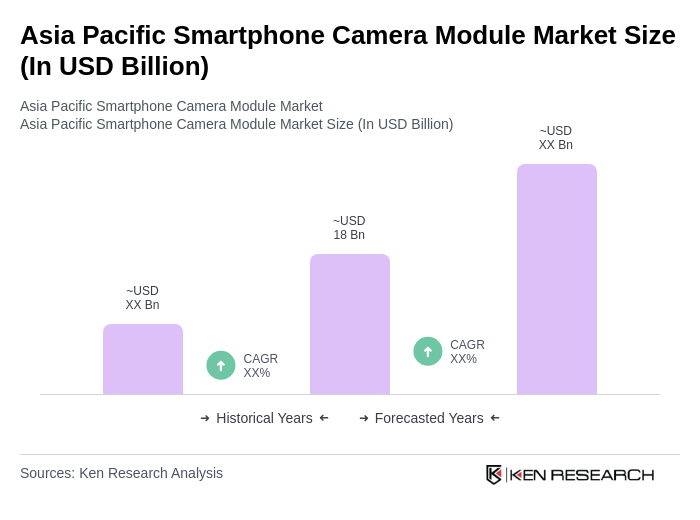
- The Asia Pacific Smartphone Camera Module Market is valued at USD 18 billion, based on a five-year historical analysis. This aligns with sources indicating Asia Pacific accounts for roughly one?third to two?fifths of the global camera module market, given the region’s dominant share in electronics manufacturing and smartphone assembly . This growth is primarily driven by the increasing demand for high-quality imaging in smartphones, fueled by advancements in camera technology (e.g., higher megapixels, OIS, periscope telephoto) and consumer preferences for enhanced photography experiences . The proliferation of social media and the rise of content creation have further accelerated the need for superior camera capabilities in mobile devices .
- Key players in this market include China, South Korea, and Japan, which dominate due to their strong manufacturing capabilities and technological advancements. China is a major hub for smartphone and component production with extensive contract manufacturing ecosystems, while South Korea and Japan lead in premium modules and imaging components through firms like LG Innotek, Samsung Electro?Mechanics, and Sony . The presence of leading smartphone manufacturers and tier?1 module suppliers in these countries also contributes to their dominance in the market .
- In 2023, the Indian government advanced the Production?Linked Incentive (PLI) framework for electronics to boost domestic manufacturing of components, including modules used in smartphones, with notified PLI schemes for Large Scale Electronics Manufacturing that cover sub?assemblies and components in the local value chain . This initiative aims to attract investments and enhance local production capabilities, thereby reducing reliance on imports and fostering a competitive environment for manufacturers in the region .
Asia Pacific Smartphone Camera Module Market Segmentation
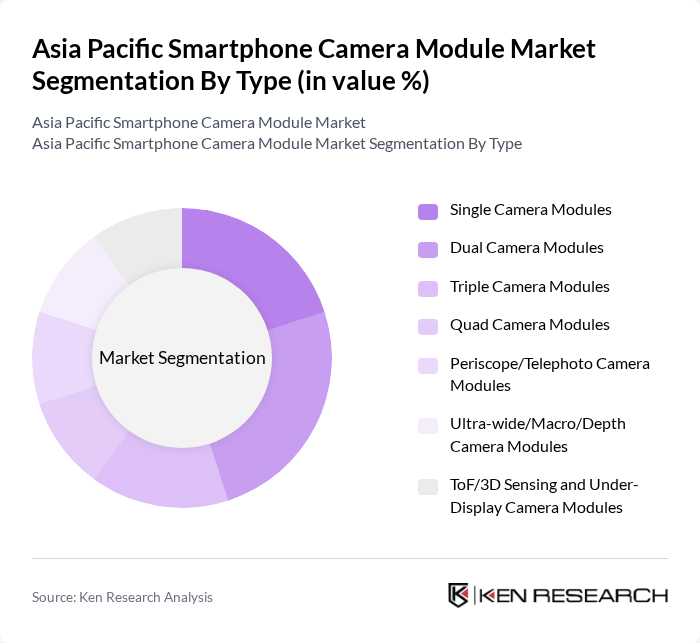
By Type:The market is segmented into various types of camera modules, including Single Camera Modules, Dual Camera Modules, Triple Camera Modules, Quad Camera Modules, Periscope/Telephoto Camera Modules, Ultra-wide/Macro/Depth Camera Modules, and ToF/3D Sensing and Under-Display Camera Modules. Each type serves different consumer needs and preferences, with specific applications in smartphone photography. Recent device portfolios from leading Android OEMs in Asia Pacific show widespread multi?camera adoption (main wide + ultra?wide, depth/macro variants) and growing use of periscope telephoto/OIS at mid?to?premium tiers, while ToF/3D sensing adoption is concentrated in select flagship models .
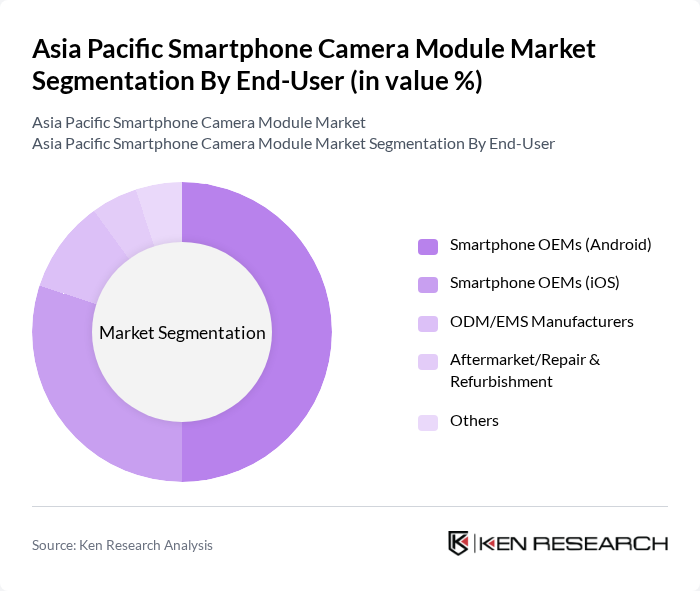
By End-User:The market is segmented based on end-users, including Smartphone OEMs (Android), Smartphone OEMs (iOS), ODM/EMS Manufacturers, Aftermarket/Repair & Refurbishment, and Others. This segmentation highlights the diverse applications of camera modules across different smartphone brands and manufacturing processes. The Asia Pacific demand base is predominantly Android OEMs and their ODM/EMS partners, with iOS demand tied to the regional manufacturing supply chain for select models and components .
Asia Pacific Smartphone Camera Module Market Competitive Landscape
The Asia Pacific Smartphone Camera Module Market is characterized by a dynamic mix of regional and international players. Leading participants such as Sunny Optical Technology Group Co., Ltd., LG Innotek Co., Ltd., Samsung Electro-Mechanics Co., Ltd., Sony Group Corporation (Sony Semiconductor Solutions), OmniVision Technologies, Inc., OFILM Group Co., Ltd., Q Technology (Group) Company Limited, Luxvisions Innovation Limited (Pegatron Group), Cowell e Holdings Inc. (Luxshare Precision), Sharp Corporation, Foxconn Technology Group (Hon Hai Precision Industry Co., Ltd.), Chicony Electronics Co., Ltd., Cammsys Co., Ltd., Partron Co., Ltd., AAC Technologies Holdings Inc. contribute to innovation, geographic expansion, and service delivery in this space .
Asia Pacific Smartphone Camera Module Market Industry Analysis
Growth Drivers
- Increasing Demand for High-Resolution Cameras:The Asia Pacific region is witnessing a surge in demand for high-resolution smartphone cameras, driven by consumer preferences for superior image quality. In future, the average resolution of smartphone cameras is projected to reach 108 megapixels, up from 64 megapixels in the past. This trend is supported by the growing number of smartphone users, which is expected to exceed 1.2 billion in the region, according to the GSMA.
- Advancements in Camera Technology:Continuous innovations in camera technology are propelling the smartphone camera module market. For instance, the introduction of optical image stabilization (OIS) and enhanced low-light performance features are becoming standard in mid-range smartphones. By future, it is estimated that 70% of smartphones will incorporate advanced camera technologies, as reported by Counterpoint Research, enhancing user experience and driving sales.
- Growth in Social Media and Content Creation:The rise of social media platforms has significantly influenced smartphone camera usage, with over 80% of users in Asia Pacific sharing photos online. In future, the number of active social media users in the region is projected to reach 1.1 billion, according to Statista. This trend is encouraging smartphone manufacturers to invest in high-quality camera modules, catering to the needs of content creators and influencers.
Market Challenges
- Intense Competition Among Manufacturers:The smartphone camera module market is characterized by fierce competition, with numerous players vying for market share. In future, the top five manufacturers are expected to account for over 60% of the market, leading to price wars and reduced profit margins. This competitive landscape pressures companies to innovate continuously while managing costs effectively, as highlighted by industry reports from IHS Markit.
- Supply Chain Disruptions:The ongoing global supply chain challenges, exacerbated by geopolitical tensions and the COVID-19 pandemic, pose significant risks to the smartphone camera module market. In future, it is anticipated that 30% of manufacturers will face delays in component sourcing, impacting production timelines. This disruption can lead to increased costs and potential shortages in the market, as reported by the World Economic Forum.
Asia Pacific Smartphone Camera Module Market Future Outlook
The future of the Asia Pacific smartphone camera module market appears promising, driven by technological advancements and evolving consumer preferences. As manufacturers increasingly adopt AI-integrated camera modules, the demand for enhanced imaging capabilities will rise. Additionally, the shift towards modular camera systems is expected to gain traction, allowing users to customize their devices. With the integration of augmented reality features and the rollout of 5G technology, the market is poised for significant growth, enhancing user experiences and expanding application possibilities.
Market Opportunities
- Expansion into Emerging Markets:Emerging markets in Asia Pacific present significant growth opportunities for smartphone camera module manufacturers. With smartphone penetration expected to increase by 15% in countries like India and Indonesia in future, companies can tap into a growing consumer base eager for advanced camera features, driving sales and market share.
- Development of AI-Integrated Camera Modules:The integration of artificial intelligence in camera modules is a burgeoning opportunity. By future, it is projected that 40% of new smartphone models will feature AI capabilities, enhancing image processing and user experience. This trend offers manufacturers a chance to differentiate their products and cater to tech-savvy consumers seeking innovative features.
Scope of the Report
| Segment | Sub-Segments |
|---|---|
| By Type | Single Camera Modules Dual Camera Modules Triple Camera Modules Quad Camera Modules Periscope/Telephoto Camera Modules Ultra-wide/Macro/Depth Camera Modules ToF/3D Sensing and Under-Display Camera Modules |
| By End-User | Smartphone OEMs (Android) Smartphone OEMs (iOS) ODM/EMS Manufacturers Aftermarket/Repair & Refurbishment Others |
| By Region | China South Korea Japan Taiwan India & Southeast Asia |
| By Technology | CMOS Technology Stacked/BSI Sensors and OIS-enabled Modules Autofocus Mechanisms (PDAF/Laser AF/VCM) Lens Systems (Plastic/Hybrid/Glass; Periscope) |
| By Application | Rear Main Camera Auxiliary Rear Cameras (Ultra-wide/Telephoto/Macro/Depth) Front/Selfie Camera D Sensing/Facial Recognition AR/Computational Photography |
| By Investment Source | Domestic Investment Foreign Direct Investment (FDI) Joint Ventures and Strategic Alliances Government Grants & Incentives Others |
| By Policy Support | Subsidies for Local Manufacturing Tax Incentives for R&D Import Duty Exemptions PLI/Export Incentives and Localization Mandates |
Key Target Audience
Investors and Venture Capitalist Firms
Government and Regulatory Bodies (e.g., Ministry of Electronics and Information Technology, Telecommunications Regulatory Authority)
Smartphone Manufacturers
Camera Module Manufacturers
Telecommunications Companies
Component Suppliers
Industry Associations (e.g., Asia Mobile Industry Association)
Financial Institutions
Players Mentioned in the Report:
Sunny Optical Technology Group Co., Ltd.
LG Innotek Co., Ltd.
Samsung Electro-Mechanics Co., Ltd.
Sony Group Corporation (Sony Semiconductor Solutions)
OmniVision Technologies, Inc.
OFILM Group Co., Ltd.
Q Technology (Group) Company Limited
Luxvisions Innovation Limited (Pegatron Group)
Cowell e Holdings Inc. (Luxshare Precision)
Sharp Corporation
Foxconn Technology Group (Hon Hai Precision Industry Co., Ltd.)
Chicony Electronics Co., Ltd.
Cammsys Co., Ltd.
Partron Co., Ltd.
AAC Technologies Holdings Inc.
Table of Contents
Market Assessment Phase
1. Executive Summary and Approach
2. Asia Pacific Smartphone Camera Module Market Overview
2.1 Key Insights and Strategic Recommendations
2.2 Asia Pacific Smartphone Camera Module Market Overview
2.3 Definition and Scope
2.4 Evolution of Market Ecosystem
2.5 Timeline of Key Regulatory Milestones
2.6 Value Chain & Stakeholder Mapping
2.7 Business Cycle Analysis
2.8 Policy & Incentive Landscape
3. Asia Pacific Smartphone Camera Module Market Analysis
3.1 Growth Drivers
3.1.1 Increasing demand for high-resolution cameras
3.1.2 Advancements in camera technology
3.1.3 Rising smartphone penetration
3.1.4 Growth in social media and content creation
3.2 Market Challenges
3.2.1 Intense competition among manufacturers
3.2.2 Rapid technological changes
3.2.3 Supply chain disruptions
3.2.4 Price sensitivity among consumers
3.3 Market Opportunities
3.3.1 Expansion into emerging markets
3.3.2 Development of AI-integrated camera modules
3.3.3 Collaborations with smartphone manufacturers
3.3.4 Increasing demand for dual and triple camera setups
3.4 Market Trends
3.4.1 Shift towards modular camera systems
3.4.2 Growing focus on sustainability in manufacturing
3.4.3 Integration of augmented reality features
3.4.4 Rise of 5G technology enhancing camera capabilities
3.5 Government Regulation
3.5.1 Standards for electronic waste management
3.5.2 Regulations on import tariffs for electronic components
3.5.3 Compliance with safety standards for electronic devices
3.5.4 Incentives for local manufacturing of electronic components
4. SWOT Analysis
5. Stakeholder Analysis
6. Porter's Five Forces Analysis
7. Asia Pacific Smartphone Camera Module Market Market Size, 2019-2024
7.1 By Value
7.2 By Volume
7.3 By Average Selling Price
8. Asia Pacific Smartphone Camera Module Market Segmentation
8.1 By Type
8.1.1 Single Camera Modules
8.1.2 Dual Camera Modules
8.1.3 Triple Camera Modules
8.1.4 Quad Camera Modules
8.1.5 Periscope/Telephoto Camera Modules
8.1.6 Ultra-wide/Macro/Depth Camera Modules
8.1.7 ToF/3D Sensing and Under-Display Camera Modules
8.2 By End-User
8.2.1 Smartphone OEMs (Android)
8.2.2 Smartphone OEMs (iOS)
8.2.3 ODM/EMS Manufacturers
8.2.4 Aftermarket/Repair & Refurbishment
8.2.5 Others
8.3 By Region
8.3.1 China
8.3.2 South Korea
8.3.3 Japan
8.3.4 Taiwan
8.3.5 India & Southeast Asia
8.4 By Technology
8.4.1 CMOS Technology
8.4.2 Stacked/BSI Sensors and OIS-enabled Modules
8.4.3 Autofocus Mechanisms (PDAF/Laser AF/VCM)
8.4.4 Lens Systems (Plastic/Hybrid/Glass; Periscope)
8.5 By Application
8.5.1 Rear Main Camera
8.5.2 Auxiliary Rear Cameras (Ultra-wide/Telephoto/Macro/Depth)
8.5.3 Front/Selfie Camera
8.5.4 3D Sensing/Facial Recognition
8.5.5 AR/Computational Photography
8.6 By Investment Source
8.6.1 Domestic Investment
8.6.2 Foreign Direct Investment (FDI)
8.6.3 Joint Ventures and Strategic Alliances
8.6.4 Government Grants & Incentives
8.6.5 Others
8.7 By Policy Support
8.7.1 Subsidies for Local Manufacturing
8.7.2 Tax Incentives for R&D
8.7.3 Import Duty Exemptions
8.7.4 PLI/Export Incentives and Localization Mandates
9. Asia Pacific Smartphone Camera Module Market Competitive Analysis
9.1 Market Share of Key Players
9.2 Cross Comparison of Key Players
9.2.1 Company Name (e.g., Sunny Optical, LG Innotek, Samsung Electro-Mechanics, OFILM, Foxconn (Hon Hai), Q Technology, Luxvisions Innovation, Cowell e Holdings, Cammsys, Sharp)
9.2.2 Scale Tier (Revenue/Capacity: Large, Medium, Small)
9.2.3 Camera Module Revenue Growth Rate (YoY, %)
9.2.4 Share of Supply to Top OEMs (e.g., Apple, Samsung, Xiaomi, OPPO, vivo, Transsion) (%)
9.2.5 Win-rate in New Model Awards (program wins per year)
9.2.6 ASP Trend by Resolution/Feature (e.g., 50MP, 200MP, OIS) (USD)
9.2.7 Product Innovation Velocity (new SKUs/features launched per year)
9.2.8 Yield Rate and RMA/Field Return Rate (%)
9.2.9 Vertical Integration Index (in-house lens/sensor/VCM, 0–1)
9.2.10 Capacity Utilization & Lead Time (%, weeks)
9.3 SWOT Analysis of Top Players
9.4 Pricing Analysis
9.5 Detailed Profile of Major Companies
9.5.1 Sunny Optical Technology Group Co., Ltd.
9.5.2 LG Innotek Co., Ltd.
9.5.3 Samsung Electro-Mechanics Co., Ltd.
9.5.4 Sony Group Corporation (Sony Semiconductor Solutions)
9.5.5 OmniVision Technologies, Inc.
9.5.6 OFILM Group Co., Ltd.
9.5.7 Q Technology (Group) Company Limited
9.5.8 Luxvisions Innovation Limited (Pegatron Group)
9.5.9 Cowell e Holdings Inc. (Luxshare Precision)
9.5.10 Sharp Corporation
9.5.11 Foxconn Technology Group (Hon Hai Precision Industry Co., Ltd.)
9.5.12 Chicony Electronics Co., Ltd.
9.5.13 Cammsys Co., Ltd.
9.5.14 Partron Co., Ltd.
9.5.15 AAC Technologies Holdings Inc.
10. Asia Pacific Smartphone Camera Module Market End-User Analysis
10.1 Procurement Behavior of Key Ministries
10.1.1 Government Procurement Policies
10.1.2 Budget Allocations for Technology
10.1.3 Evaluation Criteria for Suppliers
10.1.4 Contract Award Processes
10.2 Corporate Spend on Infrastructure & Energy
10.2.1 Investment in Camera Technologies
10.2.2 Budget Trends in Smartphone Development
10.2.3 Spending on R&D for Camera Modules
10.3 Pain Point Analysis by End-User Category
10.3.1 Quality vs. Cost Concerns
10.3.2 Supply Chain Reliability Issues
10.3.3 Technological Compatibility Challenges
10.4 User Readiness for Adoption
10.4.1 Awareness of New Technologies
10.4.2 Training and Support Needs
10.4.3 Adoption Barriers
10.5 Post-Deployment ROI and Use Case Expansion
10.5.1 Measurement of ROI
10.5.2 Expansion into New Use Cases
10.5.3 Long-term Value Assessment
11. Asia Pacific Smartphone Camera Module Market Future Size, 2025-2030
11.1 By Value
11.2 By Volume
11.3 By Average Selling Price
Go-To-Market Strategy Phase
1. Whitespace Analysis + Business Model Canvas
1.1 Market Gaps Identification
1.2 Business Model Framework
2. Marketing and Positioning Recommendations
2.1 Branding Strategies
2.2 Product USPs
3. Distribution Plan
3.1 Urban Retail Strategies
3.2 Rural NGO Tie-ups
4. Channel & Pricing Gaps
4.1 Underserved Routes
4.2 Pricing Bands Analysis
5. Unmet Demand & Latent Needs
5.1 Category Gaps
5.2 Consumer Segments
6. Customer Relationship
6.1 Loyalty Programs
6.2 After-sales Service
7. Value Proposition
7.1 Sustainability Initiatives
7.2 Integrated Supply Chains
8. Key Activities
8.1 Regulatory Compliance
8.2 Branding Efforts
8.3 Distribution Setup
9. Entry Strategy Evaluation
9.1 Domestic Market Entry Strategy
9.1.1 Product Mix Considerations
9.1.2 Pricing Band Strategy
9.1.3 Packaging Approaches
9.2 Export Entry Strategy
9.2.1 Target Countries
9.2.2 Compliance Roadmap
10. Entry Mode Assessment
10.1 Joint Ventures
10.2 Greenfield Investments
10.3 Mergers & Acquisitions
10.4 Distributor Model
11. Capital and Timeline Estimation
11.1 Capital Requirements
11.2 Timelines for Implementation
12. Control vs Risk Trade-Off
12.1 Ownership Considerations
12.2 Partnerships Evaluation
13. Profitability Outlook
13.1 Breakeven Analysis
13.2 Long-term Sustainability
14. Potential Partner List
14.1 Distributors
14.2 Joint Ventures
14.3 Acquisition Targets
15. Execution Roadmap
15.1 Phased Plan for Market Entry
15.1.1 Market Setup
15.1.2 Market Entry
15.1.3 Growth Acceleration
15.1.4 Scale & Stabilize
15.2 Key Activities and Milestones
15.2.1 Milestone Planning
15.2.2 Activity Tracking
Research Methodology
Phase 1: Approach1
Desk Research
- Market reports from industry associations such as the Asia Pacific Mobile Industry Association
- Analysis of smartphone camera module specifications and trends from technology publications
- Government publications on electronics manufacturing and import/export data
Primary Research
- Interviews with product managers at leading smartphone manufacturers
- Surveys with optical engineers and R&D teams in camera module companies
- Field interviews with retailers and distributors in the smartphone market
Validation & Triangulation
- Cross-validation of data from multiple sources including trade publications and market surveys
- Triangulation of insights from primary interviews with secondary data findings
- Sanity checks through expert panels comprising industry veterans and analysts
Phase 2: Market Size Estimation1
Top-down Assessment
- Analysis of total smartphone sales in the Asia Pacific region to estimate camera module demand
- Segmentation of market size by smartphone categories (e.g., flagship, mid-range, budget)
- Incorporation of growth rates from emerging markets within the region
Bottom-up Modeling
- Volume estimates based on production data from major camera module manufacturers
- Cost analysis of camera modules based on component pricing and assembly costs
- Estimation of market share distribution among key players in the camera module supply chain
Forecasting & Scenario Analysis
- Multi-variable forecasting using smartphone adoption rates and technological advancements
- Scenario analysis based on potential shifts in consumer preferences and market disruptions
- Baseline, optimistic, and pessimistic forecasts through 2030, considering economic factors
Phase 3: CATI Sample Composition1
| Scope Item/Segment | Sample Size | Target Respondent Profiles |
|---|---|---|
| Smartphone Manufacturers | 120 | Product Managers, R&D Engineers |
| Camera Module Suppliers | 90 | Supply Chain Managers, Technical Directors |
| Retailers and Distributors | 70 | Sales Managers, Category Buyers |
| Market Analysts | 50 | Industry Analysts, Market Researchers |
| Consumer Electronics Experts | 60 | Technology Consultants, Product Reviewers |
Frequently Asked Questions
What is the current value of the Asia Pacific Smartphone Camera Module Market?
The Asia Pacific Smartphone Camera Module Market is valued at approximately USD 18 billion, reflecting its significant share of the global camera module market, which is driven by advancements in camera technology and increasing consumer demand for high-quality imaging in smartphones.
Which countries dominate the Asia Pacific Smartphone Camera Module Market?
What are the key growth drivers for the Asia Pacific Smartphone Camera Module Market?
What challenges does the Asia Pacific Smartphone Camera Module Market face?
Other Regional/Country Reports
Indonesia Smartphone Camera Module Market
Malaysia Smartphone Camera Module Market
KSA Smartphone Camera Module Market
APAC Smartphone Camera Module Market
SEA Smartphone Camera Module Market
Vietnam Smartphone Camera Module Market
Why Buy From Us?

What makes us stand out is that our consultants follow Robust, Refine and Result (RRR) methodology. Robust for clear definitions, approaches and sanity checking, Refine for differentiating respondents' facts and opinions, and Result for presenting data with story.

We have set a benchmark in the industry by offering our clients with syndicated and customized market research reports featuring coverage of entire market as well as meticulous research and analyst insights.

While we don't replace traditional research, we flip the method upside down. Our dual approach of Top Bottom & Bottom Top ensures quality deliverable by not just verifying company fundamentals but also looking at the sector and macroeconomic factors.

With one step in the future, our research team constantly tries to show you the bigger picture. We help with some of the tough questions you may encounter along the way: How is the industry positioned? Best marketing channel? KPI's of competitors? By aligning every element, we help maximize success.

Our report gives you instant access to the answers and sources that other companies might choose to hide. We elaborate each steps of research methodology we have used and showcase you the sample size to earn your trust.

If you need any support, we are here! We pride ourselves on universe strength, data quality, and quick, friendly, and professional service.