About the Report
Base Year 2024Australia Distributed Acoustic Sensing Market Overview
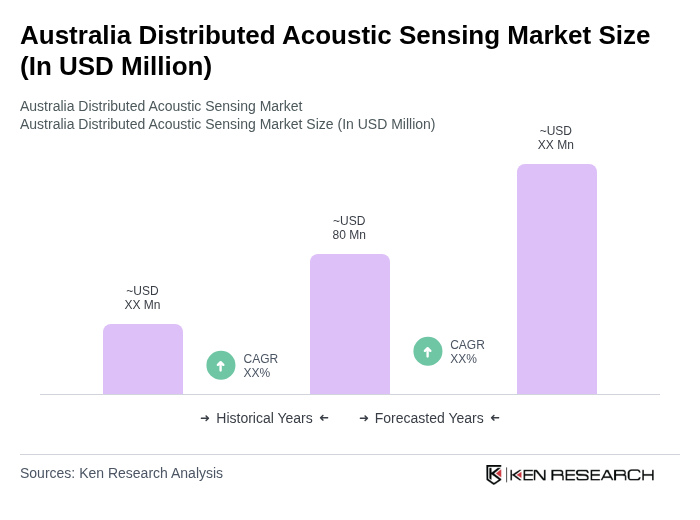
- The Australia Distributed Acoustic Sensing Market is valued at USD 80 million, based on a five-year historical analysis and its share within the global distributed acoustic sensing market. This growth is primarily driven by the increasing demand for real-time monitoring solutions across oil and gas, power and utilities, transportation, and security, where distributed acoustic sensing is widely used for leak detection, perimeter security, and infrastructure condition monitoring. The technology's ability to convert existing fiber-optic cables into continuous sensing arrays, providing high-resolution, real-time data over long distances, is enhancing operational efficiency and predictive maintenance for infrastructure monitoring and asset management.
- Key cities dominating the market include Sydney, Melbourne, and Brisbane. These urban centers are major hubs for technological innovation, telecommunications infrastructure, energy and utilities headquarters, and transport corridors, which significantly contribute to the demand for distributed acoustic sensing solutions in pipelines, rail corridors, and urban security applications. The presence of major industries, large pipeline networks, data centers, and a growing focus on smart city initiatives and critical infrastructure resilience further bolster the market in these regions.
- To enhance the safety and efficiency of critical infrastructure through advanced monitoring technologies, Australia has strengthened its regulatory framework for pipelines and critical assets, which indirectly supports the adoption of distributed acoustic sensing in new and existing projects. The Security of Critical Infrastructure Act 2018 and its subsequent amendments, administered by the Australian Government Department of Home Affairs, impose risk management, cyber and physical security, and incident reporting obligations on operators of critical infrastructure, including gas, electricity, and certain data and transport assets, encouraging deployment of advanced, real-time monitoring systems. In parallel, the Pipeline Regulations and safety requirements under the Offshore Petroleum and Greenhouse Gas Storage (Safety) Regulations 2009, administered by the National Offshore Petroleum Safety and Environmental Management Authority (NOPSEMA), require licensees to implement appropriate leak detection, integrity management, and environmental protection measures for subsea and onshore pipelines, for which distributed acoustic sensing solutions are increasingly used.
Australia Distributed Acoustic Sensing Market Segmentation
By Component:The components of the market include hardware, software, and services, in line with global distributed acoustic sensing market practice. Hardware encompasses interrogator units, optoelectronic modules, and associated fiber interfaces used in distributed acoustic sensing systems, while software refers to the analytics platforms and applications that process, visualize, and interpret acoustic and vibration data in real time. Services include system design, engineering, installation, calibration, data interpretation, maintenance, and lifecycle support, which are crucial for ensuring the effective and reliable operation of these systems across long linear assets and complex facilities.
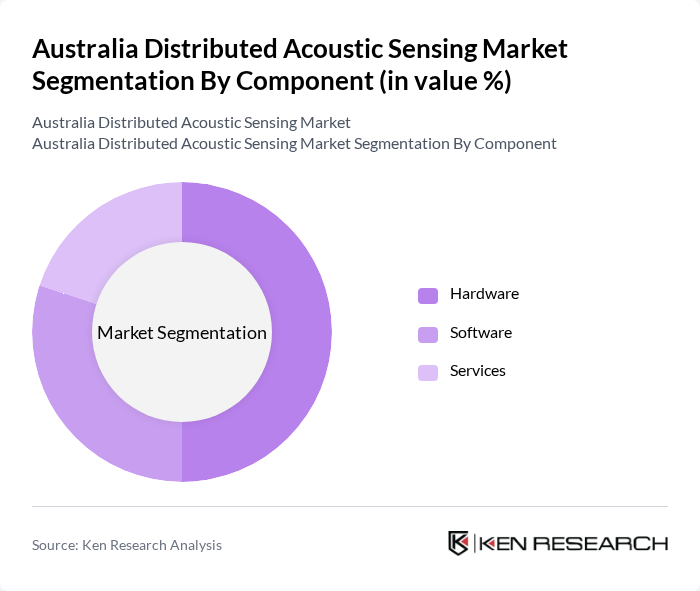
The hardware segment is currently dominating the market, consistent with global trends in distributed acoustic sensing, due to increasing investments in advanced interrogator units, robust fiber infrastructure, and sensing hardware for long-distance, high-sensitivity monitoring. The demand for highly reliable, field-hardened systems that can withstand harsh environmental conditions in oil and gas fields, offshore environments, and remote pipeline and rail corridors is driving growth in this segment. Additionally, the rise in smart city projects, growing focus on critical infrastructure security, and the need for real-time data analytics and predictive maintenance are further propelling the hardware market as operators upgrade legacy monitoring systems to fiber-based sensing.
By Fiber Type:The market is segmented into single-mode fiber and multi-mode fiber, consistent with standard distributed acoustic sensing classifications. Single-mode fiber is known for its long-distance transmission capabilities, low attenuation, and high sensitivity, making it suitable for extensive linear monitoring applications such as cross-country pipelines, high-voltage power cables, and railways. Multi-mode fiber, on the other hand, is often used for shorter-distance applications within facilities or industrial sites and can be more cost-effective for specific use cases where very long reach is not required.
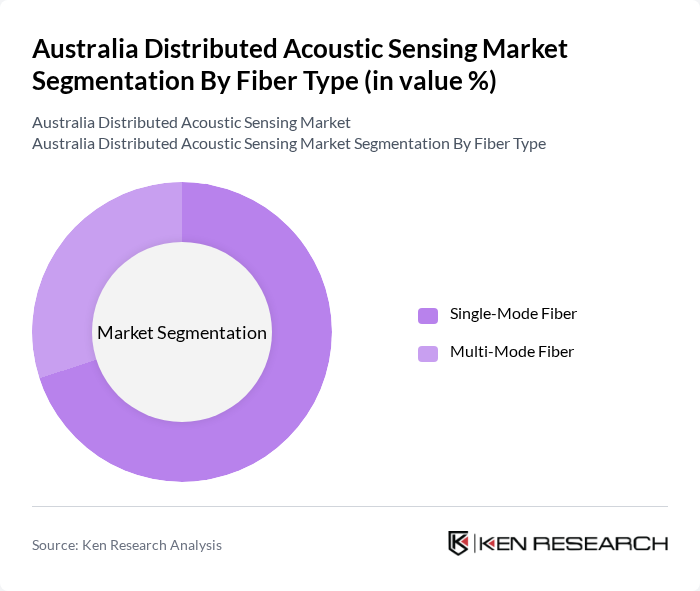
The single-mode fiber segment is leading the market, mirroring global distributed acoustic sensing adoption patterns, due to its superior performance in long-distance, high-resolution applications, which is essential for monitoring extensive infrastructure such as oil and gas pipelines, subsea assets, and railways. The increasing need for high-speed, low-loss data transmission and the growing adoption of advanced sensing technologies for continuous integrity monitoring, intrusion detection, and environmental risk management are key factors contributing to the dominance of single-mode fiber in the market.
Australia Distributed Acoustic Sensing Market Competitive Landscape
The Australia Distributed Acoustic Sensing Market is characterized by a dynamic mix of regional and international players. Leading participants such as OptaSense, Silixa, QinetiQ, Fotech Group, Schlumberger, Halliburton, Baker Hughes, Future Fibre Technologies, Bandweaver, Hifi Engineering, Omnisens, OFS, Fibre Completion Services, Hexagon, Teledyne Technologies contribute to innovation, geographic expansion, and service delivery in this space.
Australia Distributed Acoustic Sensing Market Industry Analysis
Growth Drivers
- Increasing Demand for Real-Time Monitoring:The Australian Distributed Acoustic Sensing (DAS) market is experiencing a surge in demand for real-time monitoring solutions, particularly in sectors like oil and gas, where operational efficiency is critical. In future, the Australian oil and gas sector is projected to invest approximately AUD 15 billion in technology upgrades, emphasizing the need for advanced monitoring systems. This trend is driven by the necessity to enhance safety, reduce downtime, and optimize resource management, making DAS an attractive solution for industry stakeholders.
- Advancements in Fiber Optic Technology:The evolution of fiber optic technology is a significant growth driver for the DAS market in Australia. With the global fiber optic market expected to reach USD 8 billion in future, innovations such as improved sensitivity and data transmission capabilities are enhancing DAS applications. These advancements enable more accurate and efficient monitoring of infrastructure, particularly in remote areas, thereby increasing the adoption of DAS systems across various industries, including transportation and utilities.
- Rising Investments in Infrastructure Development:Australia is witnessing a robust increase in infrastructure development, with the government allocating AUD 110 billion for infrastructure projects over the next decade. This investment is expected to drive the demand for DAS technology, as it provides critical monitoring capabilities for construction and maintenance activities. The integration of DAS in infrastructure projects enhances safety and efficiency, making it a vital component in the execution of large-scale developments across the country.
Market Challenges
- High Initial Setup Costs:One of the primary challenges facing the DAS market in Australia is the high initial setup costs associated with deploying these systems. The average installation cost for DAS can range from AUD 100,000 to AUD 500,000, depending on the complexity and scale of the project. This financial barrier can deter potential users, particularly small to medium-sized enterprises, from adopting DAS technology, limiting market growth and penetration in various sectors.
- Limited Awareness Among Potential Users:Despite the advantages of DAS technology, there remains a significant knowledge gap among potential users in Australia. Many industries are still unfamiliar with the benefits and applications of DAS, which can hinder adoption rates. According to a recent industry report, approximately 60% of companies in sectors like construction and utilities have not yet explored DAS solutions, indicating a need for increased education and outreach to promote awareness and understanding of this technology.
Australia Distributed Acoustic Sensing Market Future Outlook
The future of the Australia Distributed Acoustic Sensing market appears promising, driven by technological advancements and increasing demand across various sectors. As industries prioritize real-time monitoring and predictive maintenance, the integration of DAS with IoT technologies is expected to enhance operational efficiencies. Furthermore, the growing focus on environmental monitoring and sustainability will likely create new applications for DAS, positioning it as a critical tool for future infrastructure and resource management initiatives in Australia.
Market Opportunities
- Expansion in Renewable Energy Sectors:The shift towards renewable energy sources presents a significant opportunity for DAS technology. With Australia aiming to achieve 50% renewable energy in future, the need for effective monitoring solutions in solar and wind farms is increasing. DAS can provide real-time data on infrastructure integrity, enhancing operational efficiency and safety in these emerging sectors.
- Integration with IoT Technologies:The convergence of DAS with IoT technologies offers substantial market opportunities. As IoT adoption grows, integrating DAS systems can enhance data collection and analysis capabilities. This synergy can lead to improved decision-making processes in industries such as transportation and utilities, driving further demand for DAS solutions in Australia.
Scope of the Report
| Segment | Sub-Segments |
|---|---|
| By Component | Hardware Software Services |
| By Fiber Type | Single-Mode Fiber Multi-Mode Fiber |
| By Application | Pipeline Monitoring Power Cable and Subsea Cable Monitoring Rail and Roadway Monitoring Perimeter and Border Security Fire and Leak Detection Structural Health and Asset Integrity Monitoring Others |
| By End-Use Industry | Oil and Gas Power and Utilities Security and Surveillance Environment and Infrastructure Transportation Others |
| By Region | New South Wales Victoria Queensland Western Australia South Australia Others |
Key Target Audience
Investors and Venture Capitalist Firms
Government and Regulatory Bodies (e.g., Australian Energy Regulator, Geoscience Australia)
Manufacturers and Producers
Telecommunications Companies
Oil and Gas Exploration Companies
Mining Corporations
Infrastructure Development Agencies
Environmental Monitoring Organizations
Players Mentioned in the Report:
OptaSense
Silixa
QinetiQ
Fotech Group
Schlumberger
Halliburton
Baker Hughes
Future Fibre Technologies
Bandweaver
Hifi Engineering
Omnisens
OFS
Fibre Completion Services
Hexagon
Teledyne Technologies
Table of Contents
Market Assessment Phase
1. Executive Summary and Approach
2. Australia Distributed Acoustic Sensing Market Overview
2.1 Key Insights and Strategic Recommendations
2.2 Australia Distributed Acoustic Sensing Market Overview
2.3 Definition and Scope
2.4 Evolution of Market Ecosystem
2.5 Timeline of Key Regulatory Milestones
2.6 Value Chain & Stakeholder Mapping
2.7 Business Cycle Analysis
2.8 Policy & Incentive Landscape
3. Australia Distributed Acoustic Sensing Market Analysis
3.1 Growth Drivers
3.1.1 Increasing demand for real-time monitoring
3.1.2 Advancements in fiber optic technology
3.1.3 Rising investments in infrastructure development
3.1.4 Growing applications in oil and gas exploration
3.2 Market Challenges
3.2.1 High initial setup costs
3.2.2 Limited awareness among potential users
3.2.3 Regulatory hurdles
3.2.4 Competition from alternative sensing technologies
3.3 Market Opportunities
3.3.1 Expansion in renewable energy sectors
3.3.2 Integration with IoT technologies
3.3.3 Increasing demand for security applications
3.3.4 Potential in environmental monitoring
3.4 Market Trends
3.4.1 Growing adoption of smart city initiatives
3.4.2 Enhanced data analytics capabilities
3.4.3 Shift towards sustainable practices
3.4.4 Rising focus on predictive maintenance
3.5 Government Regulation
3.5.1 Standards for fiber optic installations
3.5.2 Environmental impact assessments
3.5.3 Data privacy regulations
3.5.4 Incentives for technology adoption
4. SWOT Analysis
5. Stakeholder Analysis
6. Porter's Five Forces Analysis
7. Australia Distributed Acoustic Sensing Market Market Size, 2019-2024
7.1 By Value
7.2 By Volume
7.3 By Average Selling Price
8. Australia Distributed Acoustic Sensing Market Segmentation
8.1 By Component
8.1.1 Hardware
8.1.2 Software
8.1.3 Services
8.2 By Fiber Type
8.2.1 Single-Mode Fiber
8.2.2 Multi-Mode Fiber
8.3 By Application
8.3.1 Pipeline Monitoring
8.3.2 Power Cable and Subsea Cable Monitoring
8.3.3 Rail and Roadway Monitoring
8.3.4 Perimeter and Border Security
8.3.5 Fire and Leak Detection
8.3.6 Structural Health and Asset Integrity Monitoring
8.3.7 Others
8.4 By End-Use Industry
8.4.1 Oil and Gas
8.4.2 Power and Utilities
8.4.3 Security and Surveillance
8.4.4 Environment and Infrastructure
8.4.5 Transportation
8.4.6 Others
8.5 By Region
8.5.1 New South Wales
8.5.2 Victoria
8.5.3 Queensland
8.5.4 Western Australia
8.5.5 South Australia
8.5.6 Others
9. Australia Distributed Acoustic Sensing Market Competitive Analysis
9.1 Market Share of Key Players
9.2 Cross Comparison of Key Players
9.2.1 Company Name
9.2.2 Group Size (Large, Medium, or Small as per industry convention)
9.2.3 Australia DAS Revenue (Latest Year, USD Million)
9.2.4 3-Year Australia DAS Revenue CAGR (%)
9.2.5 Australia DAS Market Share (%)
9.2.6 Australia Project Pipeline Value (USD Million)
9.2.7 R&D Intensity (% of Revenue)
9.2.8 Product and Feature Release Frequency (per Year)
9.2.9 Average Deal Size (USD, Australia)
9.2.10 Win Rate in Competitive Bids (%)
9.2.11 Customer Retention / Renewal Rate (%)
9.2.12 EBITDA Margin (%) – Australia DAS
9.3 SWOT Analysis of Top Players
9.4 Pricing Analysis
9.5 Detailed Profile of Major Companies
9.5.1 OptaSense
9.5.2 Silixa
9.5.3 QinetiQ
9.5.4 Fotech Group
9.5.5 Schlumberger
9.5.6 Halliburton
9.5.7 Baker Hughes
9.5.8 Future Fibre Technologies
9.5.9 Bandweaver
9.5.10 Hifi Engineering
9.5.11 Omnisens
9.5.12 OFS
9.5.13 Fibre Completion Services
9.5.14 Hexagon
9.5.15 Teledyne Technologies
10. Australia Distributed Acoustic Sensing Market End-User Analysis
10.1 Procurement Behavior of Key Ministries
10.1.1 Budget Allocation Trends
10.1.2 Decision-Making Processes
10.1.3 Preferred Suppliers
10.1.4 Contracting Practices
10.2 Corporate Spend on Infrastructure & Energy
10.2.1 Investment Trends
10.2.2 Major Projects
10.2.3 Funding Sources
10.2.4 Future Projections
10.3 Pain Point Analysis by End-User Category
10.3.1 Common Challenges
10.3.2 Technology Gaps
10.3.3 Budget Constraints
10.3.4 Regulatory Compliance Issues
10.4 User Readiness for Adoption
10.4.1 Awareness Levels
10.4.2 Training Needs
10.4.3 Infrastructure Readiness
10.4.4 Support Requirements
10.5 Post-Deployment ROI and Use Case Expansion
10.5.1 Performance Metrics
10.5.2 Case Studies
10.5.3 User Feedback
10.5.4 Future Use Cases
11. Australia Distributed Acoustic Sensing Market Future Size, 2025-2030
11.1 By Value
11.2 By Volume
11.3 By Average Selling Price
Go-To-Market Strategy Phase
1. Whitespace Analysis + Business Model Canvas
1.1 Market Gaps Identification
1.2 Value Proposition Development
1.3 Revenue Streams
1.4 Cost Structure Analysis
1.5 Key Partnerships
1.6 Customer Segments
1.7 Channels
2. Marketing and Positioning Recommendations
2.1 Branding Strategies
2.2 Product USPs
3. Distribution Plan
3.1 Urban Retail vs Rural NGO Tie-ups
4. Channel & Pricing Gaps
4.1 Underserved Routes
4.2 Pricing Bands
5. Unmet Demand & Latent Needs
5.1 Category Gaps
5.2 Consumer Segments
6. Customer Relationship
6.1 Loyalty Programs
6.2 After-sales Service
7. Value Proposition
7.1 Sustainability
7.2 Integrated Supply Chains
8. Key Activities
8.1 Regulatory Compliance
8.2 Branding
8.3 Distribution Setup
9. Entry Strategy Evaluation
9.1 Domestic Market Entry Strategy
9.1.1 Product Mix
9.1.2 Pricing Band
9.1.3 Packaging
9.2 Export Entry Strategy
9.2.1 Target Countries
9.2.2 Compliance Roadmap
10. Entry Mode Assessment
10.1 JV
10.2 Greenfield
10.3 M&A
10.4 Distributor Model
11. Capital and Timeline Estimation
11.1 Capital Requirements
11.2 Timelines
12. Control vs Risk Trade-Off
12.1 Ownership vs Partnerships
13. Profitability Outlook
13.1 Breakeven Analysis
13.2 Long-term Sustainability
14. Potential Partner List
14.1 Distributors
14.2 JVs
14.3 Acquisition Targets
15. Execution Roadmap
15.1 Phased Plan for Market Entry
15.1.1 Market Setup
15.1.2 Market Entry
15.1.3 Growth Acceleration
15.1.4 Scale & Stabilize
15.2 Key Activities and Milestones
15.2.1 Milestone Planning
15.2.2 Activity Tracking
Research Methodology
Phase 1: Approach1
Desk Research
- Analysis of industry reports from Australian government agencies and research institutions
- Review of academic publications and white papers on Distributed Acoustic Sensing (DAS) technologies
- Examination of market trends and forecasts from industry associations and consultancy firms
Primary Research
- Interviews with key stakeholders in the DAS market, including technology providers and end-users
- Surveys targeting infrastructure project managers and environmental monitoring specialists
- Field visits to operational sites utilizing DAS for real-time monitoring
Validation & Triangulation
- Cross-validation of findings through multiple data sources, including market reports and expert opinions
- Triangulation of quantitative data with qualitative insights from industry experts
- Sanity checks through peer reviews and feedback from advisory panels
Phase 2: Market Size Estimation1
Top-down Assessment
- Estimation of the overall market size based on national infrastructure investment trends
- Segmentation of the market by application areas such as oil & gas, transportation, and environmental monitoring
- Incorporation of government initiatives promoting smart infrastructure and monitoring technologies
Bottom-up Modeling
- Collection of data on installed DAS systems from leading providers and project case studies
- Operational cost analysis based on pricing models of DAS solutions and service contracts
- Volume estimates derived from project-specific deployments and usage rates
Forecasting & Scenario Analysis
- Multi-variable regression analysis incorporating factors such as technological advancements and regulatory changes
- Scenario modeling based on varying levels of market adoption and investment in infrastructure
- Development of baseline, optimistic, and pessimistic forecasts through 2030
Phase 3: CATI Sample Composition1
| Scope Item/Segment | Sample Size | Target Respondent Profiles |
|---|---|---|
| Oil & Gas Monitoring Applications | 100 | Field Engineers, Operations Managers |
| Transportation Infrastructure Projects | 80 | Project Managers, Civil Engineers |
| Environmental Monitoring Systems | 70 | Environmental Scientists, Compliance Officers |
| Telecommunications Network Monitoring | 60 | Network Engineers, IT Managers |
| Smart City Initiatives | 90 | Urban Planners, Smart Technology Consultants |
Frequently Asked Questions
What is the current value of the Australia Distributed Acoustic Sensing Market?
The Australia Distributed Acoustic Sensing Market is valued at approximately USD 80 million, reflecting its significant role within the global distributed acoustic sensing market, driven by increasing demand for real-time monitoring solutions across various sectors.
What are the primary applications of Distributed Acoustic Sensing in Australia?
Which cities are leading in the Australia Distributed Acoustic Sensing Market?
What factors are driving the growth of the Australia Distributed Acoustic Sensing Market?
Other Regional/Country Reports
Other Adjacent Reports
Mexico Fiber Optic Sensing Market
South Korea Pipeline Monitoring Market
UAE Perimeter Security MarketBahrain Oil and Gas Monitoring Market
Oman Power Grid Monitoring Market
KSA Railway Infrastructure Monitoring Market
Bahrain Smart City Technology Market
UAE IoT Sensor MarketMalaysia Renewable Energy Monitoring Market
Bahrain Critical Infrastructure Protection Market
Why Buy From Us?

What makes us stand out is that our consultants follow Robust, Refine and Result (RRR) methodology. Robust for clear definitions, approaches and sanity checking, Refine for differentiating respondents' facts and opinions, and Result for presenting data with story.

We have set a benchmark in the industry by offering our clients with syndicated and customized market research reports featuring coverage of entire market as well as meticulous research and analyst insights.

While we don't replace traditional research, we flip the method upside down. Our dual approach of Top Bottom & Bottom Top ensures quality deliverable by not just verifying company fundamentals but also looking at the sector and macroeconomic factors.

With one step in the future, our research team constantly tries to show you the bigger picture. We help with some of the tough questions you may encounter along the way: How is the industry positioned? Best marketing channel? KPI's of competitors? By aligning every element, we help maximize success.

Our report gives you instant access to the answers and sources that other companies might choose to hide. We elaborate each steps of research methodology we have used and showcase you the sample size to earn your trust.

If you need any support, we are here! We pride ourselves on universe strength, data quality, and quick, friendly, and professional service.