About the Report
Base Year 2024Listen to the audio summary
Brazil Agriculture Crops And Cereals Industry Market Overview
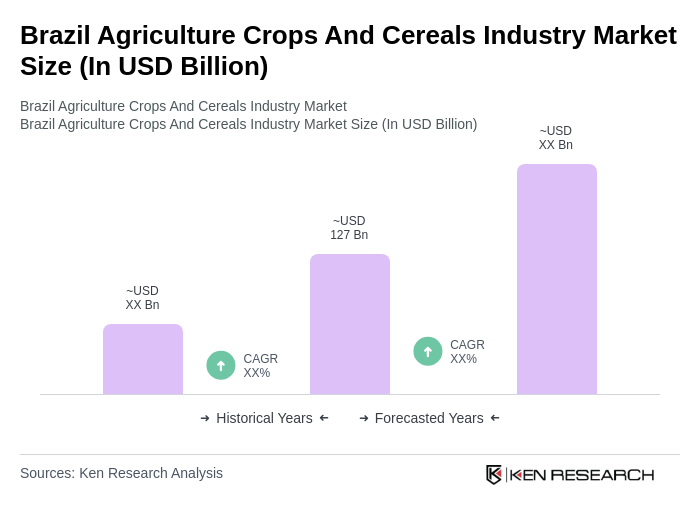
- The Brazil Agriculture Crops and Cereals Industry Market is valued at approximately USD 127 billion, based on a five-year historical analysis. This growth is primarily driven by Brazil's status as one of the world's largest agricultural producers, with significant contributions from soybeans, corn, and sugarcane. The increasing global demand for food and biofuels, coupled with advancements in agricultural technology and the adoption of sustainable practices, has further propelled the market's expansion.
- Key regions dominating the market include the Central-West and Southeast regions, particularly states like Mato Grosso and São Paulo. These areas benefit from fertile land, favorable climate conditions, and well-established infrastructure, making them ideal for large-scale agricultural production. The concentration of agribusinesses and access to export markets also contribute to their dominance.
- In 2023, the Brazilian government reinforced the National Policy for Agroecology and Organic Production, aiming to promote sustainable agricultural practices. This policy encourages farmers to adopt organic farming methods and provides financial incentives for transitioning to agroecological practices, thereby enhancing the sustainability of the agriculture sector.
Brazil Agriculture Crops And Cereals Industry Market Segmentation
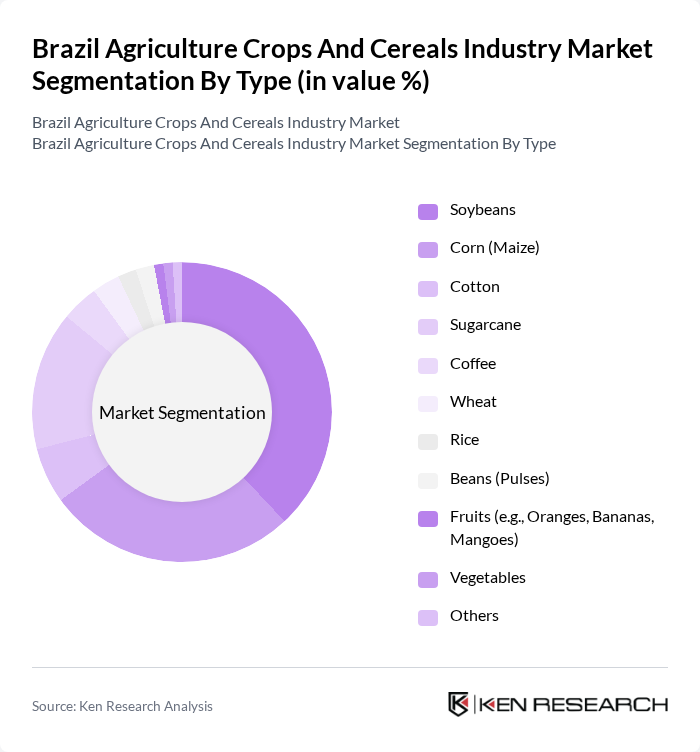
By Type:This segmentation includes various agricultural products that are crucial for both domestic consumption and export. The primary subsegments are soybeans, corn (maize), cotton, sugarcane, coffee, wheat, rice, beans (pulses), fruits, vegetables, and others. Among these, soybeans and sugarcane are particularly dominant due to their high demand in both local and international markets.
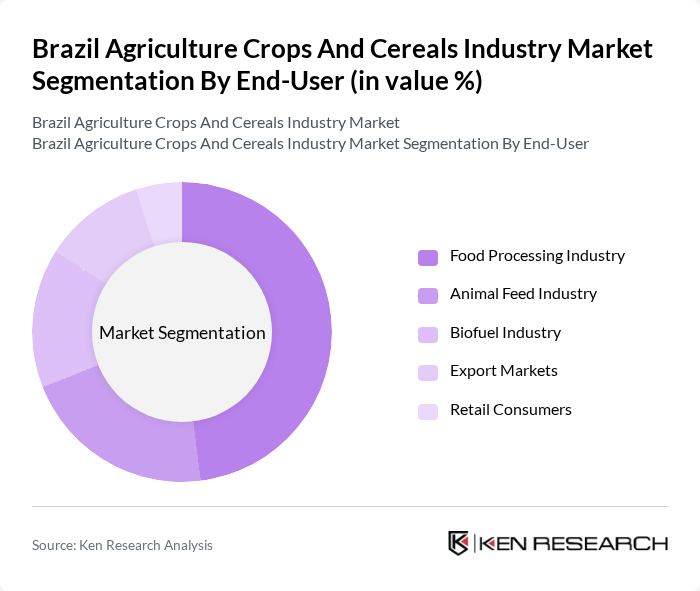
By End-User:This segmentation focuses on the various industries that utilize agricultural products. The primary subsegments include the food processing industry, animal feed industry, biofuel industry, export markets, and retail consumers. The food processing industry is the leading segment, driven by the increasing demand for processed foods and convenience products.
Brazil Agriculture Crops And Cereals Industry Market Competitive Landscape
The Brazil Agriculture Crops And Cereals Industry Market is characterized by a dynamic mix of regional and international players. Leading participants such as Bunge Brasil, Cargill Agrícola S.A., ADM do Brasil Ltda., Louis Dreyfus Company Brasil S.A., Syngenta Proteção de Cultivos Ltda., Bayer S.A., Corteva Agriscience Brasil Ltda., Grupo André Maggi (Amaggi), Coamo Agroindustrial Cooperativa, Grupo Bom Futuro, SLC Agrícola S.A., Agro Amazônia Produtos Agropecuários S.A., Terra Santa Agro S.A., BrasilAgro – Companhia Brasileira de Propriedades Agrícolas, Agroceres Sementes S.A. contribute to innovation, geographic expansion, and service delivery in this space.
Brazil Agriculture Crops And Cereals Industry Market Industry Analysis
Growth Drivers
- Increasing Domestic Demand:Brazil's domestic consumption of agricultural products is projected to reach 200 million tons in future, driven by a growing population of over 203 million. The rise in per capita income, which is expected to increase by 3.5% in future, further fuels demand for diverse food products. This trend is particularly evident in the consumption of cereals, which is anticipated to grow by 2.5 million tons, reflecting a shift towards healthier diets and increased protein consumption.
- Export Opportunities:Brazil is the world's largest exporter of soybeans, with exports expected to reach approximately 100 million tons in future, valued at approximately $48 billion. The demand from countries like China, which imports over 60% of its soybeans, significantly contributes to this growth. Additionally, Brazil's strategic trade agreements with other nations enhance its export potential, allowing for increased market penetration and revenue generation in the global agricultural sector.
- Technological Advancements in Agriculture:The adoption of precision agriculture technologies is projected to increase by 15% in future, enhancing crop yields and resource efficiency. Investments in agri-tech solutions, estimated at $1.5 billion, focus on data analytics, drones, and IoT devices. These innovations are expected to improve productivity by 20%, allowing Brazilian farmers to optimize inputs and reduce costs, thereby boosting overall agricultural output and sustainability.
Market Challenges
- Climate Change Impact:Brazil's agriculture is increasingly vulnerable to climate change, with an estimated 7% to 18% reduction in crop yields projected in future due to extreme weather events. The World Bank reports that droughts and floods could lead to losses exceeding $7 billion annually. This unpredictability poses significant risks to food security and farmer livelihoods, necessitating urgent adaptation strategies to mitigate these effects on agricultural productivity.
- Infrastructure Limitations:Brazil's agricultural sector faces significant infrastructure challenges, with over 50% of rural roads in poor condition, hindering access to markets. The lack of efficient transportation systems results in increased logistics costs, estimated at $2.5 billion annually. Additionally, inadequate storage facilities lead to post-harvest losses of approximately 15% for certain crops, impacting overall profitability and competitiveness in both domestic and international markets.
Brazil Agriculture Crops And Cereals Industry Market Future Outlook
The future of Brazil's agriculture crops and cereals industry appears promising, driven by increasing domestic demand and a focus on sustainable practices. As the government emphasizes technological innovation and infrastructure improvements, the sector is expected to adapt to climate challenges effectively. Furthermore, the rise of e-commerce in agriculture will facilitate direct-to-consumer sales, enhancing market access for farmers. Overall, these trends indicate a resilient industry poised for growth and transformation in the coming years.
Market Opportunities
- Organic Farming Growth:The organic farming sector in Brazil is projected to expand significantly, with an estimated market value of $1.2 billion in future. This growth is driven by increasing consumer awareness and demand for organic products, particularly in urban areas. The government’s support for organic certification and sustainable practices further enhances this opportunity, positioning Brazil as a leader in organic agriculture in Latin America.
- Sustainable Practices Adoption:The adoption of sustainable agricultural practices is expected to increase, with investments in eco-friendly technologies projected to reach $500 million in future. This shift is driven by both consumer demand for sustainable products and regulatory pressures. Implementing practices such as crop rotation and reduced chemical usage can enhance soil health and biodiversity, ultimately leading to improved long-term productivity and environmental stewardship.
Scope of the Report
| Segment | Sub-Segments |
|---|---|
| By Type | Soybeans Corn (Maize) Cotton Sugarcane Coffee Wheat Rice Beans (Pulses) Fruits (e.g., Oranges, Bananas, Mangoes) Vegetables Others |
| By End-User | Food Processing Industry Animal Feed Industry Biofuel Industry Export Markets Retail Consumers |
| By Distribution Channel | Direct Sales Wholesalers Online Retail Supermarkets and Hypermarkets |
| By Region | North Region Northeast Region Central-West Region Southeast Region South Region |
| By Crop Type | Staple Crops (e.g., Rice, Beans, Corn, Wheat) Cash Crops (e.g., Soybeans, Sugarcane, Coffee, Cotton) Specialty Crops (e.g., Fruits, Vegetables, Cocoa) |
| By Farming Method | Conventional Farming Organic Farming Precision/Technological Farming Hydroponics |
| By Price Range | Low Price Mid Price High Price |
Key Target Audience
Investors and Venture Capitalist Firms
Government and Regulatory Bodies (e.g., Ministry of Agriculture, Livestock and Food Supply)
Manufacturers and Producers
Distributors and Retailers
Exporters and Importers
Agrochemical and Fertilizer Companies
Food Processing Companies
Financial Institutions
Players Mentioned in the Report:
Bunge Brasil
Cargill Agricola S.A.
ADM do Brasil Ltda.
Louis Dreyfus Company Brasil S.A.
Syngenta Protecao de Cultivos Ltda.
Bayer S.A.
Corteva Agriscience Brasil Ltda.
Grupo Andre Maggi (Amaggi)
Coamo Agroindustrial Cooperativa
Grupo Bom Futuro
SLC Agricola S.A.
Agro Amazonia Produtos Agropecuarios S.A.
Terra Santa Agro S.A.
BrasilAgro Companhia Brasileira de Propriedades Agricolas
Agroceres Sementes S.A.
Table of Contents
Market Assessment Phase
1. Executive Summary and Approach
2. Brazil Agriculture Crops And Cereals Industry Market Overview
2.1 Key Insights and Strategic Recommendations
2.2 Brazil Agriculture Crops And Cereals Industry Market Overview
2.3 Definition and Scope
2.4 Evolution of Market Ecosystem
2.5 Timeline of Key Regulatory Milestones
2.6 Value Chain & Stakeholder Mapping
2.7 Business Cycle Analysis
2.8 Policy & Incentive Landscape
3. Brazil Agriculture Crops And Cereals Industry Market Analysis
3.1 Growth Drivers
3.1.1 Increasing Domestic Demand
3.1.2 Export Opportunities
3.1.3 Technological Advancements in Agriculture
3.1.4 Government Support and Subsidies
3.2 Market Challenges
3.2.1 Climate Change Impact
3.2.2 Infrastructure Limitations
3.2.3 Price Volatility of Raw Materials
3.2.4 Regulatory Compliance Issues
3.3 Market Opportunities
3.3.1 Organic Farming Growth
3.3.2 Sustainable Practices Adoption
3.3.3 Investment in Agri-Tech Solutions
3.3.4 Expansion into New Markets
3.4 Market Trends
3.4.1 Shift Towards Sustainable Agriculture
3.4.2 Increasing Use of Precision Farming
3.4.3 Rise of E-commerce in Agriculture
3.4.4 Focus on Crop Diversification
3.5 Government Regulation
3.5.1 Environmental Protection Laws
3.5.2 Agricultural Subsidy Programs
3.5.3 Food Safety Regulations
3.5.4 Land Use Policies
4. SWOT Analysis
5. Stakeholder Analysis
6. Porter's Five Forces Analysis
7. Brazil Agriculture Crops And Cereals Industry Market Market Size, 2019-2024
7.1 By Value
7.2 By Volume
7.3 By Average Selling Price
8. Brazil Agriculture Crops And Cereals Industry Market Segmentation
8.1 By Type
8.1.1 Soybeans
8.1.2 Corn (Maize)
8.1.3 Cotton
8.1.4 Sugarcane
8.1.5 Coffee
8.1.6 Wheat
8.1.7 Rice
8.1.8 Beans (Pulses)
8.1.9 Fruits (e.g., Oranges, Bananas, Mangoes)
8.1.10 Vegetables
8.1.11 Others
8.2 By End-User
8.2.1 Food Processing Industry
8.2.2 Animal Feed Industry
8.2.3 Biofuel Industry
8.2.4 Export Markets
8.2.5 Retail Consumers
8.3 By Distribution Channel
8.3.1 Direct Sales
8.3.2 Wholesalers
8.3.3 Online Retail
8.3.4 Supermarkets and Hypermarkets
8.4 By Region
8.4.1 North Region
8.4.2 Northeast Region
8.4.3 Central-West Region
8.4.4 Southeast Region
8.4.5 South Region
8.5 By Crop Type
8.5.1 Staple Crops (e.g., Rice, Beans, Corn, Wheat)
8.5.2 Cash Crops (e.g., Soybeans, Sugarcane, Coffee, Cotton)
8.5.3 Specialty Crops (e.g., Fruits, Vegetables, Cocoa)
8.6 By Farming Method
8.6.1 Conventional Farming
8.6.2 Organic Farming
8.6.3 Precision/Technological Farming
8.6.4 Hydroponics
8.7 By Price Range
8.7.1 Low Price
8.7.2 Mid Price
8.7.3 High Price
9. Brazil Agriculture Crops And Cereals Industry Market Competitive Analysis
9.1 Market Share of Key Players
9.2 Cross Comparison of Key Players
9.2.1 Company Name
9.2.2 Group Size (Large, Medium, or Small as per industry convention)
9.2.3 Annual Revenue (BRL/USD)
9.2.4 Revenue Growth Rate (%)
9.2.5 Market Share (%)
9.2.6 Crop Production Volume (Metric Tons)
9.2.7 Export Volume (Metric Tons or USD)
9.2.8 Geographic Coverage (Domestic/Export Markets)
9.2.9 Product Portfolio Breadth (Number of Crops/Segments)
9.2.10 R&D Investment (% of Revenue)
9.2.11 Sustainability/ESG Score
9.2.12 Supply Chain Efficiency Index
9.2.13 Innovation Rate (New Products/Year)
9.2.14 Customer Base (Number of Clients/Partners)
9.2.15 Brand Recognition Score
9.3 SWOT Analysis of Top Players
9.4 Pricing Analysis
9.5 Detailed Profile of Major Companies
9.5.1 Bunge Brasil
9.5.2 Cargill Agrícola S.A.
9.5.3 ADM do Brasil Ltda.
9.5.4 Louis Dreyfus Company Brasil S.A.
9.5.5 Syngenta Proteção de Cultivos Ltda.
9.5.6 Bayer S.A.
9.5.7 Corteva Agriscience Brasil Ltda.
9.5.8 Grupo André Maggi (Amaggi)
9.5.9 Coamo Agroindustrial Cooperativa
9.5.10 Grupo Bom Futuro
9.5.11 SLC Agrícola S.A.
9.5.12 Agro Amazônia Produtos Agropecuários S.A.
9.5.13 Terra Santa Agro S.A.
9.5.14 BrasilAgro – Companhia Brasileira de Propriedades Agrícolas
9.5.15 Agroceres Sementes S.A.
10. Brazil Agriculture Crops And Cereals Industry Market End-User Analysis
10.1 Procurement Behavior of Key Ministries
10.1.1 Ministry of Agriculture
10.1.2 Ministry of Environment
10.1.3 Ministry of Industry and Trade
10.2 Corporate Spend on Infrastructure & Energy
10.2.1 Investment in Sustainable Practices
10.2.2 Funding for Technological Innovations
10.3 Pain Point Analysis by End-User Category
10.3.1 Cost of Inputs
10.3.2 Access to Markets
10.3.3 Regulatory Compliance
10.4 User Readiness for Adoption
10.4.1 Awareness of New Technologies
10.4.2 Training and Support Needs
10.5 Post-Deployment ROI and Use Case Expansion
10.5.1 Measurement of Success Metrics
10.5.2 Opportunities for Scaling
11. Brazil Agriculture Crops And Cereals Industry Market Future Size, 2025-2030
11.1 By Value
11.2 By Volume
11.3 By Average Selling Price
Go-To-Market Strategy Phase
1. Whitespace Analysis + Business Model Canvas
1.1 Market Gaps Identification
1.2 Value Proposition Development
1.3 Revenue Streams Analysis
1.4 Cost Structure Evaluation
1.5 Key Partnerships Exploration
1.6 Customer Segments Definition
1.7 Channels Strategy
2. Marketing and Positioning Recommendations
2.1 Branding Strategies
2.2 Product USPs
2.3 Target Audience Identification
2.4 Communication Strategy
2.5 Digital Marketing Tactics
3. Distribution Plan
3.1 Urban Retail Strategy
3.2 Rural NGO Tie-ups
3.3 Logistics and Supply Chain Management
3.4 Distribution Partnerships
4. Channel & Pricing Gaps
4.1 Underserved Routes
4.2 Pricing Bands Analysis
4.3 Competitor Pricing Comparison
5. Unmet Demand & Latent Needs
5.1 Category Gaps Identification
5.2 Consumer Segments Analysis
5.3 Emerging Trends Exploration
6. Customer Relationship
6.1 Loyalty Programs Development
6.2 After-sales Service Strategies
6.3 Customer Feedback Mechanisms
7. Value Proposition
7.1 Sustainability Initiatives
7.2 Integrated Supply Chains
7.3 Competitive Advantage Analysis
8. Key Activities
8.1 Regulatory Compliance
8.2 Branding Initiatives
8.3 Distribution Setup
9. Entry Strategy Evaluation
9.1 Domestic Market Entry Strategy
9.1.1 Product Mix Considerations
9.1.2 Pricing Band Strategy
9.1.3 Packaging Solutions
9.2 Export Entry Strategy
9.2.1 Target Countries Identification
9.2.2 Compliance Roadmap Development
10. Entry Mode Assessment
10.1 Joint Ventures
10.2 Greenfield Investments
10.3 Mergers & Acquisitions
10.4 Distributor Model Evaluation
11. Capital and Timeline Estimation
11.1 Capital Requirements Analysis
11.2 Timelines for Implementation
12. Control vs Risk Trade-Off
12.1 Ownership vs Partnerships
12.2 Risk Management Strategies
13. Profitability Outlook
13.1 Breakeven Analysis
13.2 Long-term Sustainability Strategies
14. Potential Partner List
14.1 Distributors Identification
14.2 Joint Ventures Opportunities
14.3 Acquisition Targets
15. Execution Roadmap
15.1 Phased Plan for Market Entry
15.1.1 Market Setup
15.1.2 Market Entry
15.1.3 Growth Acceleration
15.1.4 Scale & Stabilize
15.2 Key Activities and Milestones
15.2.1 Milestone Planning
15.2.2 Activity Tracking
Research Methodology
Phase 1: Approach1
Desk Research
- Analysis of agricultural production statistics from the Brazilian Institute of Geography and Statistics (IBGE)
- Review of market reports from agricultural associations and government publications
- Examination of trade data and export-import statistics from the Ministry of Agriculture, Livestock, and Food Supply (MAPA)
Primary Research
- Interviews with agronomists and crop specialists in Brazil's leading agricultural regions
- Surveys with farmers and cooperatives to gather insights on crop yields and challenges
- Focus groups with agricultural technology providers to understand market trends and innovations
Validation & Triangulation
- Cross-validation of data from multiple sources, including government and industry reports
- Triangulation of findings from primary interviews with secondary data insights
- Sanity checks through expert panel discussions with industry veterans
Phase 2: Market Size Estimation1
Top-down Assessment
- Estimation of total agricultural output based on national GDP contributions from the agriculture sector
- Segmentation of crop types and their respective market shares within the overall agricultural output
- Incorporation of historical growth rates and future projections based on climatic and economic factors
Bottom-up Modeling
- Collection of yield data from major crop producers to establish baseline production volumes
- Analysis of input costs and pricing trends for key agricultural inputs such as seeds and fertilizers
- Volume x price calculations to derive revenue estimates for each crop segment
Forecasting & Scenario Analysis
- Multi-variable regression analysis incorporating factors such as climate change, technology adoption, and policy shifts
- Scenario modeling based on potential changes in trade agreements and domestic agricultural policies
- Development of baseline, optimistic, and pessimistic forecasts through 2030
Phase 3: CATI Sample Composition1
| Scope Item/Segment | Sample Size | Target Respondent Profiles |
|---|---|---|
| Cereal Crop Producers | 60 | Farm Owners, Agronomists |
| Legume Cultivators | 40 | Farm Managers, Cooperative Leaders |
| Fertilizer Suppliers | 40 | Sales Managers, Product Development Specialists |
| Exporters of Agricultural Products | 40 | Export Managers, Trade Analysts |
| Agri-tech Innovators | 40 | Technology Developers, Market Strategists |
Frequently Asked Questions
What is the current value of the Brazil Agriculture Crops and Cereals Industry Market?
The Brazil Agriculture Crops and Cereals Industry Market is valued at approximately USD 127 billion, reflecting its position as one of the world's largest agricultural producers, particularly in soybeans, corn, and sugarcane.
Which regions in Brazil dominate the agriculture crops and cereals market?
What are the main crops produced in Brazil's agriculture sector?
How is the Brazilian government supporting sustainable agriculture practices?
Other Regional/Country Reports
Indonesia Agriculture Crops And Cereals Industry Market
Malaysia Agriculture Crops And Cereals Industry Market
KSA Agriculture Crops And Cereals Industry Market
APAC Agriculture Crops And Cereals Industry Market
SEA Agriculture Crops And Cereals Industry Market
Vietnam Agriculture Crops And Cereals Industry Market
Why Buy From Us?

What makes us stand out is that our consultants follow Robust, Refine and Result (RRR) methodology. Robust for clear definitions, approaches and sanity checking, Refine for differentiating respondents' facts and opinions, and Result for presenting data with story.

We have set a benchmark in the industry by offering our clients with syndicated and customized market research reports featuring coverage of entire market as well as meticulous research and analyst insights.

While we don't replace traditional research, we flip the method upside down. Our dual approach of Top Bottom & Bottom Top ensures quality deliverable by not just verifying company fundamentals but also looking at the sector and macroeconomic factors.

With one step in the future, our research team constantly tries to show you the bigger picture. We help with some of the tough questions you may encounter along the way: How is the industry positioned? Best marketing channel? KPI's of competitors? By aligning every element, we help maximize success.

Our report gives you instant access to the answers and sources that other companies might choose to hide. We elaborate each steps of research methodology we have used and showcase you the sample size to earn your trust.

If you need any support, we are here! We pride ourselves on universe strength, data quality, and quick, friendly, and professional service.