About the Report
Base Year 2024California Legal Cannabis Market Overview
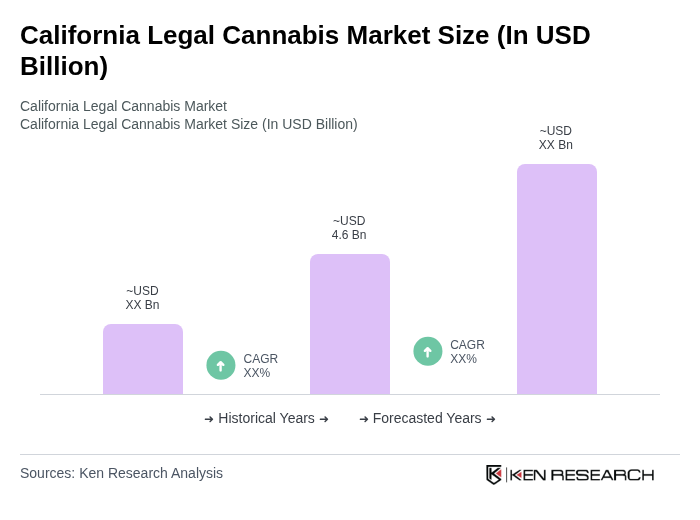
- The California Legal Cannabis Market is valued at USD 4.6 billion, based on a five-year historical analysis. This growth is primarily driven by the increasing acceptance of cannabis for both recreational and medicinal use, alongside a robust regulatory framework that supports legal sales. The market has seen a surge in consumer demand, particularly for high-quality products and innovative consumption methods such as beverages showing rapid growth, contributing to its substantial economic footprint.
- Key cities such as Los Angeles, San Francisco, and San Diego dominate the California Legal Cannabis Market due to their large populations, progressive attitudes towards cannabis, and well-established retail infrastructures. These urban centers not only serve as major consumption hubs but also attract tourists seeking cannabis experiences, further enhancing their market presence.
- The Emergency Regulations for Social Equity Licensing, 2023 issued by the Department of Cannabis Control require social equity applicants to demonstrate residency and economic impact criteria, mandating a minimum 51% ownership by qualified individuals with streamlined application reviews within 90 days to facilitate market entry. This regulation reduces the time and complexity involved in obtaining necessary permits, thereby encouraging more entrepreneurs to enter the market. The initiative is expected to foster competition and innovation within the industry, ultimately benefiting consumers through increased product variety and improved pricing.
California Legal Cannabis Market Segmentation
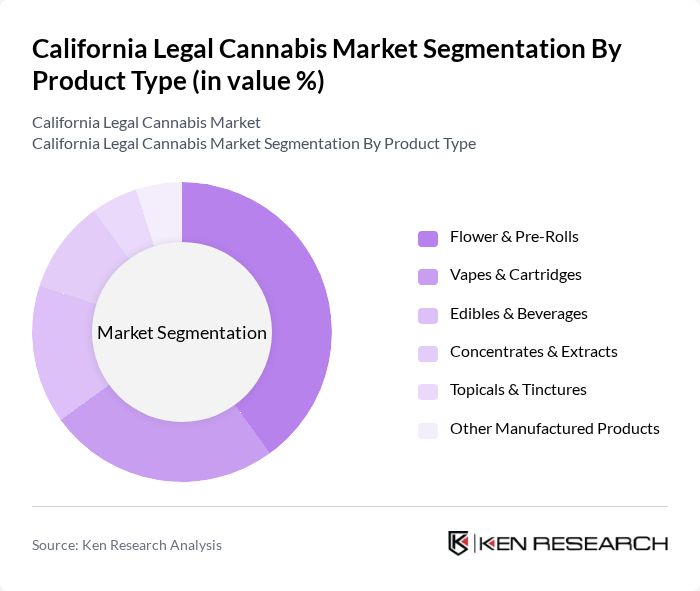
By Product Type:The California Legal Cannabis Market is segmented into various product types, including Flower & Pre-Rolls, Vapes & Cartridges, Edibles & Beverages, Concentrates & Extracts, Topicals & Tinctures, and Other Manufactured Products. Among these, Flower & Pre-Rolls have historically dominated the market due to their traditional appeal and widespread consumer acceptance. However, Vapes & Cartridges are rapidly gaining traction, particularly among younger consumers who prefer discreet consumption methods. The growing trend towards health-conscious and convenient options has also led to increased interest in Edibles & Beverages.
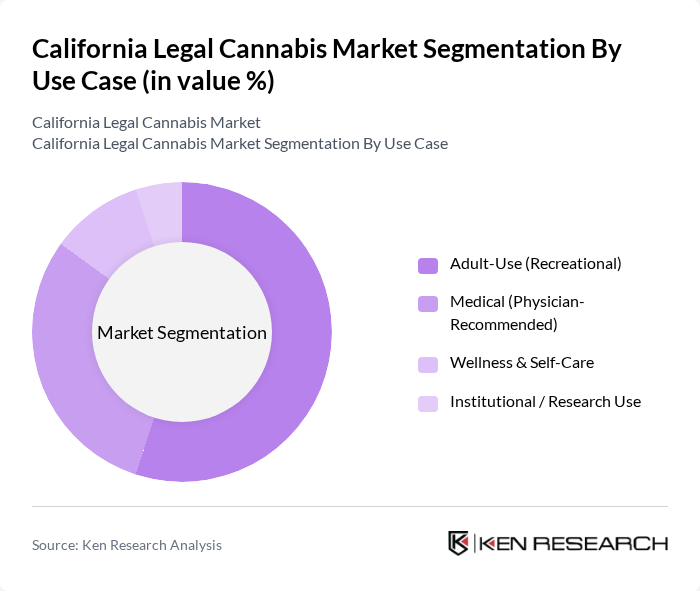
By Use Case:The market is also segmented by use case, which includes Adult-Use (Recreational), Medical (Physician-Recommended), Wellness & Self-Care, and Institutional / Research Use. The Adult-Use segment is the largest, driven by the legalization of recreational cannabis and a growing consumer base that seeks both enjoyment and therapeutic benefits. Medical use remains significant, particularly among older demographics and patients with chronic conditions, while the Wellness & Self-Care segment is emerging as consumers increasingly turn to cannabis for holistic health solutions.
California Legal Cannabis Market Competitive Landscape
The California Legal Cannabis Market is characterized by a dynamic mix of regional and international players. Leading participants such as STIIIZY (Shryne Group Inc.), Cookies Retail / Cookies SF, Glass House Brands Inc., The Parent Company (TPCO Holding Corp.), Lowell Farms Inc. / Lowell Herb Co., KIVA Brands Inc., Curaleaf, Cresco Labs, Green Thumb Industries, Trulieve, Harvest Health & Recreation, TerrAscend, 4Front Ventures, Eaze, Flow Kana contribute to innovation, geographic expansion, and service delivery in this space.
California Legal Cannabis Market Industry Analysis
Growth Drivers
- Increasing Legalization and Acceptance:The legalization of cannabis in California has led to a significant increase in market participation. As of the future, over 60% of Californians support cannabis legalization, according to a recent survey by the Public Policy Institute of California. This growing acceptance has resulted in a market that generated approximately $5.4 billion in sales recently, with expectations for continued growth as more consumers embrace legal cannabis products.
- Expanding Consumer Base:The consumer demographic for cannabis in California is diversifying, with notable increases in usage among older adults. Data from the California Department of Public Health indicates that cannabis use among adults aged 50 and older rose by 32% from 2020 to the future. This expanding consumer base is driving demand for a wider range of products, contributing to an estimated 16% increase in overall market sales recently, reaching $5.4 billion.
- Innovations in Product Offerings:The California cannabis market is witnessing a surge in innovative product offerings, including edibles, beverages, and topicals. In the recent past, cannabis-infused beverages alone accounted for $1.5 billion in sales, reflecting a 27% increase from the previous year. This trend is supported by consumer preferences shifting towards more diverse and convenient consumption methods, which are expected to continue driving market growth in the future.
Market Challenges
- Regulatory Complexities:The cannabis industry in California faces significant regulatory hurdles, with over 1,100 local jurisdictions imposing varying regulations. This complexity can hinder market entry and operational efficiency. Recently, approximately 42% of cannabis businesses reported difficulties in navigating these regulations, leading to increased operational costs and potential market exit for smaller players, which could stifle overall market growth.
- High Taxation Rates:California imposes some of the highest taxes on cannabis in the nation, with a combined state and local tax rate exceeding 32%. This high taxation has resulted in a significant price disparity between legal and black market products. Recently, legal cannabis sales were approximately $5.4 billion, but the black market is estimated to be worth $9 billion, indicating that high taxes are driving consumers to seek cheaper alternatives.
California Legal Cannabis Market Future Outlook
The California legal cannabis market is poised for continued evolution, driven by shifting consumer preferences and regulatory adjustments. As the state refines its regulatory framework, businesses may find new opportunities for growth. Additionally, the increasing focus on health and wellness is likely to spur demand for medicinal cannabis products. Innovations in technology and cultivation methods will further enhance product quality and availability, positioning the market for robust expansion in the coming years.
Market Opportunities
- Expansion into New Demographics:Targeting emerging demographics, such as seniors and wellness-focused consumers, presents a significant opportunity. With a 32% increase in cannabis use among adults aged 50 and older, businesses can tailor products to meet the needs of this growing segment, potentially increasing market share and driving sales.
- Development of Cannabis-Infused Products:The rise in popularity of cannabis-infused products, particularly beverages and edibles, offers a lucrative opportunity. With sales of cannabis-infused beverages reaching $1.5 billion recently, companies can capitalize on this trend by innovating new product lines that cater to health-conscious consumers, thereby expanding their market reach.
Scope of the Report
| Segment | Sub-Segments |
|---|---|
| By Product Type | Flower & Pre-Rolls Vapes & Cartridges Edibles & Beverages Concentrates & Extracts Topicals & Tinctures Other Manufactured Products |
| By Use Case | Adult-Use (Recreational) Medical (Physician-Recommended) Wellness & Self-Care Institutional / Research Use |
| By Licensed Activity | Cultivation Manufacturing & Processing Distribution Retail Storefront Dispensaries Delivery-Only Retail Testing Laboratories |
| By Potency & Cannabinoid Profile | High-THC Products CBD-Dominant & Hemp-Derived Products Balanced THC/CBD Products Minor Cannabinoid Products (CBN, CBG, etc.) |
| By Consumer Demographics | Gen Z (21–27) Millennials (28–43) Gen X (44–59) Baby Boomers (60+) Other Segments (Tourists, Business Travelers, etc.) |
| By Retail Format | Urban Dispensaries Suburban Dispensaries Delivery Platforms Social Consumption Lounges & Cafés Pharmacies & Wellness Clinics (CBD / hemp products) |
| By Regulatory / Tax Environment | High-Tax Municipalities Low- and No-Local-Tax Municipalities Opt-In Jurisdictions (Allowing Retail) Opt-Out Jurisdictions (Banning Retail) |
Key Target Audience
Investors and Venture Capitalist Firms
Government and Regulatory Bodies (e.g., California Bureau of Cannabis Control, California Department of Public Health)
Manufacturers and Producers
Distributors and Retailers
Testing Laboratories
Industry Associations (e.g., California Cannabis Industry Association)
Financial Institutions
Real Estate Developers
Players Mentioned in the Report:
STIIIZY (Shryne Group Inc.)
Cookies Retail / Cookies SF
Glass House Brands Inc.
The Parent Company (TPCO Holding Corp.)
Lowell Farms Inc. / Lowell Herb Co.
KIVA Brands Inc.
Curaleaf
Cresco Labs
Green Thumb Industries
Trulieve
Harvest Health & Recreation
TerrAscend
4Front Ventures
Eaze
Flow Kana
Table of Contents
Market Assessment Phase
1. Executive Summary and Approach
2. California Legal Cannabis Market Overview
2.1 Key Insights and Strategic Recommendations
2.2 California Legal Cannabis Market Overview
2.3 Definition and Scope
2.4 Evolution of Market Ecosystem
2.5 Timeline of Key Regulatory Milestones
2.6 Value Chain & Stakeholder Mapping
2.7 Business Cycle Analysis
2.8 Policy & Incentive Landscape
3. California Legal Cannabis Market Analysis
3.1 Growth Drivers
3.1.1 Increasing legalization and acceptance
3.1.2 Expanding consumer base
3.1.3 Innovations in product offerings
3.1.4 Rising demand for medicinal cannabis
3.2 Market Challenges
3.2.1 Regulatory complexities
3.2.2 High taxation rates
3.2.3 Competition from the black market
3.2.4 Supply chain disruptions
3.3 Market Opportunities
3.3.1 Expansion into new demographics
3.3.2 Development of cannabis-infused products
3.3.3 E-commerce growth
3.3.4 International market expansion
3.4 Market Trends
3.4.1 Shift towards organic and sustainable products
3.4.2 Increased focus on health and wellness
3.4.3 Rise of cannabis tourism
3.4.4 Technological advancements in cultivation
3.5 Government Regulation
3.5.1 Proposition 64 (Adult Use of Marijuana Act)
3.5.2 California Medical Marijuana Regulation and Safety Act (MMRSA)
3.5.3 Local ordinances and zoning laws
3.5.4 Licensing requirements for dispensaries
4. SWOT Analysis
5. Stakeholder Analysis
6. Porter's Five Forces Analysis
7. California Legal Cannabis Market Market Size, 2019-2024
7.1 By Value
7.2 By Volume
7.3 By Average Selling Price
8. California Legal Cannabis Market Segmentation
8.1 By Product Type
8.1.1 Flower & Pre-Rolls
8.1.2 Vapes & Cartridges
8.1.3 Edibles & Beverages
8.1.4 Concentrates & Extracts
8.1.5 Topicals & Tinctures
8.1.6 Other Manufactured Products
8.2 By Use Case
8.2.1 Adult-Use (Recreational)
8.2.2 Medical (Physician-Recommended)
8.2.3 Wellness & Self-Care
8.2.4 Institutional / Research Use
8.3 By Licensed Activity
8.3.1 Cultivation
8.3.2 Manufacturing & Processing
8.3.3 Distribution
8.3.4 Retail Storefront Dispensaries
8.3.5 Delivery-Only Retail
8.3.6 Testing Laboratories
8.4 By Potency & Cannabinoid Profile
8.4.1 High-THC Products
8.4.2 CBD-Dominant & Hemp-Derived Products
8.4.3 Balanced THC/CBD Products
8.4.4 Minor Cannabinoid Products (CBN, CBG, etc.)
8.5 By Consumer Demographics
8.5.1 Gen Z (21–27)
8.5.2 Millennials (28–43)
8.5.3 Gen X (44–59)
8.5.4 Baby Boomers (60+)
8.5.5 Other Segments (Tourists, Business Travelers, etc.)
8.6 By Retail Format
8.6.1 Urban Dispensaries
8.6.2 Suburban Dispensaries
8.6.3 Delivery Platforms
8.6.4 Social Consumption Lounges & Cafés
8.6.5 Pharmacies & Wellness Clinics (CBD / hemp products)
8.7 By Regulatory / Tax Environment
8.7.1 High-Tax Municipalities
8.7.2 Low- and No-Local-Tax Municipalities
8.7.3 Opt-In Jurisdictions (Allowing Retail)
8.7.4 Opt-Out Jurisdictions (Banning Retail)
9. California Legal Cannabis Market Competitive Analysis
9.1 Market Share of Key Players
9.2 Cross Comparison of Key Players
9.2.1 Company Name
9.2.2 License Footprint (Number of Active State Licenses)
9.2.3 Number of Retail Locations in California
9.2.4 Estimated California Cannabis Revenue (YoY)
9.2.5 Same-Store Sales Growth (California, YoY %)
9.2.6 Average Basket Size (USD per Transaction)
9.2.7 Product Mix by Category (Flower, Vapes, Edibles, Concentrates, Topicals)
9.2.8 Market Penetration Rate (%)
9.2.9 Distribution Network Efficiency
9.2.10 Compliance Adherence Rate
9.3 SWOT Analysis of Top Players
9.4 Pricing Analysis
9.5 Detailed Profile of Major Companies
9.5.1 STIIIZY (Shryne Group Inc.)
9.5.2 Cookies Retail / Cookies SF
9.5.3 Glass House Brands Inc.
9.5.4 The Parent Company (TPCO Holding Corp.)
9.5.5 Lowell Farms Inc. / Lowell Herb Co.
9.5.6 KIVA Brands Inc.
9.5.7 Curaleaf
9.5.8 Cresco Labs
9.5.9 Green Thumb Industries
9.5.10 Trulieve
9.5.11 Harvest Health & Recreation
9.5.12 TerrAscend
9.5.13 4Front Ventures
9.5.14 Eaze
9.5.15 Flow Kana
10. California Legal Cannabis Market End-User Analysis
10.1 Procurement Behavior of Key Ministries
10.1.1 State Health Department
10.1.2 Department of Consumer Affairs
10.1.3 Local Government Agencies
10.1.4 Others
10.2 Corporate Spend on Infrastructure & Energy
10.2.1 Investment in Cultivation Facilities
10.2.2 Spending on Compliance and Security
10.2.3 Marketing and Branding Expenditures
10.2.4 Others
10.3 Pain Point Analysis by End-User Category
10.3.1 Dispensaries
10.3.2 Consumers
10.3.3 Producers
10.3.4 Others
10.4 User Readiness for Adoption
10.4.1 Awareness Levels
10.4.2 Accessibility of Products
10.4.3 Education and Training Needs
10.4.4 Others
10.5 Post-Deployment ROI and Use Case Expansion
10.5.1 Measurement of Success Metrics
10.5.2 Customer Feedback and Adaptation
10.5.3 Expansion into New Markets
10.5.4 Others
11. California Legal Cannabis Market Future Size, 2025-2030
11.1 By Value
11.2 By Volume
11.3 By Average Selling Price
Go-To-Market Strategy Phase
1. Whitespace Analysis + Business Model Canvas
1.1 Market Gaps Identification
1.2 Business Model Development
2. Marketing and Positioning Recommendations
2.1 Branding Strategies
2.2 Product USPs
3. Distribution Plan
3.1 Urban Retail vs Rural NGO Tie-ups
4. Channel & Pricing Gaps
4.1 Underserved Routes
4.2 Pricing Bands
5. Unmet Demand & Latent Needs
5.1 Category Gaps
5.2 Consumer Segments
6. Customer Relationship
6.1 Loyalty Programs
6.2 After-sales Service
7. Value Proposition
7.1 Sustainability
7.2 Integrated Supply Chains
8. Key Activities
8.1 Regulatory Compliance
8.2 Branding
8.3 Distribution Setup
9. Entry Strategy Evaluation
9.1 Domestic Market Entry Strategy
9.1.1 Product Mix
9.1.2 Pricing Band
9.1.3 Packaging
9.2 Export Entry Strategy
9.2.1 Target Countries
9.2.2 Compliance Roadmap
10. Entry Mode Assessment
10.1 JV
10.2 Greenfield
10.3 M&A
10.4 Distributor Model
11. Capital and Timeline Estimation
11.1 Capital Requirements
11.2 Timelines
12. Control vs Risk Trade-Off
12.1 Ownership vs Partnerships
13. Profitability Outlook
13.1 Breakeven Analysis
13.2 Long-term Sustainability
14. Potential Partner List
14.1 Distributors
14.2 JVs
14.3 Acquisition Targets
15. Execution Roadmap
15.1 Phased Plan for Market Entry
15.1.1 Market Setup
15.1.2 Market Entry
15.1.3 Growth Acceleration
15.1.4 Scale & Stabilize
15.2 Key Activities and Milestones
15.2.1 Milestone Planning
15.2.2 Activity Tracking
Research Methodology
Phase 1: Approach1
Desk Research
- Analysis of state regulations and compliance requirements from the California Bureau of Cannabis Control
- Review of market reports and white papers from industry associations such as the California Cannabis Industry Association
- Examination of demographic and economic data from the U.S. Census Bureau and California Department of Finance
Primary Research
- Interviews with cannabis dispensary owners and operators across various regions in California
- Surveys targeting consumers to understand purchasing behavior and preferences
- Field interviews with cultivators and manufacturers to gather insights on production practices and challenges
Validation & Triangulation
- Cross-validation of findings through comparison with sales data from cannabis tracking systems
- Triangulation of insights from primary interviews with secondary data sources
- Sanity checks conducted through expert panel discussions with industry veterans
Phase 2: Market Size Estimation1
Top-down Assessment
- Estimation of total market size based on state tax revenue from cannabis sales
- Segmentation of the market by product type, including flower, edibles, and concentrates
- Incorporation of growth rates from historical sales data and projected consumer trends
Bottom-up Modeling
- Volume estimates derived from cultivation yields and retail sales data
- Cost analysis based on operational expenses of dispensaries and cultivation facilities
- Calculation of market size using average price points across different product categories
Forecasting & Scenario Analysis
- Multi-variable forecasting models incorporating factors such as legalization trends and consumer acceptance
- Scenario analysis based on potential changes in regulatory frameworks and market dynamics
- Development of baseline, optimistic, and pessimistic market projections through 2030
Phase 3: CATI Sample Composition1
| Scope Item/Segment | Sample Size | Target Respondent Profiles |
|---|---|---|
| Retail Dispensaries | 75 | Dispensary Owners, Store Managers |
| Cultivation Facilities | 50 | Cultivators, Operations Managers |
| Consumer Insights | 120 | Regular Cannabis Users, Occasional Buyers |
| Manufacturers of Cannabis Products | 45 | Product Development Managers, Quality Assurance Leads |
| Regulatory Bodies | 40 | Policy Makers, Compliance Officers |
Frequently Asked Questions
What is the current value of the California legal cannabis market?
The California legal cannabis market is valued at approximately USD 4.6 billion, driven by increasing consumer demand for both recreational and medicinal cannabis products, alongside a supportive regulatory framework that facilitates legal sales.
Which cities are the largest markets for legal cannabis in California?
What are the main product types in the California legal cannabis market?
How has consumer demographics changed in the California cannabis market?
Other Regional/Country Reports
Indonesia California Legal Cannabis Market
Malaysia California Legal Cannabis Market
KSA California Legal Cannabis Market
APAC California Legal Cannabis Market
SEA California Legal Cannabis Market
Vietnam California Legal Cannabis Market
Other Adjacent Reports
Egypt Hemp Products Market
UAE CBD Therapeutics Market
Functional Beverages MarketUAE Edible Supplements Market
Germany Vape Devices Market
Brazil Herbal Extracts Market
Belgium Wellness Products Market
Belgium Alternative Medicine Market
Kuwait Agricultural Biotechnology Market Size, Share, Growth Drivers, Trends, Opportunities & Forecast 2025–2030Belgium Nutraceutical Supplements Market
Why Buy From Us?

What makes us stand out is that our consultants follow Robust, Refine and Result (RRR) methodology. Robust for clear definitions, approaches and sanity checking, Refine for differentiating respondents' facts and opinions, and Result for presenting data with story.

We have set a benchmark in the industry by offering our clients with syndicated and customized market research reports featuring coverage of entire market as well as meticulous research and analyst insights.

While we don't replace traditional research, we flip the method upside down. Our dual approach of Top Bottom & Bottom Top ensures quality deliverable by not just verifying company fundamentals but also looking at the sector and macroeconomic factors.

With one step in the future, our research team constantly tries to show you the bigger picture. We help with some of the tough questions you may encounter along the way: How is the industry positioned? Best marketing channel? KPI's of competitors? By aligning every element, we help maximize success.

Our report gives you instant access to the answers and sources that other companies might choose to hide. We elaborate each steps of research methodology we have used and showcase you the sample size to earn your trust.

If you need any support, we are here! We pride ourselves on universe strength, data quality, and quick, friendly, and professional service.