About the Report
Base Year 2024Canada Co Working Office Spaces Market Overview
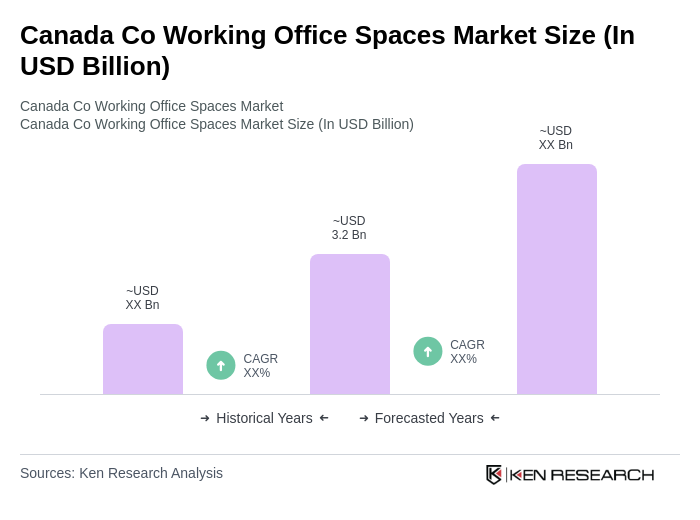
- The Canada Co Working Office Spaces Market is valued at USD 3.2 billion, based on a five-year historical analysis. This growth is primarily driven by the increasing demand for flexible workspaces, the rise of remote and hybrid work models, and the need for cost-effective office solutions among startups, SMEs, and distributed teams. The market has seen a shift toward collaborative, amenity-rich environments that support networking, community, and turnkey services (IT, meeting rooms, events).
- Key cities dominating the market include Toronto, Vancouver, and Montreal, underpinned by strong tech ecosystems, creative industries, and dense startup activity that bolster demand for flexible space. Toronto and Vancouver are consistently cited as leading hubs within the Canadian co-working landscape.
- The Canadian regulatory landscape continues to elevate sustainability requirements in commercial buildings, including co-working facilities, with energy-efficiency standards embedded in national and provincial codes (e.g., NECB and updated provincial building codes) and green-building programs encouraging the adoption of higher performance and renewable energy measures. Many new developments targeting flexible workspaces align with these frameworks to improve environmental performance.
Canada Co Working Office Spaces Market Segmentation
By Type:The co-working office spaces market can be segmented into various types, including Private Offices (enclosed suites), Dedicated Desks, Hot Desks, Meeting and Conference Rooms, Virtual Offices, Event and Training Spaces, and Enterprise Solutions. Each type caters to different user needs, with private offices offering privacy and dedicated desks providing a fixed workspace, while hot desks promote flexibility and collaboration. Operators increasingly emphasize enterprise suites and managed solutions for corporate teams alongside community programming and on-demand meeting room access.

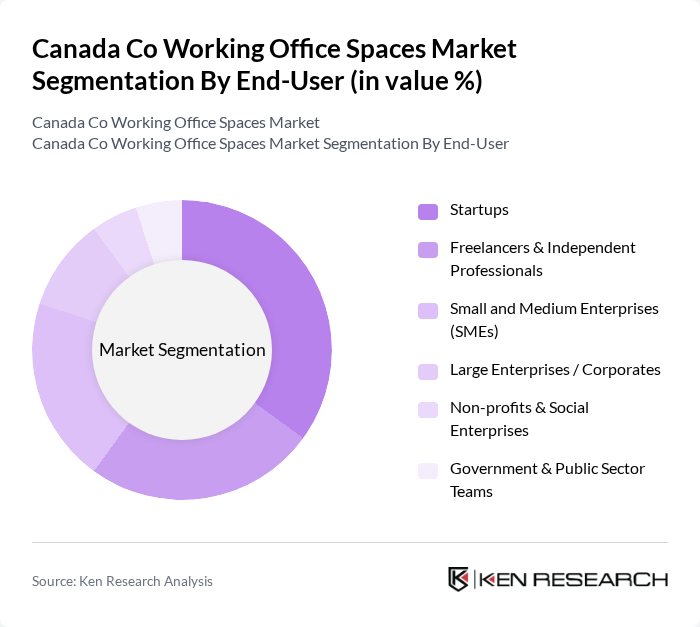
By End-User:The end-user segmentation includes Startups, Freelancers & Independent Professionals, Small and Medium Enterprises (SMEs), Large Enterprises / Corporates, Non-profits & Social Enterprises, and Government & Public Sector Teams. Startups and freelancers are core users due to affordability and community, while SMEs and larger enterprises are adopting flexible space to support hybrid work and distributed teams.
Canada Co Working Office Spaces Market Competitive Landscape
The Canada Co Working Office Spaces Market is characterized by a dynamic mix of regional and international players. Leading participants such as WeWork (Canada), Spaces (IWG plc), Regus (IWG plc), Workhaus, Work Nicer, iQ Office Suites, TPC Toronto (The Professional Centre), L’Atelier Vancouver Coworking, HiVE Vancouver, Beta Collective, Workplace One, La Halte 24/7, BNKR (BNKR Cowork), District 28, Lab T.O. contribute to innovation, geographic expansion, and service delivery in this space.
Canada Co Working Office Spaces Market Industry Analysis
Growth Drivers
- Increasing Demand for Flexible Workspaces:The demand for flexible workspaces in Canada has surged, with over 1.5 million square feet of co-working space added in the recent past. This trend is driven by businesses seeking adaptable solutions to accommodate fluctuating workforce sizes. According to the Canada Mortgage and Housing Corporation, 60% of companies are now prioritizing flexible office arrangements, reflecting a significant shift in workplace dynamics and a growing preference for co-working environments.
- Rise of Remote Work Culture:The remote work culture has become a permanent fixture in Canada, with approximately 30% of the workforce engaged in hybrid or fully remote roles as of the recent past. This shift has led to an increased reliance on co-working spaces, which provide essential infrastructure for remote workers. The Canadian government reported that 40% of businesses have adopted flexible work policies, further fueling the demand for co-working solutions that cater to this evolving workforce.
- Cost-Effectiveness for Startups and Freelancers:Co-working spaces offer significant cost savings for startups and freelancers, with average monthly memberships ranging from CAD 300 to CAD 600. This affordability allows small businesses to access professional environments without the burden of long-term leases. The Startup Canada report indicates that 70% of startups prefer co-working spaces for their flexibility and lower overhead costs, making them an attractive option in the current economic climate.
Market Challenges
- High Competition Among Co-Working Spaces:The co-working market in Canada is highly competitive, with over 1,000 co-working spaces operating across major cities. This saturation has led to price wars and reduced profit margins, making it challenging for new entrants to establish themselves. According to a recent industry report, occupancy rates in some urban areas have dropped to 65%, highlighting the intense competition and the need for differentiation among providers.
- Economic Fluctuations Affecting Occupancy Rates:Economic uncertainties, including inflation rates projected at 3.5% for the near future, have impacted occupancy rates in co-working spaces. Many businesses are hesitant to commit to flexible office solutions amid fluctuating economic conditions. The Canadian Federation of Independent Business reported that 45% of small businesses are concerned about rising costs, which may lead to reduced demand for co-working spaces as companies tighten budgets.
Canada Co Working Office Spaces Market Future Outlook
The future of the co-working office space market in Canada appears promising, driven by the ongoing evolution of work culture and technological advancements. As businesses increasingly adopt hybrid work models, the demand for flexible office solutions is expected to rise. Additionally, the integration of smart technologies into co-working environments will enhance user experience and operational efficiency. Companies that adapt to these trends and focus on community-building initiatives will likely thrive in this dynamic landscape, positioning themselves for long-term success.
Market Opportunities
- Expansion into Suburban Areas:There is a growing opportunity for co-working spaces to expand into suburban regions, where demand is increasing due to remote work trends. With urban centers becoming saturated, suburban areas offer untapped markets, as evidenced by a 25% increase in inquiries for co-working spaces outside major cities in the recent past.
- Collaboration with Tech Companies for Smart Offices:Partnering with technology firms to create smart office solutions presents a significant opportunity. The global smart office market is projected to reach CAD 50 billion in the near future, indicating a strong demand for tech-enhanced workspaces. Co-working providers can leverage this trend to attract tech-savvy clients seeking innovative environments.
Scope of the Report
| Segment | Sub-Segments |
|---|---|
| By Type | Private Offices (enclosed suites) Dedicated Desks Hot Desks Meeting and Conference Rooms Virtual Offices (mailing address, receptionist) Event and Training Spaces Enterprise Solutions / Managed Suites |
| By End-User | Startups Freelancers & Independent Professionals Small and Medium Enterprises (SMEs) Large Enterprises / Corporates Non-profits & Social Enterprises Government & Public Sector Teams |
| By Location | Central Business Districts (Toronto, Vancouver, Montreal, Calgary) Urban Fringe / Inner Suburbs Suburban / Secondary Cities Transit-Oriented & Mixed-Use Developments University & Innovation Districts |
| By Service Offering | Basic Membership (access + amenities) Premium Membership (24/7, premium locations) Meeting Room & Day Pass Packages Managed Services (IT, reception, mail, security) Add-ons (lockers, parking, podcast/creator studios) |
| By Duration of Use | Hourly / Day Pass Month-to-Month –12 Month Agreements + Month Managed Leases |
| By Industry | Technology & Startups Creative & Media Professional Services (legal, consulting, accounting) Life Sciences & Health Non-profit & Public Administration |
| By Pricing Model | Pay-as-you-go Subscription / Membership Seat-based / Desk-based Pricing Enterprise Contracts (per-suite / per-location) |
Key Target Audience
Investors and Venture Capitalist Firms
Government and Regulatory Bodies (e.g., Canada Mortgage and Housing Corporation, Innovation, Science and Economic Development Canada)
Real Estate Developers
Property Management Companies
Commercial Landlords
Technology Providers
Industry Associations (e.g., Coworking Canada)
Financial Institutions
Players Mentioned in the Report:
WeWork (Canada)
Spaces (IWG plc)
Regus (IWG plc)
Workhaus
Work Nicer
iQ Office Suites
TPC Toronto (The Professional Centre)
LAtelier Vancouver Coworking
HiVE Vancouver
Beta Collective
Workplace One
La Halte 24/7
BNKR (BNKR Cowork)
District 28
Lab T.O.
Table of Contents
Market Assessment Phase
1. Executive Summary and Approach
2. Canada Co Working Office Spaces Market Overview
2.1 Key Insights and Strategic Recommendations
2.2 Canada Co Working Office Spaces Market Overview
2.3 Definition and Scope
2.4 Evolution of Market Ecosystem
2.5 Timeline of Key Regulatory Milestones
2.6 Value Chain & Stakeholder Mapping
2.7 Business Cycle Analysis
2.8 Policy & Incentive Landscape
3. Canada Co Working Office Spaces Market Analysis
3.1 Growth Drivers
3.1.1 Increasing demand for flexible workspaces
3.1.2 Rise of remote work culture
3.1.3 Cost-effectiveness for startups and freelancers
3.1.4 Technological advancements in workspace management
3.2 Market Challenges
3.2.1 High competition among co-working spaces
3.2.2 Economic fluctuations affecting occupancy rates
3.2.3 Regulatory hurdles in urban areas
3.2.4 Changing preferences of businesses post-pandemic
3.3 Market Opportunities
3.3.1 Expansion into suburban areas
3.3.2 Collaboration with tech companies for smart offices
3.3.3 Offering niche services for specific industries
3.3.4 Partnerships with local businesses for community building
3.4 Market Trends
3.4.1 Increased focus on wellness and sustainability
3.4.2 Growth of hybrid work models
3.4.3 Integration of technology in workspace solutions
3.4.4 Customization of office spaces for client needs
3.5 Government Regulation
3.5.1 Zoning laws affecting co-working space locations
3.5.2 Health and safety regulations post-COVID-19
3.5.3 Tax incentives for small businesses
3.5.4 Environmental regulations impacting building standards
4. SWOT Analysis
5. Stakeholder Analysis
6. Porter's Five Forces Analysis
7. Canada Co Working Office Spaces Market Market Size, 2019-2024
7.1 By Value
7.2 By Volume
7.3 By Average Selling Price
8. Canada Co Working Office Spaces Market Segmentation
8.1 By Type
8.1.1 Private Offices (enclosed suites)
8.1.2 Dedicated Desks
8.1.3 Hot Desks
8.1.4 Meeting and Conference Rooms
8.1.5 Virtual Offices (mailing address, receptionist)
8.1.6 Event and Training Spaces
8.1.7 Enterprise Solutions / Managed Suites
8.2 By End-User
8.2.1 Startups
8.2.2 Freelancers & Independent Professionals
8.2.3 Small and Medium Enterprises (SMEs)
8.2.4 Large Enterprises / Corporates
8.2.5 Non-profits & Social Enterprises
8.2.6 Government & Public Sector Teams
8.3 By Location
8.3.1 Central Business Districts (Toronto, Vancouver, Montreal, Calgary)
8.3.2 Urban Fringe / Inner Suburbs
8.3.3 Suburban / Secondary Cities
8.3.4 Transit-Oriented & Mixed-Use Developments
8.3.5 University & Innovation Districts
8.4 By Service Offering
8.4.1 Basic Membership (access + amenities)
8.4.2 Premium Membership (24/7, premium locations)
8.4.3 Meeting Room & Day Pass Packages
8.4.4 Managed Services (IT, reception, mail, security)
8.4.5 Add-ons (lockers, parking, podcast/creator studios)
8.5 By Duration of Use
8.5.1 Hourly / Day Pass
8.5.2 Month-to-Month
8.5.3 6–12 Month Agreements
8.5.4 12+ Month Managed Leases
8.6 By Industry
8.6.1 Technology & Startups
8.6.2 Creative & Media
8.6.3 Professional Services (legal, consulting, accounting)
8.6.4 Life Sciences & Health
8.6.5 Non-profit & Public Administration
8.7 By Pricing Model
8.7.1 Pay-as-you-go
8.7.2 Subscription / Membership
8.7.3 Seat-based / Desk-based Pricing
8.7.4 Enterprise Contracts (per-suite / per-location)
9. Canada Co Working Office Spaces Market Competitive Analysis
9.1 Market Share of Key Players
9.2 Cross Comparison of Key Players
9.2.1 Company Name
9.2.2 Portfolio Size (locations in Canada; total desks)
9.2.3 Occupancy Rate (%)
9.2.4 Revenue per Available Workstation (RevPAW)
9.2.5 Customer Retention / Renewal Rate (%)
9.2.6 Pricing Model (day pass, membership tiers, enterprise)
9.2.7 Average Contract Tenure (months)
9.2.8 Net Promoter Score (NPS)
9.2.9 Same-Location Sales Growth (YoY %)
9.2.10 Customer Acquisition Cost (CAC) and Payback (months)
9.3 SWOT Analysis of Top Players
9.4 Pricing Analysis
9.5 Detailed Profile of Major Companies
9.5.1 WeWork (Canada)
9.5.2 Spaces (IWG plc)
9.5.3 Regus (IWG plc)
9.5.4 Workhaus
9.5.5 Work Nicer
9.5.6 iQ Office Suites
9.5.7 TPC Toronto (The Professional Centre)
9.5.8 L’Atelier Vancouver Coworking
9.5.9 HiVE Vancouver
9.5.10 Beta Collective
9.5.11 Workplace One
9.5.12 La Halte 24/7
9.5.13 BNKR (BNKR Cowork)
9.5.14 District 28
9.5.15 Lab T.O.
10. Canada Co Working Office Spaces Market End-User Analysis
10.1 Procurement Behavior of Key Ministries
10.1.1 Government contracts for office space
10.1.2 Budget allocation for co-working spaces
10.1.3 Evaluation criteria for workspace procurement
10.2 Corporate Spend on Infrastructure & Energy
10.2.1 Investment in flexible workspaces
10.2.2 Budgeting for employee wellness initiatives
10.2.3 Trends in corporate real estate spending
10.3 Pain Point Analysis by End-User Category
10.3.1 Need for flexibility in workspace
10.3.2 Challenges in maintaining productivity
10.3.3 Issues with traditional office leases
10.4 User Readiness for Adoption
10.4.1 Attitudes towards co-working spaces
10.4.2 Factors influencing adoption decisions
10.4.3 Readiness for hybrid work models
10.5 Post-Deployment ROI and Use Case Expansion
10.5.1 Measuring success of co-working arrangements
10.5.2 Opportunities for scaling workspace solutions
10.5.3 Long-term benefits of co-working
11. Canada Co Working Office Spaces Market Future Size, 2025-2030
11.1 By Value
11.2 By Volume
11.3 By Average Selling Price
Go-To-Market Strategy Phase
1. Whitespace Analysis + Business Model Canvas
1.1
2. Marketing and Positioning Recommendations
2.1
3. Distribution Plan
3.1
4. Channel & Pricing Gaps
4.1
5. Unmet Demand & Latent Needs
5.1
6. Customer Relationship
7.1
7. Value Proposition
8.1
8. Key Activities
9.1
9. Entry Strategy Evaluation
9.1 Domestic Market Entry Strategy
10.1.1
9.2 Export Entry Strategy
10.2.1
10. Entry Mode Assessment
11.1
11. Capital and Timeline Estimation
12.1
12. Control vs Risk Trade-Off
13.1
13. Profitability Outlook
14.1
14. Potential Partner List
15.1
15. Execution Roadmap
15.1 Phased Plan for Market Entry
16.1.1
15.2 Key Activities and Milestones
16.2.1
Research Methodology
Phase 1: Approach1
Desk Research
- Analysis of industry reports from real estate associations and co-working space publications
- Review of government statistics on commercial real estate and employment trends in Canada
- Examination of market studies and white papers from leading co-working space providers
Primary Research
- Interviews with founders and managers of co-working spaces across major Canadian cities
- Surveys targeting freelancers, startups, and remote workers utilizing co-working spaces
- Focus groups with community managers to understand user experience and satisfaction
Validation & Triangulation
- Cross-validation of findings through multiple data sources including industry reports and expert opinions
- Triangulation of qualitative insights from interviews with quantitative data from surveys
- Sanity checks through expert panel reviews comprising real estate analysts and co-working industry veterans
Phase 2: Market Size Estimation1
Top-down Assessment
- Estimation of total addressable market based on national commercial real estate metrics
- Segmentation of market size by province and urban centers with high demand for co-working spaces
- Incorporation of trends in remote work and flexible office solutions post-pandemic
Bottom-up Modeling
- Data collection on occupancy rates and pricing models from a sample of co-working spaces
- Estimation of revenue streams from membership fees, event spaces, and additional services
- Volume x pricing analysis to derive potential market revenue for different service tiers
Forecasting & Scenario Analysis
- Multi-factor regression analysis incorporating economic indicators and employment rates
- Scenario modeling based on varying levels of remote work adoption and urbanization trends
- Baseline, optimistic, and pessimistic projections for market growth through 2030
Phase 3: CATI Sample Composition1
| Scope Item/Segment | Sample Size | Target Respondent Profiles |
|---|---|---|
| Freelancers and Remote Workers | 150 | Independent Professionals, Digital Nomads |
| Startups and Small Businesses | 100 | Founders, Business Development Managers |
| Corporate Clients Utilizing Co-working | 80 | HR Managers, Workplace & Facilities Coordinators |
| Community Managers of Co-working Spaces | 60 | Operations Managers, Customer Experience Leads |
| Real Estate Analysts and Consultants | 50 | Market Researchers, Real Estate Advisors |
Frequently Asked Questions
What is the current value of the Canada Co Working Office Spaces Market?
The Canada Co Working Office Spaces Market is valued at approximately USD 3.2 billion, reflecting a significant growth trend driven by the increasing demand for flexible workspaces and the rise of remote and hybrid work models.
Which cities are the main hubs for co-working spaces in Canada?
What types of co-working spaces are available in Canada?
Who are the primary users of co-working spaces in Canada?
Other Regional/Country Reports
Indonesia Co Working Office Spaces Market
Malaysia Co Working Office Spaces Market
KSA Co Working Office Spaces Market
APAC Co Working Office Spaces Market
SEA Co Working Office Spaces Market
Vietnam Co Working Office Spaces Market
Why Buy From Us?

What makes us stand out is that our consultants follow Robust, Refine and Result (RRR) methodology. Robust for clear definitions, approaches and sanity checking, Refine for differentiating respondents' facts and opinions, and Result for presenting data with story.

We have set a benchmark in the industry by offering our clients with syndicated and customized market research reports featuring coverage of entire market as well as meticulous research and analyst insights.

While we don't replace traditional research, we flip the method upside down. Our dual approach of Top Bottom & Bottom Top ensures quality deliverable by not just verifying company fundamentals but also looking at the sector and macroeconomic factors.

With one step in the future, our research team constantly tries to show you the bigger picture. We help with some of the tough questions you may encounter along the way: How is the industry positioned? Best marketing channel? KPI's of competitors? By aligning every element, we help maximize success.

Our report gives you instant access to the answers and sources that other companies might choose to hide. We elaborate each steps of research methodology we have used and showcase you the sample size to earn your trust.

If you need any support, we are here! We pride ourselves on universe strength, data quality, and quick, friendly, and professional service.