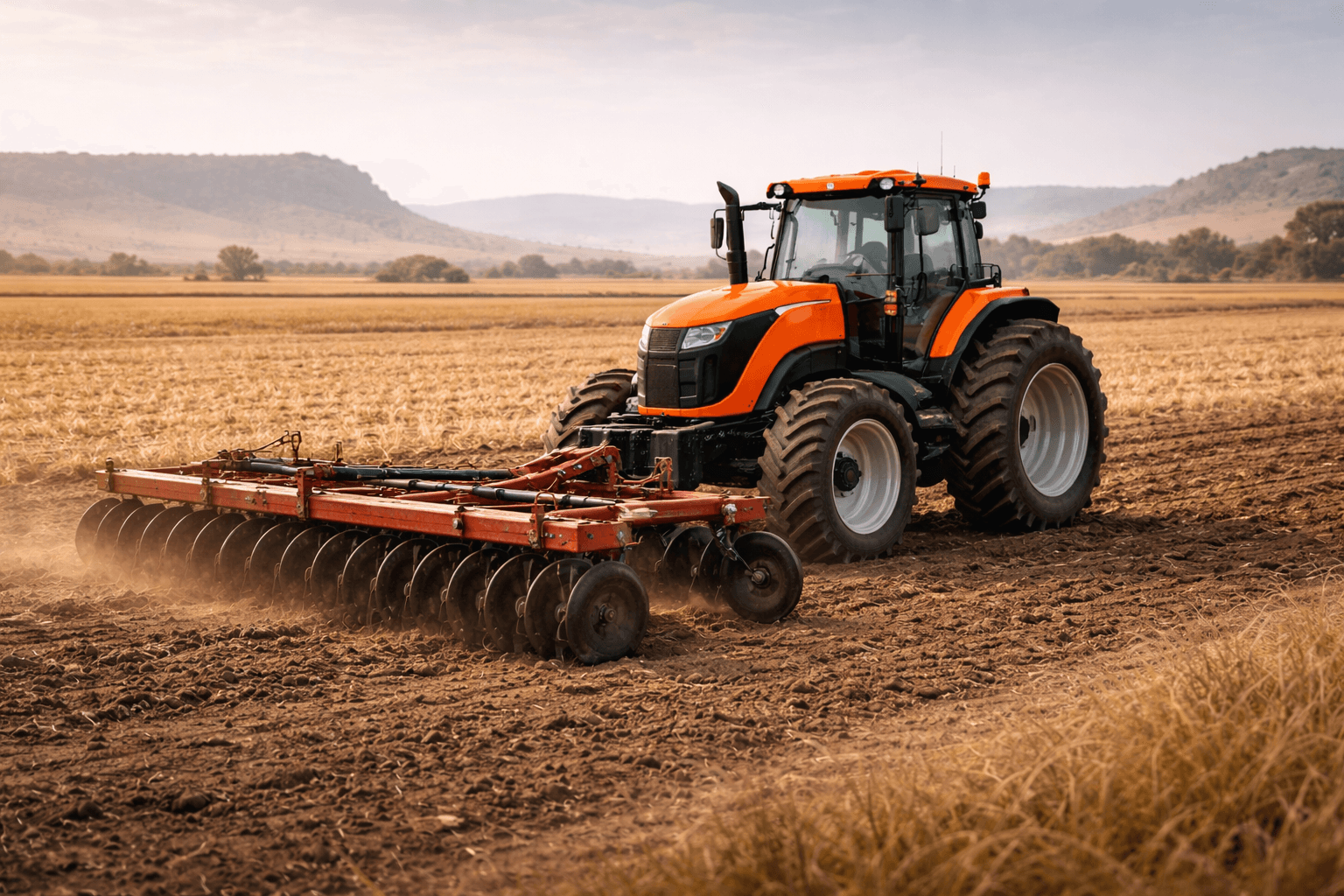
South Africa Agricultural Equipment & Machinery Competition Benchmarking 2025: Product Portfolio, Dealer Network, Customer Segments & Company Performance
Published on: December 2025
Report Overview
South Africa Agricultural Equipment Market Overview
Market Highlights
The South Africa Agricultural Equipment Market showcases a diverse competitive structure, where multinational corporations, regional manufacturers, and local firms engage in a dynamic interplay. Multinationals leverage their extensive resources for efficiency, while regional players focus on tailored solutions that resonate with local agricultural practices, and local firms capitalize on agility and niche expertise to carve out market segments.
Innovation from global leaders is increasingly harmonized with local adaptations, as companies integrate advanced technologies while considering the unique agricultural landscape of South Africa. This synergy fosters the development of equipment that meets specific regional needs, ensuring that innovations are not only cutting-edge but also practical and relevant to local farmers.
The distribution and aftersales ecosystem is critical in enhancing customer satisfaction and operational reliability. Strategic collaborations among manufacturers, distributors, and service providers are essential for delivering comprehensive support, ensuring that equipment maintenance and parts availability are seamlessly managed to minimize downtime and maximize productivity for end-users.
Looking ahead, the competitive landscape is being shaped by a focus on sustainability, technological integration, and operational agility. Companies are increasingly adopting data-driven strategies to enhance efficiency, while also committing to environmentally friendly practices that resonate with the growing demand for sustainable agriculture, positioning themselves favorably in a rapidly evolving market.
Ecosystem Matrix
The ecosystem highlights a concentration of large multinational corporations with established local subsidiaries alongside strong regional and domestic manufacturers, reflecting both global and local capabilities in the South African agricultural equipment industry.
Medium-sized players complement this landscape by addressing specialized machinery needs and distribution gaps, while small-scale domestic companies thrive in providing niche solutions tailored to local farming conditions.
Leading Player Profiles
Company Profile Overview
Leading global corporations like John Deere, CNH Industrial, and AGCO dominate distribution and advanced machinery, whereas domestic manufacturers like Bell Equipment and Falcon Agricultural Equipment maintain strong relevance with locally adapted machinery.
The mix of global and local players indicates a dual structure where international expertise drives advanced mechanization, while local innovation sustains region-specific agricultural practices.
Key Operational Performance Metrics
Company Performance Overview
Unlock Market Insights
Dive deeper into production, distribution, and pricing intelligence.
Get Customized ReportOperational performance hinges on distribution breadth, service coverage, and pricing strategies, all of which determine customer adoption rates across South Africa’s diverse farming sectors.
Import dependency versus local manufacturing capacity plays a critical role in shaping competitiveness, particularly with rising demand for cost-effective and locally serviced equipment.
Core Financial Performance Metrics
Financial performance comparisons center on revenue generation, margin sustainability, and cost structures, reflecting the balance between global corporations with high-scale imports and domestic players with localized production economics.
Margins remain a critical differentiator in evaluating operational efficiency and long-term competitiveness in the agricultural equipment industry.
Table of Contents
1. Ecosystem Matrix
1.1 Large Players
1.1.1 John Deere South Africa
1.1.2 CNH Industrial
1.1.3 AGCO Massey Ferguson
1.1.4 Bell Equipment
1.1.5 Landini South Africa
1.1.6 SAME Deutz-Fahr South Africa
1.2 Medium Players
1.2.1 BHBW South Africa
1.2.2 Kubota South Africa
1.2.3 JCB South Africa
1.2.4 CLAAS Southern Africa
1.2.5 Rovic Leers
1.2.6 Northmec
1.3 Small Players
1.3.1 Falcon Agricultural Equipment
1.3.2 Staalmeester
1.3.3 Radium Engineering
1.3.4 Amazone South Africa
1.3.5 Lemken South Africa
1.3.6 Senter 360
2. Leading Player Profiles
2.1 Company Name
2.2 Group Name
2.3 Headquarters
2.4 Established Year
2.5 Core Product Focus
2.6 Mode of Functioning
3. Key Operational Performance Metrics
3.1 Production Capacity (Units/Year)
3.2 Number of Distribution Outlets
3.3 After-Sales Service Coverage
3.4 Import Dependency (%)
3.5 Local Manufacturing (%)
3.6 Product Range Breadth
3.7 Export Share (%)
3.8 Pricing (USD)
4. Core Financial Performance Metrics
4.1 Parameters
4.1.1 Revenue (USD Mn)
4.1.2 Revenue Growth (%)
4.1.3 COGS (USD Mn)
4.1.4 COGS Growth (%)
4.1.5 EBITDA (USD Mn)
4.1.6 EBITDA Growth (%)
4.1.7 EBITDA Margin (%)
4.1.8 PAT (USD Mn)
4.1.9 PAT Margin (%)
5. Methodology
5.1 Approach
5.1.1 Desk Sources
5.1.2 Primary Interviews
5.1.3 Sanity Checking & Validation
5.2 Benchmarking Process
5.2.1 Data Collection
5.2.2 Primary Validation
5.2.3 Proxy KPI Modelling
5.2.4 Normalization & Indexing
5.2.5 Gap Analysis
5.2.6 Peer Review
5.3 Sample Composition
5.3.1 Scope Items
5.3.2 Sample Size
5.3.3 Target Respondents
Methodology
Ken Research will deploy its proprietary, multi-layered research framework—combining robust secondary research, targeted primary outreach, and rigorous data validation—to deliver an authoritative competitive landscape analysis of the South Africa Agricultural Equipment Market.
Desk Sources
- Industry reports from Ken Research proprietary archives and syndicated databases
- Company annual reports and investor presentations
- Government and trade association publications, including AgriSA, South African Agricultural Machinery Association, and DAFF
- Trade magazines, journals, and industry e-articles such as FarmBiz, African Farming, and Engineering News
- Financial databases including Bloomberg, Capital IQ, and Orbis
- Web analytics and digital usage dashboards such as SimilarWeb, Statista, and OEM portals
Primary Interviews
- CATIs and online surveys with category managers and R&D heads at agricultural equipment manufacturers
- Senior sales and marketing leaders of tractor, harvester, and implement brands
- Dealers, distributors, and regional channel partners
- Farm cooperatives and large-scale farmers as end users
- Industry analysts and agriculture consultants
Sanity Checking and Validation
- Triangulation to cross-verify estimates from secondary data, primary inputs, and proxy model outputs
- Proxy KPI synthesis using production capacity, distribution outlets, after-sales coverage, and import dependency to estimate revenues and market share
- Outlier analysis to identify and reconcile anomalous data points through follow-up validation
- Assumption tracking with a structured log documenting limitations and proxy KPI sources
- Peer review by internal subject-matter experts prior to finalization