About the Report
Base Year 2024GCC Biological Safety Cabinets Market Overview
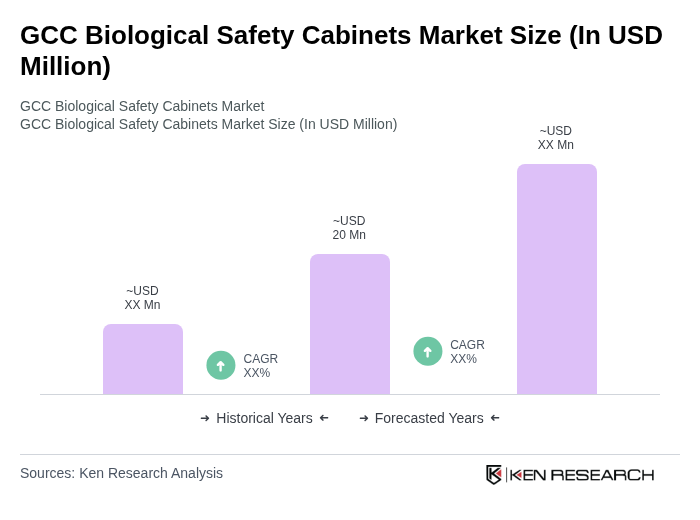
- The GCC Biological Safety Cabinets market is valued at USD 20 million, based on a five-year historical analysis. This growth is primarily driven by the increasing demand for laboratory safety equipment due to rising health concerns, more stringent biosafety and infection-control requirements in hospitals and laboratories, and the expansion of the pharmaceutical, biotechnology, and clinical diagnostics sectors in the region.
- Key players in this market include Saudi Arabia, the UAE, and Qatar. These countries dominate the market due to their robust healthcare infrastructure, high per-capita health spending, significant investments in research and development, and a growing number of pharmaceutical, biopharmaceutical, and biotechnology companies and reference laboratories that require advanced containment and biosafety equipment.
- In the UAE, biosafety practices in laboratories handling biological materials are governed by frameworks such as the UAE Federal Law No. 14 of 2014 on the Control of Communicable Diseases and its Executive Regulations issued by the Ministry of Health and Prevention, which require healthcare and laboratory facilities to implement appropriate engineering controls, including certified containment and ventilation systems, for handling infectious agents; in parallel, many GCC laboratories align with international standards such as WHO Laboratory Biosafety Manual and EN 12469 / NSF/ANSI 49 performance standards for biological safety cabinets when selecting and operating equipment, which effectively drives the demand for certified biological safety cabinets across the region.
GCC Biological Safety Cabinets Market Segmentation
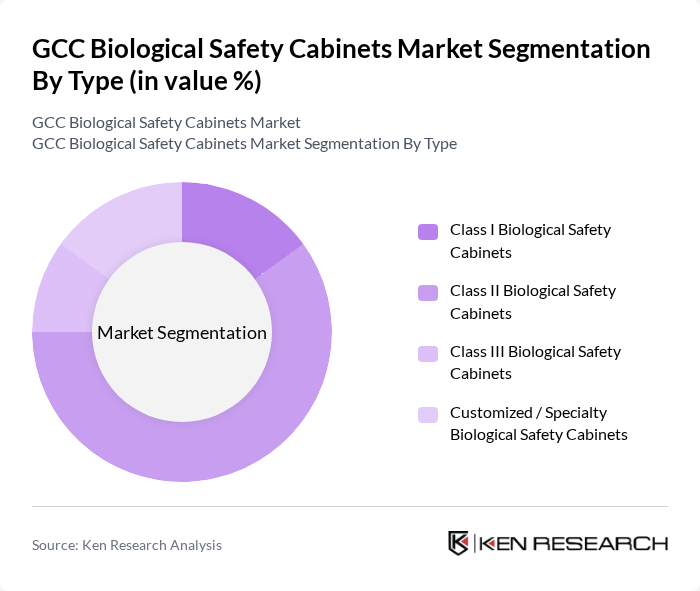
By Type:The market is segmented into various types of biological safety cabinets, including Class I, Class II, Class III, and customized/specialty cabinets. Class II Biological Safety Cabinets dominate the market due to their versatility and effectiveness in protecting the user, the product, and the environment from hazardous biological materials, and they are the most commonly used cabinets globally for routine microbiology, cell culture, and clinical applications. The increasing focus on laboratory biosafety, the rise in vaccine, biologics, and cell/gene therapy research, and the expansion of hospital and independent diagnostic laboratories in GCC countries further bolster the demand for Class II cabinets.
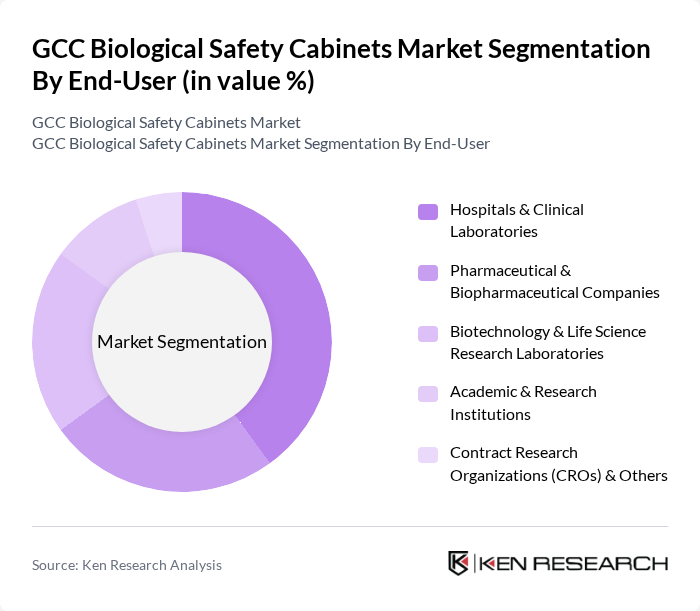
By End-User:The end-user segmentation includes hospitals & clinical laboratories, pharmaceutical & biopharmaceutical companies, biotechnology & life science research laboratories, academic & research institutions, and contract research organizations (CROs). Hospitals and clinical laboratories are the leading end-users, driven by the increasing need for safe handling of infectious samples, growing test volumes in microbiology and molecular diagnostics, and accreditation requirements that emphasize validated biosafety infrastructure. Pharmaceutical, biopharmaceutical, and biotechnology research facilities in the GCC also contribute significantly to demand, as they increasingly invest in BSL-2 and BSL-3 laboratories for vaccine development, biologics manufacturing, and advanced therapy R&D.
GCC Biological Safety Cabinets Market Competitive Landscape
The GCC Biological Safety Cabinets Market is characterized by a dynamic mix of regional and international players. Leading participants such as Thermo Fisher Scientific Inc., Esco Micro Pte. Ltd., Labconco Corporation, The Baker Company, Inc., NuAire, Inc., Germfree Laboratories Inc., Kewaunee Scientific Corporation, BioBase Group Ltd., Telstar (Azbil Telstar, S.L.U.), EuroClone S.p.A., Faster S.r.l., Waldner Holding SE & Co. KG, Cruma S.A., Azbil Corporation, Local GCC Distributors & System Integrators (e.g., Gulf Scientific Corporation, Al-Khazindar, etc.) contribute to innovation, geographic expansion, and service delivery in this space.
GCC Biological Safety Cabinets Market Industry Analysis
Growth Drivers
- Increasing Demand for Laboratory Safety Equipment:The GCC region has witnessed a significant rise in laboratory safety equipment demand, driven by a growing number of research facilities. In future, the number of laboratories in the GCC is projected to exceed 1,200, reflecting a 15% increase from the previous year. This surge is attributed to heightened research activities in biotechnology and pharmaceuticals, necessitating advanced safety solutions to protect personnel and ensure compliance with safety standards.
- Rising Awareness of Biosafety Regulations:The implementation of stringent biosafety regulations across the GCC has heightened awareness among laboratory operators. In future, it is estimated that 80% of laboratories will adopt new biosafety protocols, driven by government initiatives and international standards. This regulatory push is expected to increase the demand for biological safety cabinets, as facilities seek to comply with safety requirements and protect against biological hazards.
- Growth in Biotechnology and Pharmaceutical Sectors:The GCC biotechnology and pharmaceutical sectors are projected to grow significantly, with investments expected to reach $10 billion in future. This growth is fueled by government support and a focus on innovation, leading to increased research and development activities. Consequently, the demand for biological safety cabinets is anticipated to rise, as these sectors require advanced safety equipment to conduct research and development safely.
Market Challenges
- High Initial Investment Costs:One of the primary challenges facing the GCC biological safety cabinets market is the high initial investment required for purchasing and installing these units. The average cost of a high-quality biological safety cabinet can range from $5,000 to $20,000, which poses a barrier for smaller laboratories and research facilities. This financial hurdle can limit market growth, particularly in emerging markets within the GCC.
- Stringent Regulatory Compliance Requirements:Compliance with stringent regulatory standards can be a significant challenge for laboratories in the GCC. Facilities must adhere to international biosafety standards, which often require extensive documentation and regular inspections. In future, it is estimated that 70% of laboratories will face compliance-related challenges, leading to increased operational costs and potential delays in research activities, thereby impacting the market for biological safety cabinets.
GCC Biological Safety Cabinets Market Future Outlook
The future of the GCC biological safety cabinets market appears promising, driven by technological advancements and increasing government support for research initiatives. As laboratories prioritize safety and efficiency, the integration of smart technologies and energy-efficient designs will likely become standard. Furthermore, the expansion of research activities in emerging markets will create new opportunities for manufacturers, fostering innovation and product diversification to meet evolving customer needs.
Market Opportunities
- Technological Advancements in Safety Cabinet Design:Innovations in safety cabinet technology, such as enhanced filtration systems and automated monitoring, present significant market opportunities. These advancements can improve safety and operational efficiency, attracting more laboratories to invest in modern solutions, thereby expanding the market.
- Growing Demand in Emerging Markets:Emerging markets within the GCC are experiencing rapid growth in research and development activities. As these markets expand, the demand for biological safety cabinets is expected to rise, providing manufacturers with opportunities to penetrate new regions and cater to the increasing need for laboratory safety equipment.
Scope of the Report
| Segment | Sub-Segments |
|---|---|
| By Type | Class I Biological Safety Cabinets Class II Biological Safety Cabinets Class III Biological Safety Cabinets Customized / Specialty Biological Safety Cabinets |
| By End-User | Hospitals & Clinical Laboratories Pharmaceutical & Biopharmaceutical Companies Biotechnology & Life Science Research Laboratories Academic & Research Institutions Contract Research Organizations (CROs) & Others |
| By Application | Microbiological & Infectious Disease Research Pharmaceutical & Biologics Production Clinical Diagnostics & Pathology Cell & Gene Therapy, Vaccine and Advanced Therapy Applications |
| By Material | Stainless Steel Powder-Coated Steel Polypropylene & Composite Materials Glass & Other Transparent Shielding Materials |
| By Region | Saudi Arabia UAE Qatar Kuwait Oman |
| By Distribution Channel | Direct Sales (OEM to End-User) Authorized Local Distributors & System Integrators Online Procurement Platforms & E-Catalogs Turnkey Project Contractors & Others |
| By Price Range | Budget (Entry-Level Class I/Small Footprint Units) Mid-Range (Standard Class II Units) Premium (High-Performance & Customized Class II/III Units) Service-Linked & Long-Term Contract Offerings |
Key Target Audience
Investors and Venture Capitalist Firms
Government and Regulatory Bodies (e.g., Ministry of Health, Environmental Protection Agency)
Manufacturers and Producers
Distributors and Retailers
Healthcare Facilities and Laboratories
Pharmaceutical and Biotechnology Companies
Industry Associations and Trade Organizations
Financial Institutions and Investment Banks
Players Mentioned in the Report:
Thermo Fisher Scientific Inc.
Esco Micro Pte. Ltd.
Labconco Corporation
The Baker Company, Inc.
NuAire, Inc.
Germfree Laboratories Inc.
Kewaunee Scientific Corporation
BioBase Group Ltd.
Telstar (Azbil Telstar, S.L.U.)
EuroClone S.p.A.
Faster S.r.l.
Waldner Holding SE & Co. KG
Cruma S.A.
Azbil Corporation
Local GCC Distributors & System Integrators (e.g., Gulf Scientific Corporation, Al-Khazindar, etc.)
Table of Contents
Market Assessment Phase
1. Executive Summary and Approach
2. GCC Biological Safety Cabinets Market Overview
2.1 Key Insights and Strategic Recommendations
2.2 GCC Biological Safety Cabinets Market Overview
2.3 Definition and Scope
2.4 Evolution of Market Ecosystem
2.5 Timeline of Key Regulatory Milestones
2.6 Value Chain & Stakeholder Mapping
2.7 Business Cycle Analysis
2.8 Policy & Incentive Landscape
3. GCC Biological Safety Cabinets Market Analysis
3.1 Growth Drivers
3.1.1 Increasing demand for laboratory safety equipment
3.1.2 Rising awareness of biosafety regulations
3.1.3 Growth in biotechnology and pharmaceutical sectors
3.1.4 Expansion of research and development activities
3.2 Market Challenges
3.2.1 High initial investment costs
3.2.2 Stringent regulatory compliance requirements
3.2.3 Limited availability of skilled professionals
3.2.4 Competition from alternative safety solutions
3.3 Market Opportunities
3.3.1 Technological advancements in safety cabinet design
3.3.2 Increasing government funding for research initiatives
3.3.3 Growing demand in emerging markets
3.3.4 Potential for product diversification
3.4 Market Trends
3.4.1 Shift towards energy-efficient models
3.4.2 Integration of smart technology in safety cabinets
3.4.3 Rising focus on sustainability and eco-friendly products
3.4.4 Increased customization options for end-users
3.5 Government Regulation
3.5.1 Compliance with international biosafety standards
3.5.2 Implementation of local health and safety regulations
3.5.3 Certification requirements for laboratory equipment
3.5.4 Monitoring and enforcement of safety protocols
4. SWOT Analysis
5. Stakeholder Analysis
6. Porter's Five Forces Analysis
7. GCC Biological Safety Cabinets Market Market Size, 2019-2024
7.1 By Value
7.2 By Volume
7.3 By Average Selling Price
8. GCC Biological Safety Cabinets Market Segmentation
8.1 By Type
8.1.1 Class I Biological Safety Cabinets
8.1.2 Class II Biological Safety Cabinets
8.1.3 Class III Biological Safety Cabinets
8.1.4 Customized / Specialty Biological Safety Cabinets
8.2 By End-User
8.2.1 Hospitals & Clinical Laboratories
8.2.2 Pharmaceutical & Biopharmaceutical Companies
8.2.3 Biotechnology & Life Science Research Laboratories
8.2.4 Academic & Research Institutions
8.2.5 Contract Research Organizations (CROs) & Others
8.3 By Application
8.3.1 Microbiological & Infectious Disease Research
8.3.2 Pharmaceutical & Biologics Production
8.3.3 Clinical Diagnostics & Pathology
8.3.4 Cell & Gene Therapy, Vaccine and Advanced Therapy Applications
8.4 By Material
8.4.1 Stainless Steel
8.4.2 Powder-Coated Steel
8.4.3 Polypropylene & Composite Materials
8.4.4 Glass & Other Transparent Shielding Materials
8.5 By Region
8.5.1 Saudi Arabia
8.5.2 UAE
8.5.3 Qatar
8.5.4 Kuwait
8.5.5 Oman
8.6 By Distribution Channel
8.6.1 Direct Sales (OEM to End-User)
8.6.2 Authorized Local Distributors & System Integrators
8.6.3 Online Procurement Platforms & E-Catalogs
8.6.4 Turnkey Project Contractors & Others
8.7 By Price Range
8.7.1 Budget (Entry-Level Class I/Small Footprint Units)
8.7.2 Mid-Range (Standard Class II Units)
8.7.3 Premium (High-Performance & Customized Class II/III Units)
8.7.4 Service-Linked & Long-Term Contract Offerings
9. GCC Biological Safety Cabinets Market Competitive Analysis
9.1 Market Share of Key Players
9.2 Cross Comparison of Key Players
9.2.1 Company Name
9.2.2 Company Size (Global vs Regional; Large, Medium, Small)
9.2.3 GCC Revenue and 3–5 Year Revenue CAGR from BSC Segment
9.2.4 Installed Base of Biological Safety Cabinets in GCC
9.2.5 GCC Market Share by Class Type (Class I / II / III)
9.2.6 R&D Intensity (R&D Spend as % of Revenue, New Product Launches)
9.2.7 Compliance & Certification Coverage (EN 12469, NSF/ANSI 49, Local SFDA/ESMA, etc.)
9.2.8 Average Selling Price Positioning in GCC (Budget / Mid-Range / Premium)
9.2.9 Distribution & Service Network Strength in GCC (No. of Countries, Service Centers, Partners)
9.2.10 Key End-User Penetration (Hospitals, Pharma/Biotech, CROs, Academic Labs)
9.3 SWOT Analysis of Top Players
9.4 Pricing Analysis
9.5 Detailed Profile of Major Companies
9.5.1 Thermo Fisher Scientific Inc.
9.5.2 Esco Micro Pte. Ltd.
9.5.3 Labconco Corporation
9.5.4 The Baker Company, Inc.
9.5.5 NuAire, Inc.
9.5.6 Germfree Laboratories Inc.
9.5.7 Kewaunee Scientific Corporation
9.5.8 BioBase Group Ltd.
9.5.9 Telstar (Azbil Telstar, S.L.U.)
9.5.10 EuroClone S.p.A.
9.5.11 Faster S.r.l.
9.5.12 Waldner Holding SE & Co. KG
9.5.13 Cruma S.A.
9.5.14 Azbil Corporation
9.5.15 Local GCC Distributors & System Integrators (e.g., Gulf Scientific Corporation, Al-Khazindar, etc.)
10. GCC Biological Safety Cabinets Market End-User Analysis
10.1 Procurement Behavior of Key Ministries
10.1.1 Government procurement policies
10.1.2 Budget allocation for laboratory equipment
10.1.3 Evaluation criteria for suppliers
10.1.4 Contract management practices
10.2 Corporate Spend on Infrastructure & Energy
10.2.1 Investment trends in laboratory infrastructure
10.2.2 Budgeting for safety equipment
10.2.3 Cost-benefit analysis of safety cabinets
10.2.4 Energy efficiency considerations
10.3 Pain Point Analysis by End-User Category
10.3.1 Safety compliance challenges
10.3.2 Equipment maintenance issues
10.3.3 Budget constraints
10.3.4 Training and skill gaps
10.4 User Readiness for Adoption
10.4.1 Awareness of safety cabinet benefits
10.4.2 Training programs for end-users
10.4.3 Adoption barriers
10.4.4 Feedback mechanisms
10.5 Post-Deployment ROI and Use Case Expansion
10.5.1 Measurement of safety improvements
10.5.2 Cost savings analysis
10.5.3 User satisfaction surveys
10.5.4 Opportunities for additional applications
11. GCC Biological Safety Cabinets Market Future Size, 2025-2030
11.1 By Value
11.2 By Volume
11.3 By Average Selling Price
Go-To-Market Strategy Phase
1. Whitespace Analysis + Business Model Canvas
1.1 Market gaps identification
1.2 Value proposition development
1.3 Revenue model exploration
1.4 Customer segmentation analysis
1.5 Key partnerships identification
1.6 Cost structure analysis
1.7 Competitive advantage assessment
2. Marketing and Positioning Recommendations
2.1 Branding strategies
2.2 Product USPs
2.3 Target market identification
2.4 Communication strategies
2.5 Digital marketing initiatives
2.6 Trade show participation
2.7 Customer engagement tactics
3. Distribution Plan
3.1 Urban retail vs rural NGO tie-ups
3.2 Online distribution channels
3.3 Direct sales strategies
3.4 Partnerships with distributors
3.5 Logistics and supply chain management
3.6 Inventory management practices
3.7 Customer service integration
4. Channel & Pricing Gaps
4.1 Underserved routes
4.2 Pricing bands
4.3 Competitor pricing analysis
4.4 Value-based pricing strategies
4.5 Discount and promotion strategies
4.6 Price elasticity considerations
4.7 Customer feedback on pricing
5. Unmet Demand & Latent Needs
5.1 Category gaps
5.2 Consumer segments
5.3 Emerging trends analysis
5.4 Product development opportunities
5.5 Market entry barriers
5.6 Customer pain points
5.7 Future demand forecasting
6. Customer Relationship
6.1 Loyalty programs
6.2 After-sales service
6.3 Customer feedback mechanisms
6.4 Relationship management strategies
6.5 Community engagement initiatives
6.6 Customer education programs
6.7 Retention strategies
7. Value Proposition
7.1 Sustainability
7.2 Integrated supply chains
7.3 Cost-effectiveness
7.4 Quality assurance
7.5 Innovation in product design
7.6 Customer-centric approach
7.7 Competitive differentiation
8. Key Activities
8.1 Regulatory compliance
8.2 Branding
8.3 Distribution setup
8.4 Market research
8.5 Training and development
8.6 Performance monitoring
8.7 Stakeholder engagement
9. Entry Strategy Evaluation
9.1 Domestic Market Entry Strategy
9.1.1 Product mix
9.1.2 Pricing band
9.1.3 Packaging
9.2 Export Entry Strategy
9.2.1 Target countries
9.2.2 Compliance roadmap
10. Entry Mode Assessment
10.1 JV
10.2 Greenfield
10.3 M&A
10.4 Distributor Model
11. Capital and Timeline Estimation
11.1 Capital requirements
11.2 Timelines
12. Control vs Risk Trade-Off
12.1 Ownership vs Partnerships
13. Profitability Outlook
13.1 Breakeven analysis
13.2 Long-term sustainability
14. Potential Partner List
14.1 Distributors
14.2 JVs
14.3 Acquisition targets
15. Execution Roadmap
15.1 Phased Plan for Market Entry
15.1.1 Market Setup
15.1.2 Market Entry
15.1.3 Growth Acceleration
15.1.4 Scale & Stabilize
15.2 Key Activities and Milestones
15.2.1 Activity timelines
15.2.2 Milestone tracking
Research Methodology
Phase 1: Approach1
Desk Research
- Industry reports from GCC health and safety regulatory bodies
- Market analysis publications from scientific journals and trade associations
- Statistical data from government health departments and environmental agencies
Primary Research
- Interviews with laboratory managers in hospitals and research institutions
- Surveys with suppliers of biological safety cabinets and related equipment
- Field interviews with safety compliance officers in biotech firms
Validation & Triangulation
- Cross-validation of market data through multiple industry sources
- Triangulation of findings from primary interviews and secondary data
- Sanity checks conducted with a panel of industry experts
Phase 2: Market Size Estimation1
Top-down Assessment
- Analysis of total healthcare expenditure in the GCC region
- Segmentation of market size by end-user applications (e.g., hospitals, research labs)
- Incorporation of growth trends in biotechnology and pharmaceutical sectors
Bottom-up Modeling
- Estimation of unit sales based on historical sales data from manufacturers
- Operational cost analysis for installation and maintenance of cabinets
- Volume x price calculations for different cabinet types and specifications
Forecasting & Scenario Analysis
- Multi-variable forecasting using trends in laboratory safety regulations
- Scenario modeling based on potential market disruptions (e.g., pandemics)
- Baseline, optimistic, and pessimistic forecasts through 2030
Phase 3: CATI Sample Composition1
| Scope Item/Segment | Sample Size | Target Respondent Profiles |
|---|---|---|
| Healthcare Facilities | 120 | Laboratory Managers, Safety Officers |
| Biotechnology Companies | 90 | R&D Directors, Compliance Managers |
| Pharmaceutical Manufacturers | 80 | Production Managers, Quality Assurance Heads |
| Academic Research Institutions | 70 | Principal Investigators, Lab Supervisors |
| Government Regulatory Bodies | 40 | Policy Makers, Health Inspectors |
Frequently Asked Questions
What is the current value of the GCC Biological Safety Cabinets market?
The GCC Biological Safety Cabinets market is valued at approximately USD 20 million, driven by increasing health concerns and stringent biosafety regulations in laboratories and hospitals across the region.
Which countries are the key players in the GCC Biological Safety Cabinets market?
What types of biological safety cabinets are available in the GCC market?
Who are the primary end-users of biological safety cabinets in the GCC?
Other Regional/Country Reports
Indonesia Biological Safety Cabinets Market
Malaysia Biological Safety Cabinets Market
KSA Biological Safety Cabinets Market
APAC Biological Safety Cabinets Market
SEA Biological Safety Cabinets Market
Vietnam Biological Safety Cabinets Market
Other Adjacent Reports
Brazil Laboratory Furniture Market
Indonesia Cleanroom Technology Market
Mexico Biosafety Testing Services Market
Qatar Pharmaceutical Equipment Market
South Africa Biotechnology Instruments Market
Mexico Laboratory Ventilation Systems Market
Vietnam Sterilization Equipment Market
Malaysia Infection Control Products Market
Belgium Laboratory Consumables Market
Germany Microbiology Equipment Market
Why Buy From Us?

What makes us stand out is that our consultants follow Robust, Refine and Result (RRR) methodology. Robust for clear definitions, approaches and sanity checking, Refine for differentiating respondents' facts and opinions, and Result for presenting data with story.

We have set a benchmark in the industry by offering our clients with syndicated and customized market research reports featuring coverage of entire market as well as meticulous research and analyst insights.

While we don't replace traditional research, we flip the method upside down. Our dual approach of Top Bottom & Bottom Top ensures quality deliverable by not just verifying company fundamentals but also looking at the sector and macroeconomic factors.

With one step in the future, our research team constantly tries to show you the bigger picture. We help with some of the tough questions you may encounter along the way: How is the industry positioned? Best marketing channel? KPI's of competitors? By aligning every element, we help maximize success.

Our report gives you instant access to the answers and sources that other companies might choose to hide. We elaborate each steps of research methodology we have used and showcase you the sample size to earn your trust.

If you need any support, we are here! We pride ourselves on universe strength, data quality, and quick, friendly, and professional service.