About the Report
Base Year 2024GCC Durian Fruit Market Overview
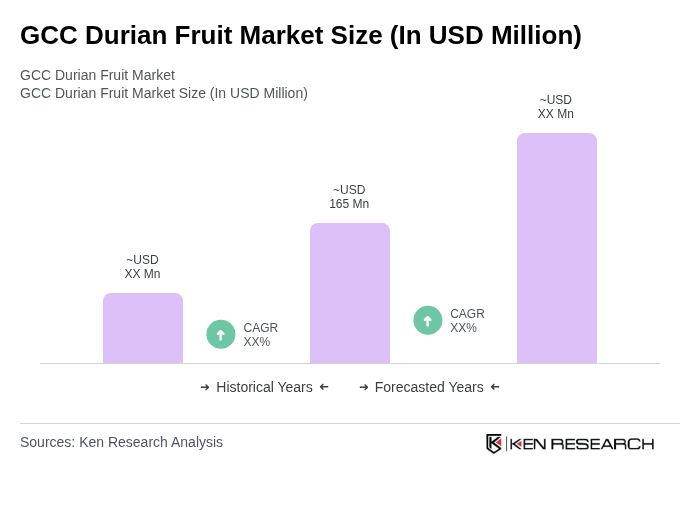
- The GCC Durian Fruit Market is valued at USD 165 million, based on a five-year historical analysis. This market size reflects the region’s increasing consumer demand for exotic fruits, rising health consciousness, and the growing popularity of durian in culinary applications. Imports from Southeast Asia have surged, with Thailand and Malaysia as primary suppliers, as GCC consumers become more adventurous and seek premium tropical fruit experiences.
- Key players in this market include the UAE, Saudi Arabia, and Qatar, which lead due to their affluent populations and a strong culture of food exploration. The UAE, in particular, serves as a hub for exotic fruits, supported by a diverse expatriate community and robust retail infrastructure, driving demand for durian and other tropical fruits.
- In 2023, GCC governments strengthened regulations to ensure the quality and safety of imported fruits, including durian. The “GCC Standardization Organization Technical Regulation for Fresh Fruits and Vegetables (GSO 1234:2023)” issued by the GCC Standardization Organization requires all imported durians to undergo mandatory phytosanitary inspections and certification. These measures prevent the introduction of pests and diseases and require compliance with residue limits and traceability standards, enhancing consumer confidence in the safety of exotic fruits.
GCC Durian Fruit Market Segmentation
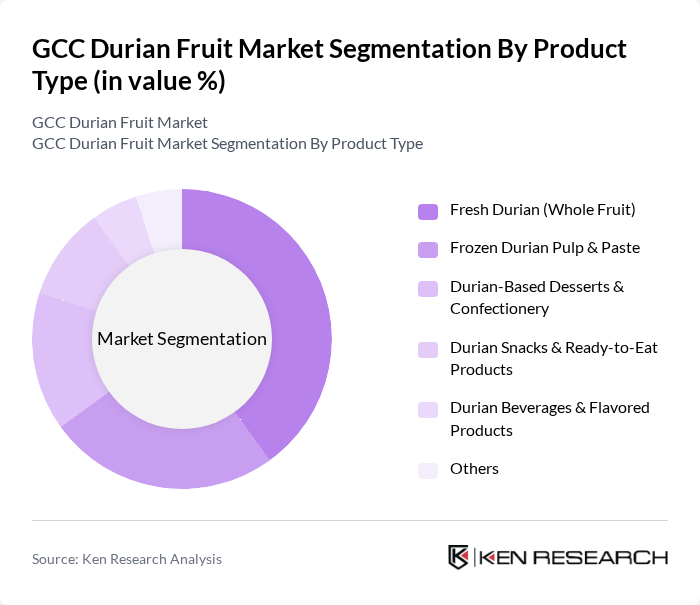
By Product Type:The product type segmentation of the market includes various forms of durian products, catering to diverse consumer preferences.Fresh durian (whole fruit)remains the most popular choice, driven by its distinctive flavor and texture.Frozen durian pulp and pasteare gaining traction due to convenience for culinary and bakery applications.Durian-based desserts and confectioneryare on the rise, appealing to consumers seeking innovative sweet treats.Durian snacks and ready-to-eat productsare increasingly popular among younger consumers, whiledurian beverages and flavored productsare emerging as trendy options. Other forms, including dried durian and ingredient blends, contribute to market diversity.
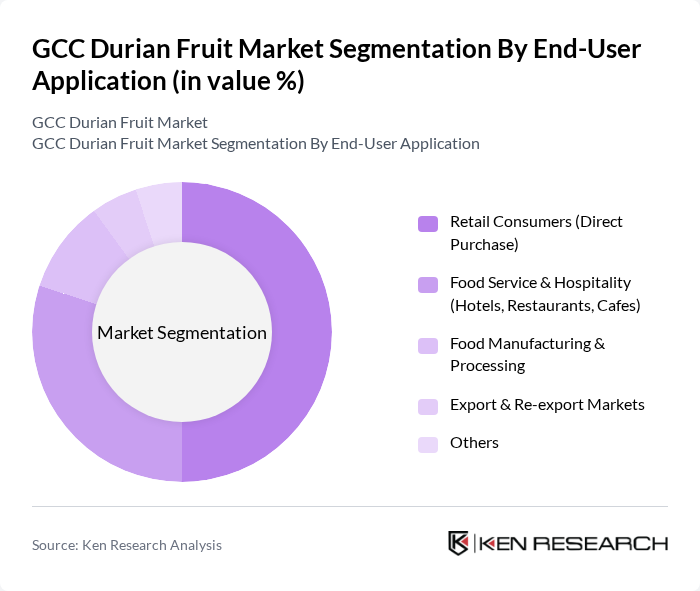
By End-User Application:This segmentation highlights the diverse applications of durian products across consumer sectors.Retail consumerspurchasing directly from stores represent the largest market segment, driven by the growing trend of exotic fruit consumption. Thefood service and hospitality sector, including hotels, restaurants, and cafes, is a major contributor as establishments seek to offer unique culinary experiences.Food manufacturing and processingapplications are expanding, with durian used in various products such as ice creams, pastries, and beverages.Export and re-export marketsare gaining importance as international demand for durian grows, while other applications such as ingredient supply and catering continue to support market diversity.
GCC Durian Fruit Market Competitive Landscape
The GCC Durian Fruit Market is characterized by a dynamic mix of regional and international players. Leading participants such as Al Ain Farms (UAE), Emirates Fruit Company (UAE), Agri-Fresh Trading LLC (UAE), Al Watania Agriculture (Saudi Arabia), Al-Futtaim Group (UAE), Spinneys Distribution (UAE/GCC), Carrefour GCC (Distribution & Retail), Lulu Hypermarket (GCC Operations), Majid Al Futtaim Retail (Supermarket Operations), Bin Dasmal Group (Saudi Arabia), Agri-Tech Solutions GCC (Import & Distribution), Gulf Exotic Fruits Trading (GCC), Arabian Agricultural Company (Multi-GCC), Emirates Agro-Export (UAE), Charoen Pokphand Group (Regional Supplier) contribute to innovation, geographic expansion, and service delivery in this space.
GCC Durian Fruit Market Industry Analysis
Growth Drivers
- Increasing Consumer Demand for Exotic Fruits:The GCC region has witnessed a significant rise in consumer interest in exotic fruits, with the market for such products growing by approximately 15% annually. In future, the demand for durian is expected to reach 12,000 tons, driven by a growing population of expatriates and locals seeking unique culinary experiences. This trend is supported by the increasing availability of durian in supermarkets and specialty stores, enhancing its accessibility to consumers.
- Rising Health Consciousness Among Consumers:Health trends in the GCC are shifting towards natural and nutrient-rich foods, with the durian fruit being recognized for its high vitamin C and antioxidant content. In future, the health food market in the GCC is projected to exceed $12 billion, with exotic fruits like durian gaining traction among health-conscious consumers. This shift is further fueled by social media influencers promoting the health benefits of durian, increasing its appeal.
- Expansion of Distribution Channels:The distribution landscape for durian in the GCC is evolving, with e-commerce platforms and local markets expanding their offerings. In future, online grocery sales in the region are expected to surpass $6 billion, facilitating easier access to durian. Additionally, partnerships with local farmers and importers are enhancing supply chain efficiency, ensuring fresher products reach consumers, thus driving market growth.
Market Challenges
- High Import Costs and Tariffs:The importation of durian into the GCC faces significant financial barriers, with tariffs averaging 10% on exotic fruits. This results in an increased retail price, making durian less competitive compared to locally available fruits. In future, the total import cost for durian is projected to reach $18 million, impacting overall market growth and limiting consumer access to this exotic fruit.
- Perception Issues Regarding Taste and Odor:Durian's strong odor and unique taste continue to pose challenges in consumer acceptance within the GCC. Despite its nutritional benefits, many potential consumers remain hesitant due to cultural perceptions. In future, surveys indicate that approximately 35% of consumers are still unfamiliar with durian, which hinders market penetration and limits its growth potential in the region.
GCC Durian Fruit Market Future Outlook
The future of the GCC durian fruit market appears promising, driven by increasing consumer awareness and innovative marketing strategies. As local farming initiatives gain traction, the supply of durian may improve, reducing reliance on imports. Additionally, the rise of e-commerce platforms is expected to facilitate greater access to durian, appealing to a broader audience. With ongoing culinary trends and health consciousness, the market is poised for significant growth in the coming years, enhancing its presence in the region.
Market Opportunities
- Development of Local Farming Initiatives:Investing in local durian farming can significantly reduce import dependency. With government support, local farms could produce up to 2,500 tons of durian by 2025, enhancing sustainability and freshness in the market. This initiative could also create job opportunities and stimulate the local economy.
- Increasing Tourism and Culinary Experiences:The GCC's growing tourism sector presents an opportunity to promote durian through culinary experiences. In future, tourism is expected to contribute $55 billion to the GCC economy, with food tourism becoming a key attraction. This trend can drive demand for durian-based dishes, enhancing its visibility and acceptance among tourists and locals alike.
Scope of the Report
| Segment | Sub-Segments |
|---|---|
| By Product Type | Fresh Durian (Whole Fruit) Frozen Durian Pulp & Paste Durian-Based Desserts & Confectionery Durian Snacks & Ready-to-Eat Products Durian Beverages & Flavored Products Others |
| By End-User Application | Retail Consumers (Direct Purchase) Food Service & Hospitality (Hotels, Restaurants, Cafes) Food Manufacturing & Processing Export & Re-export Markets Others |
| By Distribution Channel | Supermarkets & Hypermarkets E-commerce & Online Retail Platforms Specialty Stores & Gourmet Shops Direct Sales & Farmers Markets Convenience Stores Others |
| By Origin & Source | Southeast Asian Imports (Thailand, Malaysia, Indonesia) Chinese Imports Local GCC Cultivation Others |
| By Packaging Type | Bulk Packaging (Commercial) Retail Packaging (Consumer Units) Eco-friendly & Sustainable Packaging Premium Packaging (Gift Sets) Others |
| By Price Positioning | Premium Segment (Musang King, Monthong Varieties) Mid-range Segment (Standard Varieties) Budget Segment (Processed & Value-Added) Others |
| By Consumer Demographics | Age Group (18-35, 35-50, 50+) Income Level (High, Middle, Lower-Middle) Geographic Location (Urban, Suburban, Rural) Nationality & Expatriate Communities Others |
Key Target Audience
Investors and Venture Capitalist Firms
Government and Regulatory Bodies (e.g., Ministry of Climate Change and Environment, Food Safety Authority)
Manufacturers and Producers
Distributors and Retailers
Importers and Exporters
Food Service Providers
Industry Associations (e.g., GCC Fruit and Vegetable Association)
Logistics and Supply Chain Companies
Players Mentioned in the Report:
Al Ain Farms (UAE)
Emirates Fruit Company (UAE)
Agri-Fresh Trading LLC (UAE)
Al Watania Agriculture (Saudi Arabia)
Al-Futtaim Group (UAE)
Spinneys Distribution (UAE/GCC)
Carrefour GCC (Distribution & Retail)
Lulu Hypermarket (GCC Operations)
Majid Al Futtaim Retail (Supermarket Operations)
Bin Dasmal Group (Saudi Arabia)
Agri-Tech Solutions GCC (Import & Distribution)
Gulf Exotic Fruits Trading (GCC)
Arabian Agricultural Company (Multi-GCC)
Emirates Agro-Export (UAE)
Charoen Pokphand Group (Regional Supplier)
Table of Contents
Market Assessment Phase
1. Executive Summary and Approach
2. GCC Durian Fruit Market Overview
2.1 Key Insights and Strategic Recommendations
2.2 GCC Durian Fruit Market Overview
2.3 Definition and Scope
2.4 Evolution of Market Ecosystem
2.5 Timeline of Key Regulatory Milestones
2.6 Value Chain & Stakeholder Mapping
2.7 Business Cycle Analysis
2.8 Policy & Incentive Landscape
3. GCC Durian Fruit Market Analysis
3.1 Growth Drivers
3.1.1 Increasing consumer demand for exotic fruits
3.1.2 Rising health consciousness among consumers
3.1.3 Expansion of distribution channels
3.1.4 Growing popularity of durian in culinary applications
3.2 Market Challenges
3.2.1 High import costs and tariffs
3.2.2 Limited local cultivation
3.2.3 Perception issues regarding taste and odor
3.2.4 Supply chain inefficiencies
3.3 Market Opportunities
3.3.1 Development of local farming initiatives
3.3.2 Increasing tourism and culinary experiences
3.3.3 E-commerce growth for exotic fruits
3.3.4 Export potential to neighboring regions
3.4 Market Trends
3.4.1 Rising popularity of organic durian
3.4.2 Innovative product offerings (e.g., durian snacks)
3.4.3 Increased marketing efforts targeting millennials
3.4.4 Sustainability practices in sourcing and packaging
3.5 Government Regulation
3.5.1 Import regulations and quality standards
3.5.2 Agricultural subsidies for local farmers
3.5.3 Food safety regulations
3.5.4 Trade agreements impacting durian imports
4. SWOT Analysis
5. Stakeholder Analysis
6. Porter's Five Forces Analysis
7. GCC Durian Fruit Market Market Size, 2019-2024
7.1 By Value
7.2 By Volume
7.3 By Average Selling Price
8. GCC Durian Fruit Market Segmentation
8.1 By Product Type
8.1.1 Fresh Durian (Whole Fruit)
8.1.2 Frozen Durian Pulp & Paste
8.1.3 Durian-Based Desserts & Confectionery
8.1.4 Durian Snacks & Ready-to-Eat Products
8.1.5 Durian Beverages & Flavored Products
8.1.6 Others
8.2 By End-User Application
8.2.1 Retail Consumers (Direct Purchase)
8.2.2 Food Service & Hospitality (Hotels, Restaurants, Cafes)
8.2.3 Food Manufacturing & Processing
8.2.4 Export & Re-export Markets
8.2.5 Others
8.3 By Distribution Channel
8.3.1 Supermarkets & Hypermarkets
8.3.2 E-commerce & Online Retail Platforms
8.3.3 Specialty Stores & Gourmet Shops
8.3.4 Direct Sales & Farmers Markets
8.3.5 Convenience Stores
8.3.6 Others
8.4 By Origin & Source
8.4.1 Southeast Asian Imports (Thailand, Malaysia, Indonesia)
8.4.2 Chinese Imports
8.4.3 Local GCC Cultivation
8.4.4 Others
8.5 By Packaging Type
8.5.1 Bulk Packaging (Commercial)
8.5.2 Retail Packaging (Consumer Units)
8.5.3 Eco-friendly & Sustainable Packaging
8.5.4 Premium Packaging (Gift Sets)
8.5.5 Others
8.6 By Price Positioning
8.6.1 Premium Segment (Musang King, Monthong Varieties)
8.6.2 Mid-range Segment (Standard Varieties)
8.6.3 Budget Segment (Processed & Value-Added)
8.6.4 Others
8.7 By Consumer Demographics
8.7.1 Age Group (18-35, 35-50, 50+)
8.7.2 Income Level (High, Middle, Lower-Middle)
8.7.3 Geographic Location (Urban, Suburban, Rural)
8.7.4 Nationality & Expatriate Communities
8.7.5 Others
9. GCC Durian Fruit Market Competitive Analysis
9.1 Market Share of Key Players
9.2 Cross Comparison of Key Players
9.2.1 Company Name
9.2.2 Company Size Classification (Large, Medium, Small)
9.2.3 Year-over-Year Revenue Growth Rate (%)
9.2.4 Market Penetration Rate (% of GCC Market)
9.2.5 Customer Retention Rate (%)
9.2.6 Pricing Strategy (Premium/Mid-range/Budget)
9.2.7 Cold Chain & Distribution Efficiency (Days to Market)
9.2.8 Product Portfolio Diversification Index
9.2.9 Brand Recognition Score (Regional Awareness %)
9.2.10 Net Promoter Score (NPS) & Customer Satisfaction
9.3 SWOT Analysis of Top Players
9.4 Pricing Analysis
9.5 Detailed Profile of Major Companies
9.5.1 Al Ain Farms (UAE)
9.5.2 Emirates Fruit Company (UAE)
9.5.3 Agri-Fresh Trading LLC (UAE)
9.5.4 Al Watania Agriculture (Saudi Arabia)
9.5.5 Al-Futtaim Group (UAE)
9.5.6 Spinneys Distribution (UAE/GCC)
9.5.7 Carrefour GCC (Distribution & Retail)
9.5.8 Lulu Hypermarket (GCC Operations)
9.5.9 Majid Al Futtaim Retail (Supermarket Operations)
9.5.10 Bin Dasmal Group (Saudi Arabia)
9.5.11 Agri-Tech Solutions GCC (Import & Distribution)
9.5.12 Gulf Exotic Fruits Trading (GCC)
9.5.13 Arabian Agricultural Company (Multi-GCC)
9.5.14 Emirates Agro-Export (UAE)
9.5.15 Charoen Pokphand Group (Regional Supplier)
10. GCC Durian Fruit Market End-User Analysis
10.1 Procurement Behavior of Key Ministries
10.1.1 Ministry of Agriculture & Food Security
10.1.2 Ministry of Health & Food Safety Authorities
10.1.3 Ministry of Commerce & Trade
10.1.4 Others
10.2 Corporate Spend on Infrastructure & Energy
10.2.1 Investment in Cold Storage Facilities
10.2.2 Transportation Infrastructure & Logistics
10.2.3 Marketing and Promotion
10.2.4 Others
10.3 Pain Point Analysis by End-User Category
10.3.1 Supply Chain Delays
10.3.2 Quality Assurance Issues
10.3.3 Pricing Volatility
10.3.4 Others
10.4 User Readiness for Adoption
10.4.1 Awareness of Durian Benefits
10.4.2 Availability of Products
10.4.3 Consumer Education
10.4.4 Others
10.5 Post-Deployment ROI and Use Case Expansion
10.5.1 Increased Sales Revenue
10.5.2 Market Expansion Opportunities
10.5.3 Customer Feedback and Adaptation
10.5.4 Others
11. GCC Durian Fruit Market Future Size, 2025-2030
11.1 By Value
11.2 By Volume
11.3 By Average Selling Price
Go-To-Market Strategy Phase
1. Whitespace Analysis + Business Model Canvas
1.1 Market Gaps Identification
1.2 Business Model Development
2. Marketing and Positioning Recommendations
2.1 Branding Strategies
2.2 Product USPs
3. Distribution Plan
3.1 Urban Retail Strategies
3.2 Rural NGO Tie-ups
4. Channel & Pricing Gaps
4.1 Underserved Routes
4.2 Pricing Bands
5. Unmet Demand & Latent Needs
5.1 Category Gaps
5.2 Consumer Segments
6. Customer Relationship
6.1 Loyalty Programs
6.2 After-sales Service
7. Value Proposition
7.1 Sustainability
7.2 Integrated Supply Chains
8. Key Activities
8.1 Regulatory Compliance
8.2 Branding
8.3 Distribution Setup
9. Entry Strategy Evaluation
9.1 Domestic Market Entry Strategy
9.1.1 Product Mix
9.1.2 Pricing Band
9.1.3 Packaging
9.2 Export Entry Strategy
9.2.1 Target Countries
9.2.2 Compliance Roadmap
10. Entry Mode Assessment
10.1 JV
10.2 Greenfield
10.3 M&A
10.4 Distributor Model
11. Capital and Timeline Estimation
11.1 Capital Requirements
11.2 Timelines
12. Control vs Risk Trade-Off
12.1 Ownership vs Partnerships
13. Profitability Outlook
13.1 Breakeven Analysis
13.2 Long-term Sustainability
14. Potential Partner List
14.1 Distributors
14.2 JVs
14.3 Acquisition Targets
15. Execution Roadmap
15.1 Phase
Research Methodology
Phase 1: Approach1
Desk Research
- Market reports from agricultural and fruit trade associations in the GCC region
- Statistical data from national agricultural ministries and trade departments
- Published articles and white papers on durian cultivation and export trends
Primary Research
- Interviews with importers and distributors of exotic fruits in the GCC
- Surveys with retailers specializing in tropical fruits and gourmet products
- Field visits to durian farms and processing facilities in Southeast Asia
Validation & Triangulation
- Cross-validation of market size estimates using multiple data sources
- Triangulation of consumer preferences through focus groups and surveys
- Sanity checks through expert reviews from agricultural economists and market analysts
Phase 2: Market Size Estimation1
Top-down Assessment
- Analysis of total fruit import volumes in the GCC with a focus on tropical fruits
- Segmentation of durian market share within the broader exotic fruit category
- Incorporation of regional consumption trends and demographic factors
Bottom-up Modeling
- Volume estimates based on sales data from key retailers and wholesalers
- Pricing analysis of durian across different market segments and regions
- Estimation of growth rates based on historical sales data and market trends
Forecasting & Scenario Analysis
- Multi-factor regression analysis incorporating consumer trends and economic indicators
- Scenario modeling based on potential changes in import regulations and tariffs
- Baseline, optimistic, and pessimistic forecasts through 2030 based on market dynamics
Phase 3: CATI Sample Composition1
| Scope Item/Segment | Sample Size | Target Respondent Profiles |
|---|---|---|
| Retail Market for Exotic Fruits | 120 | Store Managers, Category Buyers |
| Import and Distribution Channels | 100 | Import Managers, Logistics Coordinators |
| Consumer Preferences and Trends | 150 | End Consumers, Food Enthusiasts |
| Durian Farming Practices | 80 | Farm Owners, Agricultural Experts |
| Market Regulation Insights | 50 | Policy Makers, Trade Association Representatives |
Frequently Asked Questions
What is the current value of the GCC Durian Fruit Market?
The GCC Durian Fruit Market is valued at approximately USD 165 million, reflecting a growing consumer demand for exotic fruits and the increasing popularity of durian in culinary applications across the region.
Which countries are the primary suppliers of durian to the GCC?
What regulations govern the import of durian in the GCC?
What are the main product types available in the GCC Durian Fruit Market?
Other Regional/Country Reports
Malaysia Durian Fruit Market
KSA Durian Fruit Market
APAC Durian Fruit Market
SEA Durian Fruit Market
Vietnam Durian Fruit Market
Other Adjacent Reports
Malaysia Exotic Fruit Import Market
Germany Tropical Fruit Processing Market
Kuwait Fresh Produce Distribution Market
Thailand Frozen Fruit Products Market
Japan Health and Wellness Food Market
Philippines Online Grocery Retail Market
Philippines Food Service and Hospitality Market
Vietnam Agricultural Import Logistics Market
KSA Culinary Tourism Experiences Market
Vietnam Fruit-Based Confectionery Market
Why Buy From Us?

What makes us stand out is that our consultants follow Robust, Refine and Result (RRR) methodology. Robust for clear definitions, approaches and sanity checking, Refine for differentiating respondents' facts and opinions, and Result for presenting data with story.

We have set a benchmark in the industry by offering our clients with syndicated and customized market research reports featuring coverage of entire market as well as meticulous research and analyst insights.

While we don't replace traditional research, we flip the method upside down. Our dual approach of Top Bottom & Bottom Top ensures quality deliverable by not just verifying company fundamentals but also looking at the sector and macroeconomic factors.

With one step in the future, our research team constantly tries to show you the bigger picture. We help with some of the tough questions you may encounter along the way: How is the industry positioned? Best marketing channel? KPI's of competitors? By aligning every element, we help maximize success.

Our report gives you instant access to the answers and sources that other companies might choose to hide. We elaborate each steps of research methodology we have used and showcase you the sample size to earn your trust.

If you need any support, we are here! We pride ourselves on universe strength, data quality, and quick, friendly, and professional service.