About the Report
Base Year 2024GCC Handheld Counter IED Market Overview
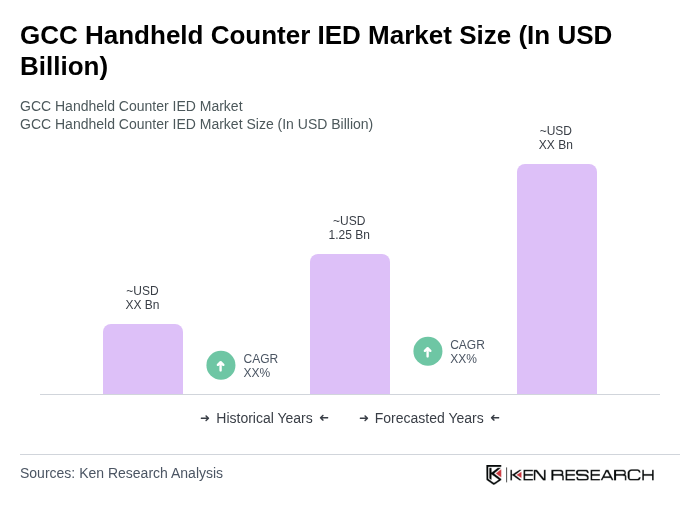
- The GCC Handheld Counter IED Market is valued at USD 1.25 billion, based on a five-year historical analysis. This growth is primarily driven by heightened security concerns, persistent geopolitical tensions, and the increasing adoption of advanced counter-terrorism measures. Demand for handheld devices capable of detecting and neutralizing improvised explosive devices (IEDs) continues to rise, especially within military and law enforcement sectors, as these organizations prioritize rapid threat identification and field mobility .
- Key players in this market include Saudi Arabia, the United Arab Emirates, and Qatar. These countries maintain dominance due to significant defense expenditures, ongoing military modernization initiatives, and their strategic geopolitical positions, which necessitate robust national security frameworks. The prevalence of asymmetric threats and the need for rapid response capabilities further amplify demand for handheld counter IED solutions in these regions .
- In 2023, the United Arab Emirates Ministry of Interior issued the “National Standard for Counter-IED Equipment and Operations, 2023,” mandating the integration of advanced counter-IED technologies in military and law enforcement operations. This regulation establishes technical standards for handheld detection and neutralization devices, requires periodic compliance audits, and sets minimum performance thresholds for procurement, thereby driving investments in handheld counter IED solutions across the GCC .
GCC Handheld Counter IED Market Segmentation
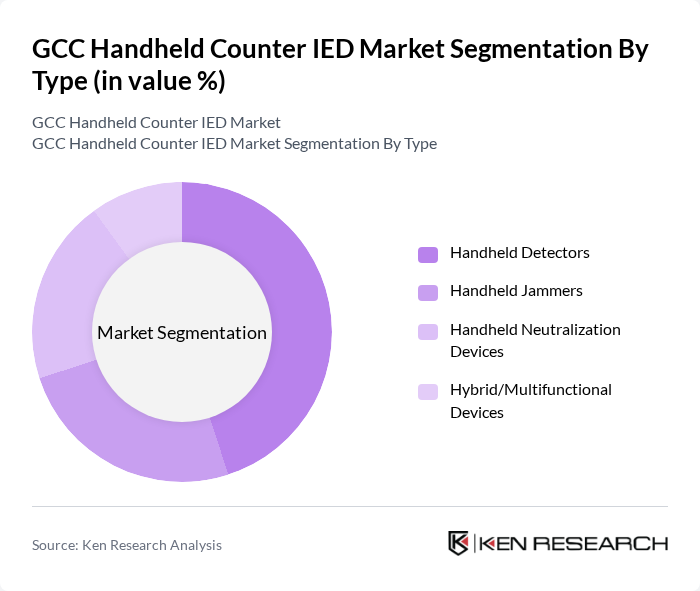
By Type:The handheld counter IED market is segmented into four main types: Handheld Detectors, Handheld Jammers, Handheld Neutralization Devices, and Hybrid/Multifunctional Devices. Among these, Handheld Detectors remain the leading subsegment due to their essential role in early threat identification and field deployment flexibility. The growing emphasis on proactive security protocols and the integration of multi-sensor technologies have further accelerated demand for these devices, particularly in military and law enforcement operations .
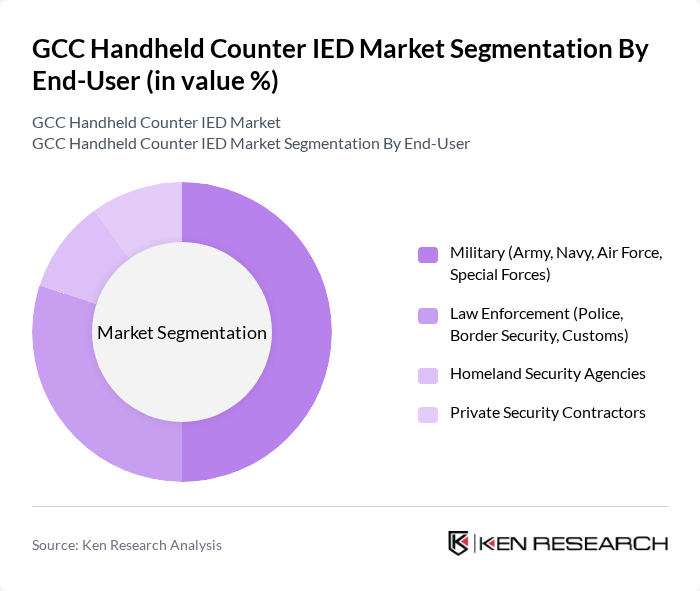
By End-User:The market is segmented by end-user into Military (Army, Navy, Air Force, Special Forces), Law Enforcement (Police, Border Security, Customs), Homeland Security Agencies, and Private Security Contractors. The Military segment is the dominant end-user, reflecting the sector’s ongoing investments in advanced field equipment and the prioritization of rapid threat mitigation in high-risk environments. Modernization of defense forces and increased cross-border security initiatives in the GCC further reinforce this segment’s leading position .
GCC Handheld Counter IED Market Competitive Landscape
The GCC Handheld Counter IED Market is characterized by a dynamic mix of regional and international players. Leading participants such as Northrop Grumman, Raytheon Technologies, Thales Group, BAE Systems, Teledyne FLIR (formerly FLIR Systems), L3Harris Technologies, Chemring Group PLC, Safran Electronics & Defense, General Dynamics Mission Systems, Leonardo S.p.A., Rheinmetall AG, Elbit Systems Ltd., QinetiQ Group plc, Rapiscan Systems (OSI Systems, Inc.), and Guartel Technologies Ltd. contribute to innovation, geographic expansion, and service delivery in this space.
GCC Handheld Counter IED Market Industry Analysis
Growth Drivers
- Increasing Terrorism Threats:The GCC region has witnessed a significant rise in terrorism-related incidents, with over 1,000 attacks reported in 2023 alone, according to the Global Terrorism Index. This alarming trend has prompted governments to prioritize security measures, leading to an increased demand for handheld counter IED devices. The heightened threat level has resulted in a projected increase in defense budgets, with GCC countries collectively allocating approximately $150 billion for security enhancements in future, driving market growth.
- Advancements in Technology:The handheld counter IED market is experiencing rapid technological advancements, particularly in artificial intelligence and machine learning. In future, the global defense technology spending is expected to reach $2.2 trillion, with a significant portion directed towards innovative security solutions. These advancements enhance detection capabilities, making devices more effective against evolving threats. As a result, the integration of cutting-edge technology is a key driver for market growth, attracting investments from both public and private sectors.
- Government Defense Spending:GCC governments are significantly increasing their defense spending, with a projected growth rate of 5% annually, reaching approximately $180 billion in future. This increase is driven by the need to bolster national security in response to regional instability. The allocation of funds towards advanced security technologies, including handheld counter IED systems, is expected to create a robust market environment. This strategic focus on defense spending is crucial for enhancing the capabilities of security forces across the region.
Market Challenges
- High Initial Investment Costs:The high initial investment required for handheld counter IED systems poses a significant challenge for many GCC countries. The average cost of advanced devices can exceed $100,000, which may deter smaller defense agencies from procurement. Additionally, budget constraints in some nations limit their ability to invest in these critical technologies. This financial barrier can slow down the adoption rate of essential security solutions, impacting overall market growth.
- Regulatory Compliance Issues:Navigating the complex regulatory landscape is a major challenge for manufacturers and suppliers in the GCC handheld counter IED market. Compliance with stringent export control regulations and safety standards can delay product launches and increase operational costs. In future, it is estimated that compliance-related expenses could account for up to 15% of total operational costs for companies in this sector. This regulatory burden can hinder market entry and limit competition among providers.
GCC Handheld Counter IED Market Future Outlook
The future of the GCC handheld counter IED market appears promising, driven by ongoing technological advancements and increasing government investments in security. As threats evolve, the demand for innovative solutions will likely rise, fostering a competitive landscape. Additionally, collaboration between defense agencies and private sector firms is expected to enhance product development. The focus on research and development will further lead to the creation of advanced features, ensuring that security forces are equipped with the most effective tools to combat emerging threats.
Market Opportunities
- Expansion in Emerging Markets:Emerging markets within the GCC present significant opportunities for growth. Countries like Oman and Kuwait are increasing their defense budgets, with projected increases of 10% in future. This trend opens avenues for manufacturers to introduce advanced handheld counter IED solutions tailored to local needs, enhancing market penetration and revenue potential.
- Collaborations with Defense Agencies:Strategic partnerships with defense agencies can drive innovation and market growth. Collaborations are expected to increase by 20% in future, as agencies seek to leverage private sector expertise. These partnerships can facilitate the development of customized solutions, ensuring that security forces have access to the latest technologies, thereby enhancing operational effectiveness.
Scope of the Report
| Segment | Sub-Segments |
|---|---|
| By Type | Handheld Detectors Handheld Jammers Handheld Neutralization Devices Hybrid/Multifunctional Devices |
| By End-User | Military (Army, Navy, Air Force, Special Forces) Law Enforcement (Police, Border Security, Customs) Homeland Security Agencies Private Security Contractors |
| By Application | Route Clearance Checkpoint Screening Critical Infrastructure Protection Event & Venue Security |
| By Technology | Ground Penetrating Radar (GPR) Electromagnetic Induction Sensors Infrared/Optical Sensors Advanced Signal Processing/AI-enabled Devices |
| By Region | Saudi Arabia United Arab Emirates (UAE) Qatar Kuwait Oman Bahrain |
| By Investment Source | Government Defense Budgets Private Sector Investments International Security Aid Public-Private Partnerships |
| By Policy Support | Defense Procurement Policies Security Grants Technology Modernization Initiatives Export/Import Regulations |
Key Target Audience
Investors and Venture Capitalist Firms
Government and Regulatory Bodies (e.g., Ministry of Defense, Ministry of Interior)
Military and Defense Agencies
Law Enforcement Agencies
Security and Counter-Terrorism Organizations
Manufacturers and Producers of Counter-IED Technologies
Distributors and Suppliers of Defense Equipment
Financial Institutions and Funding Agencies
Players Mentioned in the Report:
Northrop Grumman
Raytheon Technologies
Thales Group
BAE Systems
Teledyne FLIR (formerly FLIR Systems)
L3Harris Technologies
Chemring Group PLC
Safran Electronics & Defense
General Dynamics Mission Systems
Leonardo S.p.A.
Rheinmetall AG
Elbit Systems Ltd.
QinetiQ Group plc
Rapiscan Systems (OSI Systems, Inc.)
Guartel Technologies Ltd.
Table of Contents
Market Assessment Phase
1. Executive Summary and Approach
2. GCC Handheld Counter IED Market Overview
2.1 Key Insights and Strategic Recommendations
2.2 GCC Handheld Counter IED Market Overview
2.3 Definition and Scope
2.4 Evolution of Market Ecosystem
2.5 Timeline of Key Regulatory Milestones
2.6 Value Chain & Stakeholder Mapping
2.7 Business Cycle Analysis
2.8 Policy & Incentive Landscape
3. GCC Handheld Counter IED Market Analysis
3.1 Growth Drivers
3.1.1 Increasing Terrorism Threats
3.1.2 Advancements in Technology
3.1.3 Government Defense Spending
3.1.4 Rising Demand for Security Solutions
3.2 Market Challenges
3.2.1 High Initial Investment Costs
3.2.2 Regulatory Compliance Issues
3.2.3 Limited Awareness Among End-Users
3.2.4 Rapid Technological Changes
3.3 Market Opportunities
3.3.1 Expansion in Emerging Markets
3.3.2 Collaborations with Defense Agencies
3.3.3 Development of Advanced Features
3.3.4 Increased Focus on R&D
3.4 Market Trends
3.4.1 Integration of AI and Machine Learning
3.4.2 Shift Towards Portable Solutions
3.4.3 Growing Importance of Cybersecurity
3.4.4 Enhanced User Training Programs
3.5 Government Regulation
3.5.1 Export Control Regulations
3.5.2 Safety Standards Compliance
3.5.3 Procurement Policies for Defense Equipment
3.5.4 Environmental Regulations
4. SWOT Analysis
5. Stakeholder Analysis
6. Porter's Five Forces Analysis
7. GCC Handheld Counter IED Market Market Size, 2019-2024
7.1 By Value
7.2 By Volume
7.3 By Average Selling Price
8. GCC Handheld Counter IED Market Segmentation
8.1 By Type
8.1.1 Handheld Detectors
8.1.2 Handheld Jammers
8.1.3 Handheld Neutralization Devices
8.1.4 Hybrid/Multifunctional Devices
8.2 By End-User
8.2.1 Military (Army, Navy, Air Force, Special Forces)
8.2.2 Law Enforcement (Police, Border Security, Customs)
8.2.3 Homeland Security Agencies
8.2.4 Private Security Contractors
8.3 By Application
8.3.1 Route Clearance
8.3.2 Checkpoint Screening
8.3.3 Critical Infrastructure Protection
8.3.4 Event & Venue Security
8.4 By Technology
8.4.1 Ground Penetrating Radar (GPR)
8.4.2 Electromagnetic Induction Sensors
8.4.3 Infrared/Optical Sensors
8.4.4 Advanced Signal Processing/AI-enabled Devices
8.5 By Region
8.5.1 Saudi Arabia
8.5.2 United Arab Emirates (UAE)
8.5.3 Qatar
8.5.4 Kuwait
8.5.5 Oman
8.5.6 Bahrain
8.6 By Investment Source
8.6.1 Government Defense Budgets
8.6.2 Private Sector Investments
8.6.3 International Security Aid
8.6.4 Public-Private Partnerships
8.7 By Policy Support
8.7.1 Defense Procurement Policies
8.7.2 Security Grants
8.7.3 Technology Modernization Initiatives
8.7.4 Export/Import Regulations
9. GCC Handheld Counter IED Market Competitive Analysis
9.1 Market Share of Key Players
9.2 Cross Comparison of Key Players
9.2.1 Company Name
9.2.2 Product Portfolio Breadth (Number of Handheld Counter-IED Solutions)
9.2.3 Regional Presence (GCC Market Penetration)
9.2.4 Revenue from Handheld Counter-IED Segment (USD, Latest FY)
9.2.5 R&D Intensity (% of Revenue Spent on R&D)
9.2.6 Number of Active Defense Contracts in GCC
9.2.7 Technology Differentiation (Patents, Proprietary Features)
9.2.8 Delivery Lead Time (Average Weeks)
9.2.9 After-Sales Support Infrastructure (GCC Service Centers)
9.2.10 Customer Referenceability (Major GCC End-Users)
9.3 SWOT Analysis of Top Players
9.4 Pricing Analysis
9.5 Detailed Profile of Major Companies
9.5.1 Northrop Grumman
9.5.2 Raytheon Technologies
9.5.3 Thales Group
9.5.4 BAE Systems
9.5.5 Teledyne FLIR (formerly FLIR Systems)
9.5.6 L3Harris Technologies
9.5.7 Chemring Group PLC
9.5.8 Safran Electronics & Defense
9.5.9 General Dynamics Mission Systems
9.5.10 Leonardo S.p.A.
9.5.11 Rheinmetall AG
9.5.12 Elbit Systems Ltd.
9.5.13 QinetiQ Group plc
9.5.14 Rapiscan Systems (OSI Systems, Inc.)
9.5.15 Guartel Technologies Ltd.
10. GCC Handheld Counter IED Market End-User Analysis
10.1 Procurement Behavior of Key Ministries
10.1.1 Defense Ministry
10.1.2 Interior Ministry
10.1.3 Emergency Services
10.1.4 Others
10.2 Corporate Spend on Infrastructure & Energy
10.2.1 Government Contracts
10.2.2 Private Sector Investments
10.2.3 International Collaborations
10.2.4 Others
10.3 Pain Point Analysis by End-User Category
10.3.1 Budget Constraints
10.3.2 Technology Integration Issues
10.3.3 Training and Support Needs
10.3.4 Others
10.4 User Readiness for Adoption
10.4.1 Training Programs
10.4.2 Infrastructure Readiness
10.4.3 Policy Support
10.4.4 Others
10.5 Post-Deployment ROI and Use Case Expansion
10.5.1 Performance Metrics
10.5.2 User Feedback
10.5.3 Future Expansion Plans
10.5.4 Others
11. GCC Handheld Counter IED Market Future Size, 2025-2030
11.1 By Value
11.2 By Volume
11.3 By Average Selling Price
Go-To-Market Strategy Phase
1. Whitespace Analysis + Business Model Canvas
1.1 Market Gaps Identification
1.2 Business Model Development
2. Marketing and Positioning Recommendations
2.1 Branding Strategies
2.2 Product USPs
3. Distribution Plan
3.1 Urban Retail Strategies
3.2 Rural NGO Tie-Ups
4. Channel & Pricing Gaps
4.1 Underserved Routes
4.2 Pricing Bands
5. Unmet Demand & Latent Needs
5.1 Category Gaps
5.2 Consumer Segments
6. Customer Relationship
6.1 Loyalty Programs
6.2 After-Sales Service
7. Value Proposition
7.1 Sustainability
7.2 Integrated Supply Chains
8. Key Activities
8.1 Regulatory Compliance
8.2 Branding
8.3 Distribution Setup
9. Entry Strategy Evaluation
9.1 Domestic Market Entry Strategy
9.1.1 Product Mix
9.1.2 Pricing Band
9.1.3 Packaging
9.2 Export Entry Strategy
9.2.1 Target Countries
9.2.2 Compliance Roadmap
10. Entry Mode Assessment
10.1 Joint Ventures
10.2 Greenfield Investments
10.3 Mergers & Acquisitions
10.4 Distributor Model
11. Capital and Timeline Estimation
11.1 Capital Requirements
11.2 Timelines
12. Control vs Risk Trade-Off
12.1 Ownership vs Partnerships
13. Profitability Outlook
13.1 Breakeven Analysis
13.2 Long-Term Sustainability
14. Potential Partner List
14.1 Distributors
14.2 Joint Ventures
14.3 Acquisition Targets
15. Execution Roadmap
15.1 Phased Plan for Market Entry
15.1.1 Market Setup
15.1.2 Market Entry
15.1.3 Growth Acceleration
15.1.4 Scale & Stabilize
15.2 Key Activities and Milestones
15.2.1 Milestone Planning
15.2.2 Activity Tracking
Research Methodology
Phase 1: Approach1
Desk Research
- Industry reports from defense and security agencies in the GCC region
- Market analysis publications from trade associations focused on counter-IED technologies
- Government procurement data and defense budgets related to handheld counter-IED systems
Primary Research
- Interviews with military procurement officers and defense contractors
- Surveys with security consultants specializing in counter-terrorism technologies
- Field interviews with end-users, including military personnel and law enforcement agencies
Validation & Triangulation
- Cross-validation of findings through multiple expert interviews and secondary data sources
- Triangulation of market data from government reports, industry publications, and expert insights
- Sanity checks through feedback from a panel of industry experts and stakeholders
Phase 2: Market Size Estimation1
Top-down Assessment
- Analysis of defense spending trends in GCC countries and allocation for counter-IED technologies
- Segmentation of the market by application areas such as military, law enforcement, and civilian use
- Incorporation of regional security threats and their impact on market demand
Bottom-up Modeling
- Estimation of unit sales based on historical data from defense contracts and procurement records
- Cost analysis of handheld counter-IED devices, including R&D and production expenses
- Volume x price modeling to derive revenue projections for different market segments
Forecasting & Scenario Analysis
- Multi-factor regression analysis incorporating geopolitical stability, defense budgets, and technological advancements
- Scenario planning based on potential changes in regional security dynamics and defense policies
- Baseline, optimistic, and pessimistic forecasts through 2030, considering various market drivers
Phase 3: CATI Sample Composition1
| Scope Item/Segment | Sample Size | Target Respondent Profiles |
|---|---|---|
| Military Procurement Departments | 60 | Procurement Officers, Defense Analysts |
| Law Enforcement Agencies | 50 | Security Managers, Tactical Operations Leaders |
| Private Security Firms | 40 | Operations Managers, Technology Specialists |
| Government Defense Contractors | 40 | Business Development Managers, Product Engineers |
| Research Institutions in Defense Technology | 40 | Research Scientists, Policy Advisors |
Frequently Asked Questions
What is the current value of the GCC Handheld Counter IED Market?
The GCC Handheld Counter IED Market is valued at approximately USD 1.25 billion, driven by increasing security concerns, geopolitical tensions, and the adoption of advanced counter-terrorism measures, particularly in military and law enforcement sectors.
Which countries are the key players in the GCC Handheld Counter IED Market?
What types of handheld counter IED devices are available in the market?
Who are the primary end-users of handheld counter IED devices?
Other Regional/Country Reports
Indonesia Handheld Counter IED Market
Malaysia Handheld Counter IED Market
APAC Handheld Counter IED Market
SEA Handheld Counter IED Market
Vietnam Handheld Counter IED Market
Other Adjacent Reports
KSA Explosive Detection Systems Market
Brazil Electronic Countermeasures Market
Oman Military Robotics Market
Philippines Surveillance Drone Market
KSA Tactical Communication Devices Market
Southeast Asia Personal Protective Equipment Market Outlook to 2030: Size, Share, Growth and TrendsJapan Border Security Technology Market
Mexico Threat Intelligence Software Market
Brazil Cybersecurity Defense Market
Belgium Counter-Terrorism Training Market
Why Buy From Us?

What makes us stand out is that our consultants follow Robust, Refine and Result (RRR) methodology. Robust for clear definitions, approaches and sanity checking, Refine for differentiating respondents' facts and opinions, and Result for presenting data with story.

We have set a benchmark in the industry by offering our clients with syndicated and customized market research reports featuring coverage of entire market as well as meticulous research and analyst insights.

While we don't replace traditional research, we flip the method upside down. Our dual approach of Top Bottom & Bottom Top ensures quality deliverable by not just verifying company fundamentals but also looking at the sector and macroeconomic factors.

With one step in the future, our research team constantly tries to show you the bigger picture. We help with some of the tough questions you may encounter along the way: How is the industry positioned? Best marketing channel? KPI's of competitors? By aligning every element, we help maximize success.

Our report gives you instant access to the answers and sources that other companies might choose to hide. We elaborate each steps of research methodology we have used and showcase you the sample size to earn your trust.

If you need any support, we are here! We pride ourselves on universe strength, data quality, and quick, friendly, and professional service.