About the Report
Base Year 2024GCC Regenerative Agriculture Market Overview
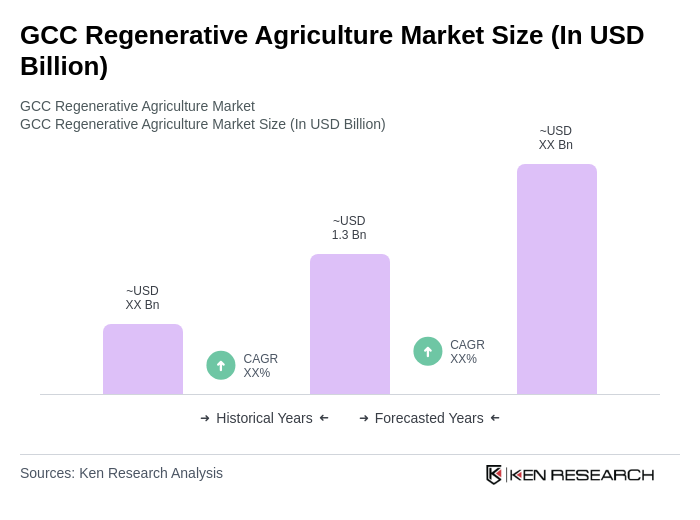
- The GCC Regenerative Agriculture Market is valued at USD 1.3 billion, based on a five-year historical analysis. This growth is primarily driven by increasing awareness of sustainable farming practices, government initiatives promoting environmental sustainability, and the rising demand for organic produce. The market is also supported by advancements in agricultural technologies that enhance soil health and biodiversity, alongside corporate sustainability commitments and carbon-neutral supply chain initiatives that are accelerating adoption of regenerative practices across the region.
- Key players in this market include Saudi Arabia, the United Arab Emirates, and Oman. These countries dominate the market due to their significant investments in agricultural innovation, favorable climatic conditions for diverse farming practices, and strong government support for sustainable agriculture initiatives. The focus on food security and reducing dependency on food imports further strengthens their market position, complemented by the integration of digital tools and precision agriculture technologies that enable farmers to implement climate-smart practices while monetizing ecosystem services.
- The UAE Federal Decree-Law No. 24 of 2021 on the Regulation of the Organic Agriculture Sector, issued by the Ministry of Climate Change and Environment, establishes comprehensive standards for sustainable agricultural practices including regenerative agriculture principles. This regulation mandates certification requirements for organic and sustainable farming operations, sets quality standards for soil management and water conservation practices, and requires farms to implement biodiversity enhancement measures. The law applies to all agricultural operations seeking organic or sustainable certification, with specific provisions for minimum soil health requirements, water usage efficiency thresholds, and mandatory reporting on environmental impact metrics.
GCC Regenerative Agriculture Market Segmentation
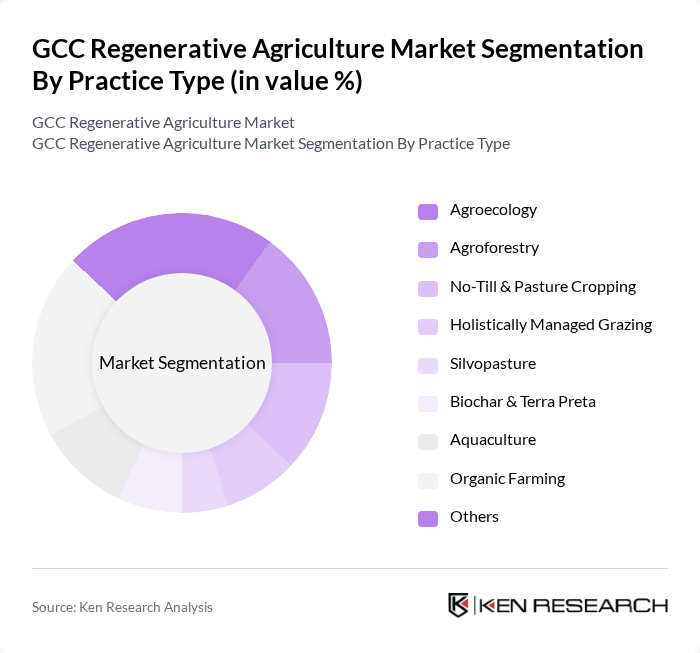
By Practice Type:The practice types in regenerative agriculture include various methods aimed at restoring soil health and enhancing ecosystem services. The subsegments are Agroecology, Agroforestry, No-Till & Pasture Cropping, Holistically Managed Grazing, Silvopasture, Biochar & Terra Preta, Aquaculture, Organic Farming, and Others. Among these, Organic Farming is currently the leading subsegment due to the increasing consumer demand for organic products and the growing awareness of health and environmental benefits associated with organic farming practices. The segment is further strengthened by corporate procurement contracts that prioritize regeneratively-sourced ingredients and premium pricing mechanisms that provide growers with predictable revenue streams.
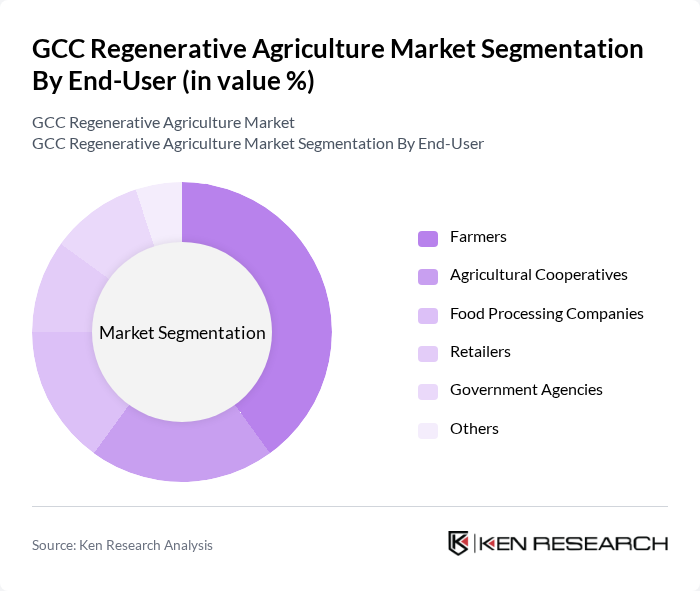
By End-User:The end-users in the regenerative agriculture market include Farmers, Agricultural Cooperatives, Food Processing Companies, Retailers, Government Agencies, and Others. Farmers are the dominant end-user segment, as they are the primary implementers of regenerative practices on their lands. The increasing focus on sustainable farming methods and the need for improved crop yields are driving farmers to adopt regenerative agriculture techniques. This adoption is accelerated by access to transition funds that help overcome credit barriers, digital verification platforms that enable carbon credit monetization, and technical support programs that reduce the risks associated with implementing cover-cropping, reduced-tillage, and composting programs.
GCC Regenerative Agriculture Market Competitive Landscape
The GCC Regenerative Agriculture Market is characterized by a dynamic mix of regional and international players. Leading participants such as Almarai Company, Al Dahra Agriculture, Al Ain Farms, Emirates Bio Farm, Al-Futtaim Group, Al Ghurair Foods, Al Watania Agriculture, Al Jazeera Agricultural Company, Al Mufeed Farms, Al Qudra Holding, Al Ain Dairy, Emirates Agriculture Company, Al Maktoum Foundation, Al Mufeed Agricultural Group, Emirates Green Building Council contribute to innovation, geographic expansion, and service delivery in this space.
GCC Regenerative Agriculture Market Industry Analysis
Growth Drivers
- Increasing Consumer Demand for Sustainable Products:The GCC region has witnessed a significant rise in consumer demand for sustainable agricultural products, with the organic food market projected to reach $1.5 billion in the future. This shift is driven by a growing awareness of environmental issues, as 70% of consumers express a preference for eco-friendly products. The increasing availability of organic certifications further supports this trend, encouraging farmers to adopt regenerative practices to meet consumer expectations.
- Government Initiatives Promoting Sustainable Farming:Governments in the GCC are actively promoting sustainable agriculture through various initiatives. For instance, the UAE's Ministry of Climate Change and Environment allocated $100 million in the future to support sustainable farming projects. Additionally, Saudi Arabia's Vision 2030 emphasizes agricultural sustainability, aiming to increase the contribution of the agricultural sector to GDP by 10% in the future, thereby fostering regenerative practices among farmers.
- Technological Advancements in Agricultural Practices:The integration of technology in agriculture is a key driver for the GCC regenerative agriculture market. In the future, investments in agricultural technology are expected to exceed $500 million, focusing on precision farming, soil health monitoring, and data analytics. These advancements enable farmers to optimize resource use, enhance crop yields, and implement regenerative practices effectively, contributing to sustainable agricultural growth in the region.
Market Challenges
- Limited Access to Financing for Farmers:Access to financing remains a significant challenge for farmers in the GCC region. According to the World Bank, approximately 40% of smallholder farmers lack access to credit facilities, hindering their ability to invest in regenerative practices. This financial barrier limits the adoption of sustainable technologies and practices, ultimately affecting the growth potential of the regenerative agriculture market in the region.
- Lack of Awareness and Education on Regenerative Practices:A considerable gap exists in awareness and education regarding regenerative agriculture among farmers in the GCC. Reports indicate that only 30% of farmers are familiar with regenerative practices, which impedes their adoption. This lack of knowledge is compounded by insufficient training programs, making it challenging for farmers to transition from conventional to regenerative methods effectively, thus stalling market growth.
GCC Regenerative Agriculture Market Future Outlook
The future of the GCC regenerative agriculture market appears promising, driven by increasing consumer awareness and government support for sustainable practices. As technological innovations continue to emerge, farmers are likely to adopt more efficient methods, enhancing productivity while preserving environmental integrity. Additionally, the growing emphasis on local food systems is expected to foster community engagement and resilience, paving the way for a more sustainable agricultural landscape in the future.
Market Opportunities
- Expansion of Organic and Regenerative Product Lines:There is a significant opportunity for farmers to expand their organic and regenerative product offerings. With the organic market projected to grow by 15% annually, farmers can capitalize on this trend by diversifying their crops and adopting regenerative practices, thereby increasing their market share and profitability.
- Collaboration with NGOs for Community-Based Projects:Collaborating with NGOs presents a unique opportunity for farmers to implement community-based regenerative agriculture projects. Such partnerships can enhance knowledge sharing and provide access to funding, enabling farmers to adopt sustainable practices more effectively and improve local food security in the GCC region.
Scope of the Report
| Segment | Sub-Segments |
|---|---|
| By Practice Type | Agroecology Agroforestry No-Till & Pasture Cropping Holistically Managed Grazing Silvopasture Biochar & Terra Preta Aquaculture Organic Farming Others |
| By End-User | Farmers Agricultural Cooperatives Food Processing Companies Retailers Government Agencies Others |
| By Application | Soil Health Improvement Water Conservation Biodiversity Enhancement Carbon Sequestration Crop Yield Improvement Others |
| By Distribution Channel | Direct Sales Online Retail Wholesale Distributors Agricultural Shows and Expos Others |
| By Investment Source | Private Investments Government Grants International Aid Crowdfunding Others |
| By Policy Support | Subsidies Tax Incentives Research Grants Training Programs Others |
| By Certification Type | Organic Certification Biodynamic Certification Regenerative Certification Others |
Key Target Audience
Investors and Venture Capitalist Firms
Government and Regulatory Bodies (e.g., Ministry of Environment and Water, Ministry of Agriculture and Fisheries)
Agricultural Producers and Farmers' Cooperatives
Agri-tech Companies and Startups
Non-Governmental Organizations (NGOs) focused on Sustainability
Food and Beverage Manufacturers
Environmental and Conservation Agencies (e.g.,
Supply Chain and Logistics Companies
Players Mentioned in the Report:
Almarai Company
Al Dahra Agriculture
Al Ain Farms
Emirates Bio Farm
Al-Futtaim Group
Al Ghurair Foods
Al Watania Agriculture
Al Jazeera Agricultural Company
Al Mufeed Farms
Al Qudra Holding
Al Ain Dairy
Emirates Agriculture Company
Al Maktoum Foundation
Al Mufeed Agricultural Group
Emirates Green Building Council
Table of Contents
Market Assessment Phase
1. Executive Summary and Approach
2. GCC Regenerative Agriculture Market Overview
2.1 Key Insights and Strategic Recommendations
2.2 GCC Regenerative Agriculture Market Overview
2.3 Definition and Scope
2.4 Evolution of Market Ecosystem
2.5 Timeline of Key Regulatory Milestones
2.6 Value Chain & Stakeholder Mapping
2.7 Business Cycle Analysis
2.8 Policy & Incentive Landscape
3. GCC Regenerative Agriculture Market Analysis
3.1 Growth Drivers
3.1.1 Increasing consumer demand for sustainable products
3.1.2 Government initiatives promoting sustainable farming
3.1.3 Technological advancements in agricultural practices
3.1.4 Rising awareness of soil health and biodiversity
3.2 Market Challenges
3.2.1 Limited access to financing for farmers
3.2.2 Lack of awareness and education on regenerative practices
3.2.3 Regulatory hurdles and compliance issues
3.2.4 Climate change impacts on agricultural productivity
3.3 Market Opportunities
3.3.1 Expansion of organic and regenerative product lines
3.3.2 Collaboration with NGOs for community-based projects
3.3.3 Investment in research and development for innovative solutions
3.3.4 Export potential for GCC regenerative products
3.4 Market Trends
3.4.1 Shift towards agroecological practices
3.4.2 Integration of technology in farming operations
3.4.3 Growing interest in carbon farming and credits
3.4.4 Increased focus on local food systems and supply chains
3.5 Government Regulation
3.5.1 Implementation of sustainable agriculture policies
3.5.2 Subsidies for regenerative farming practices
3.5.3 Standards for organic certification
3.5.4 Regulations on chemical inputs and pesticides
4. SWOT Analysis
5. Stakeholder Analysis
6. Porter's Five Forces Analysis
7. GCC Regenerative Agriculture Market Market Size, 2019-2024
7.1 By Value
7.2 By Volume
7.3 By Average Selling Price
8. GCC Regenerative Agriculture Market Segmentation
8.1 By Practice Type
8.1.1 Agroecology
8.1.2 Agroforestry
8.1.3 No-Till & Pasture Cropping
8.1.4 Holistically Managed Grazing
8.1.5 Silvopasture
8.1.6 Biochar & Terra Preta
8.1.7 Aquaculture
8.1.8 Organic Farming
8.1.9 Others
8.2 By End-User
8.2.1 Farmers
8.2.2 Agricultural Cooperatives
8.2.3 Food Processing Companies
8.2.4 Retailers
8.2.5 Government Agencies
8.2.6 Others
8.3 By Application
8.3.1 Soil Health Improvement
8.3.2 Water Conservation
8.3.3 Biodiversity Enhancement
8.3.4 Carbon Sequestration
8.3.5 Crop Yield Improvement
8.3.6 Others
8.4 By Distribution Channel
8.4.1 Direct Sales
8.4.2 Online Retail
8.4.3 Wholesale Distributors
8.4.4 Agricultural Shows and Expos
8.4.5 Others
8.5 By Investment Source
8.5.1 Private Investments
8.5.2 Government Grants
8.5.3 International Aid
8.5.4 Crowdfunding
8.5.5 Others
8.6 By Policy Support
8.6.1 Subsidies
8.6.2 Tax Incentives
8.6.3 Research Grants
8.6.4 Training Programs
8.6.5 Others
8.7 By Certification Type
8.7.1 Organic Certification
8.7.2 Biodynamic Certification
8.7.3 Regenerative Certification
8.7.4 Others
9. GCC Regenerative Agriculture Market Competitive Analysis
9.1 Market Share of Key Players(Micro, Small, Medium, Large Enterprises)
9.2 Cross Comparison of Key Players
9.2.1 Company Name
9.2.2 Group Size (Large, Medium, or Small as per industry convention)
9.2.3 Revenue Growth Rate (YoY, %)
9.2.4 Market Penetration Rate (GCC market share, %)
9.2.5 Customer Retention Rate (%)
9.2.6 Pricing Strategy (Premium, Competitive, Economy)
9.2.7 Product Diversification Index (Number of regenerative product lines)
9.2.8 Supply Chain Efficiency (Lead time, % on-time delivery)
9.2.9 Brand Recognition Score (Brand awareness in GCC, 1-10 scale)
9.2.10 Sustainability Index (ESG score, carbon footprint reduction, % regenerative acreage)
9.3 SWOT Analysis of Top Players
9.4 Pricing Analysis(By Class and Payload)
9.5 Detailed Profile of Major Companies
9.5.1 Almarai Company
9.5.2 Al Dahra Agriculture
9.5.3 Al Ain Farms
9.5.4 Emirates Bio Farm
9.5.5 Al-Futtaim Group
9.5.6 Al Ghurair Foods
9.5.7 Al Watania Agriculture
9.5.8 Al Jazeera Agricultural Company
9.5.9 Al Mufeed Farms
9.5.10 Al Qudra Holding
9.5.11 Al Ain Dairy
9.5.12 Emirates Agriculture Company
9.5.13 Al Maktoum Foundation
9.5.14 Al Mufeed Agricultural Group
9.5.15 Emirates Green Building Council
10. GCC Regenerative Agriculture Market End-User Analysis
10.1 Procurement Behavior of Key Ministries
10.1.1 Ministry of Agriculture
10.1.2 Ministry of Environment
10.1.3 Ministry of Finance
10.2 Corporate Spend on Infrastructure & Energy
10.2.1 Investment in Sustainable Practices
10.2.2 Budget Allocation for Research and Development
10.2.3 Expenditure on Training and Capacity Building
10.3 Pain Point Analysis by End-User Category
10.3.1 Farmers
10.3.2 Agricultural Cooperatives
10.3.3 Food Processors
10.4 User Readiness for Adoption
10.4.1 Awareness Levels
10.4.2 Training Needs
10.4.3 Financial Readiness
10.5 Post-Deployment ROI and Use Case Expansion
10.5.1 Measurement of Success
10.5.2 Case Studies of Successful Implementations
10.5.3 Future Expansion Plans
11. GCC Regenerative Agriculture Market Future Size, 2025-2030
11.1 By Value
11.2 By Volume
11.3 By Average Selling Price
Go-To-Market Strategy Phase
1. Whitespace Analysis + Business Model Canvas
1.1 Market Gaps Identification
1.2 Value Proposition Development
1.3 Revenue Streams Analysis
1.4 Customer Segmentation
1.5 Key Partnerships
1.6 Cost Structure
1.7 Channels of Distribution
2. Marketing and Positioning Recommendations
2.1 Branding Strategies
2.2 Product USPs
2.3 Target Audience Identification
2.4 Communication Strategy
2.5 Digital Marketing Approaches
3. Distribution Plan
3.1 Urban Retail Strategies
3.2 Rural NGO Tie-ups
3.3 E-commerce Integration
3.4 Logistics and Supply Chain Management
4. Channel & Pricing Gaps
4.1 Underserved Routes
4.2 Pricing Bands Analysis
4.3 Competitor Pricing Strategies
5. Unmet Demand & Latent Needs
5.1 Category Gaps
5.2 Consumer Segments Analysis
5.3 Emerging Trends and Needs
6. Customer Relationship
6.1 Loyalty Programs
6.2 After-sales Service
6.3 Customer Feedback Mechanisms
7. Value Proposition
7.1 Sustainability Initiatives
7.2 Integrated Supply Chains
7.3 Community Engagement
8. Key Activities
8.1 Regulatory Compliance
8.2 Branding Efforts
8.3 Distribution Setup
9. Entry Strategy Evaluation
9.1 Domestic Market Entry Strategy
9.1.1 Product Mix
9.1.2 Pricing Band
9.1.3 Packaging Considerations
9.2 Export Entry Strategy
9.2.1 Target Countries
9.2.2 Compliance Roadmap
10. Entry Mode Assessment
10.1 Joint Ventures
10.2 Greenfield Investments
10.3 Mergers & Acquisitions
10.4 Distributor Model
11. Capital and Timeline Estimation
11.1 Capital Requirements
11.2 Timelines for Implementation
12. Control vs Risk Trade-Off
12.1 Ownership Considerations
12.2 Partnerships Evaluation
13. Profitability Outlook
13.1 Breakeven Analysis
13.2 Long-term Sustainability Strategies
14. Potential Partner List
14.1 Distributors
14.2 Joint Ventures
14.3 Acquisition Targets
15. Execution Roadmap
15.1 Phased Plan for Market Entry
15.1.1 Market Setup
15.1.2 Market Entry
15.1.3 Growth Acceleration
15.1.4 Scale & Stabilize
15.2 Key Activities and Milestones
15.2.1 Activity Planning
15.2.2 Milestone Tracking
Research Methodology
Phase 1: Approach1
Desk Research
- Analysis of market reports from agricultural organizations and NGOs focused on regenerative practices
- Review of academic journals and publications on regenerative agriculture techniques and benefits
- Examination of government policies and initiatives promoting sustainable agriculture in the GCC region
Primary Research
- Interviews with agronomists and soil health experts specializing in regenerative agriculture
- Surveys with farmers currently implementing regenerative practices in the GCC
- Focus groups with agricultural extension officers and sustainability consultants
Validation & Triangulation
- Cross-validation of findings through multiple expert interviews and stakeholder feedback
- Triangulation of data from academic research, industry reports, and field observations
- Sanity checks through peer reviews and expert panels in the agricultural sector
Phase 2: Market Size Estimation1
Top-down Assessment
- Estimation of the total agricultural output in the GCC and its potential for regenerative practices
- Analysis of government funding and incentives for regenerative agriculture initiatives
- Identification of key crops and sectors that can benefit from regenerative agriculture
Bottom-up Modeling
- Collection of data on the number of farms adopting regenerative practices and their average size
- Estimation of the economic impact of regenerative agriculture on local economies
- Calculation of cost savings and yield improvements from regenerative practices
Forecasting & Scenario Analysis
- Development of growth scenarios based on adoption rates of regenerative practices
- Analysis of external factors such as climate change and market demand for sustainable products
- Projections of market growth through 2030 under various regulatory and economic conditions
Phase 3: CATI Sample Composition1
| Scope Item/Segment | Sample Size | Target Respondent Profiles |
|---|---|---|
| Farmers Implementing Regenerative Practices | 120 | Smallholder Farmers, Organic Farmers |
| Agricultural Consultants and Advisors | 85 | Agronomy Experts, Sustainability Consultants |
| Government Officials in Agriculture | 65 | Policy Makers, Agricultural Extension Officers |
| Research Institutions Focused on Agriculture | 55 | Researchers, Academics in Agricultural Sciences |
| NGOs and Environmental Organizations | 50 | Program Managers, Environmental Advocates |
Frequently Asked Questions
What is the current value of the GCC Regenerative Agriculture Market?
The GCC Regenerative Agriculture Market is valued at approximately USD 1.3 billion, driven by increasing awareness of sustainable farming practices, government initiatives, and the rising demand for organic produce. This market is expected to grow further as regenerative practices gain traction across the region.
Which countries are the key players in the GCC Regenerative Agriculture Market?
What are the main practice types in regenerative agriculture?
How do government initiatives support regenerative agriculture in the GCC?
Other Regional/Country Reports
Indonesia Regenerative Agriculture Market
Malaysia Regenerative Agriculture Market
KSA Regenerative Agriculture Market
APAC Regenerative Agriculture Market
SEA Regenerative Agriculture Market
Vietnam Regenerative Agriculture Market
Other Adjacent Reports
Philippines Organic Farming Market
Thailand Sustainable Agriculture Market
North America Precision Agriculture Market Outlook to 2030: Size, Share, Growth and TrendsIndonesia Agroforestry Market
Saudi Arabia Biochar MarketKSA Carbon Credit MarketBelgium Agri-Tech Market
KSA Soil Health Management Market
Qatar Biodiversity Conservation Market
Mexico Water-Efficient Irrigation Market
Why Buy From Us?

What makes us stand out is that our consultants follow Robust, Refine and Result (RRR) methodology. Robust for clear definitions, approaches and sanity checking, Refine for differentiating respondents' facts and opinions, and Result for presenting data with story.

We have set a benchmark in the industry by offering our clients with syndicated and customized market research reports featuring coverage of entire market as well as meticulous research and analyst insights.

While we don't replace traditional research, we flip the method upside down. Our dual approach of Top Bottom & Bottom Top ensures quality deliverable by not just verifying company fundamentals but also looking at the sector and macroeconomic factors.

With one step in the future, our research team constantly tries to show you the bigger picture. We help with some of the tough questions you may encounter along the way: How is the industry positioned? Best marketing channel? KPI's of competitors? By aligning every element, we help maximize success.

Our report gives you instant access to the answers and sources that other companies might choose to hide. We elaborate each steps of research methodology we have used and showcase you the sample size to earn your trust.

If you need any support, we are here! We pride ourselves on universe strength, data quality, and quick, friendly, and professional service.