About the Report
Base Year 2024GCC Subdermal Contraceptive Implants Market Overview
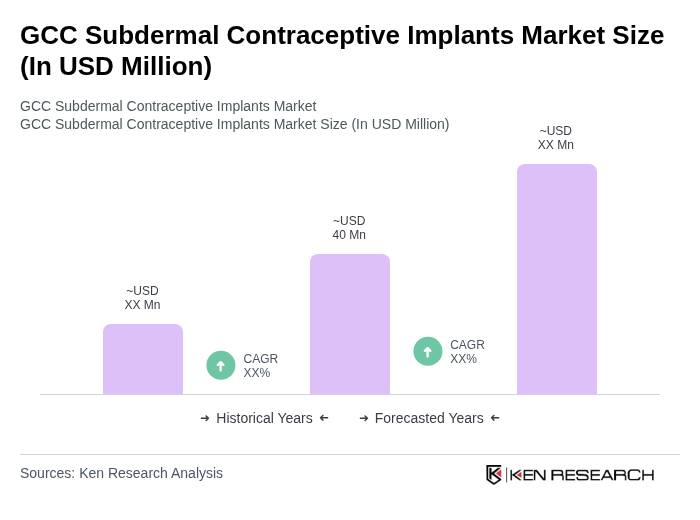
- The GCC Subdermal Contraceptive Implants Market is valued at USD 40 million, based on a five-year historical analysis and the GCC’s share within the global subdermal contraceptive implants market, which is estimated at about USD 0.96–1.21 billion globally. This growth is primarily driven by increasing awareness of family planning, expansion of long-acting reversible contraception (LARC) in national programs, rising female workforce participation, and the growing role of donor-supported and multilateral procurement initiatives that improve access to implants across the region.
- Key players in this market include Saudi Arabia and the UAE, which dominate due to their advanced healthcare infrastructure, high disposable incomes, large investments in women’s health, and strong government support for reproductive and maternal health services. These countries have established a robust network of public and private hospitals, primary care centers, and specialized women’s health and gynecology clinics that facilitate the distribution and accessibility of contraceptive implants through both routine care and targeted family planning initiatives.
- In Saudi Arabia, access to contraceptive methods, including long-acting reversible contraceptives such as implants, is integrated into primary healthcare and maternal and child health services under national policies guided by the Ministry of Health and aligned with the Health Sector Transformation Program and the system of governmental family planning services. While there is no single rule mandating implants in every facility, reproductive health and birth spacing services are operationalized through Ministry of Health standards and service packages that require public health facilities to provide counseling and access to modern contraceptive options, including implants where clinically appropriate.
GCC Subdermal Contraceptive Implants Market Segmentation
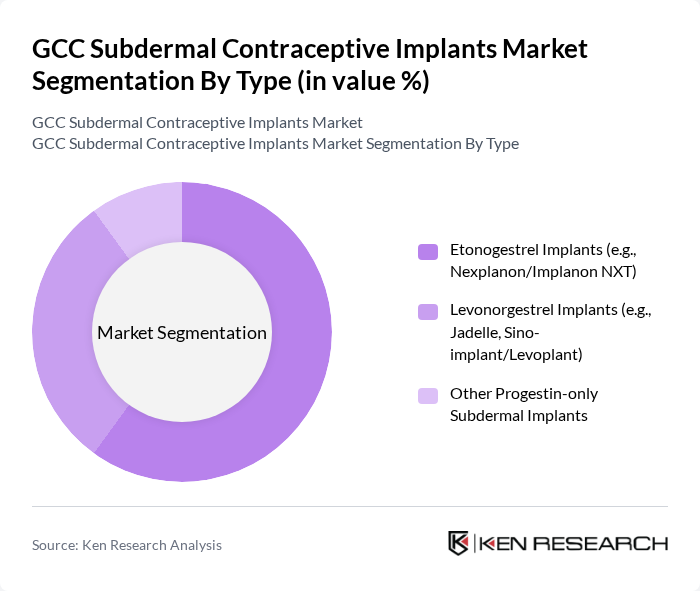
By Type:The market is segmented into three main types of subdermal contraceptive implants: Etonogestrel Implants (e.g., Nexplanon/Implanon NXT), Levonorgestrel Implants (e.g., Jadelle, Sino-implant/Levoplant), and Other Progestin-only Subdermal Implants. Etonogestrel implants are widely used globally and in GCC markets due to their high contraceptive efficacy, single-rod design, and long duration of action of up to three years, which simplifies insertion and removal and supports adoption in clinical practice. Levonorgestrel implants also represent a significant share, particularly in programs leveraging bulk procurement and donor-supported supply, given their effectiveness for up to five years and suitability for large-scale family planning initiatives in emerging markets. The growing acceptance of both etonogestrel and levonorgestrel implants in family planning programs, supported by international agencies and regional health authorities, has strengthened their position within the GCC subdermal contraceptive implants market.
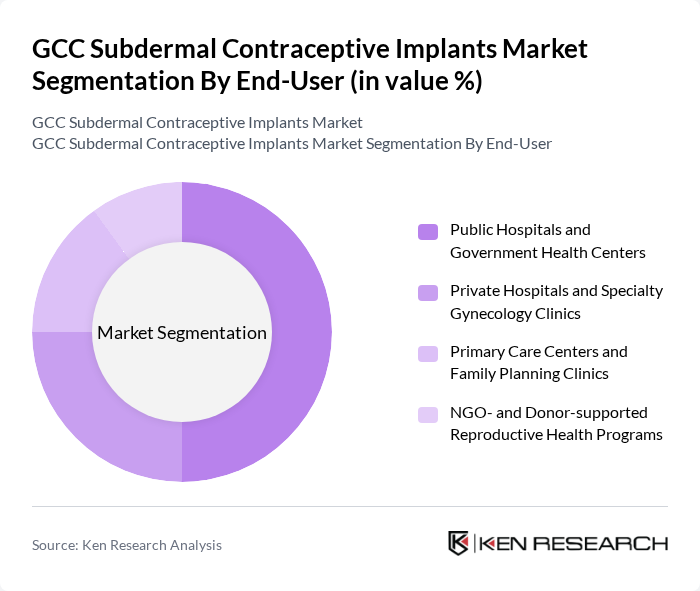
By End-User:The end-user segmentation includes Public Hospitals and Government Health Centers, Private Hospitals and Specialty Gynecology Clinics, Primary Care Centers and Family Planning Clinics, and NGO- and Donor-supported Reproductive Health Programs. Public hospitals and government health centers account for a substantial share of global implant provision, as hospitals retained about 45% of subdermal contraceptive implants revenue in recent global analyses, reflecting established procedural capacity, reimbursement coverage, and integration of implants into routine reproductive health and maternity pathways. Private hospitals and specialty gynecology clinics also play a key role in the GCC by serving insured and higher-income populations seeking specialist contraceptive counseling and LARC insertion. Primary care centers and family planning clinics, together with NGO- and donor-supported reproductive health programs and multilateral partners such as UNFPA and MSI, contribute to outreach, training, and community-based service delivery, particularly for underserved groups and migrant populations, thereby supporting the overall penetration of subdermal implants in the region.
GCC Subdermal Contraceptive Implants Market Competitive Landscape
The GCC Subdermal Contraceptive Implants Market is characterized by a dynamic mix of regional and international players. Leading participants such as Organon & Co. (Nexplanon/Implanon NXT), Bayer AG, Shanghai Dahua Pharmaceutical Co., Ltd. (Sino-implant/Levoplant), HRA Pharma (a Perrigo company), Gedeon Richter Plc, Mithra Pharmaceuticals, Exeltis, Merck & Co., Inc. (Regional Women’s Health Partnerships), Pfizer Inc. (Contraceptive Portfolio Partner), Ferring Pharmaceuticals, International Planned Parenthood Federation (IPPF) – Regional Supply & Programs, Marie Stopes International (MSI Reproductive Choices), United Nations Population Fund (UNFPA) – Procurement Partner, Gulf Drug LLC (UAE) – Regional Distributor, Tamer Group (Saudi Arabia) – Healthcare Distributor contribute to innovation, geographic expansion, and service delivery in this space.
GCC Subdermal Contraceptive Implants Market Industry Analysis
Growth Drivers
- Increasing Awareness of Family Planning:The GCC region has seen a significant rise in family planning awareness, with over 60% of women aged 15-49 now knowledgeable about contraceptive options. This increase is supported by government campaigns and educational programs, which have allocated approximately $200 million to enhance reproductive health education. As awareness grows, the demand for effective contraceptive methods, including subdermal implants, is expected to rise, driving market growth.
- Rising Demand for Long-Term Contraceptive Solutions:The demand for long-term contraceptive solutions is surging, with an estimated 30% increase in the use of subdermal implants in the GCC. This trend is driven by the desire for convenience and effectiveness, as implants can provide protection for up to three years. The growing preference for long-term solutions is further supported by healthcare providers emphasizing the benefits of implants over traditional methods.
- Government Initiatives Promoting Reproductive Health:GCC governments are projected to invest over $150 million in reproductive health initiatives, focusing on increasing access to contraceptive methods. These initiatives include subsidizing the cost of implants and enhancing healthcare infrastructure. Such government support is crucial in addressing barriers to access and ensuring that women can obtain subdermal contraceptive implants, thereby fostering market growth in the region.
Market Challenges
- Cultural Resistance to Contraceptive Methods:Cultural attitudes towards contraceptive methods in the GCC can pose significant challenges. Surveys indicate that approximately 40% of women still face societal stigma regarding contraceptive use. This resistance can hinder the adoption of subdermal implants, as many women may prioritize traditional family planning methods due to cultural beliefs, limiting market penetration and growth potential.
- Limited Access to Healthcare Facilities:Access to healthcare facilities remains a critical challenge in the GCC, particularly in rural areas. It is estimated that 25% of women live more than 30 kilometers from the nearest healthcare provider. This geographical barrier restricts access to subdermal contraceptive implants, as women may find it difficult to obtain necessary consultations and procedures, ultimately impacting market growth.
GCC Subdermal Contraceptive Implants Market Future Outlook
The future of the GCC subdermal contraceptive implants market appears promising, driven by increasing healthcare investments and a growing focus on women's health. As governments enhance healthcare infrastructure and promote reproductive health initiatives, access to contraceptive options is expected to improve. Additionally, the integration of digital health tools and telehealth services will facilitate better education and access to family planning resources, further supporting the adoption of subdermal implants in the region.
Market Opportunities
- Expansion of Healthcare Infrastructure:The ongoing expansion of healthcare infrastructure in the GCC is a significant opportunity for the subdermal contraceptive implants market. With over $1 billion allocated for healthcare facility upgrades, improved access to services will likely increase the availability of contraceptive options, including implants, thereby enhancing market growth potential.
- Increasing Partnerships with NGOs:Collaborations between governments and NGOs are creating new opportunities for the subdermal contraceptive implants market. Partnerships are expected to facilitate outreach programs that educate women about contraceptive options, with an estimated 500,000 women targeted for education and access initiatives. This collaborative approach can significantly boost market penetration and acceptance of implants.
Scope of the Report
| Segment | Sub-Segments |
|---|---|
| By Type | Etonogestrel Implants (e.g., Nexplanon/Implanon NXT) Levonorgestrel Implants (e.g., Jadelle, Sino-implant/Levoplant) Other Progestin-only Subdermal Implants |
| By End-User | Public Hospitals and Government Health Centers Private Hospitals and Specialty Gynecology Clinics Primary Care Centers and Family Planning Clinics NGO- and Donor-supported Reproductive Health Programs |
| By Distribution Channel | Government Procurement & Tender-based Supply Private Hospital & Clinic Procurement Retail and Hospital Pharmacies Online and Telehealth-enabled Channels |
| By Region | Saudi Arabia UAE Qatar Kuwait Oman Bahrain |
| By Age Group | –24 Years –34 Years –44 Years Years and Above |
| By Income Level | Low Income Middle Income High Income Others |
| By Awareness Level | High Awareness Moderate Awareness Low Awareness Others |
Key Target Audience
Investors and Venture Capitalist Firms
Government and Regulatory Bodies (e.g., Ministry of Health, Food and Drug Authority)
Manufacturers and Producers
Distributors and Retailers
Healthcare Providers and Clinics
Pharmaceutical Supply Chain Companies
Non-Governmental Organizations (NGOs) focused on reproductive health
Health Insurance Companies
Players Mentioned in the Report:
Organon & Co. (Nexplanon/Implanon NXT)
Bayer AG
Shanghai Dahua Pharmaceutical Co., Ltd. (Sino-implant/Levoplant)
HRA Pharma (a Perrigo company)
Gedeon Richter Plc
Mithra Pharmaceuticals
Exeltis
Merck & Co., Inc. (Regional Womens Health Partnerships)
Pfizer Inc. (Contraceptive Portfolio Partner)
Ferring Pharmaceuticals
International Planned Parenthood Federation (IPPF) Regional Supply & Programs
Marie Stopes International (MSI Reproductive Choices)
United Nations Population Fund (UNFPA) Procurement Partner
Gulf Drug LLC (UAE) Regional Distributor
Tamer Group (Saudi Arabia) Healthcare Distributor
Table of Contents
Market Assessment Phase
1. Executive Summary and Approach
2. GCC Subdermal Contraceptive Implants Market Overview
2.1 Key Insights and Strategic Recommendations
2.2 GCC Subdermal Contraceptive Implants Market Overview
2.3 Definition and Scope
2.4 Evolution of Market Ecosystem
2.5 Timeline of Key Regulatory Milestones
2.6 Value Chain & Stakeholder Mapping
2.7 Business Cycle Analysis
2.8 Policy & Incentive Landscape
3. GCC Subdermal Contraceptive Implants Market Analysis
3.1 Growth Drivers
3.1.1 Increasing awareness of family planning
3.1.2 Rising demand for long-term contraceptive solutions
3.1.3 Government initiatives promoting reproductive health
3.1.4 Technological advancements in implant design
3.2 Market Challenges
3.2.1 Cultural resistance to contraceptive methods
3.2.2 Limited access to healthcare facilities
3.2.3 High costs associated with implants
3.2.4 Regulatory hurdles in product approval
3.3 Market Opportunities
3.3.1 Expansion of healthcare infrastructure
3.3.2 Increasing partnerships with NGOs
3.3.3 Development of new implant technologies
3.3.4 Growing acceptance of women's health initiatives
3.4 Market Trends
3.4.1 Shift towards personalized contraceptive solutions
3.4.2 Rise in telehealth services for family planning
3.4.3 Increased focus on sustainable healthcare practices
3.4.4 Integration of digital health tools in contraceptive care
3.5 Government Regulation
3.5.1 Approval processes for new contraceptive products
3.5.2 Guidelines for healthcare provider training
3.5.3 Policies supporting reproductive health funding
3.5.4 Regulations on advertising contraceptive methods
4. SWOT Analysis
5. Stakeholder Analysis
6. Porter's Five Forces Analysis
7. GCC Subdermal Contraceptive Implants Market Market Size, 2019-2024
7.1 By Value
7.2 By Volume
7.3 By Average Selling Price
8. GCC Subdermal Contraceptive Implants Market Segmentation
8.1 By Type
8.1.1 Etonogestrel Implants (e.g., Nexplanon/Implanon NXT)
8.1.2 Levonorgestrel Implants (e.g., Jadelle, Sino-implant/Levoplant)
8.1.3 Other Progestin-only Subdermal Implants
8.2 By End-User
8.2.1 Public Hospitals and Government Health Centers
8.2.2 Private Hospitals and Specialty Gynecology Clinics
8.2.3 Primary Care Centers and Family Planning Clinics
8.2.4 NGO- and Donor-supported Reproductive Health Programs
8.3 By Distribution Channel
8.3.1 Government Procurement & Tender-based Supply
8.3.2 Private Hospital & Clinic Procurement
8.3.3 Retail and Hospital Pharmacies
8.3.4 Online and Telehealth-enabled Channels
8.4 By Region
8.4.1 Saudi Arabia
8.4.2 UAE
8.4.3 Qatar
8.4.4 Kuwait
8.4.5 Oman
8.4.6 Bahrain
8.5 By Age Group
8.5.1 15–24 Years
8.5.2 25–34 Years
8.5.3 35–44 Years
8.5.4 45 Years and Above
8.6 By Income Level
8.6.1 Low Income
8.6.2 Middle Income
8.6.3 High Income
8.6.4 Others
8.7 By Awareness Level
8.7.1 High Awareness
8.7.2 Moderate Awareness
8.7.3 Low Awareness
8.7.4 Others
9. GCC Subdermal Contraceptive Implants Market Competitive Analysis
9.1 Market Share of Key Players
9.2 Cross Comparison of Key Players
9.2.1 Company Name
9.2.2 Group Size (Global, Regional, or Local Manufacturer)
9.2.3 GCC Subdermal Implant Revenue and 5-year CAGR
9.2.4 GCC Market Share in Subdermal Implants
9.2.5 Number of GCC Countries with Active Registration
9.2.6 Average Selling Price Positioning (Value, Mid, Premium)
9.2.7 Subdermal Implant Portfolio Breadth (Brands/SKUs)
9.2.8 Tender Wins and Government Contract Coverage
9.2.9 Distribution Network Depth (Hospitals/Clinics Reached)
9.2.10 Pharmacovigilance and Safety Profile (Reported AEs per 1,000 Inserts)
9.2.11 Brand Awareness Among Gynecologists (Survey-based Score)
9.2.12 Training & Support Programs for Providers (Number of Programs per Year)
9.3 SWOT Analysis of Top Players
9.4 Pricing Analysis
9.5 Detailed Profile of Major Companies
9.5.1 Organon & Co. (Nexplanon/Implanon NXT)
9.5.2 Bayer AG
9.5.3 Shanghai Dahua Pharmaceutical Co., Ltd. (Sino-implant/Levoplant)
9.5.4 HRA Pharma (a Perrigo company)
9.5.5 Gedeon Richter Plc
9.5.6 Mithra Pharmaceuticals
9.5.7 Exeltis
9.5.8 Merck & Co., Inc. (Regional Women’s Health Partnerships)
9.5.9 Pfizer Inc. (Contraceptive Portfolio Partner)
9.5.10 Ferring Pharmaceuticals
9.5.11 International Planned Parenthood Federation (IPPF) – Regional Supply & Programs
9.5.12 Marie Stopes International (MSI Reproductive Choices)
9.5.13 United Nations Population Fund (UNFPA) – Procurement Partner
9.5.14 Gulf Drug LLC (UAE) – Regional Distributor
9.5.15 Tamer Group (Saudi Arabia) – Healthcare Distributor
10. GCC Subdermal Contraceptive Implants Market End-User Analysis
10.1 Procurement Behavior of Key Ministries
10.1.1 Budget Allocation for Family Planning
10.1.2 Decision-Making Processes
10.1.3 Supplier Selection Criteria
10.1.4 Contract Management Practices
10.2 Corporate Spend on Infrastructure & Energy
10.2.1 Investment in Healthcare Facilities
10.2.2 Funding for Reproductive Health Programs
10.2.3 Partnerships with NGOs
10.2.4 Others
10.3 Pain Point Analysis by End-User Category
10.3.1 Accessibility Issues
10.3.2 Affordability Concerns
10.3.3 Cultural Barriers
10.3.4 Others
10.4 User Readiness for Adoption
10.4.1 Awareness Levels
10.4.2 Training Needs for Healthcare Providers
10.4.3 Support Systems for Users
10.4.4 Others
10.5 Post-Deployment ROI and Use Case Expansion
10.5.1 Measurement of Effectiveness
10.5.2 User Feedback Mechanisms
10.5.3 Opportunities for Product Expansion
10.5.4 Others
11. GCC Subdermal Contraceptive Implants Market Future Size, 2025-2030
11.1 By Value
11.2 By Volume
11.3 By Average Selling Price
Go-To-Market Strategy Phase
1. Whitespace Analysis + Business Model Canvas
1.1 Market Gaps Identification
1.2 Value Proposition Development
1.3 Revenue Model Structuring
1.4 Key Partnerships Identification
1.5 Customer Segmentation Analysis
1.6 Competitive Landscape Overview
1.7 Risk Assessment
2. Marketing and Positioning Recommendations
2.1 Branding Strategies
2.2 Product USPs
2.3 Target Audience Identification
2.4 Communication Strategy
2.5 Digital Marketing Approach
2.6 Offline Marketing Tactics
2.7 Performance Metrics
3. Distribution Plan
3.1 Urban Retail Strategies
3.2 Rural NGO Tie-ups
3.3 Online Distribution Channels
3.4 Partnerships with Healthcare Providers
3.5 Logistics and Supply Chain Management
3.6 Distribution Performance Metrics
4. Channel & Pricing Gaps
4.1 Underserved Routes
4.2 Pricing Bands Analysis
4.3 Competitor Pricing Strategies
4.4 Customer Willingness to Pay
4.5 Price Sensitivity Analysis
4.6 Pricing Performance Metrics
5. Unmet Demand & Latent Needs
5.1 Category Gaps Identification
5.2 Consumer Segments Analysis
5.3 Product Development Opportunities
5.4 Market Entry Strategies
5.5 Customer Feedback Mechanisms
5.6 Demand Forecasting
6. Customer Relationship
6.1 Loyalty Programs
6.2 After-sales Service
6.3 Customer Engagement Strategies
6.4 Feedback and Improvement Processes
6.5 Customer Retention Strategies
6.6 Performance Metrics
7. Value Proposition
7.1 Sustainability Initiatives
7.2 Integrated Supply Chains
7.3 Customer-Centric Innovations
7.4 Competitive Differentiation
7.5 Value Communication Strategies
7.6 Performance Metrics
8. Key Activities
8.1 Regulatory Compliance
8.2 Branding Initiatives
8.3 Distribution Setup
8.4 Training and Development
8.5 Performance Monitoring
8.6 Risk Management
9. Entry Strategy Evaluation
9.1 Domestic Market Entry Strategy
9.1.1 Product Mix
9.1.2 Pricing Band
9.1.3 Packaging
9.2 Export Entry Strategy
9.2.1 Target Countries
9.2.2 Compliance Roadmap
10. Entry Mode Assessment
10.1 Joint Ventures
10.2 Greenfield Investments
10.3 Mergers & Acquisitions
10.4 Distributor Model
10.5 Risk Assessment
11. Capital and Timeline Estimation
11.1 Capital Requirements
11.2 Timelines
11.3 Funding Sources
11.4 Financial Projections
12. Control vs Risk Trade-Off
12.1 Ownership vs Partnerships
12.2 Risk Mitigation Strategies
12.3 Performance Metrics
13. Profitability Outlook
13.1 Breakeven Analysis
13.2 Long-term Sustainability
13.3 Financial Health Indicators
14. Potential Partner List
14.1 Distributors
14.2 Joint Ventures
14.3 Acquisition Targets
15. Execution Roadmap
15.1 Phased Plan for Market Entry
15.1.1 Market Setup
15.1.2 Market Entry
15.1.3 Growth Acceleration
15.1.4 Scale & Stabilize
15.2 Key Activities and Milestones
15.2.1 Activity Planning
15.2.2 Milestone Tracking
Research Methodology
Phase 1: Approach1
Desk Research
- Analysis of market reports from health organizations and NGOs focused on reproductive health
- Review of demographic and health surveys from GCC countries to understand contraceptive usage
- Examination of regulatory frameworks and policies related to contraceptive implants in the GCC region
Primary Research
- Interviews with healthcare professionals, including gynecologists and family planning counselors
- Surveys conducted with women of reproductive age to gauge awareness and acceptance of subdermal contraceptive implants
- Focus group discussions with community health workers to understand local perceptions and barriers
Validation & Triangulation
- Cross-validation of findings through multiple data sources, including government health statistics and NGO reports
- Triangulation of qualitative insights from interviews with quantitative data from surveys
- Sanity checks through expert panel reviews involving reproductive health specialists
Phase 2: Market Size Estimation1
Top-down Assessment
- Estimation of the total addressable market based on population demographics and contraceptive prevalence rates
- Analysis of healthcare expenditure trends in the GCC region related to family planning services
- Incorporation of government initiatives promoting reproductive health and family planning
Bottom-up Modeling
- Collection of sales data from manufacturers and distributors of subdermal contraceptive implants
- Estimation of market penetration rates based on healthcare provider adoption and patient uptake
- Volume x price analysis to determine revenue potential across different GCC countries
Forecasting & Scenario Analysis
- Multi-factor regression analysis incorporating socio-economic factors, cultural attitudes, and healthcare access
- Scenario modeling based on potential changes in healthcare policies and contraceptive technology advancements
- Baseline, optimistic, and pessimistic projections for market growth through 2030
Phase 3: CATI Sample Composition1
| Scope Item/Segment | Sample Size | Target Respondent Profiles |
|---|---|---|
| Healthcare Providers | 120 | Gynecologists, Family Planning Specialists |
| Women of Reproductive Age | 150 | Women aged 18-45, Diverse Socio-economic Backgrounds |
| Community Health Workers | 90 | Health Educators, Outreach Coordinators |
| Pharmaceutical Distributors | 60 | Sales Managers, Product Managers |
| Policy Makers | 40 | Health Ministry Officials, Regulatory Authorities |
Frequently Asked Questions
What is the current value of the GCC Subdermal Contraceptive Implants Market?
The GCC Subdermal Contraceptive Implants Market is valued at approximately USD 40 million, reflecting its share within the global market, which is estimated to be between USD 0.96 billion and USD 1.21 billion.
What factors are driving the growth of the GCC Subdermal Contraceptive Implants Market?
Which countries are the key players in the GCC Subdermal Contraceptive Implants Market?
What types of subdermal contraceptive implants are available in the GCC market?
Other Regional/Country Reports
Indonesia Subdermal Contraceptive Implants Market
Malaysia Subdermal Contraceptive Implants Market
APAC Subdermal Contraceptive Implants Market
Other Adjacent Reports
Bahrain Contraceptive Devices Market
Kuwait Women\s Health Pharmaceuticals Market
Egypt Reproductive Health Services Market
South Korea Family Planning Programs Market
Brazil Hormonal Contraceptives Market
Oman Long-Acting Reversible Contraceptives Market
Philippines Gynecology Clinics Market
Malaysia Maternal Health Products Market
Philippines Birth Control Technologies Market
KSA Healthcare Distribution Services Market
Why Buy From Us?

What makes us stand out is that our consultants follow Robust, Refine and Result (RRR) methodology. Robust for clear definitions, approaches and sanity checking, Refine for differentiating respondents' facts and opinions, and Result for presenting data with story.

We have set a benchmark in the industry by offering our clients with syndicated and customized market research reports featuring coverage of entire market as well as meticulous research and analyst insights.

While we don't replace traditional research, we flip the method upside down. Our dual approach of Top Bottom & Bottom Top ensures quality deliverable by not just verifying company fundamentals but also looking at the sector and macroeconomic factors.

With one step in the future, our research team constantly tries to show you the bigger picture. We help with some of the tough questions you may encounter along the way: How is the industry positioned? Best marketing channel? KPI's of competitors? By aligning every element, we help maximize success.

Our report gives you instant access to the answers and sources that other companies might choose to hide. We elaborate each steps of research methodology we have used and showcase you the sample size to earn your trust.

If you need any support, we are here! We pride ourselves on universe strength, data quality, and quick, friendly, and professional service.