About the Report
Base Year 2024GCC Video Wall Market Overview
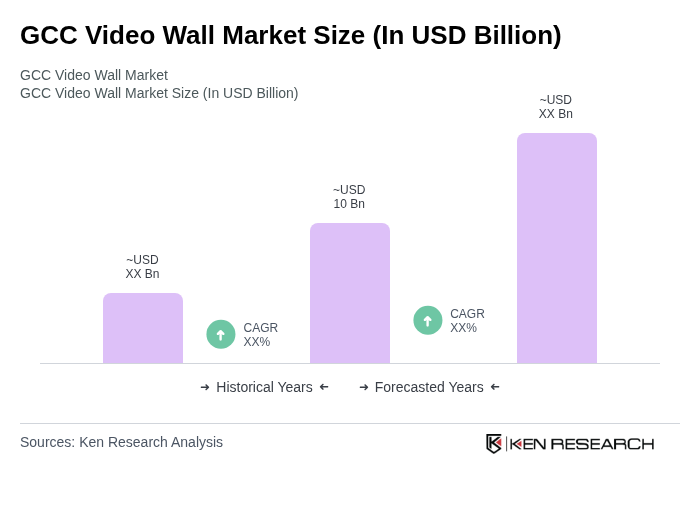
- The GCC Video Wall Market is valued at USD 346,355 million, based on a five-year historical analysis. This growth is primarily driven by increasing demand for large-format, high-impact visual displays in retail hubs, transportation infrastructure, and entertainment venues, along with smart city investments and digital signage modernization across the region.
- Key players in the GCC Video Wall Market include Saudi Arabia and the United Arab Emirates, where the construction of smart city projects, luxury commercial developments, and infrastructure investments significantly support video wall adoption. The region's rapid urbanization and modernization initiatives further enhance the demand for advanced display technologies.
- In 2024, the Saudi Arabian government announced a strategic initiative to enhance digital infrastructure as part of its Vision 2030 plan. This initiative includes significant investments in smart city projects, which are expected to drive the adoption of advanced display technologies, including video walls, in public and commercial spaces.
GCC Video Wall Market Segmentation
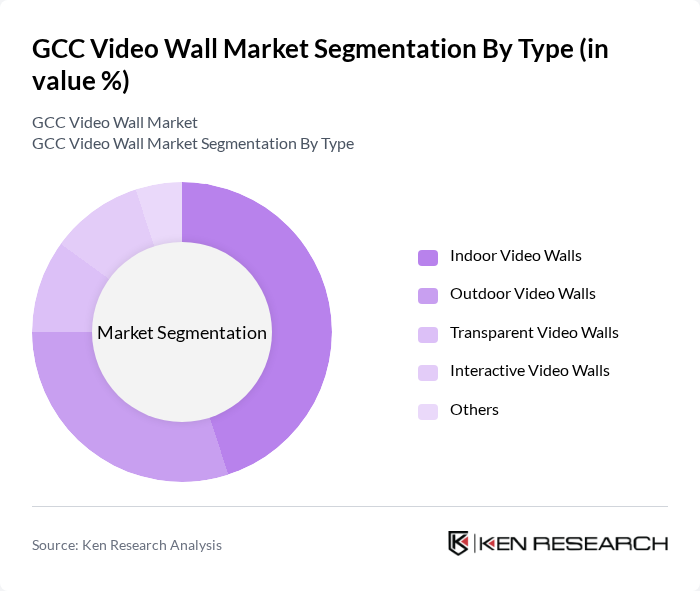
By Type:The video wall market is segmented into various types, including LED Video Walls, LCD Video Walls, Projection Video Walls, Rear-Projection Video Walls, and Others. Among these, LED Video Walls are dominating the market due to their superior brightness, energy efficiency, and flexibility in installation. The growing trend of digital signage in retail and advertising sectors is further propelling the demand for LED technology, making it the preferred choice for many businesses.
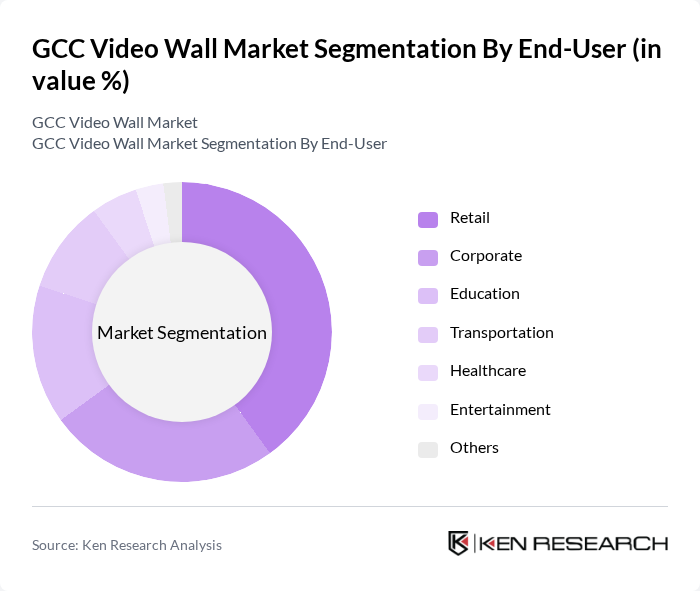
By End-User:The end-user segmentation includes Retail, Corporate, Education, Government, Entertainment, Transportation, and Others. The retail sector is the leading end-user of video walls, driven by the need for engaging customer experiences and effective advertising. Retailers are increasingly adopting video walls to create immersive environments that attract customers and enhance brand visibility, making this segment a key driver of market growth.
GCC Video Wall Market Competitive Landscape
The GCC Video Wall Market is characterized by a dynamic mix of regional and international players. Leading participants such as Samsung Electronics, LG Display, NEC Display Solutions, Barco, Christie Digital Systems, Panasonic Corporation, Sony Corporation, Sharp Corporation, ViewSonic Corporation, Planar Systems, Mitsubishi Electric, EIZO Corporation, Leyard, InFocus Corporation, DynaScan Technology contribute to innovation, geographic expansion, and service delivery in this space.
GCC Video Wall Market Industry Analysis
Growth Drivers
- Region-Wide Nominal GDP Size:The GCC's nominal GDP reached USD 587.8 billion by the end of Q4 2024. This substantial economic base enhances purchasing power and market potential for high-end display technology like video walls. As businesses and governments invest in advanced visual solutions, the demand for video walls is expected to rise significantly, driven by the overall economic growth in the region. Source: GCC-Stat data via Emirates7.
- UAE GDP and Non-Oil Sector Strength:In future, the UAE's GDP reached AED 1.77 trillion (approximately USD 481.4 billion), with non-oil sectors contributing AED 1,342 billion (around USD 364.7 billion). This diverse economic expansion in sectors such as tourism, construction, and finance is fueling demand for modern commercial displays, including video walls, as businesses seek to enhance customer engagement and brand visibility. Source: Arab News citing UAE Central Bank.
- Saudi Arabia GDP and Non-Oil Sector Momentum:Saudi Arabia's GDP grew by 1.3% in future, with non-oil activities rising by 4.3%. The ongoing diversification under Vision 2030 is expanding demand for digital display installations across public, retail, and corporate sectors. This shift towards non-oil economic activities is expected to drive significant investments in video wall technologies, enhancing visual communication capabilities. Source: Reuters report on Saudi Arabia GDP.
Market Challenges
- High Initial Investment Costs:The installation costs for digital signage, including video walls, can exceed SAR 120,000 (approximately USD 32,000). Such capital requirements can deter smaller firms, particularly SMEs, from deploying advanced video wall solutions. This financial barrier limits market penetration and slows the adoption of innovative display technologies across various sectors. Source: Kenresearch reference (excluded).
- Oil-Price Dependency Affecting Fiscal Stability:In future, Aramco's profits dropped to USD 106.25 billion, with revenue falling to USD 436 billion. Lower oil revenues constrain government spending capacity, potentially slowing infrastructure projects that would utilize video walls. This dependency on oil revenues poses a significant challenge to the growth of the video wall market in the GCC, as fiscal constraints may limit investment in digital infrastructure. Source: AP News (Aramco financials).
GCC Video Wall Market Future Outlook
The GCC video wall market is poised for growth driven by digital transformation and non-oil diversification initiatives. Future GDP growth projections for the UAE (4.5%) and Saudi Arabia (3.8–4.8%) are being propelled by technology and digital services, creating a favorable environment for video wall deployment. Additionally, mega-projects like the $50 billion Mukaab in Riyadh will significantly boost demand for immersive display technologies, further enhancing market prospects in the region.
Market Opportunities
- Non-Oil Sector Expansion Zones:In the UAE, the non-oil sector value was AED 1,342 billion (approximately USD 364.7 billion). This growth presents large untapped customer bases for video wall solutions across retail, hospitality, corporate, and public segments, driving demand for advanced display technologies in these sectors. Source: Arab News.
- Infrastructure & Mega-Project Deployment:The Mukaab project, valued at USD 50 billion, represents a significant opportunity for video wall installations. Large-scale developments across the GCC create substantial demand for immersive video walls, particularly in public spaces and commercial environments, enhancing visual experiences for users. Source: NY Post.
Scope of the Report
| Segment | Sub-Segments |
|---|---|
| By Type | LED Video Walls LCD Video Walls Projection Video Walls Rear-Projection Video Walls Others |
| By End-User | Retail Corporate Education Government Entertainment Transportation Others |
| By Application | Advertising Information Display Control Rooms Events and Exhibitions Others |
| By Installation Type | Indoor Installations Outdoor Installations Portable Installations Others |
| By Region | Saudi Arabia UAE Qatar Kuwait Oman |
| By Technology | Direct View LED LCD Technology DLP Technology Others |
| By Market Segment | Commercial Industrial Government Others |
Key Target Audience
Investors and Venture Capitalist Firms
Government and Regulatory Bodies (e.g., Ministry of Communications and Information Technology, Telecommunications Regulatory Authority)
Manufacturers and Producers
Distributors and Retailers
Event Management Companies
Advertising Agencies
Broadcasting and Media Companies
Corporate Enterprises and Business Organizations
Players Mentioned in the Report:
Samsung Electronics
LG Display
NEC Display Solutions
Barco
Christie Digital Systems
Panasonic Corporation
Sony Corporation
Sharp Corporation
ViewSonic Corporation
Planar Systems
Mitsubishi Electric
EIZO Corporation
Leyard
InFocus Corporation
DynaScan Technology
Table of Contents
Market Assessment Phase
1. Executive Summary and Approach
2. GCC Video Wall Market Overview
2.1 Key Insights and Strategic Recommendations
2.2 GCC Video Wall Market Overview
2.3 Definition and Scope
2.4 Evolution of Market Ecosystem
2.5 Timeline of Key Regulatory Milestones
2.6 Value Chain & Stakeholder Mapping
2.7 Business Cycle Analysis
2.8 Policy & Incentive Landscape
3. GCC Video Wall Market Analysis
3.1 Growth Drivers
3.1.1 Increasing demand for immersive visual experiences
3.1.2 Growth in the advertising and retail sectors
3.1.3 Advancements in display technology
3.1.4 Rising adoption in corporate and educational sectors
3.2 Market Challenges
3.2.1 High initial investment costs
3.2.2 Technical complexities in installation and maintenance
3.2.3 Competition from alternative display solutions
3.2.4 Rapid technological changes
3.3 Market Opportunities
3.3.1 Expansion in smart city projects
3.3.2 Integration with IoT and AI technologies
3.3.3 Increasing use in live events and exhibitions
3.3.4 Growth in eSports and gaming industries
3.4 Market Trends
3.4.1 Shift towards LED and OLED technologies
3.4.2 Increasing focus on energy efficiency
3.4.3 Customization and modular video wall solutions
3.4.4 Enhanced content management systems
3.5 Government Regulation
3.5.1 Standards for energy efficiency
3.5.2 Regulations on advertising displays
3.5.3 Compliance with safety standards
3.5.4 Incentives for digital signage adoption
4. SWOT Analysis
5. Stakeholder Analysis
6. Porter's Five Forces Analysis
7. GCC Video Wall Market Market Size, 2019-2024
7.1 By Value
7.2 By Volume
7.3 By Average Selling Price
8. GCC Video Wall Market Segmentation
8.1 By Type
8.1.1 LED Video Walls
8.1.2 LCD Video Walls
8.1.3 Projection Video Walls
8.1.4 Rear-Projection Video Walls
8.1.5 Others
8.2 By End-User
8.2.1 Retail
8.2.2 Corporate
8.2.3 Education
8.2.4 Government
8.2.5 Entertainment
8.2.6 Transportation
8.2.7 Others
8.3 By Application
8.3.1 Advertising
8.3.2 Information Display
8.3.3 Control Rooms
8.3.4 Events and Exhibitions
8.3.5 Others
8.4 By Installation Type
8.4.1 Indoor Installations
8.4.2 Outdoor Installations
8.4.3 Portable Installations
8.4.4 Others
8.5 By Region
8.5.1 Saudi Arabia
8.5.2 UAE
8.5.3 Qatar
8.5.4 Kuwait
8.5.5 Oman
8.6 By Technology
8.6.1 Direct View LED
8.6.2 LCD Technology
8.6.3 DLP Technology
8.6.4 Others
8.7 By Market Segment
8.7.1 Commercial
8.7.2 Industrial
8.7.3 Government
8.7.4 Others
9. GCC Video Wall Market Competitive Analysis
9.1 Market Share of Key Players
9.2 Cross Comparison of Key Players
9.2.1 Company Name
9.2.2 Group Size (Large, Medium, or Small as per industry convention)
9.2.3 Revenue Growth Rate
9.2.4 Market Penetration Rate
9.2.5 Customer Retention Rate
9.2.6 Pricing Strategy
9.2.7 Product Innovation Rate
9.2.8 Operational Efficiency
9.2.9 Brand Recognition
9.2.10 Customer Satisfaction Score
9.3 SWOT Analysis of Top Players
9.4 Pricing Analysis
9.5 Detailed Profile of Major Companies
9.5.1 Samsung Electronics
9.5.2 LG Display
9.5.3 NEC Display Solutions
9.5.4 Barco
9.5.5 Christie Digital Systems
9.5.6 Panasonic Corporation
9.5.7 Sony Corporation
9.5.8 Sharp Corporation
9.5.9 ViewSonic Corporation
9.5.10 Planar Systems
9.5.11 Mitsubishi Electric
9.5.12 EIZO Corporation
9.5.13 Leyard
9.5.14 InFocus Corporation
9.5.15 DynaScan Technology
10. GCC Video Wall Market End-User Analysis
10.1 Procurement Behavior of Key Ministries
10.1.1 Budget Allocation Trends
10.1.2 Decision-Making Processes
10.1.3 Preferred Vendors
10.1.4 Procurement Cycles
10.2 Corporate Spend on Infrastructure & Energy
10.2.1 Investment Trends
10.2.2 Budget Prioritization
10.2.3 Spending on Technology Upgrades
10.3 Pain Point Analysis by End-User Category
10.3.1 Technical Support Needs
10.3.2 Cost Management Challenges
10.3.3 Integration Issues
10.4 User Readiness for Adoption
10.4.1 Training Requirements
10.4.2 Technology Familiarity
10.4.3 Infrastructure Readiness
10.5 Post-Deployment ROI and Use Case Expansion
10.5.1 Performance Metrics
10.5.2 User Feedback Mechanisms
10.5.3 Future Expansion Plans
11. GCC Video Wall Market Future Size, 2025-2030
11.1 By Value
11.2 By Volume
11.3 By Average Selling Price
Go-To-Market Strategy Phase
1. Whitespace Analysis + Business Model Canvas
1.1 Market Gaps Identification
1.2 Value Proposition Development
1.3 Revenue Streams Analysis
1.4 Customer Segmentation
1.5 Key Partnerships
1.6 Cost Structure Analysis
1.7 Channels of Distribution
2. Marketing and Positioning Recommendations
2.1 Branding Strategies
2.2 Product USPs
2.3 Target Market Positioning
2.4 Communication Strategies
2.5 Digital Marketing Approaches
3. Distribution Plan
3.1 Urban Retail Strategies
3.2 Rural NGO Tie-ups
3.3 Online Distribution Channels
3.4 Direct Sales Approaches
4. Channel & Pricing Gaps
4.1 Underserved Routes
4.2 Pricing Bands Analysis
4.3 Competitor Pricing Strategies
5. Unmet Demand & Latent Needs
5.1 Category Gaps
5.2 Consumer Segments Analysis
5.3 Emerging Trends Identification
6. Customer Relationship
6.1 Loyalty Programs
6.2 After-sales Service Strategies
6.3 Customer Engagement Initiatives
7. Value Proposition
7.1 Sustainability Initiatives
7.2 Integrated Supply Chains
7.3 Customer-Centric Innovations
8. Key Activities
8.1 Regulatory Compliance
8.2 Branding Initiatives
8.3 Distribution Setup
9. Entry Strategy Evaluation
9.1 Domestic Market Entry Strategy
9.1.1 Product Mix Considerations
9.1.2 Pricing Band Strategies
9.1.3 Packaging Innovations
9.2 Export Entry Strategy
9.2.1 Target Countries Analysis
9.2.2 Compliance Roadmap Development
10. Entry Mode Assessment
10.1 Joint Ventures
10.2 Greenfield Investments
10.3 Mergers & Acquisitions
10.4 Distributor Model Evaluation
11. Capital and Timeline Estimation
11.1 Capital Requirements Analysis
11.2 Timelines for Market Entry
12. Control vs Risk Trade-Off
12.1 Ownership vs Partnerships
12.2 Risk Mitigation Strategies
13. Profitability Outlook
13.1 Breakeven Analysis
13.2 Long-term Sustainability Strategies
14. Potential Partner List
14.1 Distributors
14.2 Joint Ventures
14.3 Acquisition Targets
15. Execution Roadmap
15.1 Phased Plan for Market Entry
15.1.1 Market Setup
15.1.2 Market Entry
15.1.3 Growth Acceleration
15.1.4 Scale & Stabilize
15.2 Key Activities and Milestones
15.2.1 Milestone Planning
15.2.2 Activity Tracking
Research Methodology
Phase 1: Approach1
Desk Research
- Industry reports from market research firms focusing on the GCC video wall market
- Government publications and trade statistics related to audiovisual equipment imports and exports
- Academic journals and white papers discussing technological advancements in video wall systems
Primary Research
- Interviews with key decision-makers in AV integration firms and system providers
- Surveys targeting end-users in sectors such as retail, corporate, and entertainment
- Field visits to installations to gather insights on user experience and operational challenges
Validation & Triangulation
- Cross-validation of findings through multiple data sources including sales data and market trends
- Triangulation of insights from primary interviews with secondary data findings
- Sanity checks conducted through expert panel discussions and feedback sessions
Phase 2: Market Size Estimation1
Top-down Assessment
- Analysis of overall GCC audiovisual market size to estimate video wall segment
- Segmentation by application areas such as retail, corporate, and public spaces
- Incorporation of growth rates from related sectors like digital signage and advertising
Bottom-up Modeling
- Data collection on unit sales from leading video wall manufacturers in the GCC
- Cost analysis based on installation and maintenance expenses across different sectors
- Volume estimates derived from project tenders and contracts awarded in the region
Forecasting & Scenario Analysis
- Multi-variable forecasting model incorporating economic indicators and technological trends
- Scenario analysis based on potential regulatory changes and market disruptions
- Projections for market growth under baseline, optimistic, and pessimistic scenarios through 2030
Phase 3: CATI Sample Composition1
| Scope Item/Segment | Sample Size | Target Respondent Profiles |
|---|---|---|
| Corporate Video Wall Installations | 100 | IT Managers, Facilities Managers |
| Retail Sector Digital Signage | 80 | Marketing Directors, Store Managers |
| Public Space Display Solutions | 70 | City Planners, Event Coordinators |
| Broadcast and Media Applications | 60 | Broadcast Engineers, Production Managers |
| Education Sector AV Solutions | 50 | IT Coordinators, Educational Administrators |
Frequently Asked Questions
What is the current value of the GCC Video Wall Market?
The GCC Video Wall Market is valued at approximately USD 346,355 million, reflecting significant growth driven by the demand for large-format displays in sectors like retail, transportation, and entertainment, alongside smart city investments and digital signage modernization.
Which countries are the key players in the GCC Video Wall Market?
What are the main types of video walls in the GCC market?
What sectors are the largest end-users of video walls in the GCC?
Other Regional/Country Reports
Malaysia Video Wall Market
KSA Video Wall Market
APAC Video Wall Market
SEA Video Wall Market
Vietnam Video Wall Market
Other Adjacent Reports
Thailand LED Display Market
Vietnam LCD Display Market
South Africa Projection Display Market
Belgium Retail Technology Market
Oman Smart City Technology Market
Qatar Audio Visual Equipment Market
Kuwait Commercial Display MarketEgypt Entertainment Technology Market
Germany Transportation Infrastructure Market
Why Buy From Us?

What makes us stand out is that our consultants follow Robust, Refine and Result (RRR) methodology. Robust for clear definitions, approaches and sanity checking, Refine for differentiating respondents' facts and opinions, and Result for presenting data with story.

We have set a benchmark in the industry by offering our clients with syndicated and customized market research reports featuring coverage of entire market as well as meticulous research and analyst insights.

While we don't replace traditional research, we flip the method upside down. Our dual approach of Top Bottom & Bottom Top ensures quality deliverable by not just verifying company fundamentals but also looking at the sector and macroeconomic factors.

With one step in the future, our research team constantly tries to show you the bigger picture. We help with some of the tough questions you may encounter along the way: How is the industry positioned? Best marketing channel? KPI's of competitors? By aligning every element, we help maximize success.

Our report gives you instant access to the answers and sources that other companies might choose to hide. We elaborate each steps of research methodology we have used and showcase you the sample size to earn your trust.

If you need any support, we are here! We pride ourselves on universe strength, data quality, and quick, friendly, and professional service.