About the Report
Base Year 2024Germany Digital Travel and OTA Growth Market Overview
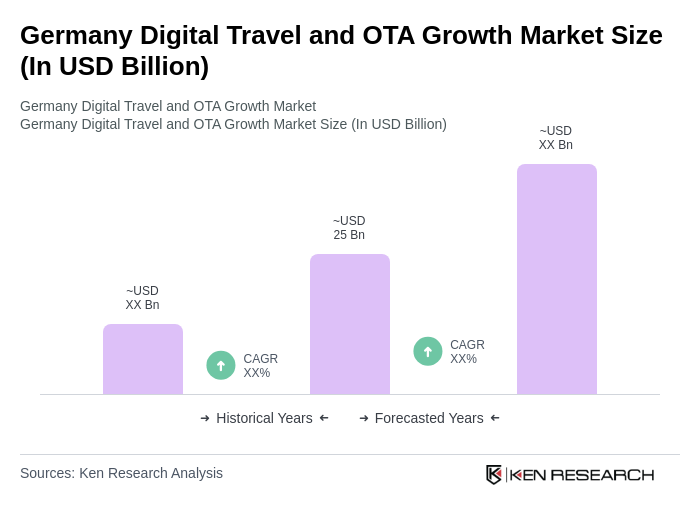
- The Germany Digital Travel and OTA Growth Market is valued at USD 25 billion, based on a five-year historical analysis. This growth is primarily driven by the increasing adoption of digital platforms for travel bookings, enhanced consumer preferences for online services, the rise of mobile applications, and the integration of AI-driven interfaces that facilitate seamless travel planning and management. The market is also benefiting from higher internet penetration, the popularity of customized travel experiences, and a shift toward mobile-first user behavior, with millennials and Gen Z increasingly favoring online channels for bookings.
- Key players in this market include major cities such as Berlin, Munich, and Frankfurt, which dominate due to their robust tourism infrastructure, high international connectivity, and a strong presence of both leisure and business travelers. These cities serve as hubs for various travel services, attracting significant investments and innovations in the digital travel space.
- The German government has implemented consumer protection regulations in the digital travel sector, notably through the Package Travel Directive (EU) 2015/2302, transposed into German law as the German Civil Code (Bürgerliches Gesetzbuch, BGB) §§ 651a–651y, which mandates transparency in pricing, clear disclosure of terms and conditions, and the provision of comprehensive pre-contractual information to consumers. These rules require online travel providers to ensure that all material contract terms—including price, itinerary, and cancellation policies—are presented in a clear, comprehensible, and prominent manner before booking, thereby fostering trust and confidence in online travel services.
Germany Digital Travel and OTA Growth Market Segmentation
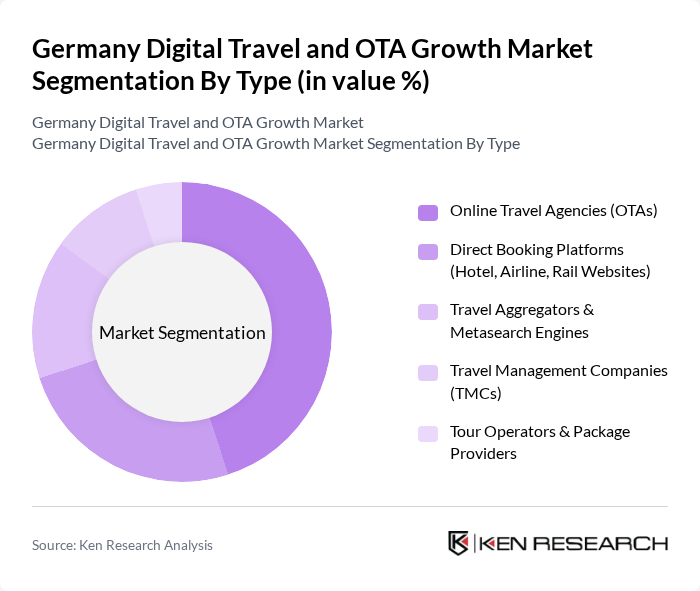
By Type:The market is segmented into various types, including Online Travel Agencies (OTAs), Direct Booking Platforms, Travel Aggregators & Metasearch Engines, Travel Management Companies (TMCs), and Tour Operators & Package Providers. Among these, Online Travel Agencies (OTAs) are the most dominant, driven by their extensive reach, user-friendly interfaces, and the convenience of booking multiple services in one place, which caters to a wide range of consumer preferences. The market is also seeing a rise in mobile and AI-driven platforms, with transportation, accommodation, and holiday packages as leading service categories.
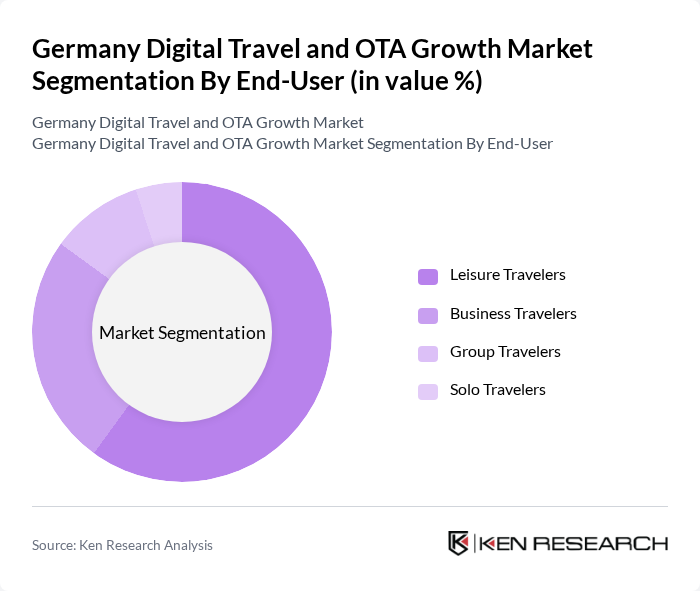
By End-User:The end-user segmentation includes Leisure Travelers, Business Travelers, Group Travelers, and Solo Travelers. Leisure Travelers dominate the market, driven by increasing disposable income, a growing trend toward experiential travel, and a preference for personalized travel experiences, which has led to a surge in demand for tailored travel packages and services. There is also a notable rise in multigenerational domestic travel, with families seeking regional destinations that offer accessibility and relaxation, further boosting the leisure segment.
Germany Digital Travel and OTA Growth Market Competitive Landscape
The Germany Digital Travel and OTA Growth Market is characterized by a dynamic mix of regional and international players. Leading participants such as Booking.com, Expedia Group, TUI Group, Trivago N.V., Airbnb, Inc., HRS Group, Lastminute.com Group, FlixMobility GmbH (FlixBus/FlixTrain), GetYourGuide, Omio, Tourlane, Skyscanner, Kayak, DER Touristik, L’TUR Tourismus AG contribute to innovation, geographic expansion, and service delivery in this space.
Germany Digital Travel and OTA Growth Market Industry Analysis
Growth Drivers
- Increasing Internet Penetration:As of future, Germany's internet penetration rate is projected to reach94%, with approximately78 millionusers accessing online services. This widespread connectivity facilitates digital travel bookings, allowing consumers to research and plan trips conveniently. The rise in internet accessibility is particularly significant in rural areas, where the number of users has increased by15%over the past two years, further driving the growth of online travel agencies (OTAs) and digital travel platforms.
- Rise of Mobile Booking:In future, mobile bookings in Germany are expected to account for55%of all online travel transactions, reflecting a significant shift in consumer behavior. With over62 millionsmartphone users in the country, the convenience of mobile applications has made it easier for travelers to book accommodations and services on-the-go. This trend is supported by the increasing availability of mobile payment options, which have grown by25%in the last year, enhancing the overall user experience in digital travel.
- Shift Towards Sustainable Travel:The demand for sustainable travel options in Germany is on the rise, with60%of travelers indicating a preference for eco-friendly accommodations and services in future. This shift is driven by heightened awareness of environmental issues, with40%of consumers willing to pay a premium for sustainable options. The German government has also introduced incentives for green travel initiatives, further encouraging the growth of sustainable tourism and attracting environmentally conscious travelers to the digital travel market.
Market Challenges
- Intense Competition:The German digital travel market is characterized by fierce competition, with over150OTAs vying for market share in future. This saturation leads to price wars and reduced profit margins, making it challenging for new entrants to establish themselves. Established players like Booking.com and Expedia dominate the market, controlling approximately60%of online bookings, which further complicates the landscape for smaller companies trying to differentiate their offerings.
- Cybersecurity Threats:As digital transactions increase, so do cybersecurity threats, with a reported30%rise in cyberattacks targeting travel companies. The financial implications of data breaches can be severe, with the average cost of a breach estimated atEUR 4.5 million. This challenge necessitates significant investment in cybersecurity measures, which can strain resources for smaller OTAs and impact their ability to compete effectively in the market.
Germany Digital Travel and OTA Growth Market Future Outlook
The future of the digital travel market in Germany appears promising, driven by technological advancements and evolving consumer preferences. As travelers increasingly seek personalized experiences, companies that leverage data analytics and artificial intelligence will likely gain a competitive edge. Additionally, the emphasis on health and safety protocols will continue to shape travel decisions, with consumers prioritizing companies that demonstrate commitment to safety. The integration of innovative technologies will further enhance customer engagement and streamline booking processes, fostering growth in the sector.
Market Opportunities
- Expansion of Niche Travel Segments:There is a growing opportunity in niche travel segments, such as wellness tourism and adventure travel, which are projected to grow by20%in future. Companies that tailor their offerings to these specific interests can attract a dedicated customer base, enhancing their market presence and profitability.
- Partnerships with Local Businesses:Collaborating with local businesses can create unique travel experiences and foster community engagement. In future, partnerships are expected to increase by15%, allowing OTAs to offer exclusive deals and packages that appeal to travelers seeking authentic experiences, thereby driving customer loyalty and satisfaction.
Scope of the Report
| Segment | Sub-Segments |
|---|---|
| By Type | Online Travel Agencies (OTAs) Direct Booking Platforms (Hotel, Airline, Rail Websites) Travel Aggregators & Metasearch Engines Travel Management Companies (TMCs) Tour Operators & Package Providers |
| By End-User | Leisure Travelers Business Travelers Group Travelers Solo Travelers |
| By Distribution Channel | Online Channels (Websites, OTAs) Offline Channels (Brick-and-Mortar Agencies) Mobile Applications Social Media & Messaging Platforms |
| By Service Type | Accommodation Services (Hotels, Short-Term Rentals) Transportation Services (Air, Rail, Bus, Car Rental) Tour and Activity Services Ancillary Services (Insurance, Transfers, Visa) |
| By Customer Segment | Individual Customers Corporate Clients Travel Agents & Intermediaries Government & Institutional Buyers |
| By Price Range | Budget Mid-Range Premium/Luxury Discount/Deal-Based |
| By Booking Method | Instant Booking Advance/Pre-Booking Last-Minute Booking Flexible/Pay-Later Booking |
| By Demographics | Age Group Gender Region |
Key Target Audience
Investors and Venture Capitalist Firms
Government and Regulatory Bodies (e.g., Federal Ministry for Economic Affairs and Energy, German National Tourist Board)
Travel Agencies and Online Travel Agencies (OTAs)
Airlines and Transportation Providers
Hospitality and Accommodation Providers
Tourism Boards and Destination Marketing Organizations
Payment Processing Companies
Technology Providers and Software Developers
Players Mentioned in the Report:
Booking.com
Expedia Group
TUI Group
Trivago N.V.
Airbnb, Inc.
HRS Group
Lastminute.com Group
FlixMobility GmbH (FlixBus/FlixTrain)
GetYourGuide
Omio
Tourlane
Skyscanner
Kayak
DER Touristik
LTUR Tourismus AG
Table of Contents
Market Assessment Phase
1. Executive Summary and Approach
2. Germany Digital Travel and OTA Growth Market Overview
2.1 Key Insights and Strategic Recommendations
2.2 Germany Digital Travel and OTA Growth Market Overview
2.3 Definition and Scope
2.4 Evolution of Market Ecosystem
2.5 Timeline of Key Regulatory Milestones
2.6 Value Chain & Stakeholder Mapping
2.7 Business Cycle Analysis
2.8 Policy & Incentive Landscape
3. Germany Digital Travel and OTA Growth Market Analysis
3.1 Growth Drivers
3.1.1 Increasing Internet Penetration
3.1.2 Rise of Mobile Booking
3.1.3 Shift Towards Sustainable Travel
3.1.4 Growth of Experience-Based Travel
3.2 Market Challenges
3.2.1 Intense Competition
3.2.2 Regulatory Compliance Issues
3.2.3 Economic Uncertainty
3.2.4 Cybersecurity Threats
3.3 Market Opportunities
3.3.1 Expansion of Niche Travel Segments
3.3.2 Partnerships with Local Businesses
3.3.3 Technological Innovations
3.3.4 Increased Focus on Customer Experience
3.4 Market Trends
3.4.1 Personalization of Travel Services
3.4.2 Growth of Subscription-Based Travel Services
3.4.3 Integration of AI in Travel Planning
3.4.4 Emphasis on Health and Safety Protocols
3.5 Government Regulation
3.5.1 Data Protection Regulations
3.5.2 Travel Safety Guidelines
3.5.3 Environmental Regulations
3.5.4 Consumer Protection Laws
4. SWOT Analysis
5. Stakeholder Analysis
6. Porter's Five Forces Analysis
7. Germany Digital Travel and OTA Growth Market Market Size, 2019-2024
7.1 By Value
7.2 By Volume
7.3 By Average Selling Price
8. Germany Digital Travel and OTA Growth Market Segmentation
8.1 By Type
8.1.1 Online Travel Agencies (OTAs)
8.1.2 Direct Booking Platforms (Hotel, Airline, Rail Websites)
8.1.3 Travel Aggregators & Metasearch Engines
8.1.4 Travel Management Companies (TMCs)
8.1.5 Tour Operators & Package Providers
8.2 By End-User
8.2.1 Leisure Travelers
8.2.2 Business Travelers
8.2.3 Group Travelers
8.2.4 Solo Travelers
8.3 By Distribution Channel
8.3.1 Online Channels (Websites, OTAs)
8.3.2 Offline Channels (Brick-and-Mortar Agencies)
8.3.3 Mobile Applications
8.3.4 Social Media & Messaging Platforms
8.4 By Service Type
8.4.1 Accommodation Services (Hotels, Short-Term Rentals)
8.4.2 Transportation Services (Air, Rail, Bus, Car Rental)
8.4.3 Tour and Activity Services
8.4.4 Ancillary Services (Insurance, Transfers, Visa)
8.5 By Customer Segment
8.5.1 Individual Customers
8.5.2 Corporate Clients
8.5.3 Travel Agents & Intermediaries
8.5.4 Government & Institutional Buyers
8.6 By Price Range
8.6.1 Budget
8.6.2 Mid-Range
8.6.3 Premium/Luxury
8.6.4 Discount/Deal-Based
8.7 By Booking Method
8.7.1 Instant Booking
8.7.2 Advance/Pre-Booking
8.7.3 Last-Minute Booking
8.7.4 Flexible/Pay-Later Booking
8.8 By Demographics
8.8.1 Age Group
8.8.2 Gender
8.8.3 Region
9. Germany Digital Travel and OTA Growth Market Competitive Analysis
9.1 Market Share of Key Players
9.2 KPIs for Cross Comparison of Key Players
9.2.1 Company Name
9.2.2 Company Size (Employees, Market Cap, or Revenue)
9.2.3 Annual Revenue (Germany/Europe)
9.2.4 Revenue Growth Rate (YoY %)
9.2.5 Gross Booking Value (GBV)
9.2.6 Customer Acquisition Cost (CAC)
9.2.7 Customer Retention Rate (%)
9.2.8 Average Order Value (AOV)
9.2.9 Market Penetration Rate (%)
9.2.10 Mobile vs Desktop Booking Share (%)
9.2.11 Brand Recognition/Awareness Score
9.2.12 Net Promoter Score (NPS)
9.2.13 Customer Satisfaction Index
9.2.14 Website/App Traffic (Monthly Active Users)
9.2.15 Conversion Rate (%)
9.3 SWOT Analysis of Top Players
9.4 Pricing Analysis
9.5 Detailed Profile of Major Companies
9.5.1 Booking.com
9.5.2 Expedia Group
9.5.3 TUI Group
9.5.4 Trivago N.V.
9.5.5 Airbnb, Inc.
9.5.6 HRS Group
9.5.7 Lastminute.com Group
9.5.8 FlixMobility GmbH (FlixBus/FlixTrain)
9.5.9 GetYourGuide
9.5.10 Omio
9.5.11 Tourlane
9.5.12 Skyscanner
9.5.13 Kayak
9.5.14 DER Touristik
9.5.15 L’TUR Tourismus AG
10. Germany Digital Travel and OTA Growth Market End-User Analysis
10.1 Procurement Behavior of Key Ministries
10.1.1 Travel Budget Allocation
10.1.2 Preferred Booking Channels
10.1.3 Compliance with Travel Policies
10.1.4 Feedback Mechanisms
10.2 Corporate Spend on Infrastructure & Energy
10.2.1 Investment in Travel Technology
10.2.2 Budget for Employee Travel
10.2.3 Partnerships with Travel Agencies
10.3 Pain Point Analysis by End-User Category
10.3.1 Booking Complexity
10.3.2 Lack of Personalization
10.3.3 Customer Support Issues
10.4 User Readiness for Adoption
10.4.1 Technology Adoption Rates
10.4.2 User Training Needs
10.4.3 Feedback on Current Solutions
10.5 Post-Deployment ROI and Use Case Expansion
10.5.1 Measurement of Travel Efficiency
10.5.2 User Satisfaction Surveys
10.5.3 Opportunities for Upselling
11. Germany Digital Travel and OTA Growth Market Future Size, 2025-2030
11.1 By Value
11.2 By Volume
11.3 By Average Selling Price
Go-To-Market Strategy Phase
1. Whitespace Analysis + Business Model Canvas
1.1 Market Gaps Identification
1.2 Value Proposition Development
1.3 Revenue Streams Analysis
1.4 Cost Structure Evaluation
1.5 Key Partnerships Exploration
1.6 Customer Segmentation
1.7 Channels of Distribution
2. Marketing and Positioning Recommendations
2.1 Branding Strategies
2.2 Product USPs
2.3 Target Audience Identification
2.4 Marketing Channels Selection
2.5 Campaign Planning
3. Distribution Plan
3.1 Urban Retail Strategies
3.2 Rural NGO Tie-Ups
3.3 Online vs Offline Distribution
3.4 Partnership Opportunities
4. Channel & Pricing Gaps
4.1 Underserved Routes
4.2 Pricing Bands Analysis
4.3 Competitor Pricing Strategies
5. Unmet Demand & Latent Needs
5.1 Category Gaps
5.2 Consumer Segments Analysis
5.3 Emerging Trends Identification
6. Customer Relationship
6.1 Loyalty Programs
6.2 After-Sales Service
6.3 Customer Feedback Mechanisms
7. Value Proposition
7.1 Sustainability Initiatives
7.2 Integrated Supply Chains
7.3 Unique Selling Points
8. Key Activities
8.1 Regulatory Compliance
8.2 Branding Efforts
8.3 Distribution Setup
9. Entry Strategy Evaluation
9.1 Domestic Market Entry Strategy
9.1.1 Product Mix
9.1.2 Pricing Band
9.1.3 Packaging Strategies
9.2 Export Entry Strategy
9.2.1 Target Countries
9.2.2 Compliance Roadmap
10. Entry Mode Assessment
10.1 Joint Ventures
10.2 Greenfield Investments
10.3 Mergers & Acquisitions
10.4 Distributor Model
11. Capital and Timeline Estimation
11.1 Capital Requirements
11.2 Timelines for Implementation
12. Control vs Risk Trade-Off
12.1 Ownership vs Partnerships
13. Profitability Outlook
13.1 Breakeven Analysis
13.2 Long-Term Sustainability
14. Potential Partner List
14.1 Distributors
14.2 Joint Ventures
14.3 Acquisition Targets
15. Execution Roadmap
15.1 Phased Plan for Market Entry
15.1.1 Market Setup
15.1.2 Market Entry
15.1.3 Growth Acceleration
15.1.4 Scale & Stabilize
15.2 Key Activities and Milestones
15.2.1 Milestone Planning
15.2.2 Activity Tracking
Research Methodology
Phase 1: Approach1
Desk Research
- Analysis of industry reports from travel associations and tourism boards in Germany
- Review of market trends and forecasts from reputable travel market research publications
- Examination of government statistics on tourism and digital travel spending
Primary Research
- Interviews with executives from leading Online Travel Agencies (OTAs) operating in Germany
- Surveys targeting travel industry professionals, including travel agents and tour operators
- Focus groups with consumers to understand digital travel preferences and behaviors
Validation & Triangulation
- Cross-validation of findings through multiple data sources, including consumer surveys and industry reports
- Triangulation of insights from expert interviews with quantitative data from market analysis
- Sanity checks through peer reviews and expert panels in the travel and tourism sector
Phase 2: Market Size Estimation1
Top-down Assessment
- Estimation of total digital travel market size based on national tourism expenditure data
- Segmentation of the market by travel type, including leisure, business, and adventure travel
- Incorporation of growth rates from digital adoption trends in the travel sector
Bottom-up Modeling
- Collection of data from leading OTAs regarding transaction volumes and revenue
- Estimation of average transaction values across different travel segments
- Analysis of customer acquisition costs and retention rates for digital travel platforms
Forecasting & Scenario Analysis
- Multi-variable regression analysis incorporating economic indicators and consumer behavior trends
- Scenario modeling based on potential impacts of regulatory changes and technological advancements
- Development of baseline, optimistic, and pessimistic growth projections through 2030
Phase 3: CATI Sample Composition1
| Scope Item/Segment | Sample Size | Target Respondent Profiles |
|---|---|---|
| Leisure Travel Consumers | 100 | Frequent Travelers, Vacation Planners |
| Business Travel Managers | 60 | Corporate Travel Managers, HR Managers |
| OTA User Experience | 50 | Online Shoppers, Travel Enthusiasts |
| Travel Agents and Consultants | 40 | Travel Agency Owners, Independent Consultants |
| Technology Providers in Travel | 40 | IT Managers, Product Development Leads |
Frequently Asked Questions
What is the current value of the Germany Digital Travel and OTA Growth Market?
The Germany Digital Travel and OTA Growth Market is valued at approximately USD 25 billion, driven by the increasing adoption of digital platforms for travel bookings and a growing preference for online services among consumers.
What factors are driving growth in the German digital travel market?
Which cities are the main hubs for digital travel in Germany?
How does the German government regulate the digital travel market?
Other Regional/Country Reports
Indonesia Digital Travel and OTA Growth Market
Malaysia Digital Travel and OTA Growth Market
KSA Digital Travel and OTA Growth Market
APAC Digital Travel and OTA Growth Market
SEA Digital Travel and OTA Growth Market
Vietnam Digital Travel and OTA Growth Market
Other Adjacent Reports
Germany Digital Travel Technology Market
Brazil Online Travel Agency Platform Market
Bahrain Mobile Travel Booking Market
Qatar AI-Driven Travel Services Market
Oman Sustainable Tourism Market
Japan Hospitality Management Software Market
Thailand Airline Reservation Systems Market
Indonesia Hotel Booking Platforms Market
Philippines Travel Analytics and Data Market
South Africa Payment Solutions for Travel Market
Why Buy From Us?

What makes us stand out is that our consultants follow Robust, Refine and Result (RRR) methodology. Robust for clear definitions, approaches and sanity checking, Refine for differentiating respondents' facts and opinions, and Result for presenting data with story.

We have set a benchmark in the industry by offering our clients with syndicated and customized market research reports featuring coverage of entire market as well as meticulous research and analyst insights.

While we don't replace traditional research, we flip the method upside down. Our dual approach of Top Bottom & Bottom Top ensures quality deliverable by not just verifying company fundamentals but also looking at the sector and macroeconomic factors.

With one step in the future, our research team constantly tries to show you the bigger picture. We help with some of the tough questions you may encounter along the way: How is the industry positioned? Best marketing channel? KPI's of competitors? By aligning every element, we help maximize success.

Our report gives you instant access to the answers and sources that other companies might choose to hide. We elaborate each steps of research methodology we have used and showcase you the sample size to earn your trust.

If you need any support, we are here! We pride ourselves on universe strength, data quality, and quick, friendly, and professional service.