About the Report
Base Year 2024Germany Facility Management in Healthcare and Retail Market Overview
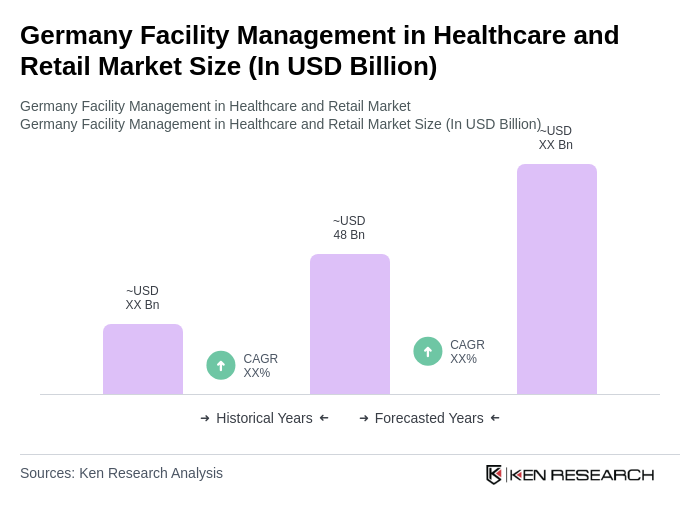
- The Germany Facility Management in Healthcare and Retail Market is valued at USD 48 billion, based on a five-year historical analysis. This growth is primarily driven by the increasing demand for efficient facility management solutions, particularly in healthcare and retail sectors, where operational efficiency, digitalization, and compliance with health and sustainability regulations are paramount. The rise in healthcare expenditures, expansion of retail spaces, and the adoption of smart building technologies have further fueled this market .
- Key cities such as Berlin, Munich, and Hamburg dominate the market due to their robust healthcare infrastructure and high concentration of retail outlets. These urban centers benefit from significant investments in healthcare facilities and retail developments, making them attractive locations for facility management services. The presence of major hospitals and shopping centers in these cities enhances the demand for specialized facility management solutions .
- Regulation of facility management in healthcare is governed by the Infection Protection Act (Infektionsschutzgesetz, IfSG), issued by the Federal Ministry of Health, most recently amended in 2023. This act mandates that all healthcare facilities implement comprehensive hygiene, infection control, and operational standards to ensure patient safety and service quality. Facilities must maintain documented hygiene plans, conduct regular staff training, and comply with strict monitoring and reporting requirements .
Germany Facility Management in Healthcare and Retail Market Segmentation
By Type:The market is segmented into various types of facility management services, including Hard Services, Soft Services, Integrated Facility Management, Specialized Healthcare Facility Services, and Energy & Sustainability Services. Each of these segments plays a crucial role in addressing the diverse needs of healthcare and retail facilities .
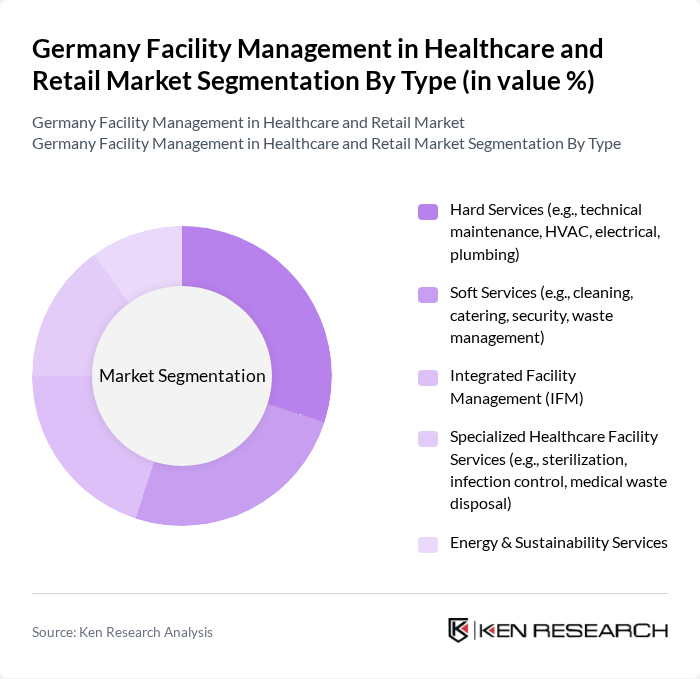
The Hard Services segment is currently dominating the market due to the essential nature of technical maintenance and infrastructure support in healthcare and retail facilities. The increasing complexity of building systems, coupled with stringent regulatory requirements and the integration of smart building technologies, has led to a heightened demand for reliable hard services. This segment encompasses critical functions such as HVAC, electrical, and plumbing services, which are vital for maintaining operational efficiency and compliance with health and safety standards. As facilities strive to enhance their operational capabilities and sustainability, the reliance on hard services continues to grow .
By End-User:The market is segmented based on end-users, including Hospitals & Clinics, Retail Chains & Shopping Centers, Pharmacies & Outpatient Centers, Elderly Care & Rehabilitation Facilities, and Diagnostic & Laboratory Facilities. Each end-user category has unique requirements that influence the demand for facility management services .
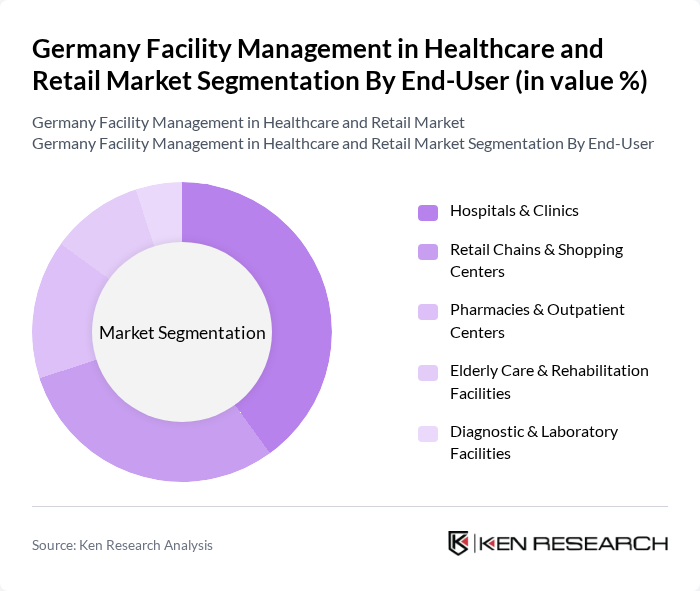
The Hospitals & Clinics segment is the largest end-user category, driven by the increasing demand for healthcare services and the need for efficient facility management to ensure patient safety and comfort. Hospitals require comprehensive facility management solutions to maintain their infrastructure, comply with health regulations, and provide a safe environment for patients and staff. The growing focus on patient-centered care, operational efficiency, and regulatory compliance further propels the demand for specialized facility management services in this sector .
Germany Facility Management in Healthcare and Retail Market Competitive Landscape
The Germany Facility Management in Healthcare and Retail Market is characterized by a dynamic mix of regional and international players. Leading participants such as ISS Facility Services GmbH, Sodexo Services GmbH, CBRE Group, Inc., JLL (Jones Lang LaSalle SE), Bilfinger SE, Dussmann Group, Apleona GmbH, STRABAG Property and Facility Services GmbH, Caverion Deutschland GmbH, KÖTTER Services, Gegenbauer Holding SE & Co. KG, WISAG Facility Service Holding GmbH & Co. KG, Engie Deutschland GmbH, SPIE Deutschland & Zentraleuropa GmbH, Compass Group Deutschland GmbH contribute to innovation, geographic expansion, and service delivery in this space .
Germany Facility Management in Healthcare and Retail Market Industry Analysis
Growth Drivers
- Increasing Demand for Healthcare Services:The German healthcare sector is projected to reach €500 billion in future, driven by an aging population and rising chronic diseases. This surge necessitates enhanced facility management services to ensure operational efficiency and patient satisfaction. The number of hospital admissions is expected to exceed 19 million annually, further amplifying the demand for specialized facility management solutions tailored to healthcare environments, thereby fostering market growth.
- Rise in Retail Sector Investments:The retail sector in Germany is anticipated to invest approximately €30 billion in infrastructure and facility upgrades in future. This investment is fueled by the increasing trend of omnichannel retailing, which requires efficient facility management to streamline operations. With over 300,000 retail establishments, the demand for integrated facility management services is expected to rise, enhancing operational efficiency and customer experience in the retail space.
- Technological Advancements in Facility Management:The integration of advanced technologies, such as AI and IoT, is transforming facility management in Germany. In future, the market for smart building technologies is projected to reach €10 billion, driven by the need for automation and data analytics. These technologies enhance operational efficiency, reduce costs, and improve service delivery, making them essential for healthcare and retail facilities aiming to optimize their management processes.
Market Challenges
- Regulatory Compliance Issues:Facility management in Germany faces stringent regulatory compliance challenges, particularly in healthcare. The healthcare sector must adhere to over 200 regulations, including health and safety standards. Non-compliance can result in fines exceeding €1 million, creating a significant barrier for facility management providers. This regulatory landscape necessitates continuous monitoring and adaptation, straining resources and complicating service delivery.
- High Competition Among Service Providers:The facility management market in Germany is characterized by intense competition, with over 1,000 service providers vying for market share. This saturation leads to price wars, reducing profit margins for companies. In future, the average profit margin in the sector is expected to decline to 5%, compelling firms to innovate and differentiate their services to maintain competitiveness and profitability in this challenging environment.
Germany Facility Management in Healthcare and Retail Market Future Outlook
The future of facility management in Germany's healthcare and retail sectors appears promising, driven by technological advancements and increasing demand for efficient services. As smart building technologies gain traction, companies will likely invest in automation and data analytics to enhance operational efficiency. Additionally, the focus on sustainability and health standards will shape service offerings, compelling providers to adopt innovative solutions that align with evolving consumer expectations and regulatory requirements.
Market Opportunities
- Expansion of Smart Building Technologies:The growing adoption of smart building technologies presents a significant opportunity for facility management providers. With an expected investment of €10 billion in smart solutions in future, companies can leverage IoT and AI to enhance operational efficiency, reduce energy consumption, and improve service delivery, positioning themselves as leaders in the market.
- Potential for Green Facility Management Solutions:The increasing emphasis on sustainability offers a lucrative opportunity for facility management firms. With Germany's commitment to reducing carbon emissions by 55% in future, the demand for green facility management solutions is set to rise. Companies that develop eco-friendly practices and technologies can capture a growing segment of environmentally conscious clients, enhancing their market position.
Scope of the Report
| Segment | Sub-Segments |
|---|---|
| By Type | Hard Services (e.g., technical maintenance, HVAC, electrical, plumbing) Soft Services (e.g., cleaning, catering, security, waste management) Integrated Facility Management (IFM) Specialized Healthcare Facility Services (e.g., sterilization, infection control, medical waste disposal) Energy & Sustainability Services |
| By End-User | Hospitals & Clinics Retail Chains & Shopping Centers Pharmacies & Outpatient Centers Elderly Care & Rehabilitation Facilities Diagnostic & Laboratory Facilities |
| By Service Model | Outsourced Facility Management In-House Facility Management Hybrid/Partially Outsourced Facility Management |
| By Contract Type | Fixed-Term Contracts Open-Ended/Framework Agreements Project-Based/Short-Term Contracts |
| By Geographic Coverage | Urban Areas (e.g., Berlin, Munich, Hamburg) Suburban Areas Rural Areas |
| By Service Frequency | Daily Services Weekly Services Monthly/Periodic Services |
| By Pricing Model | Fixed Pricing Variable Pricing Performance-Based Pricing |
Key Target Audience
Investors and Venture Capitalist Firms
Government and Regulatory Bodies (e.g., Federal Ministry of Health, Federal Office for Building and Regional Planning)
Healthcare Providers and Hospital Administrators
Retail Chain Management Executives
Facility Management Service Providers
Real Estate Developers and Property Managers
Healthcare Technology Solution Providers
Insurance Companies and Risk Management Firms
Players Mentioned in the Report:
ISS Facility Services GmbH
Sodexo Services GmbH
CBRE Group, Inc.
JLL (Jones Lang LaSalle SE)
Bilfinger SE
Dussmann Group
Apleona GmbH
STRABAG Property and Facility Services GmbH
Caverion Deutschland GmbH
KOTTER Services
Gegenbauer Holding SE & Co. KG
WISAG Facility Service Holding GmbH & Co. KG
Engie Deutschland GmbH
SPIE Deutschland & Zentraleuropa GmbH
Compass Group Deutschland GmbH
Table of Contents
Market Assessment Phase
1. Executive Summary and Approach
2. Germany Facility Management in Healthcare and Retail Market Overview
2.1 Key Insights and Strategic Recommendations
2.2 Germany Facility Management in Healthcare and Retail Market Overview
2.3 Definition and Scope
2.4 Evolution of Market Ecosystem
2.5 Timeline of Key Regulatory Milestones
2.6 Value Chain & Stakeholder Mapping
2.7 Business Cycle Analysis
2.8 Policy & Incentive Landscape
3. Germany Facility Management in Healthcare and Retail Market Analysis
3.1 Growth Drivers
3.1.1 Increasing Demand for Healthcare Services
3.1.2 Rise in Retail Sector Investments
3.1.3 Technological Advancements in Facility Management
3.1.4 Focus on Cost Efficiency and Sustainability
3.2 Market Challenges
3.2.1 Regulatory Compliance Issues
3.2.2 High Competition Among Service Providers
3.2.3 Fluctuating Operational Costs
3.2.4 Workforce Shortages in Facility Management
3.3 Market Opportunities
3.3.1 Expansion of Smart Building Technologies
3.3.2 Growing Demand for Outsourced Services
3.3.3 Increased Focus on Health and Safety Standards
3.3.4 Potential for Green Facility Management Solutions
3.4 Market Trends
3.4.1 Integration of IoT in Facility Management
3.4.2 Shift Towards Preventive Maintenance
3.4.3 Emphasis on Data-Driven Decision Making
3.4.4 Rise of Integrated Facility Management Services
3.5 Government Regulation
3.5.1 Health and Safety Regulations
3.5.2 Environmental Compliance Standards
3.5.3 Labor Laws Affecting Facility Management
3.5.4 Data Protection Regulations
4. SWOT Analysis
5. Stakeholder Analysis
6. Porter's Five Forces Analysis
7. Germany Facility Management in Healthcare and Retail Market Market Size, 2019-2024
7.1 By Value
7.2 By Volume
7.3 By Average Selling Price
8. Germany Facility Management in Healthcare and Retail Market Segmentation
8.1 By Type
8.1.1 Hard Services (e.g., technical maintenance, HVAC, electrical, plumbing)
8.1.2 Soft Services (e.g., cleaning, catering, security, waste management)
8.1.3 Integrated Facility Management (IFM)
8.1.4 Specialized Healthcare Facility Services (e.g., sterilization, infection control, medical waste disposal)
8.1.5 Energy & Sustainability Services
8.2 By End-User
8.2.1 Hospitals & Clinics
8.2.2 Retail Chains & Shopping Centers
8.2.3 Pharmacies & Outpatient Centers
8.2.4 Elderly Care & Rehabilitation Facilities
8.2.5 Diagnostic & Laboratory Facilities
8.3 By Service Model
8.3.1 Outsourced Facility Management
8.3.2 In-House Facility Management
8.3.3 Hybrid/Partially Outsourced Facility Management
8.4 By Contract Type
8.4.1 Fixed-Term Contracts
8.4.2 Open-Ended/Framework Agreements
8.4.3 Project-Based/Short-Term Contracts
8.5 By Geographic Coverage
8.5.1 Urban Areas (e.g., Berlin, Munich, Hamburg)
8.5.2 Suburban Areas
8.5.3 Rural Areas
8.6 By Service Frequency
8.6.1 Daily Services
8.6.2 Weekly Services
8.6.3 Monthly/Periodic Services
8.7 By Pricing Model
8.7.1 Fixed Pricing
8.7.2 Variable Pricing
8.7.3 Performance-Based Pricing
9. Germany Facility Management in Healthcare and Retail Market Competitive Analysis
9.1 Market Share of Key Players
9.2 Cross Comparison of Key Players
9.2.1 Company Name
9.2.2 Group Size (Large, Medium, or Small as per industry convention)
9.2.3 Revenue (EUR, latest fiscal year)
9.2.4 Revenue Growth Rate (YoY %)
9.2.5 Market Share in Healthcare & Retail FM (%)
9.2.6 Number of Healthcare/Retail Contracts
9.2.7 Customer Retention Rate (%)
9.2.8 Service Quality Index (e.g., based on client surveys or certifications)
9.2.9 Operational Efficiency Ratio (e.g., cost-to-revenue, response time)
9.2.10 Market Penetration Rate (by region or sector)
9.2.11 Pricing Strategy (premium, value, bundled, etc.)
9.2.12 Employee Satisfaction Score
9.2.13 Innovation Index (e.g., digitalization, sustainability initiatives)
9.3 SWOT Analysis of Top Players
9.4 Pricing Analysis
9.5 Detailed Profile of Major Companies
9.5.1 ISS Facility Services GmbH
9.5.2 Sodexo Services GmbH
9.5.3 CBRE Group, Inc.
9.5.4 JLL (Jones Lang LaSalle SE)
9.5.5 Bilfinger SE
9.5.6 Dussmann Group
9.5.7 Apleona GmbH
9.5.8 STRABAG Property and Facility Services GmbH
9.5.9 Caverion Deutschland GmbH
9.5.10 KÖTTER Services
9.5.11 Gegenbauer Holding SE & Co. KG
9.5.12 WISAG Facility Service Holding GmbH & Co. KG
9.5.13 Engie Deutschland GmbH
9.5.14 SPIE Deutschland & Zentraleuropa GmbH
9.5.15 Compass Group Deutschland GmbH
10. Germany Facility Management in Healthcare and Retail Market End-User Analysis
10.1 Procurement Behavior of Key Ministries
10.1.1 Ministry of Health
10.1.2 Ministry of Economic Affairs
10.1.3 Ministry of Education and Research
10.2 Corporate Spend on Infrastructure & Energy
10.2.1 Healthcare Sector Investments
10.2.2 Retail Sector Investments
10.2.3 Public Sector Investments
10.3 Pain Point Analysis by End-User Category
10.3.1 Healthcare Providers
10.3.2 Retail Operators
10.3.3 Facility Management Companies
10.4 User Readiness for Adoption
10.4.1 Technology Adoption Levels
10.4.2 Training and Development Needs
10.4.3 Budget Allocation for Facility Management
10.5 Post-Deployment ROI and Use Case Expansion
10.5.1 ROI Measurement Techniques
10.5.2 Case Studies of Successful Implementations
10.5.3 Future Use Case Opportunities
11. Germany Facility Management in Healthcare and Retail Market Future Size, 2025-2030
11.1 By Value
11.2 By Volume
11.3 By Average Selling Price
Go-To-Market Strategy Phase
1. Whitespace Analysis + Business Model Canvas
1.1 Market Gaps Identification
1.2 Business Model Framework
2. Marketing and Positioning Recommendations
2.1 Branding Strategies
2.2 Product USPs
3. Distribution Plan
3.1 Urban Retail Strategies
3.2 Rural NGO Tie-Ups
4. Channel & Pricing Gaps
4.1 Underserved Routes
4.2 Pricing Bands
5. Unmet Demand & Latent Needs
5.1 Category Gaps
5.2 Consumer Segments
6. Customer Relationship
6.1 Loyalty Programs
6.2 After-Sales Service
7. Value Proposition
7.1 Sustainability Initiatives
7.2 Integrated Supply Chains
8. Key Activities
8.1 Regulatory Compliance
8.2 Branding Efforts
8.3 Distribution Setup
9. Entry Strategy Evaluation
9.1 Domestic Market Entry Strategy
9.1.1 Product Mix
9.1.2 Pricing Band
9.1.3 Packaging Strategies
9.2 Export Entry Strategy
9.2.1 Target Countries
9.2.2 Compliance Roadmap
10. Entry Mode Assessment
10.1 Joint Ventures
10.2 Greenfield Investments
10.3 Mergers & Acquisitions
10.4 Distributor Model
11. Capital and Timeline Estimation
11.1 Capital Requirements
11.2 Timelines for Implementation
12. Control vs Risk Trade-Off
12.1 Ownership vs Partnerships
13. Profitability Outlook
13.1 Breakeven Analysis
13.2 Long-Term Sustainability
14. Potential Partner List
14.1 Distributors
14.2 Joint Ventures
14.3 Acquisition Targets
15. Execution Roadmap
15.1 Phased Plan for Market Entry
15.1.1 Market Setup
15.1.2 Market Entry
15.1.3 Growth Acceleration
15.1.4 Scale & Stabilize
15.2 Key Activities and Milestones
15.2.1 Milestone Planning
15.2.2 Activity Tracking
Research Methodology
Phase 1: Approach1
Desk Research
- Analysis of industry reports from healthcare and retail associations in Germany
- Review of government publications on facility management regulations and standards
- Examination of market trends through academic journals and white papers on facility management
Primary Research
- Interviews with facility management executives in leading healthcare institutions
- Surveys targeting retail operations managers regarding facility management practices
- Focus groups with healthcare professionals to understand facility needs and challenges
Validation & Triangulation
- Cross-validation of findings through multiple data sources including industry reports and expert opinions
- Triangulation of qualitative insights from interviews with quantitative data from surveys
- Sanity checks conducted through expert panel reviews comprising industry veterans
Phase 2: Market Size Estimation1
Top-down Assessment
- Estimation of total market size based on national healthcare and retail expenditure data
- Segmentation of market size by facility management services such as cleaning, maintenance, and security
- Incorporation of growth rates from government healthcare initiatives and retail expansion plans
Bottom-up Modeling
- Collection of data from facility management service providers on service pricing and volume
- Estimation of operational costs based on service delivery models in healthcare and retail
- Calculation of market size using a volume x cost approach for various facility management services
Forecasting & Scenario Analysis
- Multi-factor regression analysis incorporating demographic trends and healthcare spending growth
- Scenario modeling based on potential regulatory changes and technological advancements in facility management
- Development of baseline, optimistic, and pessimistic forecasts through 2030
Phase 3: CATI Sample Composition1
| Scope Item/Segment | Sample Size | Target Respondent Profiles |
|---|---|---|
| Healthcare Facility Management | 120 | Facility Managers, Operations Directors |
| Retail Store Facility Management | 85 | Store Managers, Facilities Coordinators |
| Integrated Facility Services in Hospitals | 65 | Healthcare Administrators, Procurement Managers |
| Outsourced Facility Management in Retail | 55 | Contract Managers, Service Providers |
| Technology Adoption in Facility Management | 75 | IT Managers, Facility Management Consultants |
Frequently Asked Questions
What is the current value of the Germany Facility Management in Healthcare and Retail Market?
The Germany Facility Management in Healthcare and Retail Market is valued at approximately USD 48 billion, driven by the increasing demand for efficient facility management solutions in healthcare and retail sectors, as well as advancements in technology and regulatory compliance.
Which cities are the key players in the Germany Facility Management market?
What are the main types of facility management services offered in Germany?
How does the Infection Protection Act impact facility management in healthcare?
Other Regional/Country Reports
Indonesia Facility Management in Healthcare and Retail Market
Malaysia Facility Management in Healthcare and Retail Market
KSA Facility Management in Healthcare and Retail Market
APAC Facility Management in Healthcare and Retail Market
SEA Facility Management in Healthcare and Retail Market
Vietnam Facility Management in Healthcare and Retail Market
Other Adjacent Reports
Qatar Healthcare Infrastructure Market
Egypt Retail Property Management Market
Thailand Building Maintenance Services Market
Bahrain Energy Efficiency Solutions Market
Malaysia Cleaning and Sanitation Services Market
Thailand Security Systems Integration Market
UAE Waste Management Solutions Market
Oman Smart Building Technologies Market
South Korea Sustainability Consulting Services Market
Philippines Facility Software Solutions Market
Why Buy From Us?

What makes us stand out is that our consultants follow Robust, Refine and Result (RRR) methodology. Robust for clear definitions, approaches and sanity checking, Refine for differentiating respondents' facts and opinions, and Result for presenting data with story.

We have set a benchmark in the industry by offering our clients with syndicated and customized market research reports featuring coverage of entire market as well as meticulous research and analyst insights.

While we don't replace traditional research, we flip the method upside down. Our dual approach of Top Bottom & Bottom Top ensures quality deliverable by not just verifying company fundamentals but also looking at the sector and macroeconomic factors.

With one step in the future, our research team constantly tries to show you the bigger picture. We help with some of the tough questions you may encounter along the way: How is the industry positioned? Best marketing channel? KPI's of competitors? By aligning every element, we help maximize success.

Our report gives you instant access to the answers and sources that other companies might choose to hide. We elaborate each steps of research methodology we have used and showcase you the sample size to earn your trust.

If you need any support, we are here! We pride ourselves on universe strength, data quality, and quick, friendly, and professional service.