About the Report
Base Year 2024Listen to the audio summary
Global Agriculture Drones Market Overview
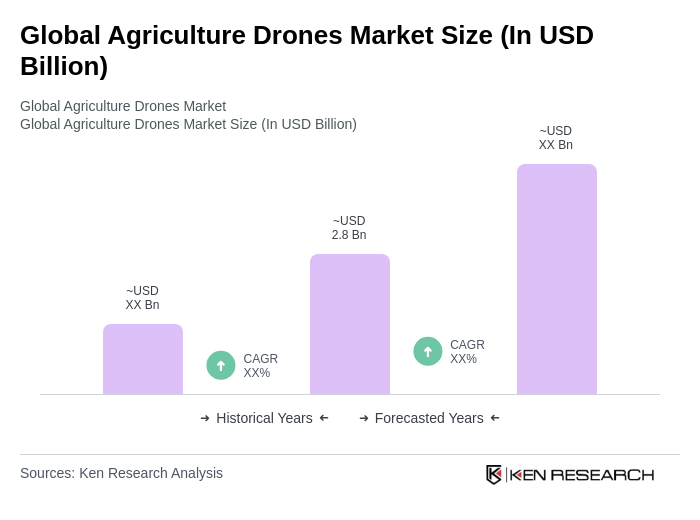
- The Global Agriculture Drones Market is valued at USD 2.8 billion, based on a five-year historical analysis. This growth is primarily driven by the increasing adoption of precision agriculture techniques, which enhance crop yield and reduce resource wastage. The integration of advanced technologies such as AI and machine learning in drone operations has further propelled market expansion, enabling farmers to make data-driven decisions.
- Key players in this market include the United States, China, and Brazil. The United States leads due to its advanced agricultural practices and significant investment in drone technology. China follows closely, driven by its large agricultural sector and government support for technological advancements. Brazil's dominance is attributed to its vast agricultural land and the need for efficient farming solutions to boost productivity.
- In 2023, the U.S. government advanced rulemaking and approvals to streamline the integration of drones in agriculture, including approvals enabling beyond-visual-line-of-sight (BVLOS) operations under specific conditions via waivers and exemptions; FAA efforts toward a BVLOS rule and expanded Part 107 waivers are intended to enhance operational efficiency and safety for agricultural use cases.
Global Agriculture Drones Market Segmentation
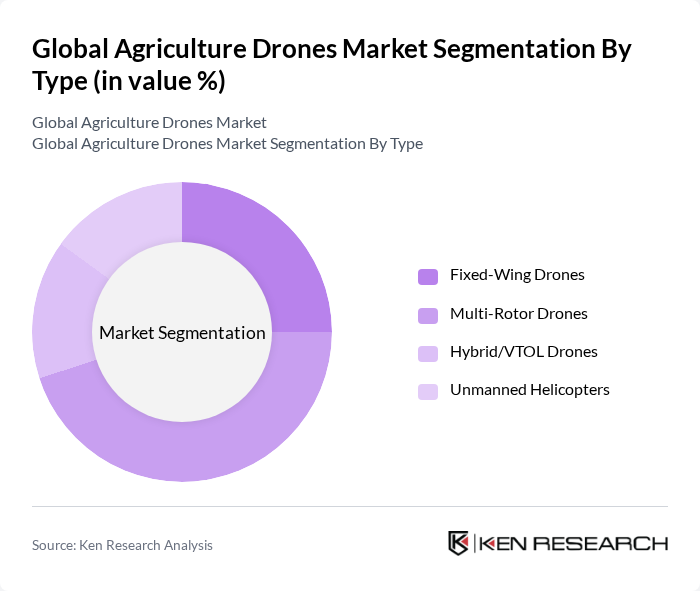
By Type:The market is segmented into Fixed-Wing Drones, Multi-Rotor Drones, Hybrid/VTOL Drones, and Unmanned Helicopters. Among these, Multi-Rotor Drones dominate the market due to their versatility, ease of use, and ability to perform various tasks such as crop spraying and monitoring. Their compact design and ability to hover make them particularly suitable for small to medium-sized farms, where precision is crucial. Fixed-Wing Drones are also gaining traction for larger fields due to their longer flight times and coverage capabilities.
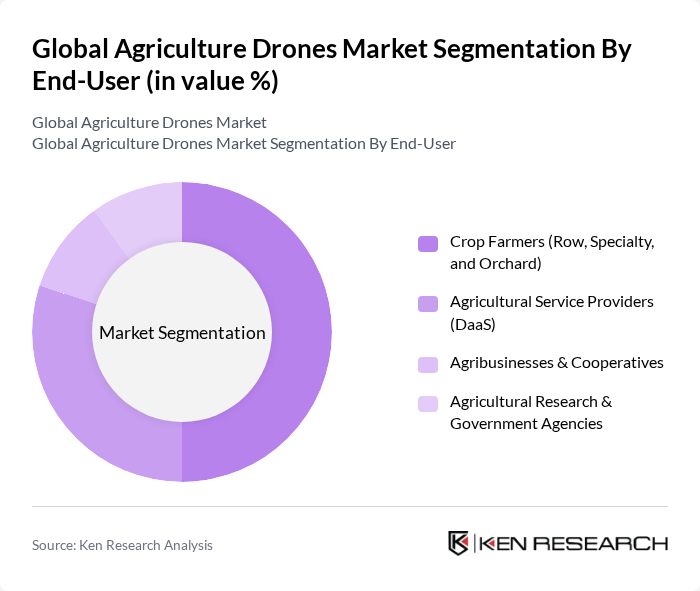
By End-User:The end-user segmentation includes Crop Farmers (Row, Specialty, and Orchard), Agricultural Service Providers (DaaS), Agribusinesses & Cooperatives, and Agricultural Research & Government Agencies. Crop Farmers are the leading segment, driven by the increasing need for efficient farming practices and the rising adoption of precision agriculture. Agricultural Service Providers are also significant, as they offer drone services to farmers who may not have the resources to invest in their own equipment.
Global Agriculture Drones Market Competitive Landscape
The Global Agriculture Drones Market is characterized by a dynamic mix of regional and international players. Leading participants such as DJI Technology Co., Ltd., Parrot Drones S.A., PrecisionHawk, Inc., AgEagle Aerial Systems Inc., senseFly SA (a AgEagle brand), Delair SAS, AeroVironment, Inc., Yuneec International Co., Ltd., Skydio, Inc., DroneDeploy, Inc., Trimble Inc., Pix4D SA, Sentera, Inc., Raptor Maps, Inc., Hylio, Inc. contribute to innovation, geographic expansion, and service delivery in this space.
Global Agriculture Drones Market Industry Analysis
Growth Drivers
- Increasing Demand for Precision Agriculture:The global precision agriculture market is projected to reach USD 12.9 billion in future, driven by the need for efficient resource management. Farmers are increasingly adopting drones for crop monitoring, which can reduce input costs by up to 20%. This shift is supported by the rising global population, expected to reach 9.7 billion by 2050, necessitating enhanced agricultural productivity to meet food demands.
- Technological Advancements in Drone Capabilities:The agriculture drone sector is witnessing rapid technological advancements, with over 50% of new models incorporating AI and machine learning for improved data analysis. In future, the integration of multispectral imaging technology is expected to enhance crop health monitoring, allowing farmers to detect issues early. This innovation is crucial as it can lead to yield increases of 10-15% per season, significantly impacting overall agricultural efficiency.
- Rising Labor Costs in Agriculture:Labor costs in agriculture have surged, with average hourly wages for farmworkers in the U.S. reported above USD 15 per hour in future according to official farm labor statistics, reflecting continued upward pressure on wages. This trend is prompting farmers to seek automation solutions, including drones, to reduce reliance on manual labor. Drones can perform tasks such as planting and spraying, potentially cutting labor costs by 30%, making them an attractive investment for cost-conscious farmers.
Market Challenges
- Regulatory Hurdles and Compliance Issues:The agriculture drone market faces significant regulatory challenges, with the FAA implementing guidelines for drone operations, including requirements for Remote ID and certification for certain operations (such as Part 107 for commercial use). Compliance costs for farmers can exceed USD 5,000 annually. These regulations, while necessary for safety, can slow market growth and limit the potential benefits of drone usage in agriculture.
- Limited Awareness and Training Among Farmers:A significant barrier to drone adoption is the lack of awareness and training among farmers. Only 30% of farmers report familiarity with drone technology, according to industry surveys. This knowledge gap can hinder effective implementation, as farmers may not fully understand the operational benefits or how to utilize drones for precision agriculture, limiting market penetration.
Global Agriculture Drones Market Future Outlook
The future of the agriculture drone market appears promising, driven by technological innovations and increasing adoption rates. As farmers become more aware of the benefits of drone technology, particularly in precision agriculture, the market is expected to expand significantly. Additionally, the integration of drones with IoT and AI technologies will enhance data collection and analysis, leading to more informed decision-making in farming practices. This evolution will likely foster a more sustainable agricultural landscape, addressing both productivity and environmental concerns.
Market Opportunities
- Expansion into Emerging Markets:Emerging markets, particularly in Asia and Africa, present significant opportunities for agriculture drones. With a combined population well above 2 billion, these regions are increasingly investing in modern agricultural practices. The demand for drones in these markets could increase by 40%, driven by the need for efficient farming solutions to combat food insecurity.
- Development of Specialized Agricultural Drones:There is a growing opportunity for the development of specialized drones tailored for specific agricultural tasks, such as crop spraying and soil analysis. The introduction of drones equipped with advanced sensors and imaging technology could enhance operational efficiency, potentially increasing crop yields by 15%.
Scope of the Report
| Segment | Sub-Segments |
|---|---|
| By Type | Fixed-Wing Drones Multi-Rotor Drones Hybrid/VTOL Drones Unmanned Helicopters |
| By End-User | Crop Farmers (Row, Specialty, and Orchard) Agricultural Service Providers (DaaS) Agribusinesses & Cooperatives Agricultural Research & Government Agencies |
| By Application | Field Mapping & Crop Scouting Variable Rate Application (VRA) & Prescription Mapping Crop Spraying & Spreading Livestock Monitoring Soil & Plant Health Analysis (Multispectral/Hyperspectral) |
| By Distribution Channel | Direct Sales (OEMs) Online (OEM/Marketplace) Value-Added Resellers/Distributors Drone-as-a-Service (Subscription/Pay-per-acre) |
| By Region | North America Europe Asia-Pacific Latin America Middle East & Africa |
| By Payload Capacity | Below 5 kg –10 kg –25 kg Above 25 kg |
| By Price Range | Entry-Level (? US$2,000) Mid-Range (US$2,001–US$10,000) Professional/Enterprise (US$10,001–US$50,000) Heavy-Duty/Industrial (? US$50,001) |
Key Target Audience
Investors and Venture Capitalist Firms
Government and Regulatory Bodies (e.g., Federal Aviation Administration, European Union Aviation Safety Agency)
Agricultural Equipment Manufacturers
Drone Technology Developers
Agricultural Cooperatives and Associations
Logistics and Supply Chain Companies
Insurance Companies Specializing in Agriculture
Agri-tech Startups and Innovators
Players Mentioned in the Report:
DJI Technology Co., Ltd.
Parrot Drones S.A.
PrecisionHawk, Inc.
AgEagle Aerial Systems Inc.
senseFly SA (a AgEagle brand)
Delair SAS
AeroVironment, Inc.
Yuneec International Co., Ltd.
Skydio, Inc.
DroneDeploy, Inc.
Trimble Inc.
Pix4D SA
Sentera, Inc.
Raptor Maps, Inc.
Hylio, Inc.
Table of Contents
Market Assessment Phase
1. Executive Summary and Approach
2. Global Agriculture Drones Market Overview
2.1 Key Insights and Strategic Recommendations
2.2 Global Agriculture Drones Market Overview
2.3 Definition and Scope
2.4 Evolution of Market Ecosystem
2.5 Timeline of Key Regulatory Milestones
2.6 Value Chain & Stakeholder Mapping
2.7 Business Cycle Analysis
2.8 Policy & Incentive Landscape
3. Global Agriculture Drones Market Analysis
3.1 Growth Drivers
3.1.1 Increasing demand for precision agriculture
3.1.2 Technological advancements in drone capabilities
3.1.3 Rising labor costs in agriculture
3.1.4 Government initiatives promoting drone usage
3.2 Market Challenges
3.2.1 Regulatory hurdles and compliance issues
3.2.2 High initial investment costs
3.2.3 Limited awareness and training among farmers
3.2.4 Data privacy and security concerns
3.3 Market Opportunities
3.3.1 Expansion into emerging markets
3.3.2 Development of specialized agricultural drones
3.3.3 Integration with IoT and AI technologies
3.3.4 Partnerships with agricultural cooperatives
3.4 Market Trends
3.4.1 Increasing adoption of drone-as-a-service models
3.4.2 Growing focus on sustainable farming practices
3.4.3 Enhanced data analytics for crop management
3.4.4 Rise of autonomous drone operations
3.5 Government Regulation
3.5.1 FAA regulations on drone operations
3.5.2 Environmental impact assessments
3.5.3 Licensing requirements for drone operators
3.5.4 Subsidies for agricultural technology adoption
4. SWOT Analysis
5. Stakeholder Analysis
6. Porter's Five Forces Analysis
7. Global Agriculture Drones Market Market Size, 2019-2024
7.1 By Value
7.2 By Volume
7.3 By Average Selling Price
8. Global Agriculture Drones Market Segmentation
8.1 By Type
8.1.1 Fixed-Wing Drones
8.1.2 Multi-Rotor Drones
8.1.3 Hybrid/VTOL Drones
8.1.4 Unmanned Helicopters
8.2 By End-User
8.2.1 Crop Farmers (Row, Specialty, and Orchard)
8.2.2 Agricultural Service Providers (DaaS)
8.2.3 Agribusinesses & Cooperatives
8.2.4 Agricultural Research & Government Agencies
8.3 By Application
8.3.1 Field Mapping & Crop Scouting
8.3.2 Variable Rate Application (VRA) & Prescription Mapping
8.3.3 Crop Spraying & Spreading
8.3.4 Livestock Monitoring
8.3.5 Soil & Plant Health Analysis (Multispectral/Hyperspectral)
8.4 By Distribution Channel
8.4.1 Direct Sales (OEMs)
8.4.2 Online (OEM/Marketplace)
8.4.3 Value-Added Resellers/Distributors
8.4.4 Drone-as-a-Service (Subscription/Pay-per-acre)
8.5 By Region
8.5.1 North America
8.5.2 Europe
8.5.3 Asia-Pacific
8.5.4 Latin America
8.5.5 Middle East & Africa
8.6 By Payload Capacity
8.6.1 Below 5 kg
8.6.2 5–10 kg
8.6.3 10–25 kg
8.6.4 Above 25 kg
8.7 By Price Range
8.7.1 Entry-Level (? US$2,000)
8.7.2 Mid-Range (US$2,001–US$10,000)
8.7.3 Professional/Enterprise (US$10,001–US$50,000)
8.7.4 Heavy-Duty/Industrial (? US$50,001)
9. Global Agriculture Drones Market Competitive Analysis
9.1 Market Share of Key Players
9.2 Cross Comparison of Key Players
9.2.1 Company Name
9.2.2 Segment Focus (Spraying, Mapping, Analytics, Autonomy, Hardware/OEM)
9.2.3 Agriculture Revenue (latest FY, US$) and Share of Total Revenue
9.2.4 Installed Base/Acres Covered (cumulative or annual)
9.2.5 Geographic Footprint (Regions served; dealer/service network size)
9.2.6 R&D Intensity (% of revenue) and Patents Filed
9.2.7 Product Portfolio Breadth (drone types, payloads, sensors)
9.2.8 Compliance & Certifications (FAA/EASA/CAA approvals, BVLOS trials)
9.2.9 Unit Economics (ASP, gross margin band)
9.2.10 Service Model KPIs (DaaS ARPU, $/acre, utilization hours per drone)
9.2.11 Customer Metrics (retention rate, net new logos, churn)
9.2.12 Partnership Ecosystem (OEMs, agronomy platforms, input companies)
9.3 SWOT Analysis of Top Players
9.4 Pricing Analysis
9.5 Detailed Profile of Major Companies
9.5.1 DJI Technology Co., Ltd.
9.5.2 Parrot Drones S.A.
9.5.3 PrecisionHawk, Inc.
9.5.4 AgEagle Aerial Systems Inc.
9.5.5 senseFly SA (a AgEagle brand)
9.5.6 Delair SAS
9.5.7 AeroVironment, Inc.
9.5.8 Yuneec International Co., Ltd.
9.5.9 Skydio, Inc.
9.5.10 DroneDeploy, Inc.
9.5.11 Trimble Inc.
9.5.12 Pix4D SA
9.5.13 Sentera, Inc.
9.5.14 Raptor Maps, Inc.
9.5.15 Hylio, Inc.
10. Global Agriculture Drones Market End-User Analysis
10.1 Procurement Behavior of Key Ministries
10.1.1 Government funding for agricultural technology
10.1.2 Procurement processes for drone services
10.1.3 Collaboration with private sector for drone deployment
10.2 Corporate Spend on Infrastructure & Energy
10.2.1 Investment in drone technology for efficiency
10.2.2 Budget allocation for agricultural innovation
10.2.3 Partnerships with tech firms for drone solutions
10.3 Pain Point Analysis by End-User Category
10.3.1 Challenges faced by crop farmers
10.3.2 Issues in livestock management
10.3.3 Barriers for agricultural research institutions
10.4 User Readiness for Adoption
10.4.1 Awareness of drone benefits among farmers
10.4.2 Training programs for drone operation
10.4.3 Accessibility of drone technology
10.5 Post-Deployment ROI and Use Case Expansion
10.5.1 Measurement of cost savings
10.5.2 Expansion of drone applications in agriculture
10.5.3 Long-term benefits of drone integration
11. Global Agriculture Drones Market Future Size, 2025-2030
11.1 By Value
11.2 By Volume
11.3 By Average Selling Price
Go-To-Market Strategy Phase
1. Whitespace Analysis + Business Model Canvas
1.1 Market Gaps and Opportunities
1.2 Business Model Framework
2. Marketing and Positioning Recommendations
2.1 Branding strategies
2.2 Product USPs
3. Distribution Plan
3.1 Urban retail vs rural NGO tie-ups
4. Channel & Pricing Gaps
4.1 Underserved routes
4.2 Pricing bands
5. Unmet Demand & Latent Needs
5.1 Category gaps
5.2 Consumer segments
6. Customer Relationship
6.1 Loyalty programs
6.2 After-sales service
7. Value Proposition
7.1 Sustainability
7.2 Integrated supply chains
8. Key Activities
8.1 Regulatory compliance
8.2 Branding
8.3 Distribution setup
9. Entry Strategy Evaluation
9.1 Domestic Market Entry Strategy
9.1.1 Product mix
9.1.2 Pricing band
9.1.3 Packaging
9.2 Export Entry Strategy
9.2.1 Target countries
9.2.2 Compliance roadmap
10. Entry Mode Assessment
10.1 JV
10.2 Greenfield
10.3 M&A
10.4 Distributor Model
11. Capital and Timeline Estimation
11.1 Capital requirements
11.2 Timelines
12. Control vs Risk Trade-Off
12.1 Ownership vs Partnerships
13. Profitability Outlook
13.1 Breakeven analysis
13.2 Long-term sustainability
14. Potential Partner List
14.1 Distributors
14.2 JVs
14.3 Acquisition targets
15. Execution Roadmap
15.1 Phased Plan for Market Entry
15.1.1 Market Setup
15.1.2 Market Entry
15.1.3 Growth Acceleration
15.1.4 Scale & Stabilize
15.2 Key Activities and Milestones
15.2.1 Milestone Planning
15.2.2 Activity Tracking
Research Methodology
Phase 1: Approach1
Desk Research
- Industry reports from agricultural technology associations and market research firms
- Government publications on agricultural drone regulations and usage statistics
- Academic journals and white papers on drone technology applications in agriculture
Primary Research
- Interviews with agronomists and agricultural technology experts
- Surveys with farmers and agricultural cooperatives utilizing drone technology
- Field visits to farms employing drones for crop monitoring and management
Validation & Triangulation
- Cross-validation of data from multiple sources including industry reports and expert interviews
- Triangulation of market trends with historical data and future projections
- Sanity checks through feedback from a panel of agricultural technology specialists
Phase 2: Market Size Estimation1
Top-down Assessment
- Analysis of global agricultural spending trends and their impact on drone adoption
- Segmentation of the market by drone type, application, and geographic region
- Incorporation of government incentives for precision agriculture technologies
Bottom-up Modeling
- Estimation of unit sales based on drone manufacturers' production data
- Operational cost analysis for drone services in various agricultural applications
- Volume x pricing model for different types of agricultural drones
Forecasting & Scenario Analysis
- Multi-variable regression analysis considering factors like crop yield improvements and technology adoption rates
- Scenario planning based on potential regulatory changes and market disruptions
- Development of baseline, optimistic, and pessimistic forecasts through 2030
Phase 3: CATI Sample Composition1
| Scope Item/Segment | Sample Size | Target Respondent Profiles |
|---|---|---|
| Cereal Crop Monitoring | 100 | Farm Owners, Agronomists |
| Precision Agriculture Services | 80 | Agricultural Consultants, Drone Service Providers |
| Fruit and Vegetable Production | 70 | Horticulturists, Farm Managers |
| Livestock Management | 60 | Livestock Farmers, Veterinary Technicians |
| Drone Technology Adoption | 90 | Technology Officers, Agricultural Researchers |
Frequently Asked Questions
What is the current value of the Global Agriculture Drones Market?
The Global Agriculture Drones Market is valued at approximately USD 2.8 billion, reflecting a significant growth trend driven by the adoption of precision agriculture techniques and advanced technologies like AI and machine learning in drone operations.
Which countries are leading in the Agriculture Drones Market?
What are the main types of drones used in agriculture?
Who are the primary end-users of agricultural drones?
Other Regional/Country Reports
Indonesia Agriculture Drones Market
Malaysia Agriculture Drones Market
APAC Agriculture Drones Market
Why Buy From Us?

What makes us stand out is that our consultants follow Robust, Refine and Result (RRR) methodology. Robust for clear definitions, approaches and sanity checking, Refine for differentiating respondents' facts and opinions, and Result for presenting data with story.

We have set a benchmark in the industry by offering our clients with syndicated and customized market research reports featuring coverage of entire market as well as meticulous research and analyst insights.

While we don't replace traditional research, we flip the method upside down. Our dual approach of Top Bottom & Bottom Top ensures quality deliverable by not just verifying company fundamentals but also looking at the sector and macroeconomic factors.

With one step in the future, our research team constantly tries to show you the bigger picture. We help with some of the tough questions you may encounter along the way: How is the industry positioned? Best marketing channel? KPI's of competitors? By aligning every element, we help maximize success.

Our report gives you instant access to the answers and sources that other companies might choose to hide. We elaborate each steps of research methodology we have used and showcase you the sample size to earn your trust.

If you need any support, we are here! We pride ourselves on universe strength, data quality, and quick, friendly, and professional service.