About the Report
Base Year 2024Listen to the audio summary
Global Alfalfa Seeds Market Overview
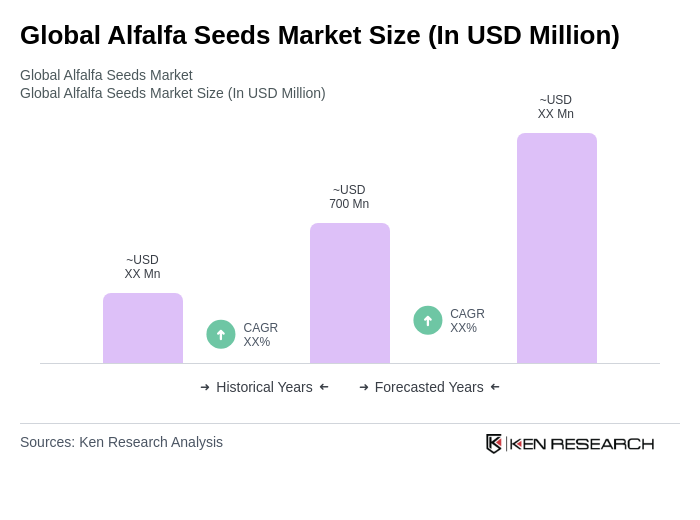
- The Global Alfalfa Seeds Market is valued at USD 700 million, based on a five-year historical analysis. This market is primarily driven by demand for high-quality animal feed in dairy and beef systems and by advances in seed breeding and traits that improve yield, disease resistance, and stress tolerance .
- Key producing and exporting regions include the United States, Canada, and Australia, supported by extensive forage acreage and advanced seed production ecosystems; North America is a leading demand center for alfalfa seed due to strong livestock and dairy sectors . The U.S. is a major alfalfa producer with a significant seed industry and export presence aligned to dairy and beef feed demand .
- Regarding regulation, there was no new U.S. federal rule in 2023 specifically “promoting” GMOs in alfalfa seed; genetically engineered (glyphosate-tolerant) alfalfa was deregulated earlier by USDA-APHIS, and ongoing U.S. policy frameworks allow GMO alfalfa cultivation subject to existing regulatory oversight rather than a new 2023 pro-GMO mandate .
Global Alfalfa Seeds Market Segmentation
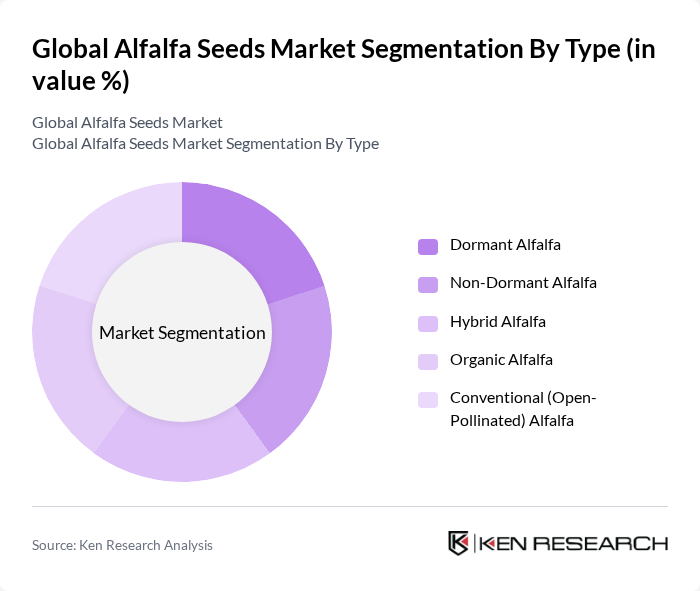
By Type:The alfalfa seeds market can be segmented into Dormant Alfalfa, Non-Dormant Alfalfa, Hybrid Alfalfa, Organic Alfalfa, and Conventional (Open-Pollinated) Alfalfa. Dormancy class preferences vary by climate: dormant types suit colder regions with winter hardiness, while non-dormant types fit warmer zones with longer seasons; seed companies continue to expand hybrid and traited offerings for disease, pest, and abiotic stress tolerance . Demand for Organic Alfalfa seed is growing in line with organic dairy and forage programs and residue-sensitive markets .
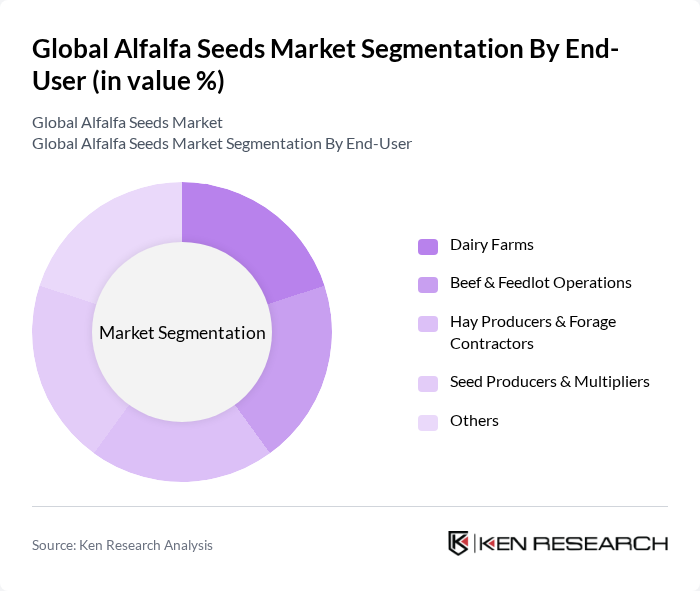
By End-User:The end-user segmentation includes Dairy Farms, Beef & Feedlot Operations, Hay Producers & Forage Contractors, Seed Producers & Multipliers, and Others. Dairy and integrated forage operations are the primary demand centers for alfalfa seed due to the crop’s protein, fiber quality, and digestibility benefits for high-performing herds; beef and feedlot systems also drive seed demand in suitable regions .
Global Alfalfa Seeds Market Competitive Landscape
The Global Alfalfa Seeds Market is characterized by a dynamic mix of regional and international players. Leading participants such as Forage Genetics International (FGI), Corteva Agriscience (Pioneer Hi-Bred), DLF Seeds A/S, Royal Barenbrug Group, S&W Seed Company, Allied Seed, LLC, WL Research (WL Alfalfas), Alforex Seeds (Corteva brand), Seedway, LLC, Nutrien Ag Solutions (Retail seed distribution), La Crosse Seed, LLC, Smith Seed Services, BrettYoung Seeds Limited, RAGT Semences, Barenbrug USA contribute to innovation, geographic expansion, and service delivery in this space.
- Notes on updates and validations:- Market size has been aligned to the seeds segment, which reputable market trackers place in the hundreds of millions of USD, not multiple billions as for the broader alfalfa (hay/forage) market .- The type and end-user market share percentages have been removed due to lack of authoritative, consistent evidence for the specific splits; qualitative segmentation has been retained and validated with current sources .- Growth drivers reflect current trends: livestock feed demand, traited seed adoption, stress tolerance, and quality forage needs across dairy and beef systems .
Global Alfalfa Seeds Market Industry Analysis
Growth Drivers
- Increasing Demand for Livestock Feed:The global livestock population is projected to reach 1.6 billion by in future, driving the demand for high-quality feed. Alfalfa, known for its high protein content, is increasingly favored, with an estimated 32 million tons consumed annually. This surge in livestock production, particularly in regions like Asia and South America, is expected to boost alfalfa seed sales significantly, as farmers seek to enhance feed efficiency and animal health.
- Rising Awareness of Nutritional Benefits:Alfalfa is recognized for its rich nutritional profile, containing essential vitamins and minerals. In future, the global health food market is anticipated to exceed $1.2 trillion, with alfalfa products gaining traction among health-conscious consumers. This trend is supported by studies indicating that alfalfa can improve digestion and reduce cholesterol levels, leading to increased demand for alfalfa seeds in both livestock and human food sectors.
- Expansion of Organic Farming Practices:The organic farming sector is projected to grow by 12% annually, with organic alfalfa seeds becoming increasingly popular. In future, the organic food market is expected to reach $350 billion globally. This growth is driven by consumer preferences for sustainably sourced products, prompting farmers to adopt organic practices, thereby increasing the demand for certified organic alfalfa seeds to meet market needs.
Market Challenges
- Fluctuating Weather Conditions:Climate change is causing unpredictable weather patterns, impacting alfalfa crop yields. In future, it is estimated that extreme weather events could reduce yields by up to 25% in some regions. Farmers face challenges in maintaining consistent production levels, which can lead to supply shortages and increased prices, ultimately affecting the alfalfa seed market's stability and growth potential.
- High Initial Investment Costs:The cost of establishing alfalfa fields can be substantial, with initial investments ranging from $350 to $550 per acre. In future, many farmers may struggle to secure financing for these upfront costs, particularly in developing regions. This financial barrier can hinder the adoption of alfalfa cultivation, limiting market growth and reducing the overall supply of alfalfa seeds in the industry.
Global Alfalfa Seeds Market Future Outlook
The future of the alfalfa seeds market appears promising, driven by increasing consumer demand for sustainable and nutritious food sources. As farmers adopt innovative agricultural practices, including precision farming and drought-resistant varieties, the efficiency of alfalfa production is expected to improve. Additionally, the integration of digital technologies in farming will enhance yield monitoring and resource management, further supporting market growth. The focus on sustainability will likely shape the industry's trajectory in the coming years.
Market Opportunities
- Growth in Export Markets:Emerging markets in Asia and Africa are increasingly importing alfalfa seeds to meet their livestock feed needs. In future, exports are projected to rise by 18%, driven by demand from countries like China and India, which are expanding their livestock sectors. This presents a significant opportunity for seed producers to tap into new markets and increase their global footprint.
- Development of Drought-Resistant Varieties:With climate change impacting water availability, the development of drought-resistant alfalfa varieties is crucial. By future, these varieties could account for 30% of the market, appealing to farmers in arid regions. This innovation not only addresses environmental challenges but also enhances crop resilience, providing a competitive edge in the alfalfa seed market.
Scope of the Report
| Segment | Sub-Segments |
|---|---|
| By Type | Dormant Alfalfa Non-Dormant Alfalfa Hybrid Alfalfa Organic Alfalfa Conventional (Open-Pollinated) Alfalfa |
| By End-User | Dairy Farms Beef & Feedlot Operations Hay Producers & Forage Contractors Seed Producers & Multipliers Others |
| By Application | Animal Feed (Hay, Silage, Pellets) Pasture & Rotational Grazing Soil Improvement & Nitrogen Fixation Erosion Control & Cover Crops Others |
| By Distribution Channel | Direct Sales (Seed Companies to Farms) Agricultural Cooperatives & Dealers Online & Catalog Retail Government & Institutional Procurement Others |
| By Region | North America Europe Asia-Pacific Latin America Middle East & Africa |
| By Seed Treatment | Inoculated (Rhizobium) Seed Pelleted & Coated Seed Fungicide/Insecticide Treated Seed Untreated Seed |
| By Price Range | Premium Mid-Range Economy |
Key Target Audience
Investors and Venture Capitalist Firms
Government and Regulatory Bodies (e.g., USDA, FAO)
Seed Manufacturers and Producers
Agricultural Cooperatives
Distributors and Retailers
Agri-tech Companies
Industry Associations (e.g., American Forage and Grassland Council)
Financial Institutions and Banks
Players Mentioned in the Report:
Forage Genetics International (FGI)
Corteva Agriscience (Pioneer Hi-Bred)
DLF Seeds A/S
Royal Barenbrug Group
S&W Seed Company
Allied Seed, LLC
WL Research (WL Alfalfas)
Alforex Seeds (Corteva brand)
Seedway, LLC
Nutrien Ag Solutions (Retail seed distribution)
La Crosse Seed, LLC
Smith Seed Services
BrettYoung Seeds Limited
RAGT Semences
Barenbrug USA
Table of Contents
Market Assessment Phase
1. Executive Summary and Approach
2. Global Alfalfa Seeds Market Overview
2.1 Key Insights and Strategic Recommendations
2.2 Global Alfalfa Seeds Market Overview
2.3 Definition and Scope
2.4 Evolution of Market Ecosystem
2.5 Timeline of Key Regulatory Milestones
2.6 Value Chain & Stakeholder Mapping
2.7 Business Cycle Analysis
2.8 Policy & Incentive Landscape
3. Global Alfalfa Seeds Market Analysis
3.1 Growth Drivers
3.1.1 Increasing Demand for Livestock Feed
3.1.2 Rising Awareness of Nutritional Benefits
3.1.3 Expansion of Organic Farming Practices
3.1.4 Technological Advancements in Seed Production
3.2 Market Challenges
3.2.1 Fluctuating Weather Conditions
3.2.2 High Initial Investment Costs
3.2.3 Pest and Disease Management Issues
3.2.4 Regulatory Compliance and Certification Hurdles
3.3 Market Opportunities
3.3.1 Growth in Export Markets
3.3.2 Development of Drought-Resistant Varieties
3.3.3 Increasing Use in Biofuel Production
3.3.4 Collaborations with Agricultural Research Institutions
3.4 Market Trends
3.4.1 Shift Towards Sustainable Agriculture
3.4.2 Adoption of Precision Agriculture Techniques
3.4.3 Growing Popularity of Alfalfa in Health Foods
3.4.4 Integration of Digital Technologies in Farming
3.5 Government Regulation
3.5.1 Seed Quality Standards
3.5.2 Environmental Protection Regulations
3.5.3 Subsidies for Organic Farming
3.5.4 Import and Export Regulations
4. SWOT Analysis
5. Stakeholder Analysis
6. Porter's Five Forces Analysis
7. Global Alfalfa Seeds Market Market Size, 2019-2024
7.1 By Value
7.2 By Volume
7.3 By Average Selling Price
8. Global Alfalfa Seeds Market Segmentation
8.1 By Type
8.1.1 Dormant Alfalfa
8.1.2 Non-Dormant Alfalfa
8.1.3 Hybrid Alfalfa
8.1.4 Organic Alfalfa
8.1.5 Conventional (Open-Pollinated) Alfalfa
8.2 By End-User
8.2.1 Dairy Farms
8.2.2 Beef & Feedlot Operations
8.2.3 Hay Producers & Forage Contractors
8.2.4 Seed Producers & Multipliers
8.2.5 Others
8.3 By Application
8.3.1 Animal Feed (Hay, Silage, Pellets)
8.3.2 Pasture & Rotational Grazing
8.3.3 Soil Improvement & Nitrogen Fixation
8.3.4 Erosion Control & Cover Crops
8.3.5 Others
8.4 By Distribution Channel
8.4.1 Direct Sales (Seed Companies to Farms)
8.4.2 Agricultural Cooperatives & Dealers
8.4.3 Online & Catalog Retail
8.4.4 Government & Institutional Procurement
8.4.5 Others
8.5 By Region
8.5.1 North America
8.5.2 Europe
8.5.3 Asia-Pacific
8.5.4 Latin America
8.5.5 Middle East & Africa
8.6 By Seed Treatment
8.6.1 Inoculated (Rhizobium) Seed
8.6.2 Pelleted & Coated Seed
8.6.3 Fungicide/Insecticide Treated Seed
8.6.4 Untreated Seed
8.7 By Price Range
8.7.1 Premium
8.7.2 Mid-Range
8.7.3 Economy
9. Global Alfalfa Seeds Market Competitive Analysis
9.1 Market Share of Key Players
9.2 Cross Comparison of Key Players
9.2.1 Revenue from Alfalfa Seeds (latest FY, USD)
9.2.2 Alfalfa Seed Volume Sold (tons or million lbs)
9.2.3 Geographic Footprint (number of countries/regions served)
9.2.4 Portfolio Breadth (number of alfalfa varieties/traits)
9.2.5 Share of Certified/Proprietary Varieties (%)
9.2.6 R&D Intensity (% of sales invested in breeding and traits)
9.2.7 Distribution Reach (number of dealers/co-ops)
9.2.8 Market Penetration in North America (% of sales)
9.2.9 Market Penetration in APAC (% of sales)
9.2.10 Average Selling Price per Unit (USD/lb or USD/kg)
9.2.11 Customer Retention/Repeat Purchase Rate (%)
9.2.12 Seed Quality KPIs (germination %, purity %, dormancy class mix)
9.2.13 Trait Adoption Rate (e.g., fall dormancy class, pest resistance %)
9.2.14 Supply Reliability (on-time delivery % / production self-sufficiency %)
9.3 SWOT Analysis of Top Players
9.4 Pricing Analysis
9.5 Detailed Profile of Major Companies
9.5.1 Forage Genetics International (FGI)
9.5.2 Corteva Agriscience (Pioneer Hi-Bred)
9.5.3 DLF Seeds A/S
9.5.4 Royal Barenbrug Group
9.5.5 S&W Seed Company
9.5.6 Allied Seed, LLC
9.5.7 WL Research (WL Alfalfas)
9.5.8 Alforex Seeds (Corteva brand)
9.5.9 Seedway, LLC
9.5.10 Nutrien Ag Solutions (Retail seed distribution)
9.5.11 La Crosse Seed, LLC
9.5.12 Smith Seed Services
9.5.13 BrettYoung Seeds Limited
9.5.14 RAGT Semences
9.5.15 Barenbrug USA
10. Global Alfalfa Seeds Market End-User Analysis
10.1 Procurement Behavior of Key Ministries
10.1.1 Government Procurement Policies
10.1.2 Budget Allocations for Agriculture
10.1.3 Supplier Selection Criteria
10.2 Corporate Spend on Infrastructure & Energy
10.2.1 Investment in Sustainable Practices
10.2.2 Budget for Seed Procurement
10.2.3 Infrastructure Development Plans
10.3 Pain Point Analysis by End-User Category
10.3.1 Cost of Quality Seeds
10.3.2 Availability of Varieties
10.3.3 Support Services from Suppliers
10.4 User Readiness for Adoption
10.4.1 Awareness of Benefits
10.4.2 Training and Support Needs
10.4.3 Financial Readiness
10.5 Post-Deployment ROI and Use Case Expansion
10.5.1 Measurement of Yield Improvements
10.5.2 Long-term Cost Savings
10.5.3 Expansion into New Markets
11. Global Alfalfa Seeds Market Future Size, 2025-2030
11.1 By Value
11.2 By Volume
11.3 By Average Selling Price
Go-To-Market Strategy Phase
1. Whitespace Analysis + Business Model Canvas
1.1 Market Gaps Identification
1.2 Value Proposition Development
1.3 Revenue Streams Analysis
1.4 Key Partnerships Exploration
1.5 Cost Structure Assessment
1.6 Customer Segmentation
1.7 Competitive Advantage Analysis
2. Marketing and Positioning Recommendations
2.1 Branding Strategies
2.2 Product USPs
2.3 Target Market Identification
2.4 Communication Strategy
2.5 Digital Marketing Tactics
3. Distribution Plan
3.1 Urban Retail Strategies
3.2 Rural NGO Tie-ups
3.3 Direct-to-Consumer Approaches
3.4 E-commerce Integration
4. Channel & Pricing Gaps
4.1 Underserved Routes
4.2 Pricing Bands Analysis
4.3 Competitor Pricing Comparison
4.4 Customer Willingness to Pay
5. Unmet Demand & Latent Needs
5.1 Category Gaps Identification
5.2 Consumer Segments Analysis
5.3 Emerging Trends Exploration
5.4 Future Needs Assessment
6. Customer Relationship
6.1 Loyalty Programs Development
6.2 After-sales Service Strategies
6.3 Customer Feedback Mechanisms
6.4 Community Engagement Initiatives
7. Value Proposition
7.1 Sustainability Initiatives
7.2 Integrated Supply Chains
7.3 Customer-Centric Innovations
7.4 Competitive Differentiation
8. Key Activities
8.1 Regulatory Compliance
8.2 Branding Initiatives
8.3 Distribution Setup
8.4 Training and Development
9. Entry Strategy Evaluation
9.1 Domestic Market Entry Strategy
9.1.1 Product Mix Considerations
9.1.2 Pricing Band Strategy
9.1.3 Packaging Innovations
9.2 Export Entry Strategy
9.2.1 Target Countries Identification
9.2.2 Compliance Roadmap Development
10. Entry Mode Assessment
10.1 Joint Ventures
10.2 Greenfield Investments
10.3 Mergers & Acquisitions
10.4 Distributor Model Evaluation
11. Capital and Timeline Estimation
11.1 Capital Requirements Analysis
11.2 Timelines for Implementation
12. Control vs Risk Trade-Off
12.1 Ownership vs Partnerships
12.2 Risk Management Strategies
13. Profitability Outlook
13.1 Breakeven Analysis
13.2 Long-term Sustainability Assessment
14. Potential Partner List
14.1 Distributors Identification
14.2 Joint Ventures Opportunities
14.3 Acquisition Targets
15. Execution Roadmap
15.1 Phased Plan for Market Entry
15.1.1 Market Setup
15.1.2 Market Entry
15.1.3 Growth Acceleration
15.1.4 Scale & Stabilize
15.2 Key Activities and Milestones
15.2.1 Milestone Planning
15.2.2 Activity Tracking
Research Methodology
Phase 1: Approach1
Desk Research
- Analysis of global agricultural reports from FAO and USDA
- Review of market studies and white papers from agricultural research institutions
- Examination of trade statistics and import/export data from national agricultural departments
Primary Research
- Interviews with seed distributors and agricultural extension officers
- Surveys with farmers and agronomists specializing in alfalfa cultivation
- Focus groups with industry experts and agribusiness consultants
Validation & Triangulation
- Cross-validation of findings through multiple data sources including government and industry reports
- Triangulation of qualitative insights from interviews with quantitative data from surveys
- Sanity checks conducted through expert panel discussions and feedback sessions
Phase 2: Market Size Estimation1
Top-down Assessment
- Estimation of market size based on global agricultural output and alfalfa acreage
- Segmentation by geographic regions and major alfalfa-producing countries
- Incorporation of trends in livestock feed demand and export potential
Bottom-up Modeling
- Volume estimates derived from seed sales data from major suppliers
- Cost analysis based on production expenses and pricing strategies of alfalfa seeds
- Aggregation of data from local markets to derive a comprehensive global figure
Forecasting & Scenario Analysis
- Utilization of time-series analysis to project future market trends based on historical data
- Scenario modeling based on varying levels of climate change impact and agricultural policy changes
- Development of optimistic, pessimistic, and baseline forecasts through 2030
Phase 3: CATI Sample Composition1
| Scope Item/Segment | Sample Size | Target Respondent Profiles |
|---|---|---|
| Alfalfa Seed Distributors | 90 | Sales Managers, Distribution Coordinators |
| Farmers Cultivating Alfalfa | 150 | Crop Managers, Farm Owners |
| Agricultural Researchers | 80 | Research Scientists, Agronomy Professors |
| Livestock Feed Manufacturers | 90 | Product Development Managers, Procurement Officers |
| Government Agricultural Officials | 70 | Policy Makers, Agricultural Extension Agents |
Frequently Asked Questions
What is the current value of the Global Alfalfa Seeds Market?
The Global Alfalfa Seeds Market is valued at approximately USD 700 million, based on a five-year historical analysis. This valuation reflects the increasing demand for high-quality animal feed and advancements in seed breeding technologies.
Which regions are the largest producers and exporters of alfalfa seeds?
What types of alfalfa seeds are available in the market?
What are the primary end-users of alfalfa seeds?
Other Regional/Country Reports
Indonesia Alfalfa Seeds Market
Malaysia Alfalfa Seeds Market
APAC Alfalfa Seeds Market
SEA Alfalfa Seeds Market
Why Buy From Us?

What makes us stand out is that our consultants follow Robust, Refine and Result (RRR) methodology. Robust for clear definitions, approaches and sanity checking, Refine for differentiating respondents' facts and opinions, and Result for presenting data with story.

We have set a benchmark in the industry by offering our clients with syndicated and customized market research reports featuring coverage of entire market as well as meticulous research and analyst insights.

While we don't replace traditional research, we flip the method upside down. Our dual approach of Top Bottom & Bottom Top ensures quality deliverable by not just verifying company fundamentals but also looking at the sector and macroeconomic factors.

With one step in the future, our research team constantly tries to show you the bigger picture. We help with some of the tough questions you may encounter along the way: How is the industry positioned? Best marketing channel? KPI's of competitors? By aligning every element, we help maximize success.

Our report gives you instant access to the answers and sources that other companies might choose to hide. We elaborate each steps of research methodology we have used and showcase you the sample size to earn your trust.

If you need any support, we are here! We pride ourselves on universe strength, data quality, and quick, friendly, and professional service.