About the Report
Base Year 2024Global Aluminum Recycling Market Overview
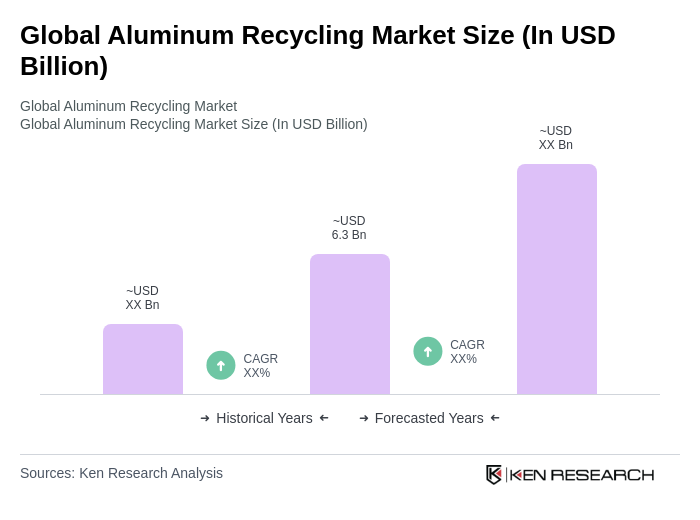
- The Global Aluminum Recycling Market is valued at USD 6.3 billion, based on a five-year historical analysis. Key drivers include the shift to circular economy models, higher energy costs favoring secondary aluminum, and corporate decarbonization commitments; recycling aluminum uses up to 95% less energy than primary production, substantially lowering greenhouse gas emissions .
- Key players in this market include the United States, Germany, and China, supported by mature scrap collection networks, advanced sorting technologies, and policy frameworks that promote recycling. Asia-Pacific leads in overall share, while the United States and Germany maintain high collection rates and infrastructure depth .
- In 2023, the European Union advanced its Circular Economy Action Plan with sectoral measures and packaging rules that tighten recycled-content and recyclability requirements; while there is no EU-wide mandate specifically requiring aluminum recycling to reach 70% by 2030, EU policy packages such as the Circular Economy Action Plan and the Packaging and Packaging Waste Regulation proposal set higher collection and recycling performance expectations that support aluminum recycling growth .
Global Aluminum Recycling Market Segmentation
By Source:The aluminum recycling market can be segmented based on the source of scrap. The primary sources include Post-Consumer Scrap, Post-Industrial/Prompt Scrap, Old Scrap, and New Scrap. Each of these sources plays a crucial role in the overall recycling process, contributing to the sustainability of aluminum production.
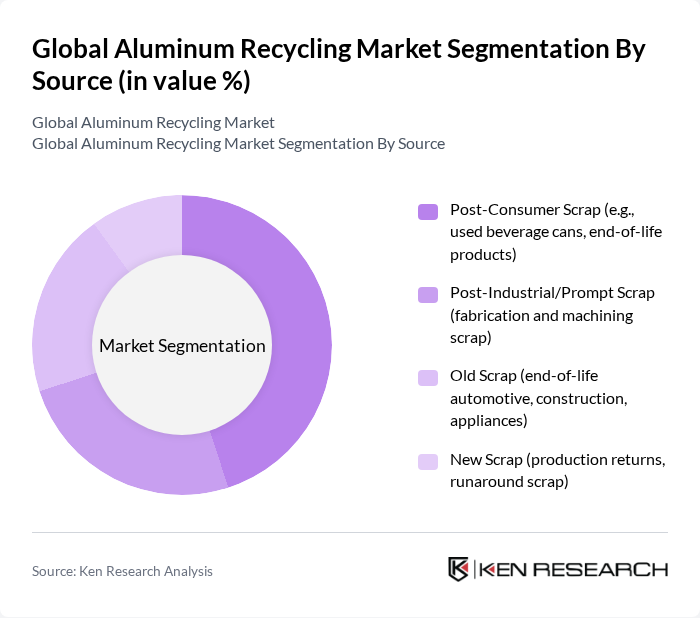
The Post-Consumer Scrap segment is the dominant source in the aluminum recycling market, driven by the increasing consumer awareness of recycling and sustainability. Used beverage cans represent a significant portion of this segment, as they are widely collected and recycled. The convenience of recycling programs and the economic benefits associated with using recycled aluminum further bolster this segment's growth. Additionally, the rise in environmental regulations and initiatives aimed at reducing waste contribute to the increasing volume of post-consumer scrap being processed .
By Aluminum Product Type (Secondary Output):The aluminum recycling market can also be segmented based on the type of aluminum products produced from recycled materials. This includes Flat Rolled Products, Cast Aluminum, Extrusions, and Deoxidizers and Master Alloys. Each product type serves different industries and applications, showcasing the versatility of recycled aluminum.
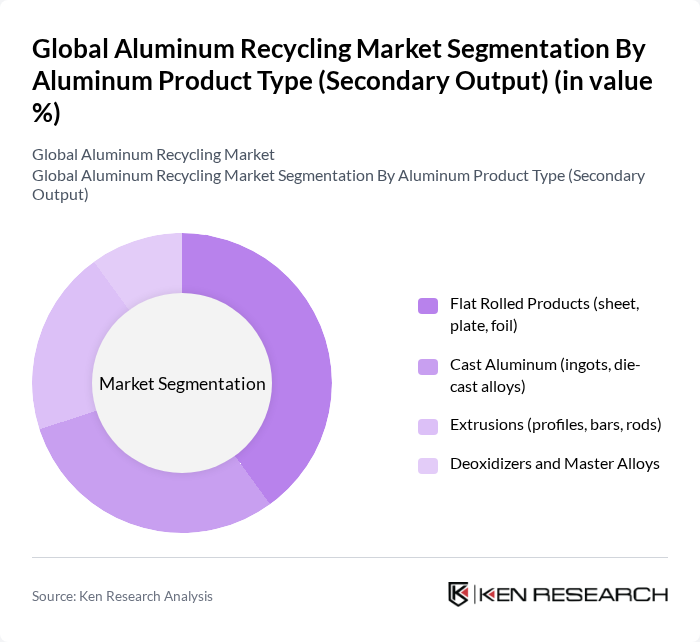
Flat Rolled Products dominate the aluminum product type segment due to their extensive use in packaging, automotive, and construction industries. The lightweight and corrosion-resistant properties of flat rolled aluminum make it a preferred choice for manufacturers. The growing demand for sustainable packaging solutions and lightweight materials in the automotive sector further drives the need for flat rolled products, solidifying their position as the leading product type in the market .
Global Aluminum Recycling Market Competitive Landscape
The Global Aluminum Recycling Market is characterized by a dynamic mix of regional and international players. Leading participants such as Novelis Inc., Alcoa Corporation, Norsk Hydro ASA (Hydro Aluminium), Constellium SE, Kaiser Aluminum Corporation, Sims Limited (Sims Metal), Chiho Environmental Group (Chiho Metal Recycling), Real Alloy, Hindalco Industries Limited, UACJ Corporation, TOMRA Systems ASA (Recycling/Sorting), EMR (European Metal Recycling), OmniSource LLC, Rio Tinto (Recycling & RenewAl initiatives), DAIKI Aluminium Industry Co., Ltd. contribute to innovation, geographic expansion, and service delivery in this space .
Global Aluminum Recycling Market Industry Analysis
Growth Drivers
- Increasing Demand for Recycled Aluminum:The global demand for recycled aluminum is projected to reach 35 million metric tons in future, driven by industries such as automotive and construction. This surge is attributed to the material's lightweight properties and energy efficiency, which are crucial for reducing carbon footprints. The automotive sector alone is expected to consume approximately 12 million metric tons, reflecting a growing trend towards sustainable manufacturing practices and resource conservation.
- Environmental Regulations and Sustainability Initiatives:Governments worldwide are implementing stringent environmental regulations, with over 60 countries adopting policies that promote recycling. For instance, the European Union's Circular Economy Action Plan aims to increase aluminum recycling rates to 85% in future. These initiatives not only encourage recycling but also impose penalties on non-compliance, driving industries to adopt recycled materials to meet regulatory standards and enhance their sustainability profiles.
- Technological Advancements in Recycling Processes:Innovations in recycling technologies are enhancing the efficiency of aluminum recovery, with investments exceeding $1.5 billion in advanced sorting and processing systems. For example, the introduction of AI-driven sorting technologies has improved recovery rates by 20%, allowing recyclers to process up to 1.8 million tons of scrap aluminum annually. These advancements are crucial for meeting the increasing demand while minimizing operational costs and environmental impact.
Market Challenges
- Fluctuating Raw Material Prices:The aluminum recycling industry faces significant challenges due to volatile raw material prices, which can swing dramatically based on global market conditions. In future, the price of scrap aluminum fluctuated between $1,900 and $2,300 per metric ton, impacting profit margins for recyclers. This unpredictability complicates financial planning and can deter investment in recycling infrastructure, ultimately affecting supply chain stability.
- Competition from Virgin Aluminum Production:The aluminum recycling sector is increasingly challenged by the competitive pricing of virgin aluminum, which was priced at approximately $2,600 per metric ton in future. This price disparity can make recycled aluminum less attractive to manufacturers, particularly in regions where energy costs for virgin production are lower. As a result, recyclers must innovate and reduce costs to remain competitive in the market.
Global Aluminum Recycling Market Future Outlook
The future of the aluminum recycling market appears promising, driven by increasing consumer awareness of sustainability and the circular economy. As industries adopt more stringent sustainability goals, the demand for recycled aluminum is expected to rise significantly. Furthermore, advancements in recycling technologies will likely enhance operational efficiencies, enabling recyclers to meet the growing demand while reducing costs. The integration of digital solutions in recycling operations will also streamline processes, making recycling more accessible and efficient for businesses and consumers alike.
Market Opportunities
- Expansion into Emerging Markets:Emerging markets, particularly in Asia and Africa, present significant opportunities for aluminum recycling growth. With urbanization rates projected to exceed 60% in future, the demand for aluminum products will rise, creating a need for efficient recycling systems. Establishing operations in these regions can lead to increased market share and profitability for recycling companies.
- Development of Innovative Recycling Technologies:The ongoing development of innovative recycling technologies, such as hydrometallurgical processes, offers substantial growth potential. These technologies can improve recovery rates and reduce energy consumption, making recycling more economically viable. Companies investing in these advancements can position themselves as leaders in the market, capitalizing on the increasing demand for sustainable materials.
Scope of the Report
| Segment | Sub-Segments |
|---|---|
| By Source | Post-Consumer Scrap (e.g., used beverage cans, end-of-life products) Post-Industrial/Prompt Scrap (fabrication and machining scrap) Old Scrap (end-of-life automotive, construction, appliances) New Scrap (production returns, runaround scrap) |
| By Aluminum Product Type (Secondary Output) | Flat Rolled Products (sheet, plate, foil) Cast Aluminum (ingots, die-cast alloys) Extrusions (profiles, bars, rods) Deoxidizers and Master Alloys |
| By End-Use Industry | Transportation (automotive, aerospace, rail) Packaging (beverage cans, foil, containers) Building & Construction (profiles, facades, windows) Electrical & Electronics Machinery & Industrial |
| By Application | Beverage Cans (UBC) Automotive Parts (body sheet, castings, wheels) Building Components (extrusions, cladding) Consumer Goods and Appliances |
| By Processing/Technology | Scrap Collection & Sorting (including sensor-based sorting) Remelting & Refining (secondary smelting) Dross/Salt Slag Recycling De-coating/De-lacquering & Pre-treatment |
| By Region | North America Europe Asia-Pacific Latin America Middle East & Africa |
| By Stakeholder | Scrap Collectors & Aggregators Secondary Smelters/Re-melters Rolling/Extrusion Mills OEMs with Closed-Loop Recycling Programs |
Key Target Audience
Investors and Venture Capitalist Firms
Government and Regulatory Bodies (e.g., Environmental Protection Agency, European Commission)
Aluminum Manufacturers and Producers
Recycling Facility Operators
Raw Material Suppliers
Industry Associations (e.g., Aluminum Association, International Aluminum Institute)
Financial Institutions
Waste Management Companies
Players Mentioned in the Report:
Novelis Inc.
Alcoa Corporation
Norsk Hydro ASA (Hydro Aluminium)
Constellium SE
Kaiser Aluminum Corporation
Sims Limited (Sims Metal)
Chiho Environmental Group (Chiho Metal Recycling)
Real Alloy
Hindalco Industries Limited
UACJ Corporation
TOMRA Systems ASA (Recycling/Sorting)
EMR (European Metal Recycling)
OmniSource LLC
Rio Tinto (Recycling & RenewAl initiatives)
DAIKI Aluminium Industry Co., Ltd.
Table of Contents
Market Assessment Phase
1. Executive Summary and Approach
2. Global Aluminum Recycling Market Overview
2.1 Key Insights and Strategic Recommendations
2.2 Global Aluminum Recycling Market Overview
2.3 Definition and Scope
2.4 Evolution of Market Ecosystem
2.5 Timeline of Key Regulatory Milestones
2.6 Value Chain & Stakeholder Mapping
2.7 Business Cycle Analysis
2.8 Policy & Incentive Landscape
3. Global Aluminum Recycling Market Analysis
3.1 Growth Drivers
3.1.1 Increasing Demand for Recycled Aluminum
3.1.2 Environmental Regulations and Sustainability Initiatives
3.1.3 Rising Scrap Aluminum Prices
3.1.4 Technological Advancements in Recycling Processes
3.2 Market Challenges
3.2.1 Fluctuating Raw Material Prices
3.2.2 Competition from Virgin Aluminum Production
3.2.3 Regulatory Compliance Costs
3.2.4 Limited Awareness of Recycling Benefits
3.3 Market Opportunities
3.3.1 Expansion into Emerging Markets
3.3.2 Development of Innovative Recycling Technologies
3.3.3 Partnerships with Automotive and Construction Industries
3.3.4 Increased Investment in Recycling Infrastructure
3.4 Market Trends
3.4.1 Growing Consumer Preference for Sustainable Products
3.4.2 Circular Economy Initiatives
3.4.3 Digitalization in Recycling Operations
3.4.4 Enhanced Sorting and Processing Technologies
3.5 Government Regulation
3.5.1 Extended Producer Responsibility (EPR) Policies
3.5.2 Import and Export Regulations on Scrap Metal
3.5.3 Incentives for Recycling Facilities
3.5.4 Emission Standards for Recycling Plants
4. SWOT Analysis
5. Stakeholder Analysis
6. Porter's Five Forces Analysis
7. Global Aluminum Recycling Market Market Size, 2019-2024
7.1 By Value
7.2 By Volume
7.3 By Average Selling Price
8. Global Aluminum Recycling Market Segmentation
8.1 By Source
8.1.1 Post-Consumer Scrap (e.g., used beverage cans, end-of-life products)
8.1.2 Post-Industrial/Prompt Scrap (fabrication and machining scrap)
8.1.3 Old Scrap (end-of-life automotive, construction, appliances)
8.1.4 New Scrap (production returns, runaround scrap)
8.2 By Aluminum Product Type (Secondary Output)
8.2.1 Flat Rolled Products (sheet, plate, foil)
8.2.2 Cast Aluminum (ingots, die-cast alloys)
8.2.3 Extrusions (profiles, bars, rods)
8.2.4 Deoxidizers and Master Alloys
8.3 By End-Use Industry
8.3.1 Transportation (automotive, aerospace, rail)
8.3.2 Packaging (beverage cans, foil, containers)
8.3.3 Building & Construction (profiles, facades, windows)
8.3.4 Electrical & Electronics
8.3.5 Machinery & Industrial
8.4 By Application
8.4.1 Beverage Cans (UBC)
8.4.2 Automotive Parts (body sheet, castings, wheels)
8.4.3 Building Components (extrusions, cladding)
8.4.4 Consumer Goods and Appliances
8.5 By Processing/Technology
8.5.1 Scrap Collection & Sorting (including sensor-based sorting)
8.5.2 Remelting & Refining (secondary smelting)
8.5.3 Dross/Salt Slag Recycling
8.5.4 De-coating/De-lacquering & Pre-treatment
8.6 By Region
8.6.1 North America
8.6.2 Europe
8.6.3 Asia-Pacific
8.6.4 Latin America
8.6.5 Middle East & Africa
8.7 By Stakeholder
8.7.1 Scrap Collectors & Aggregators
8.7.2 Secondary Smelters/Re-melters
8.7.3 Rolling/Extrusion Mills
8.7.4 OEMs with Closed-Loop Recycling Programs
9. Global Aluminum Recycling Market Competitive Analysis
9.1 Market Share of Key Players(Micro, Small, Medium, Large Enterprises)
9.2 Cross Comparison of Key Players
9.2.1 Company Name
9.2.2 Group Size (Large, Medium, or Small as per industry convention)
9.2.3 Recycled Aluminum Shipments/Volume (kt per year)
9.2.4 Secondary Production Capacity (kt per year)
9.2.5 Scrap Collection Network Coverage (number of facilities/regions)
9.2.6 End-market Mix (share to transportation, packaging, construction)
9.2.7 EBITDA Margin from Recycling Operations
9.2.8 Recovery/Yield Rate (%)
9.2.9 Energy Intensity (kWh per ton of secondary aluminum)
9.2.10 CO2e Emissions Intensity (tCO2e per ton of secondary aluminum)
9.2.11 Post-consumer Content Share (%) in Output
9.2.12 Closed-loop Contracts (number with OEMs/brands)
9.2.13 Geographic Diversification Index (revenue/volume by region)
9.2.14 R&D/Capex on Recycling (% of revenue)
9.3 SWOT Analysis of Top Players
9.4 Pricing Analysis(By Class and Payload)
9.5 Detailed Profile of Major Companies
9.5.1 Novelis Inc.
9.5.2 Alcoa Corporation
9.5.3 Norsk Hydro ASA (Hydro Aluminium)
9.5.4 Constellium SE
9.5.5 Kaiser Aluminum Corporation
9.5.6 Sims Limited (Sims Metal)
9.5.7 Chiho Environmental Group (Chiho Metal Recycling)
9.5.8 Real Alloy
9.5.9 Hindalco Industries Limited
9.5.10 UACJ Corporation
9.5.11 TOMRA Systems ASA (Recycling/Sorting)
9.5.12 EMR (European Metal Recycling)
9.5.13 OmniSource LLC
9.5.14 Rio Tinto (Recycling & RenewAl initiatives)
9.5.15 DAIKI Aluminium Industry Co., Ltd.
10. Global Aluminum Recycling Market End-User Analysis
10.1 Procurement Behavior of Key Ministries
10.1.1 Government Procurement Policies
10.1.2 Budget Allocations for Recycling Initiatives
10.1.3 Collaboration with Private Sector
10.2 Corporate Spend on Infrastructure & Energy
10.2.1 Investment in Recycling Facilities
10.2.2 Funding for Research and Development
10.2.3 Expenditure on Sustainable Practices
10.3 Pain Point Analysis by End-User Category
10.3.1 Cost of Recycling Services
10.3.2 Quality of Recycled Aluminum
10.3.3 Availability of Recycling Facilities
10.4 User Readiness for Adoption
10.4.1 Awareness of Recycling Benefits
10.4.2 Readiness to Invest in Recycling Solutions
10.4.3 Training and Support Needs
10.5 Post-Deployment ROI and Use Case Expansion
10.5.1 Measurement of Cost Savings
10.5.2 Expansion of Recycling Programs
10.5.3 Long-term Sustainability Goals
11. Global Aluminum Recycling Market Future Size, 2025-2030
11.1 By Value
11.2 By Volume
11.3 By Average Selling Price
Go-To-Market Strategy Phase
1. Whitespace Analysis + Business Model Canvas
1.1 Market Gaps Identification
1.2 Value Proposition Development
1.3 Revenue Streams Analysis
1.4 Key Partnerships
1.5 Cost Structure Analysis
1.6 Customer Segmentation
1.7 Channels of Distribution
2. Marketing and Positioning Recommendations
2.1 Branding Strategies
2.2 Product USPs
3. Distribution Plan
3.1 Urban Retail vs Rural NGO Tie-ups
4. Channel & Pricing Gaps
4.1 Underserved Routes
4.2 Pricing Bands
5. Unmet Demand & Latent Needs
5.1 Category Gaps
5.2 Consumer Segments
6. Customer Relationship
6.1 Loyalty Programs
6.2 After-sales Service
7. Value Proposition
7.1 Sustainability
7.2 Integrated Supply Chains
8. Key Activities
8.1 Regulatory Compliance
8.2 Branding
8.3 Distribution Setup
9. Entry Strategy Evaluation
9.1 Domestic Market Entry Strategy
9.1.1 Product Mix
9.1.2 Pricing Band
9.1.3 Packaging
9.2 Export Entry Strategy
9.2.1 Target Countries
9.2.2 Compliance Roadmap
10. Entry Mode Assessment
10.1 JV
10.2 Greenfield
10.3 M&A
10.4 Distributor Model
11. Capital and Timeline Estimation
11.1 Capital Requirements
11.2 Timelines
12. Control vs Risk Trade-Off
12.1 Ownership vs Partnerships
13. Profitability Outlook
13.1 Breakeven Analysis
13.2 Long-term Sustainability
14. Potential Partner List
14.1 Distributors
14.2 JVs
14.3 Acquisition Targets
15. Execution Roadmap
15.1 Phased Plan for Market Entry
15.1.1 Market Setup
15.1.2 Market Entry
15.1.3 Growth Acceleration
15.1.4 Scale & Stabilize
15.2 Key Activities and Milestones
15.2.1 Activity Planning
15.2.2 Milestone Tracking
Research Methodology
Phase 1: Approach1
Desk Research
- Industry reports from the International Aluminum Institute and other relevant organizations
- Market analysis from government publications and trade associations focused on recycling
- Academic journals and white papers discussing advancements in aluminum recycling technologies
Primary Research
- Interviews with executives from leading aluminum recycling companies
- Surveys targeting waste management professionals and recycling facility operators
- Field visits to recycling plants to observe operations and gather qualitative insights
Validation & Triangulation
- Cross-validation of data through multiple industry sources and expert opinions
- Triangulation of market trends using historical data and current market dynamics
- Sanity checks conducted through expert panel discussions and feedback sessions
Phase 2: Market Size Estimation1
Top-down Assessment
- Analysis of global aluminum production and consumption statistics to estimate recycling rates
- Segmentation of the market by end-use applications such as automotive, construction, and packaging
- Incorporation of regulatory frameworks and sustainability initiatives impacting recycling rates
Bottom-up Modeling
- Estimation of recycling volumes based on input from major recycling facilities and their capacities
- Cost analysis of recycling processes, including collection, sorting, and processing expenses
- Volume x cost calculations to derive revenue estimates for the aluminum recycling market
Forecasting & Scenario Analysis
- Multi-variable regression analysis incorporating economic indicators and environmental policies
- Scenario modeling based on potential shifts in consumer behavior and technological advancements
- Development of baseline, optimistic, and pessimistic forecasts through 2030
Phase 3: CATI Sample Composition1
| Scope Item/Segment | Sample Size | Target Respondent Profiles |
|---|---|---|
| Aluminum Recycling Facilities | 120 | Plant Managers, Operations Directors |
| End-User Industries (Automotive) | 80 | Procurement Managers, Sustainability Officers |
| Government Regulatory Bodies | 50 | Policy Makers, Environmental Analysts |
| Recycling Technology Providers | 70 | Product Development Managers, R&D Heads |
| Consumer Insights on Recycling | 90 | Market Researchers, Consumer Behavior Analysts |
Frequently Asked Questions
What is the current value of the Global Aluminum Recycling Market?
The Global Aluminum Recycling Market is valued at approximately USD 6.3 billion, reflecting a significant growth trend driven by the shift towards circular economy models and increasing energy costs favoring secondary aluminum production.
What are the main drivers of growth in the aluminum recycling market?
Which regions are leading in aluminum recycling?
What types of scrap are used in aluminum recycling?
Other Regional/Country Reports
Indonesia Aluminum Recycling Market
Malaysia Aluminum Recycling Market
APAC Aluminum Recycling Market
SEA Aluminum Recycling Market
Why Buy From Us?

What makes us stand out is that our consultants follow Robust, Refine and Result (RRR) methodology. Robust for clear definitions, approaches and sanity checking, Refine for differentiating respondents' facts and opinions, and Result for presenting data with story.

We have set a benchmark in the industry by offering our clients with syndicated and customized market research reports featuring coverage of entire market as well as meticulous research and analyst insights.

While we don't replace traditional research, we flip the method upside down. Our dual approach of Top Bottom & Bottom Top ensures quality deliverable by not just verifying company fundamentals but also looking at the sector and macroeconomic factors.

With one step in the future, our research team constantly tries to show you the bigger picture. We help with some of the tough questions you may encounter along the way: How is the industry positioned? Best marketing channel? KPI's of competitors? By aligning every element, we help maximize success.

Our report gives you instant access to the answers and sources that other companies might choose to hide. We elaborate each steps of research methodology we have used and showcase you the sample size to earn your trust.

If you need any support, we are here! We pride ourselves on universe strength, data quality, and quick, friendly, and professional service.