About the Report
Base Year 2024Global Brisket Market Overview
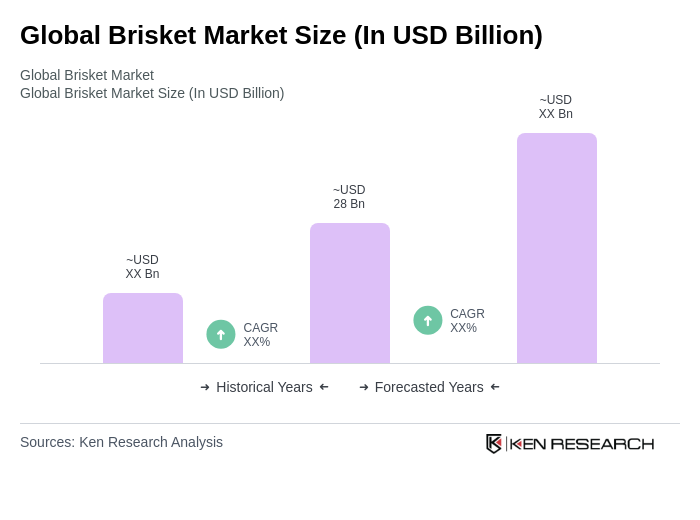
- The Global Brisket Market is valued at USD 28 billion, based on a five-year historical analysis. This robust market size is driven by the increasing popularity of barbecue culture, rising consumer demand for high-quality meat products, and a growing trend of home cooking. The sector has experienced notable growth in brisket consumption, particularly in regions where grilling and smoking are prevalent, further supporting its substantial market value .
- The United States remains a dominant player in the brisket market, attributed to the cultural significance of brisket in American cuisine, especially in barbecue and smoked meat dishes. Brazil and Australia are also prominent due to high beef consumption and brisket’s favored status in local cuisines. These countries benefit from strong agricultural sectors and advanced meat processing industries, reinforcing their leading market positions .
- The “Traceability Rule for Meat and Poultry Products, 2023” issued by the U.S. Department of Agriculture Food Safety and Inspection Service (FSIS) introduced mandatory enhanced traceability requirements for beef products, including brisket. This regulation mandates detailed recordkeeping throughout the supply chain, ensuring food safety and quality assurance, and is expected to strengthen consumer confidence and raise industry standards .
Global Brisket Market Segmentation
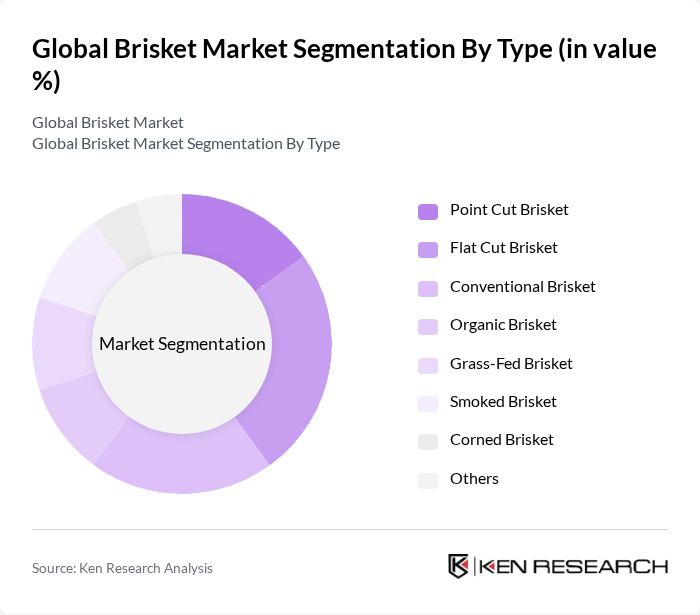
By Type:The brisket market is segmented into Point Cut Brisket, Flat Cut Brisket, Conventional Brisket, Organic Brisket, Grass-Fed Brisket, Smoked Brisket, Corned Brisket, and Others. Each type addresses diverse consumer preferences and culinary applications, shaping market trends. Notably, flat cut brisket is favored for its lean profile and consistent slicing, making it the leading segment among brisket types .
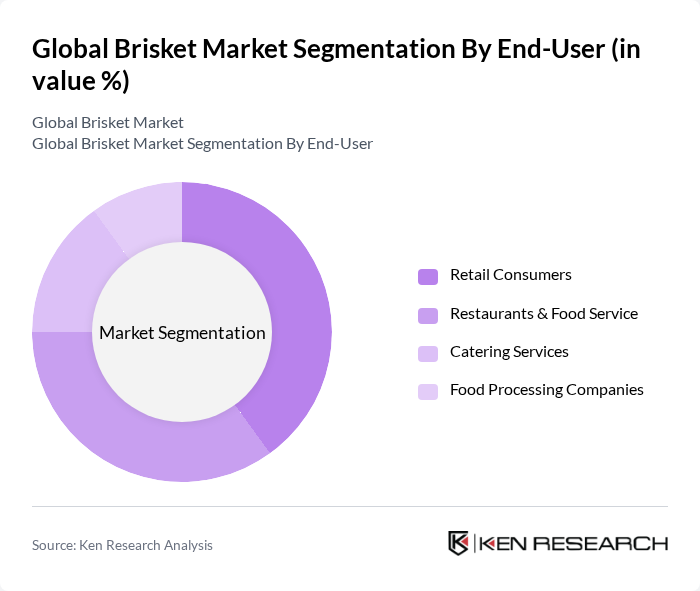
By End-User:The brisket market is segmented by end-user into Retail Consumers, Restaurants & Food Service, Catering Services, and Food Processing Companies. Each segment demonstrates unique purchasing behaviors and requirements, influencing the market landscape. Retail consumers and restaurants represent the largest demand, driven by the popularity of home cooking and foodservice brisket offerings .
Global Brisket Market Competitive Landscape
The Global Brisket Market is characterized by a dynamic mix of regional and international players. Leading participants such as Tyson Foods, Inc., JBS USA Holdings, Inc., Cargill, Inc., Smithfield Foods, Inc., National Beef Packing Company, LLC, Hormel Foods Corporation, Perdue Farms, Inc., Marfrig Global Foods S.A., BRF S.A., Pilgrim's Pride Corporation, Sanderson Farms, Inc., OBE Organic, Creekstone Farms Premium Beef, LLC, D'Artagnan, Inc., and Boston Brisket Company contribute to innovation, geographic expansion, and service delivery in this space .
Global Brisket Market Industry Analysis
Growth Drivers
- Increasing Consumer Demand for Premium Cuts:The demand for premium meat cuts, particularly brisket, has surged, with the U.S. meat consumption reaching approximately 222.2 pounds per capita in future. This trend is driven by consumers' willingness to pay more for high-quality products, as evidenced by a 15% increase in sales of premium beef cuts in future. The rise in disposable income, projected to grow by 3.5% in future, further supports this demand for premium offerings.
- Rise in Barbecue Culture and Cooking Shows:The barbecue culture has gained significant traction, with over 60 million Americans participating in barbecuing activities annually. Cooking shows featuring brisket recipes have increased viewership by 25% in future, promoting brisket as a sought-after dish. This cultural shift is reflected in the growing number of barbecue festivals, which have seen attendance rise to over 1.5 million participants, further driving brisket consumption and interest in culinary experiences.
- Expansion of Food Service Industry:The food service industry is projected to grow by 4.2% in future, with brisket becoming a staple in many restaurants and food trucks. This growth is supported by a 20% increase in the number of establishments offering brisket dishes, catering to the rising consumer preference for gourmet dining experiences. Additionally, the trend towards casual dining has led to a 30% increase in brisket sales in this sector, highlighting its popularity among consumers.
Market Challenges
- Fluctuating Raw Material Prices:The brisket market faces challenges due to fluctuating raw material prices, which have seen a 10% increase in future. Factors such as feed costs and supply chain disruptions contribute to this volatility, impacting profit margins for producers. The average cost of beef has risen to $5.50 per pound, creating pressure on both suppliers and consumers, as they navigate the implications of these price changes on purchasing decisions.
- Stringent Food Safety Regulations:Compliance with food safety regulations has become increasingly stringent, with the FDA implementing new guidelines that require additional testing and certification processes. In future, the cost of compliance is estimated to rise by 15%, placing a financial burden on small and medium-sized enterprises. This challenge can hinder market entry for new players and increase operational costs for existing businesses, affecting overall market dynamics.
Global Brisket Market Future Outlook
The future of the brisket market appears promising, driven by evolving consumer preferences and innovative culinary trends. As sustainability becomes a focal point, producers are likely to adopt more eco-friendly practices, aligning with consumer demand for responsibly sourced meat. Additionally, the integration of technology in meat processing is expected to enhance product quality and safety, further appealing to health-conscious consumers. The market is poised for growth as these trends continue to shape the industry landscape.
Market Opportunities
- Expansion into Emerging Markets:Emerging markets, particularly in Asia and Africa, present significant growth opportunities for brisket producers. With a projected increase in meat consumption by 20% in these regions in future, companies can capitalize on this trend by introducing premium brisket products tailored to local tastes and preferences, potentially increasing market share and revenue.
- Development of Value-Added Products:The development of value-added brisket products, such as pre-marinated or ready-to-cook options, can attract busy consumers seeking convenience. The market for such products is expected to grow by 18% in future, driven by the increasing demand for quick meal solutions. This innovation can enhance customer loyalty and expand the consumer base significantly.
Scope of the Report
| Segment | Sub-Segments |
|---|---|
| By Type | Point Cut Brisket Flat Cut Brisket Conventional Brisket Organic Brisket Grass-Fed Brisket Smoked Brisket Corned Brisket Others |
| By End-User | Retail Consumers Restaurants & Food Service Catering Services Food Processing Companies |
| By Sales Channel | Online Retail Supermarkets/Hypermarkets Butcher Shops Wholesale Distributors |
| By Packaging Type | Vacuum-Sealed Packaging Modified Atmosphere Packaging Bulk Packaging |
| By Region | North America (United States, Canada, Mexico) Europe (Germany, France, United Kingdom, Italy, Spain, BeNeLux, Russia, Ukraine, Rest of Europe) Asia-Pacific (China, India, Japan, South Korea, Australia, Indonesia, Vietnam, Thailand, Malaysia, Singapore, Rest of APAC) Latin America (Brazil, Argentina, Chile, Peru, Rest of SCA) Middle East & Africa (Saudi Arabia, UAE, Iran, South Africa, Egypt, Nigeria) |
| By Price Range | Premium Mid-Range Budget |
| By Quality Grade | Prime Choice Select Standard |
Key Target Audience
Investors and Venture Capitalist Firms
Government and Regulatory Bodies (e.g., USDA, FDA)
Meat Processing Companies
Food Service Operators
Wholesale Meat Distributors
Retail Grocery Chains
Food Importers and Exporters
Packaging Suppliers
Players Mentioned in the Report:
Tyson Foods, Inc.
JBS USA Holdings, Inc.
Cargill, Inc.
Smithfield Foods, Inc.
National Beef Packing Company, LLC
Hormel Foods Corporation
Perdue Farms, Inc.
Marfrig Global Foods S.A.
BRF S.A.
Pilgrim's Pride Corporation
Sanderson Farms, Inc.
OBE Organic
Creekstone Farms Premium Beef, LLC
D'Artagnan, Inc.
Boston Brisket Company
Table of Contents
Market Assessment Phase
1. Executive Summary and Approach
2. Global Brisket Market Overview
2.1 Key Insights and Strategic Recommendations
2.2 Global Brisket Market Overview
2.3 Definition and Scope
2.4 Evolution of Market Ecosystem
2.5 Timeline of Key Regulatory Milestones
2.6 Value Chain & Stakeholder Mapping
2.7 Business Cycle Analysis
2.8 Policy & Incentive Landscape
3. Global Brisket Market Analysis
3.1 Growth Drivers
3.1.1 Increasing Consumer Demand for Premium Cuts
3.1.2 Rise in Barbecue Culture and Cooking Shows
3.1.3 Expansion of Food Service Industry
3.1.4 Growth in E-commerce for Meat Products
3.2 Market Challenges
3.2.1 Fluctuating Raw Material Prices
3.2.2 Stringent Food Safety Regulations
3.2.3 Supply Chain Disruptions
3.2.4 Competition from Alternative Proteins
3.3 Market Opportunities
3.3.1 Expansion into Emerging Markets
3.3.2 Development of Value-Added Products
3.3.3 Increasing Popularity of Online Meat Delivery
3.3.4 Collaborations with Culinary Influencers
3.4 Market Trends
3.4.1 Growing Interest in Sustainable Meat Sourcing
3.4.2 Rise of Plant-Based Meat Alternatives
3.4.3 Innovations in Meat Processing Technology
3.4.4 Increased Focus on Health and Nutrition
3.5 Government Regulation
3.5.1 Food Safety Standards Compliance
3.5.2 Labeling Requirements for Meat Products
3.5.3 Import and Export Regulations
3.5.4 Animal Welfare Legislation
4. SWOT Analysis
5. Stakeholder Analysis
6. Porter's Five Forces Analysis
7. Global Brisket Market Market Size, 2019-2024
7.1 By Value
7.2 By Volume
7.3 By Average Selling Price
8. Global Brisket Market Segmentation
8.1 By Type
8.1.1 Point Cut Brisket
8.1.2 Flat Cut Brisket
8.1.3 Conventional Brisket
8.1.4 Organic Brisket
8.1.5 Grass-Fed Brisket
8.1.6 Smoked Brisket
8.1.7 Corned Brisket
8.1.8 Others
8.2 By End-User
8.2.1 Retail Consumers
8.2.2 Restaurants & Food Service
8.2.3 Catering Services
8.2.4 Food Processing Companies
8.3 By Sales Channel
8.3.1 Online Retail
8.3.2 Supermarkets/Hypermarkets
8.3.3 Butcher Shops
8.3.4 Wholesale Distributors
8.4 By Packaging Type
8.4.1 Vacuum-Sealed Packaging
8.4.2 Modified Atmosphere Packaging
8.4.3 Bulk Packaging
8.5 By Region
8.5.1 North America (United States, Canada, Mexico)
8.5.2 Europe (Germany, France, United Kingdom, Italy, Spain, BeNeLux, Russia, Ukraine, Rest of Europe)
8.5.3 Asia-Pacific (China, India, Japan, South Korea, Australia, Indonesia, Vietnam, Thailand, Malaysia, Singapore, Rest of APAC)
8.5.4 Latin America (Brazil, Argentina, Chile, Peru, Rest of SCA)
8.5.5 Middle East & Africa (Saudi Arabia, UAE, Iran, South Africa, Egypt, Nigeria)
8.6 By Price Range
8.6.1 Premium
8.6.2 Mid-Range
8.6.3 Budget
8.7 By Quality Grade
8.7.1 Prime
8.7.2 Choice
8.7.3 Select
8.7.4 Standard
9. Global Brisket Market Competitive Analysis
9.1 Market Share of Key Players
9.2 Cross Comparison of Key Players
9.2.1 Company Name
9.2.2 Group Size (Large, Medium, or Small as per industry convention)
9.2.3 Revenue Growth Rate (YoY %)
9.2.4 Market Share (%)
9.2.5 Market Penetration Rate (by region and channel)
9.2.6 Customer Retention Rate (%)
9.2.7 Average Selling Price (USD/kg)
9.2.8 Product Diversification Index (number of brisket SKUs or product lines)
9.2.9 Supply Chain Efficiency (lead time, fulfillment rate)
9.2.10 Brand Recognition Score (survey-based or digital presence index)
9.2.11 Distribution Network Coverage (number of countries/regions served)
9.2.12 Sustainability/Traceability Initiatives (certifications, % of sustainable sourcing)
9.3 SWOT Analysis of Top Players
9.4 Pricing Analysis
9.5 Detailed Profile of Major Companies
9.5.1 Tyson Foods, Inc.
9.5.2 JBS USA Holdings, Inc.
9.5.3 Cargill, Inc.
9.5.4 Smithfield Foods, Inc.
9.5.5 National Beef Packing Company, LLC
9.5.6 Hormel Foods Corporation
9.5.7 Perdue Farms, Inc.
9.5.8 Marfrig Global Foods S.A.
9.5.9 BRF S.A.
9.5.10 Pilgrim's Pride Corporation
9.5.11 Sanderson Farms, Inc.
9.5.12 OBE Organic
9.5.13 Creekstone Farms Premium Beef, LLC
9.5.14 D'Artagnan, Inc.
9.5.15 Boston Brisket Company
10. Global Brisket Market End-User Analysis
10.1 Procurement Behavior of Key Ministries
10.1.1 Government Contracts for Meat Supply
10.1.2 Budget Allocations for Food Programs
10.1.3 Compliance with Health Standards
10.2 Corporate Spend on Infrastructure & Energy
10.2.1 Investment in Cold Storage Facilities
10.2.2 Expenditure on Transportation Logistics
10.2.3 Budget for Quality Control Systems
10.3 Pain Point Analysis by End-User Category
10.3.1 Supply Chain Inefficiencies
10.3.2 Quality Assurance Challenges
10.3.3 Price Volatility Issues
10.4 User Readiness for Adoption
10.4.1 Awareness of Brisket Varieties
10.4.2 Willingness to Pay for Quality
10.4.3 Interest in Sustainable Sourcing
10.5 Post-Deployment ROI and Use Case Expansion
10.5.1 Measurement of Sales Growth
10.5.2 Customer Feedback and Satisfaction
10.5.3 Opportunities for Product Line Expansion
11. Global Brisket Market Future Size, 2025-2030
11.1 By Value
11.2 By Volume
11.3 By Average Selling Price
Go-To-Market Strategy Phase
1. Whitespace Analysis + Business Model Canvas
1.1 Identification of Market Gaps
1.2 Value Proposition Development
1.3 Revenue Streams Analysis
1.4 Cost Structure Evaluation
1.5 Key Partnerships Exploration
1.6 Customer Segmentation Insights
1.7 Channels of Distribution
2. Marketing and Positioning Recommendations
2.1 Branding Strategies
2.2 Product USPs
2.3 Target Audience Identification
2.4 Marketing Channels Selection
2.5 Promotional Tactics
3. Distribution Plan
3.1 Urban Retail Strategies
3.2 Rural NGO Tie-Ups
3.3 Direct-to-Consumer Models
3.4 Partnerships with Food Service Providers
4. Channel & Pricing Gaps
4.1 Underserved Routes
4.2 Pricing Bands Analysis
4.3 Competitor Pricing Strategies
4.4 Consumer Price Sensitivity
5. Unmet Demand & Latent Needs
5.1 Category Gaps Identification
5.2 Consumer Segments Analysis
5.3 Emerging Trends Exploration
5.4 Product Development Opportunities
6. Customer Relationship
6.1 Loyalty Programs
6.2 After-sales Service
6.3 Customer Engagement Strategies
6.4 Feedback Mechanisms
7. Value Proposition
7.1 Sustainability Initiatives
7.2 Integrated Supply Chains
7.3 Quality Assurance Measures
7.4 Customer-Centric Approaches
8. Key Activities
8.1 Regulatory Compliance
8.2 Branding Efforts
8.3 Distribution Setup
8.4 Training and Development
9. Entry Strategy Evaluation
9.1 Domestic Market Entry Strategy
9.1.1 Product Mix Considerations
9.1.2 Pricing Band Strategy
9.1.3 Packaging Innovations
9.2 Export Entry Strategy
9.2.1 Target Countries Identification
9.2.2 Compliance Roadmap Development
10. Entry Mode Assessment
10.1 Joint Ventures
10.2 Greenfield Investments
10.3 Mergers & Acquisitions
10.4 Distributor Model Evaluation
11. Capital and Timeline Estimation
11.1 Capital Requirements Analysis
11.2 Timelines for Market Entry
12. Control vs Risk Trade-Off
12.1 Ownership Considerations
12.2 Partnerships Evaluation
13. Profitability Outlook
13.1 Breakeven Analysis
13.2 Long-term Sustainability Strategies
14. Potential Partner List
14.1 Distributors
14.2 Joint Ventures
14.3 Acquisition Targets
15. Execution Roadmap
15.1 Phased Plan for Market Entry
15.1.1 Market Setup
15.1.2 Market Entry
15.1.3 Growth Acceleration
15.1.4 Scale & Stabilize
15.2 Key Activities and Milestones
15.2.1 Activity Planning
15.2.2 Milestone Tracking
Research Methodology
Phase 1: Approach1
Desk Research
- Industry reports from agricultural and meat processing associations
- Market analysis publications focusing on beef consumption trends
- Government publications on livestock statistics and export data
Primary Research
- Interviews with meat processing plant managers and quality control experts
- Surveys with distributors and wholesalers in the meat supply chain
- Field interviews with chefs and restaurant owners specializing in brisket
Validation & Triangulation
- Cross-validation of data from multiple industry sources and reports
- Triangulation of consumer preferences through social media sentiment analysis
- Sanity checks via expert panels comprising industry veterans
Phase 2: Market Size Estimation1
Top-down Assessment
- Analysis of global beef market size and brisket's share within it
- Segmentation by geographic regions and consumer demographics
- Incorporation of trends in premium meat consumption and gourmet cooking
Bottom-up Modeling
- Volume estimates based on production data from major brisket suppliers
- Pricing analysis derived from retail and wholesale market rates
- Calculation of market size using consumption patterns and frequency
Forecasting & Scenario Analysis
- Multi-variable regression analysis incorporating economic indicators and dietary trends
- Scenario modeling based on potential shifts in consumer preferences and health trends
- Baseline, optimistic, and pessimistic forecasts through 2030
Phase 3: CATI Sample Composition1
| Scope Item/Segment | Sample Size | Target Respondent Profiles |
|---|---|---|
| Retail Meat Outlets | 100 | Store Managers, Meat Department Supervisors |
| Food Service Industry | 90 | Executive Chefs, Restaurant Owners |
| Meat Processing Facilities | 80 | Production Managers, Quality Assurance Officers |
| Consumer Preferences | 100 | Home Cooks, Food Enthusiasts |
| Export and Import Traders | 70 | Trade Managers, Logistics Coordinators |
Frequently Asked Questions
What is the current value of the Global Brisket Market?
The Global Brisket Market is valued at approximately USD 28 billion, reflecting a robust demand driven by the popularity of barbecue culture, high-quality meat preferences, and the trend of home cooking.
Which countries are the leading players in the brisket market?
What are the main types of brisket available in the market?
How has the barbecue culture influenced brisket consumption?
Other Regional/Country Reports
Indonesia Brisket Market
Malaysia Brisket Market
APAC Brisket Market
SEA Brisket Market
Why Buy From Us?

What makes us stand out is that our consultants follow Robust, Refine and Result (RRR) methodology. Robust for clear definitions, approaches and sanity checking, Refine for differentiating respondents' facts and opinions, and Result for presenting data with story.

We have set a benchmark in the industry by offering our clients with syndicated and customized market research reports featuring coverage of entire market as well as meticulous research and analyst insights.

While we don't replace traditional research, we flip the method upside down. Our dual approach of Top Bottom & Bottom Top ensures quality deliverable by not just verifying company fundamentals but also looking at the sector and macroeconomic factors.

With one step in the future, our research team constantly tries to show you the bigger picture. We help with some of the tough questions you may encounter along the way: How is the industry positioned? Best marketing channel? KPI's of competitors? By aligning every element, we help maximize success.

Our report gives you instant access to the answers and sources that other companies might choose to hide. We elaborate each steps of research methodology we have used and showcase you the sample size to earn your trust.

If you need any support, we are here! We pride ourselves on universe strength, data quality, and quick, friendly, and professional service.