About the Report
Base Year 2024Global Composite Materials In Renewable Energy Market Overview
- The Global Composite Materials in Renewable Energy Market is valued at approximately USD 27–28 billion, based on a five-year analysis of adjacent, verified sub-markets (notably wind turbine composites as the dominant use-case) and broader renewable composites demand across wind, solar, marine, and hydrogen applications, with wind accounting for the majority share.
- Key players in this market include the United States, Germany, and China. The U.S. leads on technology depth and policy support for renewables manufacturing; Germany is recognized for sustained wind and materials innovation; China leads large-scale manufacturing and installations in wind and solar, underpinning composite demand in blades, nacelles, and balance-of-system structures.
- The European Green Deal sets the objective for climate neutrality by 2050 and is implemented through policy packages such as the European Climate Law and Fit for 55; these policies prioritize sustainable materials, recycling, and circularity in energy technologies, which catalyze composite innovation (e.g., recyclable thermoplastics, bio-based resins) in renewable applications.
Global Composite Materials In Renewable Energy Market Segmentation
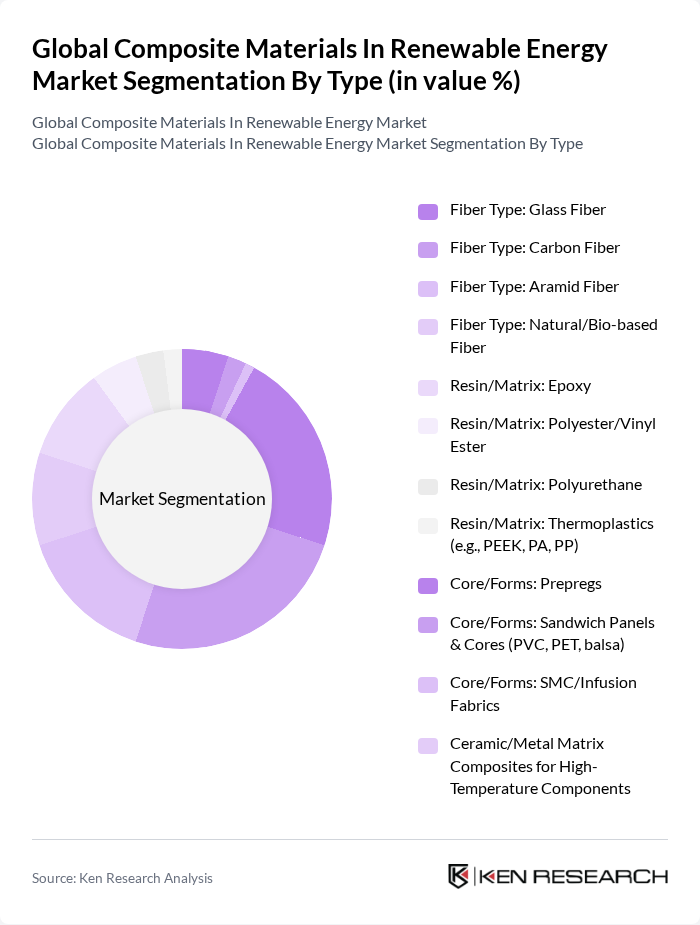
By Type:The market is segmented into various types of composite materials, including fiber types, resin/matrix types, core/forms, and ceramic/metal matrix composites. Each of these subsegments plays a crucial role in the performance and application of composite materials in renewable energy technologies.
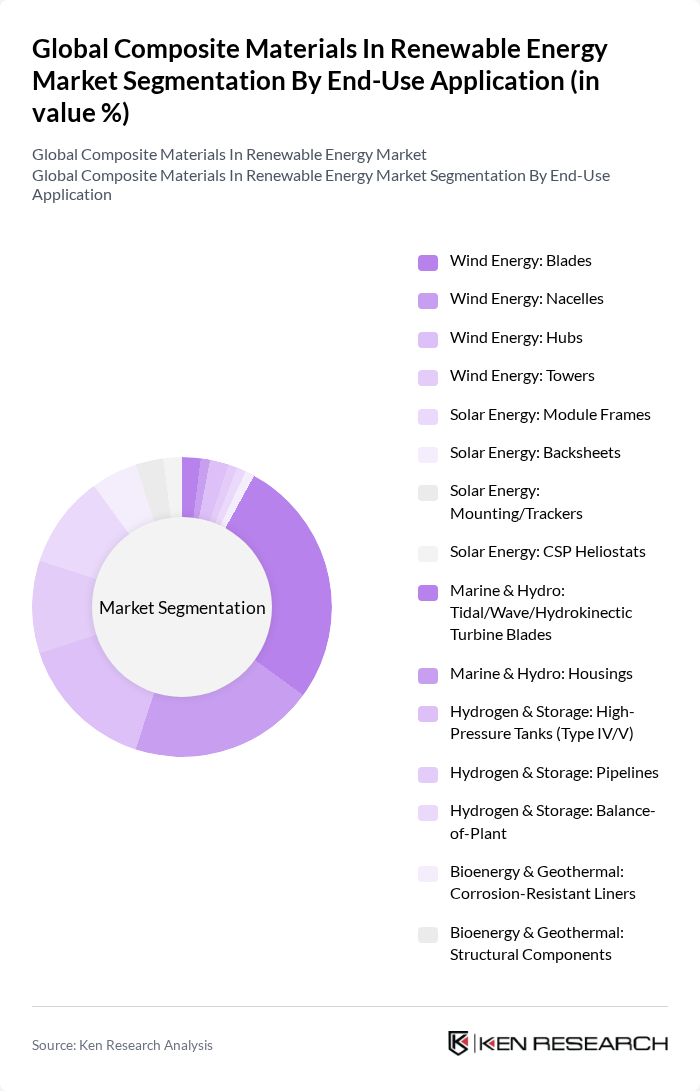
By End-Use Application:The market is also segmented based on end-use applications, which include wind energy, solar energy, marine & hydro, hydrogen & storage, and bioenergy & geothermal. Each application utilizes specific composite materials tailored to meet performance and durability requirements.
Global Composite Materials In Renewable Energy Market Competitive Landscape
The Global Composite Materials In Renewable Energy Market is characterized by a dynamic mix of regional and international players. Leading participants such as Hexcel Corporation, Toray Industries, Inc., Owens Corning, SGL Carbon SE, Mitsubishi Chemical Group Corporation, Teijin Limited, BASF SE, Solvay S.A., 3M Company, DuPont de Nemours, Inc., Covestro AG, Huntsman Corporation, AOC, LLC, Jushi Group Co., Ltd., Zoltek Companies, Inc., Gurit Holding AG, AOCOM (Ashland) Composites – INEOS Composites, Arkema S.A., DSM Engineering Materials (Avient Corporation), TPI Composites, Inc., LM Wind Power (GE Vernova), Jiangsu Hengshen Co., Ltd., Nanjing Fiberglass Research & Design Institute Co., Ltd. (NFG), BÜFA Composite Systems GmbH & Co. KG, Sicomin Epoxy Systems contribute to innovation, geographic expansion, and service delivery in this space.
Global Composite Materials In Renewable Energy Market Industry Analysis
Growth Drivers
- Increasing Demand for Renewable Energy Sources:The global renewable energy sector is projected to reach $2.15 trillion in future, driven by a surge in energy consumption and a shift towards sustainable practices. In future, renewable energy sources accounted for approximately 30% of global electricity generation, highlighting a robust demand for composite materials in wind and solar applications. This growth is supported by the International Energy Agency's forecast of a 50% increase in renewable energy capacity in future, emphasizing the need for advanced materials.
- Technological Advancements in Composite Materials:Innovations in composite materials, such as carbon fiber and bio-based composites, are enhancing performance and reducing weight in renewable energy applications. For instance, the development of lighter wind turbine blades has led to a 20% increase in energy efficiency. The global market for advanced composites is expected to reach $30 billion in future, driven by these technological advancements, which are crucial for improving the efficiency and sustainability of renewable energy systems.
- Government Initiatives and Incentives:Governments worldwide are implementing policies to promote renewable energy, with over $500 billion allocated in subsidies and incentives in future alone. The U.S. government’s Investment Tax Credit (ITC) and similar initiatives in Europe are encouraging investments in renewable energy projects, directly impacting the demand for composite materials. These initiatives are expected to create a favorable environment for market growth, as they lower the financial barriers for adopting advanced materials in renewable energy technologies.
Market Challenges
- High Initial Investment Costs:The adoption of composite materials in renewable energy systems often requires significant upfront investments, which can deter potential projects. For example, the average cost of wind turbine installation is around $1.3 million per megawatt, with composite materials adding to the overall expense. This financial barrier is particularly pronounced in developing regions, where access to capital is limited, hindering the growth of the composite materials market in renewable energy applications.
- Limited Awareness and Knowledge:There is a notable gap in understanding the benefits and applications of composite materials among stakeholders in the renewable energy sector. A survey conducted in future indicated that 60% of industry professionals lack comprehensive knowledge about advanced composites. This limited awareness can slow down the adoption of innovative materials, as decision-makers may hesitate to invest in technologies they do not fully understand, impacting market growth negatively.
Global Composite Materials In Renewable Energy Market Future Outlook
The future of composite materials in renewable energy appears promising, driven by ongoing technological advancements and increasing environmental regulations. As the global push for sustainability intensifies, the demand for lightweight, durable materials will rise. Innovations in smart technologies and circular economy practices are expected to reshape the industry landscape, fostering new applications and enhancing efficiency. Additionally, strategic partnerships among key players will likely accelerate the development of composite solutions tailored for renewable energy, ensuring a competitive edge in the market.
Market Opportunities
- Expansion into Emerging Markets:Emerging economies, particularly in Asia and Africa, present significant opportunities for the adoption of composite materials in renewable energy. With a projected investment of $1 trillion in renewable energy infrastructure in future, these regions are poised for growth. This expansion can lead to increased demand for advanced composites, as countries seek to modernize their energy systems and meet sustainability goals.
- Development of Innovative Composite Solutions:The ongoing research and development in composite materials, such as self-healing and recyclable composites, offer substantial market opportunities. The global investment in R&D for advanced materials is expected to exceed $50 billion in future. This focus on innovation can lead to the creation of more efficient and sustainable products, positioning companies to capitalize on the growing demand for eco-friendly solutions in renewable energy applications.
Scope of the Report
| Segment | Sub-Segments |
|---|---|
| By Type | Fiber Type: Glass Fiber, Carbon Fiber, Aramid Fiber, Natural/Bio-based Fiber Resin/Matrix: Epoxy, Polyester/Vinyl Ester, Polyurethane, Thermoplastics (e.g., PEEK, PA, PP) Core/Forms: Prepregs, Sandwich Panels & Cores (PVC, PET, balsa), SMC/Infusion Fabrics Ceramic/Metal Matrix Composites for High-Temperature Components |
| By End-Use Application | Wind Energy: Blades, Nacelles, Hubs, Towers Solar Energy: Module Frames, Backsheets, Mounting/Trackers, CSP Heliostats Marine & Hydro: Tidal/Wave/Hydrokinectic Turbine Blades, Housings Hydrogen & Storage: High-Pressure Tanks (Type IV/V), Pipelines, Balance-of-Plant Bioenergy & Geothermal: Corrosion-Resistant Liners, Structural Components |
| By Manufacturing Process | Vacuum Infusion/Resin Transfer Molding (VARTM/RTM) Prepreg/Autoclave and Out-of-Autoclave Pultrusion and Filament Winding Compression Molding (SMC/BMC) and Thermoplastic Stamp Forming Additive Manufacturing of Composites |
| By Technology Area | Onshore Wind Offshore Wind (Fixed and Floating) Photovoltaics (PV) Concentrated Solar Power (CSP) Marine Energy (Tidal, Wave, River Hydrokinetic) Hydrogen Storage & Transport |
| By Customer Type | OEMs (Wind Turbine, Solar, Marine Energy) Tier-1 Component Manufacturers (Blade Makers, Tank Makers) Utilities & IPPs EPCs and Project Developers |
| By Region | North America Europe Asia-Pacific Latin America Middle East & Africa |
| By Sustainability Attribute | Recyclable/Thermoplastic Composite Systems Bio-based Fibers and Resins Circularity: Reuse/Repurpose of Blades and Components |
Key Target Audience
Investors and Venture Capitalist Firms
Government and Regulatory Bodies (e.g., U.S. Department of Energy, European Commission)
Manufacturers and Producers of Composite Materials
Renewable Energy Project Developers
Energy Utility Companies
Industry Associations (e.g., Composite Materials Association)
Financial Institutions and Banks
Environmental NGOs and Advocacy Groups
Players Mentioned in the Report:
Hexcel Corporation
Toray Industries, Inc.
Owens Corning
SGL Carbon SE
Mitsubishi Chemical Group Corporation
Teijin Limited
BASF SE
Solvay S.A.
3M Company
DuPont de Nemours, Inc.
Covestro AG
Huntsman Corporation
AOC, LLC
Jushi Group Co., Ltd.
Zoltek Companies, Inc.
Gurit Holding AG
AOCOM (Ashland) Composites INEOS Composites
Arkema S.A.
DSM Engineering Materials (Avient Corporation)
TPI Composites, Inc.
LM Wind Power (GE Vernova)
Jiangsu Hengshen Co., Ltd.
Nanjing Fiberglass Research & Design Institute Co., Ltd. (NFG)
BUFA Composite Systems GmbH & Co. KG
Sicomin Epoxy Systems
Table of Contents
Market Assessment Phase
1. Executive Summary and Approach
2. Global Composite Materials In Renewable Energy Market Overview
2.1 Key Insights and Strategic Recommendations
2.2 Global Composite Materials In Renewable Energy Market Overview
2.3 Definition and Scope
2.4 Evolution of Market Ecosystem
2.5 Timeline of Key Regulatory Milestones
2.6 Value Chain & Stakeholder Mapping
2.7 Business Cycle Analysis
2.8 Policy & Incentive Landscape
3. Global Composite Materials In Renewable Energy Market Analysis
3.1 Growth Drivers
3.1.1 Increasing Demand for Renewable Energy Sources
3.1.2 Technological Advancements in Composite Materials
3.1.3 Government Initiatives and Incentives
3.1.4 Rising Environmental Concerns and Sustainability Goals
3.2 Market Challenges
3.2.1 High Initial Investment Costs
3.2.2 Limited Awareness and Knowledge
3.2.3 Supply Chain Disruptions
3.2.4 Regulatory Compliance Issues
3.3 Market Opportunities
3.3.1 Expansion into Emerging Markets
3.3.2 Development of Innovative Composite Solutions
3.3.3 Strategic Partnerships and Collaborations
3.3.4 Increasing Investment in R&D
3.4 Market Trends
3.4.1 Shift Towards Lightweight Materials
3.4.2 Integration of Smart Technologies
3.4.3 Circular Economy Practices
3.4.4 Customization and Personalization of Products
3.5 Government Regulation
3.5.1 Renewable Energy Standards and Certifications
3.5.2 Environmental Protection Regulations
3.5.3 Incentives for Renewable Energy Projects
3.5.4 Import and Export Regulations on Composite Materials
4. SWOT Analysis
5. Stakeholder Analysis
6. Porter's Five Forces Analysis
7. Global Composite Materials In Renewable Energy Market Market Size, 2019-2024
7.1 By Value
7.2 By Volume
7.3 By Average Selling Price
8. Global Composite Materials In Renewable Energy Market Segmentation
8.1 By Type
8.1.1 Fiber Type: Glass Fiber, Carbon Fiber, Aramid Fiber, Natural/Bio-based Fiber
8.1.2 Resin/Matrix: Epoxy, Polyester/Vinyl Ester, Polyurethane, Thermoplastics (e.g., PEEK, PA, PP)
8.1.3 Core/Forms: Prepregs, Sandwich Panels & Cores (PVC, PET, balsa), SMC/Infusion Fabrics
8.1.4 Ceramic/Metal Matrix Composites for High-Temperature Components
8.2 By End-Use Application
8.2.1 Wind Energy: Blades, Nacelles, Hubs, Towers
8.2.2 Solar Energy: Module Frames, Backsheets, Mounting/Trackers, CSP Heliostats
8.2.3 Marine & Hydro: Tidal/Wave/Hydrokinectic Turbine Blades, Housings
8.2.4 Hydrogen & Storage: High-Pressure Tanks (Type IV/V), Pipelines, Balance-of-Plant
8.2.5 Bioenergy & Geothermal: Corrosion-Resistant Liners, Structural Components
8.3 By Manufacturing Process
8.3.1 Vacuum Infusion/Resin Transfer Molding (VARTM/RTM)
8.3.2 Prepreg/Autoclave and Out-of-Autoclave
8.3.3 Pultrusion and Filament Winding
8.3.4 Compression Molding (SMC/BMC) and Thermoplastic Stamp Forming
8.3.5 Additive Manufacturing of Composites
8.4 By Technology Area
8.4.1 Onshore Wind
8.4.2 Offshore Wind (Fixed and Floating)
8.4.3 Photovoltaics (PV)
8.4.4 Concentrated Solar Power (CSP)
8.4.5 Marine Energy (Tidal, Wave, River Hydrokinetic)
8.4.6 Hydrogen Storage & Transport
8.5 By Customer Type
8.5.1 OEMs (Wind Turbine, Solar, Marine Energy)
8.5.2 Tier-1 Component Manufacturers (Blade Makers, Tank Makers)
8.5.3 Utilities & IPPs
8.5.4 EPCs and Project Developers
8.6 By Region
8.6.1 North America
8.6.2 Europe
8.6.3 Asia-Pacific
8.6.4 Latin America
8.6.5 Middle East & Africa
8.7 By Sustainability Attribute
8.7.1 Recyclable/Thermoplastic Composite Systems
8.7.2 Bio-based Fibers and Resins
8.7.3 Circularity: Reuse/Repurpose of Blades and Components
9. Global Composite Materials In Renewable Energy Market Competitive Analysis
9.1 Market Share of Key Players
9.2 Cross Comparison of Key Players
9.2.1 Company Name
9.2.2 Renewable-Energy Revenue Share (%)
9.2.3 Wind Blade Materials Revenue (USD) and CAGR
9.2.4 Installed Base Supported (GW-equivalent of blades/tanks using supplier materials)
9.2.5 Material Portfolio Breadth (Glass, Carbon, Resins, Prepregs, Thermoplastics)
9.2.6 Qualification Footprint (OEM/Tier-1 qualifications: Vestas, Siemens Gamesa, GE Vernova, LM Wind Power, etc.)
9.2.7 Innovation Pipeline (Patents, recyclable/thermoplastic platforms, bio-based content)
9.2.8 Manufacturing Capacity & Localization (plants by region; offshore-ready capacity)
9.2.9 Supply Chain Reliability (lead times, fiber/resin availability, dual-sourcing)
9.2.10 Quality & Certification (DNV/GL, ISO, IEC compliance; defect rates/PPM)
9.2.11 Pricing/Cost Position (ASP trends, cost per kg per performance vs peers)
9.2.12 Sustainability Metrics (recyclability, Scope 1-3 intensity, LCA disclosure)
9.3 SWOT Analysis of Top Players
9.4 Pricing Analysis
9.5 Detailed Profile of Major Companies
9.5.1 Hexcel Corporation
9.5.2 Toray Industries, Inc.
9.5.3 Owens Corning
9.5.4 SGL Carbon SE
9.5.5 Mitsubishi Chemical Group Corporation
9.5.6 Teijin Limited
9.5.7 BASF SE
9.5.8 Solvay S.A.
9.5.9 3M Company
9.5.10 DuPont de Nemours, Inc.
9.5.11 Covestro AG
9.5.12 Huntsman Corporation
9.5.13 AOC, LLC
9.5.14 Jushi Group Co., Ltd.
9.5.15 Zoltek Companies, Inc.
9.5.16 Gurit Holding AG
9.5.17 AOCOM (Ashland) Composites – INEOS Composites
9.5.18 Arkema S.A.
9.5.19 DSM Engineering Materials (Avient Corporation)
9.5.20 TPI Composites, Inc.
9.5.21 LM Wind Power (GE Vernova)
9.5.22 Jiangsu Hengshen Co., Ltd.
9.5.23 Nanjing Fiberglass Research & Design Institute Co., Ltd. (NFG)
9.5.24 BÜFA Composite Systems GmbH & Co. KG
9.5.25 Sicomin Epoxy Systems
10. Global Composite Materials In Renewable Energy Market End-User Analysis
10.1 Procurement Behavior of Key Ministries
10.1.1 Budget Allocation Trends
10.1.2 Decision-Making Processes
10.1.3 Preferred Procurement Channels
10.2 Corporate Spend on Infrastructure & Energy
10.2.1 Investment Priorities
10.2.2 Spending Patterns by Sector
10.2.3 Long-term Financial Commitments
10.3 Pain Point Analysis by End-User Category
10.3.1 Cost Management Challenges
10.3.2 Quality Assurance Issues
10.3.3 Supply Chain Disruptions
10.4 User Readiness for Adoption
10.4.1 Awareness Levels
10.4.2 Training and Support Needs
10.4.3 Technology Acceptance Rates
10.5 Post-Deployment ROI and Use Case Expansion
10.5.1 Performance Metrics
10.5.2 Case Studies of Successful Implementations
10.5.3 Future Expansion Opportunities
11. Global Composite Materials In Renewable Energy Market Future Size, 2025-2030
11.1 By Value
11.2 By Volume
11.3 By Average Selling Price
Go-To-Market Strategy Phase
1. Whitespace Analysis + Business Model Canvas
1.1 Market Gaps Identification
1.2 Value Proposition Development
1.3 Revenue Streams Analysis
1.4 Cost Structure Evaluation
1.5 Key Partnerships Exploration
1.6 Customer Segmentation
1.7 Channels and Customer Relationships
2. Marketing and Positioning Recommendations
2.1 Branding Strategies
2.2 Product USPs
3. Distribution Plan
3.1 Urban Retail vs Rural NGO Tie-ups
4. Channel & Pricing Gaps
4.1 Underserved Routes
4.2 Pricing Bands
5. Unmet Demand & Latent Needs
5.1 Category Gaps
5.2 Consumer Segments
6. Customer Relationship
6.1 Loyalty Programs
6.2 After-sales Service
7. Value Proposition
7.1 Sustainability
7.2 Integrated Supply Chains
8. Key Activities
8.1 Regulatory Compliance
8.2 Branding
8.3 Distribution Setup
9. Entry Strategy Evaluation
9.1 Domestic Market Entry Strategy
9.1.1 Product Mix
9.1.2 Pricing Band
9.1.3 Packaging
9.2 Export Entry Strategy
9.2.1 Target Countries
9.2.2 Compliance Roadmap
10. Entry Mode Assessment
10.1 Joint Ventures
10.2 Greenfield Investments
10.3 Mergers & Acquisitions
10.4 Distributor Model
11. Capital and Timeline Estimation
11.1 Capital Requirements
11.2 Timelines
12. Control vs Risk Trade-Off
12.1 Ownership vs Partnerships
13. Profitability Outlook
13.1 Breakeven Analysis
13.2 Long-term Sustainability
14. Potential Partner List
14.1 Distributors
14.2 Joint Ventures
14.3 Acquisition Targets
15. Execution Roadmap
15.1 Phased Plan for Market Entry
15.1.1 Market Setup
15.1.2 Market Entry
15.1.3 Growth Acceleration
15.1.4 Scale & Stabilize
15.2 Key Activities and Milestones
15.2.1 Milestone Planning
15.2.2 Activity Tracking
Research Methodology
Phase 1: Approach1
Desk Research
- Analysis of industry reports from renewable energy associations and composite material organizations
- Review of academic journals and publications focusing on advancements in composite materials for renewable energy applications
- Examination of government and regulatory body publications related to renewable energy policies and material standards
Primary Research
- Interviews with R&D heads at leading renewable energy firms utilizing composite materials
- Surveys with engineers and product managers involved in the design and application of composite materials in energy systems
- Field interviews with project managers overseeing renewable energy installations using composite technologies
Validation & Triangulation
- Cross-validation of findings through multiple data sources including market reports and expert opinions
- Triangulation of data from industry experts, academic research, and market trends
- Sanity checks conducted through expert panel discussions to ensure data accuracy and relevance
Phase 2: Market Size Estimation1
Top-down Assessment
- Estimation of the global market size based on renewable energy sector growth rates and composite material adoption
- Segmentation of the market by application areas such as wind energy, solar energy, and energy storage systems
- Incorporation of regional market dynamics and government incentives for renewable energy projects
Bottom-up Modeling
- Collection of data on production volumes and pricing from leading composite material manufacturers
- Estimation of market size based on the volume of composite materials used in renewable energy applications
- Analysis of cost structures and pricing strategies of composite materials in the renewable energy sector
Forecasting & Scenario Analysis
- Development of forecasting models based on historical data and projected growth in renewable energy investments
- Scenario analysis considering factors such as technological advancements and shifts in regulatory frameworks
- Creation of baseline, optimistic, and pessimistic forecasts for market growth through 2030
Phase 3: CATI Sample Composition1
| Scope Item/Segment | Sample Size | Target Respondent Profiles |
|---|---|---|
| Wind Energy Composite Applications | 120 | Project Engineers, Materials Scientists |
| Solar Panel Manufacturing | 85 | Production Managers, Quality Assurance Specialists |
| Energy Storage Solutions | 75 | Product Development Engineers, Supply Chain Managers |
| Composite Material Suppliers | 95 | Sales Directors, Technical Support Engineers |
| Research Institutions in Renewable Energy | 60 | Research Analysts, Academic Professors |
Frequently Asked Questions
What is the current value of the Global Composite Materials in Renewable Energy Market?
The Global Composite Materials in Renewable Energy Market is valued at approximately USD 2728 billion, primarily driven by demand in wind turbine composites, which dominate the market, alongside applications in solar, marine, and hydrogen sectors.
Which countries are leading in the Composite Materials in Renewable Energy Market?
What are the key applications of composite materials in renewable energy?
What types of composite materials are used in renewable energy?
Other Regional/Country Reports
Indonesia Composite Materials In Renewable Energy Market
Malaysia Composite Materials In Renewable Energy Market
APAC Composite Materials In Renewable Energy Market
SEA Composite Materials In Renewable Energy Market
Why Buy From Us?

What makes us stand out is that our consultants follow Robust, Refine and Result (RRR) methodology. Robust for clear definitions, approaches and sanity checking, Refine for differentiating respondents' facts and opinions, and Result for presenting data with story.

We have set a benchmark in the industry by offering our clients with syndicated and customized market research reports featuring coverage of entire market as well as meticulous research and analyst insights.

While we don't replace traditional research, we flip the method upside down. Our dual approach of Top Bottom & Bottom Top ensures quality deliverable by not just verifying company fundamentals but also looking at the sector and macroeconomic factors.

With one step in the future, our research team constantly tries to show you the bigger picture. We help with some of the tough questions you may encounter along the way: How is the industry positioned? Best marketing channel? KPI's of competitors? By aligning every element, we help maximize success.

Our report gives you instant access to the answers and sources that other companies might choose to hide. We elaborate each steps of research methodology we have used and showcase you the sample size to earn your trust.

If you need any support, we are here! We pride ourselves on universe strength, data quality, and quick, friendly, and professional service.