About the Report
Base Year 2024Listen to the audio summary
Global DNA Sequencing Market Overview
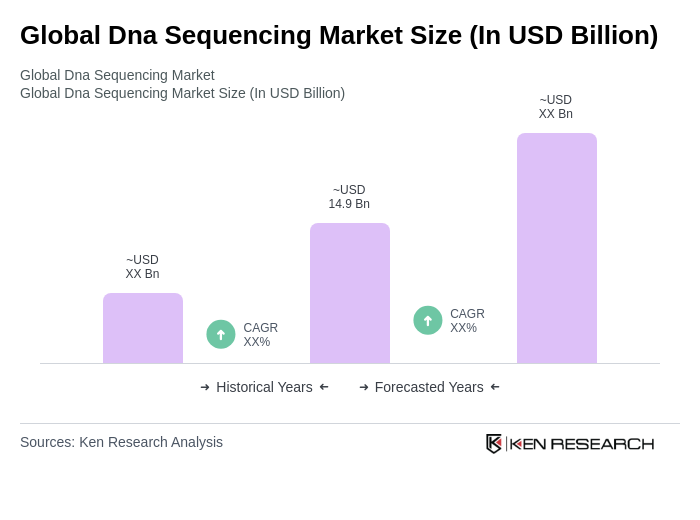
- The Global DNA Sequencing Market is valued at USD 14.9 billion, based on a five-year historical analysis. This growth is primarily driven by advancements in sequencing technologies, increasing applications in personalized medicine, and rising investments in genomics research. The demand for rapid and accurate sequencing methods has surged, particularly in clinical diagnostics and drug discovery, contributing significantly to the market's expansion. Recent trends include the integration of next-generation sequencing (NGS) into healthcare systems, expansion into precision medicine, and wider adoption in oncology and rare disease diagnostics .
- Key players in this market include the United States, Germany, and China, which dominate due to their robust healthcare infrastructure, significant research funding, and a high concentration of biotechnology firms. The presence of leading companies and research institutions in these regions fosters innovation and accelerates the adoption of DNA sequencing technologies, further solidifying their market leadership. North America, particularly the United States, leads the market owing to strong R&D investment, advanced healthcare infrastructure, and active government support for genomics initiatives .
- In 2023, the U.S. government implemented the Genomic Data Sharing Policy, which mandates that all federally funded genomic research data be made publicly available. This regulation aims to enhance transparency and collaboration in genomic research, ultimately accelerating advancements in personalized medicine and public health initiatives. The policy supports broader access to genomic datasets, facilitating research in cancer, rare diseases, and population health .
Global DNA Sequencing Market Segmentation
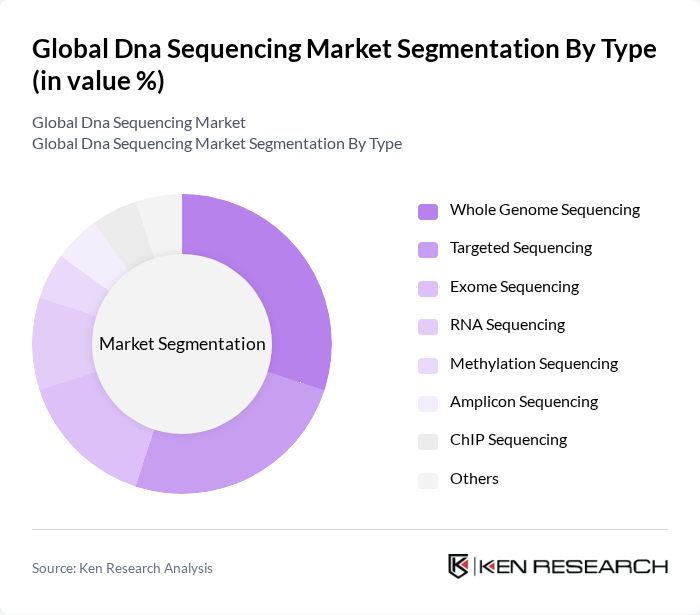
By Type:The market is segmented into various types of DNA sequencing methods, including Whole Genome Sequencing, Targeted Sequencing, Exome Sequencing, RNA Sequencing, Methylation Sequencing, Amplicon Sequencing, ChIP Sequencing, and Others. Each of these methods serves distinct purposes in research and clinical applications, catering to diverse consumer needs. Whole Genome Sequencing is primarily used for comprehensive genetic analysis, Targeted Sequencing for specific gene panels, Exome Sequencing for protein-coding regions, RNA Sequencing for transcriptome profiling, Methylation Sequencing for epigenetic studies, Amplicon Sequencing for variant detection in targeted regions, and ChIP Sequencing for DNA-protein interaction studies .
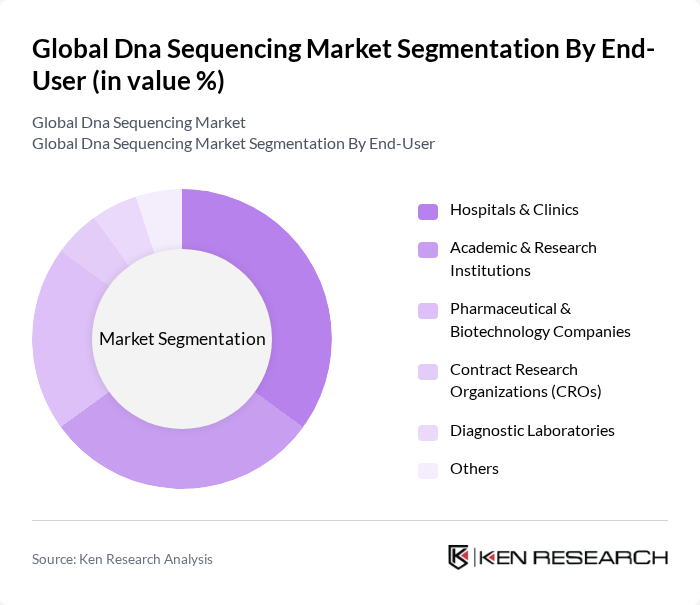
By End-User:The market is categorized based on end-users, including Hospitals & Clinics, Academic & Research Institutions, Pharmaceutical & Biotechnology Companies, Contract Research Organizations (CROs), Diagnostic Laboratories, and Others. Each segment plays a crucial role in driving the demand for DNA sequencing technologies, influenced by their specific research and clinical needs. Hospitals & Clinics utilize sequencing for clinical diagnostics and personalized medicine; Academic & Research Institutions focus on genomics research and technology development; Pharmaceutical & Biotechnology Companies leverage sequencing for drug discovery and biomarker identification; CROs provide outsourced sequencing services for clinical trials; Diagnostic Laboratories employ sequencing for genetic testing and disease screening .
Global DNA Sequencing Market Competitive Landscape
The Global DNA Sequencing Market is characterized by a dynamic mix of regional and international players. Leading participants such as Illumina, Inc., Thermo Fisher Scientific Inc., BGI Genomics Co., Ltd., Roche Sequencing Solutions, Agilent Technologies, Inc., Pacific Biosciences of California, Inc., QIAGEN N.V., Oxford Nanopore Technologies Ltd., Genomatix GmbH, Eurofins Scientific SE, PerkinElmer, Inc., Bio-Rad Laboratories, Inc., 10x Genomics, Inc., Zymo Research Corporation, F. Hoffmann-La Roche AG contribute to innovation, geographic expansion, and service delivery in this space.
Global Dna Sequencing Market Industry Analysis
Growth Drivers
- Increasing Demand for Personalized Medicine:The global personalized medicine market is projected to reach $2.45 trillion in future, driven by advancements in DNA sequencing technologies. This surge is fueled by the growing recognition of tailored therapies that enhance treatment efficacy. In future, approximately 70% of new drug approvals were linked to genomic data, highlighting the critical role of DNA sequencing in developing personalized treatment plans, thereby propelling market growth in the None region.
- Advancements in Sequencing Technologies:The DNA sequencing technology landscape is evolving rapidly, with next-generation sequencing (NGS) costs dropping to around $600 per genome in future. This reduction has made sequencing more accessible, leading to increased adoption in clinical settings. Furthermore, the introduction of portable sequencers is expected to enhance field applications, particularly in remote areas, thereby expanding the market reach and driving growth in the None region.
- Rising Prevalence of Genetic Disorders:The World Health Organization reported that genetic disorders affect approximately 1 in 17 individuals globally, translating to over 500 million people. This alarming statistic has intensified the demand for genetic testing and sequencing services. In future, the focus on early diagnosis and preventive healthcare is expected to further increase the utilization of DNA sequencing, particularly in the None region, as healthcare systems prioritize genetic insights for better patient outcomes.
Market Challenges
- High Costs of Sequencing Technologies:Despite advancements, the initial investment for high-throughput sequencing platforms can exceed $1 million, posing a significant barrier for smaller laboratories and healthcare facilities. This financial hurdle limits access to cutting-edge sequencing technologies, particularly in developing regions. As a result, many institutions may struggle to implement comprehensive genomic testing programs, hindering overall market growth in the None region.
- Data Management and Analysis Complexities:The volume of data generated by DNA sequencing is immense, with a single human genome producing approximately 200 gigabytes of raw data. Managing, storing, and analyzing this data presents significant challenges for healthcare providers. In future, the lack of standardized protocols and skilled personnel in bioinformatics may impede the effective utilization of genomic data, creating bottlenecks in the adoption of sequencing technologies in the None region.
Global Dna Sequencing Market Future Outlook
The future of the DNA sequencing market in the None region appears promising, driven by technological innovations and increasing healthcare investments. As the demand for personalized medicine continues to rise, advancements in sequencing technologies will likely enhance accessibility and affordability. Additionally, the integration of artificial intelligence in genomic data analysis is expected to streamline processes, making it easier for healthcare providers to interpret complex genetic information and improve patient care outcomes.
Market Opportunities
- Expansion of Applications in Agriculture:The agricultural sector is increasingly adopting DNA sequencing for crop improvement and pest resistance. In future, the global market for agricultural genomics is projected to reach $5 billion, presenting significant opportunities for DNA sequencing technologies to enhance food security and sustainability in the None region.
- Growth in Companion Diagnostics:The companion diagnostics market is expected to grow to $6.5 billion in future, driven by the need for personalized therapies. DNA sequencing plays a crucial role in identifying suitable patients for targeted treatments, creating opportunities for collaboration between diagnostic companies and pharmaceutical firms in the None region.
Scope of the Report
| Segment | Sub-Segments |
|---|---|
| By Type | Whole Genome Sequencing Targeted Sequencing Exome Sequencing RNA Sequencing Methylation Sequencing Amplicon Sequencing ChIP Sequencing Others |
| By End-User | Hospitals & Clinics Academic & Research Institutions Pharmaceutical & Biotechnology Companies Contract Research Organizations (CROs) Diagnostic Laboratories Others |
| By Application | Oncology Clinical Diagnostics Drug Discovery & Development Reproductive Health Agriculture & Animal Research Forensic Science Microbiology & Infectious Disease Others |
| By Region | North America Europe Asia-Pacific Latin America Middle East & Africa |
| By Technology | Sanger Sequencing Next-Generation Sequencing (NGS) Third-Generation Sequencing (Single-Molecule, Real-Time, Nanopore, etc.) Others |
| By Sales Channel | Direct Sales Distributors Online Sales Others |
| By Pricing Model | Subscription-Based Pay-Per-Use Bundled Services Others |
Key Target Audience
Investors and Venture Capitalist Firms
Government and Regulatory Bodies (e.g., National Institutes of Health, Food and Drug Administration)
Biotechnology and Pharmaceutical Companies
Clinical Laboratories and Diagnostic Centers
Healthcare Providers and Hospitals
Genomic Data Analysis Companies
Biobanks and Research Organizations
Healthcare Insurance Providers
Players Mentioned in the Report:
Illumina, Inc.
Thermo Fisher Scientific Inc.
BGI Genomics Co., Ltd.
Roche Sequencing Solutions
Agilent Technologies, Inc.
Pacific Biosciences of California, Inc.
QIAGEN N.V.
Oxford Nanopore Technologies Ltd.
Genomatix GmbH
Eurofins Scientific SE
PerkinElmer, Inc.
Bio-Rad Laboratories, Inc.
10x Genomics, Inc.
Zymo Research Corporation
F. Hoffmann-La Roche AG
Table of Contents
Market Assessment Phase
1. Executive Summary and Approach
2. Global Dna Sequencing Market Overview
2.1 Key Insights and Strategic Recommendations
2.2 Global Dna Sequencing Market Overview
2.3 Definition and Scope
2.4 Evolution of Market Ecosystem
2.5 Timeline of Key Regulatory Milestones
2.6 Value Chain & Stakeholder Mapping
2.7 Business Cycle Analysis
2.8 Policy & Incentive Landscape
3. Global Dna Sequencing Market Analysis
3.1 Growth Drivers
3.1.1 Increasing demand for personalized medicine
3.1.2 Advancements in sequencing technologies
3.1.3 Rising prevalence of genetic disorders
3.1.4 Government funding for genomics research
3.2 Market Challenges
3.2.1 High costs of sequencing technologies
3.2.2 Data management and analysis complexities
3.2.3 Ethical and privacy concerns
3.2.4 Limited reimbursement policies
3.3 Market Opportunities
3.3.1 Expansion of applications in agriculture
3.3.2 Growth in companion diagnostics
3.3.3 Increasing collaborations in research
3.3.4 Development of cost-effective sequencing solutions
3.4 Market Trends
3.4.1 Rise of next-generation sequencing (NGS)
3.4.2 Integration of AI in genomic data analysis
3.4.3 Shift towards decentralized sequencing
3.4.4 Growing focus on liquid biopsy technologies
3.5 Government Regulation
3.5.1 FDA guidelines on genetic testing
3.5.2 GDPR compliance for genetic data
3.5.3 National health policies promoting genomics
3.5.4 Regulations on data sharing and privacy
4. SWOT Analysis
5. Stakeholder Analysis
6. Porter's Five Forces Analysis
7. Global Dna Sequencing Market Market Size, 2019-2024
7.1 By Value
7.2 By Volume
7.3 By Average Selling Price
8. Global Dna Sequencing Market Segmentation
8.1 By Type
8.1.1 Whole Genome Sequencing
8.1.2 Targeted Sequencing
8.1.3 Exome Sequencing
8.1.4 RNA Sequencing
8.1.5 Methylation Sequencing
8.1.6 Amplicon Sequencing
8.1.7 ChIP Sequencing
8.1.8 Others
8.2 By End-User
8.2.1 Hospitals & Clinics
8.2.2 Academic & Research Institutions
8.2.3 Pharmaceutical & Biotechnology Companies
8.2.4 Contract Research Organizations (CROs)
8.2.5 Diagnostic Laboratories
8.2.6 Others
8.3 By Application
8.3.1 Oncology
8.3.2 Clinical Diagnostics
8.3.3 Drug Discovery & Development
8.3.4 Reproductive Health
8.3.5 Agriculture & Animal Research
8.3.6 Forensic Science
8.3.7 Microbiology & Infectious Disease
8.3.8 Others
8.4 By Region
8.4.1 North America
8.4.2 Europe
8.4.3 Asia-Pacific
8.4.4 Latin America
8.4.5 Middle East & Africa
8.5 By Technology
8.5.1 Sanger Sequencing
8.5.2 Next-Generation Sequencing (NGS)
8.5.3 Third-Generation Sequencing (Single-Molecule, Real-Time, Nanopore, etc.)
8.5.4 Others
8.6 By Sales Channel
8.6.1 Direct Sales
8.6.2 Distributors
8.6.3 Online Sales
8.6.4 Others
8.7 By Pricing Model
8.7.1 Subscription-Based
8.7.2 Pay-Per-Use
8.7.3 Bundled Services
8.7.4 Others
9. Global Dna Sequencing Market Competitive Analysis
9.1 Market Share of Key Players
9.2 Cross Comparison of Key Players
9.2.1 Company Name
9.2.2 Company Size (by Revenue/Employees)
9.2.3 Revenue Growth Rate (CAGR %)
9.2.4 Global Market Share (%)
9.2.5 R&D Investment as % of Revenue
9.2.6 Number of Patents/Intellectual Property Filings
9.2.7 Product Portfolio Breadth (Number of Sequencing Platforms/Services)
9.2.8 Geographic Presence (Number of Countries/Regions)
9.2.9 Strategic Partnerships/Collaborations (Count)
9.2.10 Customer Segments Served (e.g., clinical, research, pharma)
9.2.11 Pricing Strategy
9.2.12 Product Innovation Rate (New Launches per Year)
9.2.13 Operational Efficiency (Gross Margin %)
9.2.14 Market Expansion Rate (New Markets Entered per Year)
9.2.15 Customer Satisfaction Score (NPS or Equivalent)
9.3 SWOT Analysis of Top Players
9.4 Pricing Analysis
9.5 Detailed Profile of Major Companies
9.5.1 Illumina, Inc.
9.5.2 Thermo Fisher Scientific Inc.
9.5.3 BGI Genomics Co., Ltd.
9.5.4 Roche Sequencing Solutions
9.5.5 Agilent Technologies, Inc.
9.5.6 Pacific Biosciences of California, Inc.
9.5.7 QIAGEN N.V.
9.5.8 Oxford Nanopore Technologies Ltd.
9.5.9 Genomatix GmbH
9.5.10 Eurofins Scientific SE
9.5.11 PerkinElmer, Inc.
9.5.12 Bio-Rad Laboratories, Inc.
9.5.13 10x Genomics, Inc.
9.5.14 Zymo Research Corporation
9.5.15 F. Hoffmann-La Roche AG
10. Global Dna Sequencing Market End-User Analysis
10.1 Procurement Behavior of Key Ministries
10.1.1 Government funding for genomics
10.1.2 Collaboration with research institutions
10.1.3 Regulatory compliance requirements
10.1.4 Budget allocation for health initiatives
10.2 Corporate Spend on Infrastructure & Energy
10.2.1 Investment in genomic research facilities
10.2.2 Funding for technology upgrades
10.2.3 Expenditure on training and development
10.3 Pain Point Analysis by End-User Category
10.3.1 High costs of sequencing services
10.3.2 Limited access to advanced technologies
10.3.3 Data management challenges
10.4 User Readiness for Adoption
10.4.1 Awareness of genomic technologies
10.4.2 Training needs for end-users
10.4.3 Infrastructure readiness
10.5 Post-Deployment ROI and Use Case Expansion
10.5.1 Evaluation of cost savings
10.5.2 Expansion into new applications
10.5.3 Long-term benefits of genomic data
11. Global Dna Sequencing Market Future Size, 2025-2030
11.1 By Value
11.2 By Volume
11.3 By Average Selling Price
Go-To-Market Strategy Phase
1. Whitespace Analysis + Business Model Canvas
1.1
2. Marketing and Positioning Recommendations
2.1
3. Distribution Plan
3.1
4. Channel & Pricing Gaps
4.1
5. Unmet Demand & Latent Needs
5.1
6. Customer Relationship
7.1
7. Value Proposition
8.1
8. Key Activities
9.1
9. Entry Strategy Evaluation
9.1 Domestic Market Entry Strategy
10.1.1
9.2 Export Entry Strategy
10.2.1
10. Entry Mode Assessment
11.1
11. Capital and Timeline Estimation
12.1
12. Control vs Risk Trade-Off
13.1
13. Profitability Outlook
14.1
14. Potential Partner List
15.1
15. Execution Roadmap
15.1 Phased Plan for Market Entry
16.1.1
15.2 Key Activities and Milestones
16.2.1
Research Methodology
Phase 1: Approach1
Desk Research
- Analysis of market reports from industry associations such as the Global Alliance for Genomics and Health
- Review of scientific publications and journals focusing on advancements in DNA sequencing technologies
- Examination of regulatory frameworks and guidelines from health authorities and genomic research institutions
Primary Research
- Interviews with key opinion leaders in genomics, including researchers and clinical practitioners
- Surveys targeting laboratory managers and directors in hospitals and research institutions
- Focus groups with biotechnology firms to understand their R&D priorities and market needs
Validation & Triangulation
- Cross-validation of findings through multiple data sources, including academic and industry reports
- Triangulation of market trends with insights from expert panels and industry conferences
- Sanity checks through comparative analysis of historical market data and growth trajectories
Phase 2: Market Size Estimation1
Top-down Assessment
- Estimation of the global DNA sequencing market size based on healthcare expenditure and genomic research funding
- Segmentation by application areas such as clinical diagnostics, drug discovery, and personalized medicine
- Incorporation of trends in genomic data usage and advancements in sequencing technologies
Bottom-up Modeling
- Collection of sales data from leading DNA sequencing technology providers and service laboratories
- Estimation of market share based on product offerings and service capabilities
- Volume and pricing analysis for various sequencing platforms and services
Forecasting & Scenario Analysis
- Multi-factor regression analysis incorporating factors such as technological advancements and regulatory changes
- Scenario modeling based on potential market disruptions and emerging applications in genomics
- Development of baseline, optimistic, and pessimistic forecasts through 2030
Phase 3: CATI Sample Composition1
| Scope Item/Segment | Sample Size | Target Respondent Profiles |
|---|---|---|
| Clinical Diagnostics | 70 | Clinical Lab Directors, Pathologists |
| Research Institutions | 60 | Genomics Researchers, Lab Managers |
| Biotechnology Firms | 40 | R&D Heads, Product Development Managers |
| Pharmaceutical Companies | 50 | Drug Development Scientists, Regulatory Affairs Specialists |
| Healthcare Providers | 45 | Oncologists, Genetic Counselors |
Frequently Asked Questions
What is the current value of the Global DNA Sequencing Market?
The Global DNA Sequencing Market is valued at approximately USD 14.9 billion, driven by advancements in sequencing technologies, personalized medicine applications, and increased investments in genomics research.
What are the key drivers of growth in the DNA Sequencing Market?
Which regions dominate the Global DNA Sequencing Market?
What are the main types of DNA sequencing methods?
Other Regional/Country Reports
Indonesia Dna Sequencing Market
Malaysia Dna Sequencing Market
APAC Dna Sequencing Market
Why Buy From Us?

What makes us stand out is that our consultants follow Robust, Refine and Result (RRR) methodology. Robust for clear definitions, approaches and sanity checking, Refine for differentiating respondents' facts and opinions, and Result for presenting data with story.

We have set a benchmark in the industry by offering our clients with syndicated and customized market research reports featuring coverage of entire market as well as meticulous research and analyst insights.

While we don't replace traditional research, we flip the method upside down. Our dual approach of Top Bottom & Bottom Top ensures quality deliverable by not just verifying company fundamentals but also looking at the sector and macroeconomic factors.

With one step in the future, our research team constantly tries to show you the bigger picture. We help with some of the tough questions you may encounter along the way: How is the industry positioned? Best marketing channel? KPI's of competitors? By aligning every element, we help maximize success.

Our report gives you instant access to the answers and sources that other companies might choose to hide. We elaborate each steps of research methodology we have used and showcase you the sample size to earn your trust.

If you need any support, we are here! We pride ourselves on universe strength, data quality, and quick, friendly, and professional service.