About the Report
Base Year 2024Global Egg Freezing Embryo Banking Market Overview
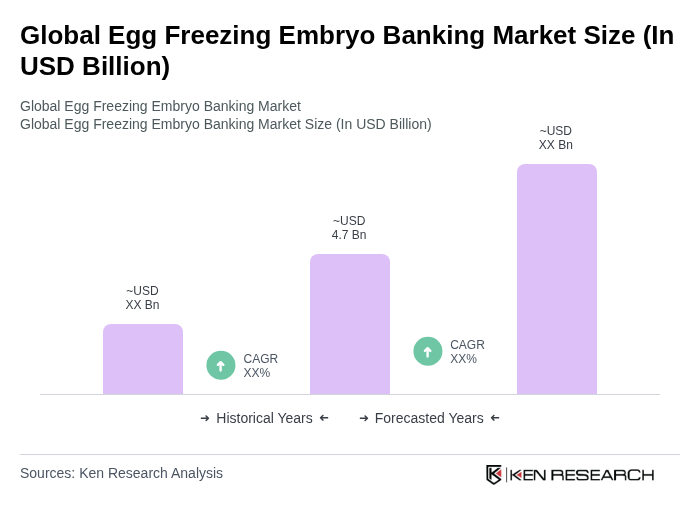
- The Global Egg Freezing Embryo Banking Market is valued at USD 4.7 billion, based on a five-year historical analysis. This growth is primarily driven by increasing awareness of fertility preservation, advancements in cryopreservation technologies—such as oocyte vitrification—and rising demand for assisted reproductive technologies. The market has seen a significant uptick in the number of women opting for egg freezing as a means to delay childbirth, influenced by changing societal norms, career priorities, and the growing prevalence of infertility due to lifestyle factors such as delayed marriage, sedentary habits, and environmental stressors .
- Key players in this market are predominantly located in North America and Europe, with the United States and Germany leading the charge. The dominance of these regions can be attributed to their advanced healthcare infrastructure, high disposable incomes, strong emphasis on reproductive health, and widespread insurance coverage for fertility treatments. Additionally, the presence of numerous fertility clinics and research institutions in these areas further bolsters their market position. Europe currently holds the largest market share, while Asia-Pacific is emerging as the fastest-growing region .
- The U.S. regulatory framework for egg freezing and embryo banking is governed by the Fertility Clinic Success Rate and Certification Act of 1992, administered by the Centers for Disease Control and Prevention (CDC) and the Society for Assisted Reproductive Technology (SART). This legislation mandates annual reporting of success rates, requires clinics to adhere to standards for laboratory practices, and enforces accreditation for facilities performing assisted reproductive procedures. Compliance ensures high standards of care and transparency for patients .
Global Egg Freezing Embryo Banking Market Segmentation
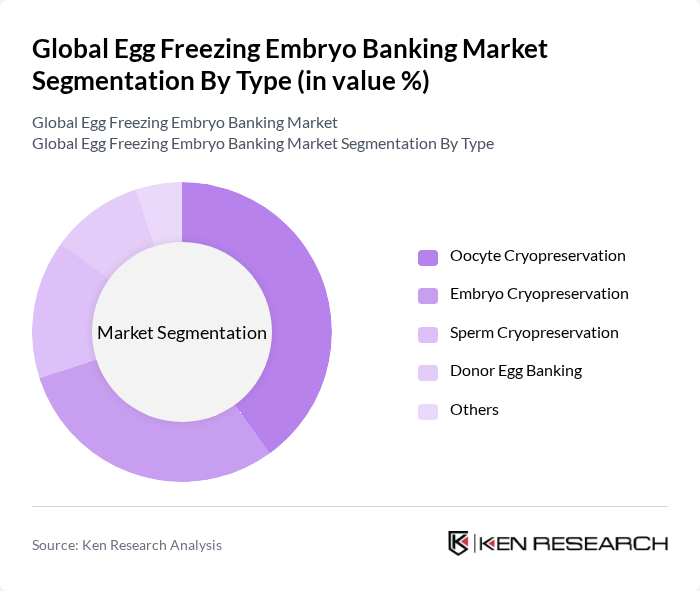
By Type:The market is segmented into various types, including Oocyte Cryopreservation, Embryo Cryopreservation, Sperm Cryopreservation, Donor Egg Banking, and Others. Among these, Oocyte Cryopreservation is currently the leading sub-segment, driven by the increasing number of women choosing to freeze their eggs for personal and professional reasons. The growing acceptance of this practice, coupled with advancements in freezing techniques such as vitrification, has significantly contributed to its dominance. Embryo Cryopreservation also holds a substantial share, reflecting the continued demand for comprehensive fertility preservation options .
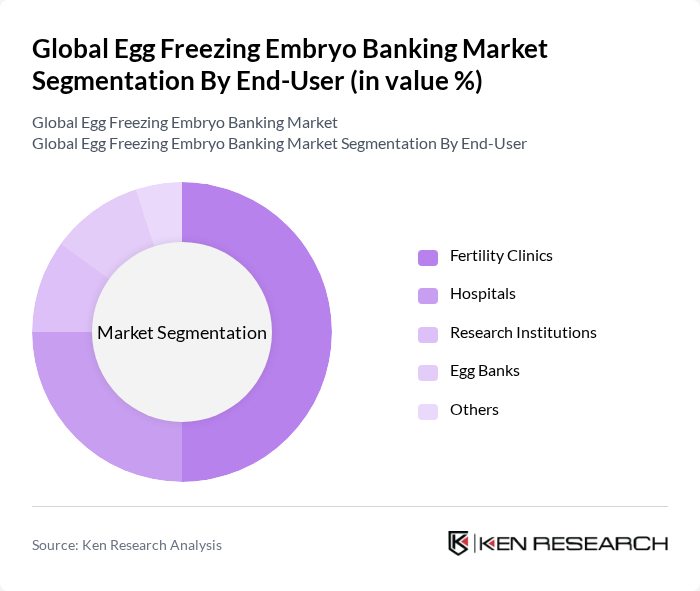
By End-User:The market is categorized into Fertility Clinics, Hospitals, Research Institutions, Egg Banks, and Others. Fertility Clinics are the dominant end-user segment, as they provide specialized services for egg freezing and embryo banking. The increasing number of fertility clinics, rising adoption of assisted reproductive technologies, and the trend toward specialized reproductive health services have significantly contributed to the expansion of this segment. Hospitals and research institutions also play a key role in supporting clinical research and offering comprehensive fertility solutions .
Global Egg Freezing Embryo Banking Market Competitive Landscape
The Global Egg Freezing Embryo Banking Market is characterized by a dynamic mix of regional and international players. Leading participants such as California Cryobank, CryoBank, Reproductive Medicine Associates of New Jersey (RMANJ), New Hope Fertility Center, CCRM Fertility, Shady Grove Fertility, Boston IVF, Fertility Centers of Illinois, The Center for Reproductive Health, Houston Fertility Institute, IVF New Jersey, The Fertility Institute, Reproductive Health Specialists, The Center for Advanced Reproductive Services, Genea Biomedx, Pinnacle Fertility, IVI RMA Global, Virtus Health, Create Fertility, and Bourn Hall Clinic contribute to innovation, geographic expansion, and service delivery in this space.
Global Egg Freezing Embryo Banking Market Industry Analysis
Growth Drivers
- Increasing Awareness of Fertility Preservation:The global fertility preservation market is projected to reach $5.5 billion in future, driven by heightened awareness among individuals regarding reproductive health. Educational campaigns and social media have significantly contributed to this awareness, with 60% of women aged 30-40 now considering egg freezing as a viable option. This shift is further supported by a 15% increase in consultations at fertility clinics, indicating a growing acceptance of egg freezing as a proactive measure for family planning.
- Advancements in Reproductive Technologies:The development of innovative reproductive technologies has significantly enhanced the success rates of egg freezing. Techniques such as vitrification have improved survival rates of frozen eggs to over 90%, making the process more appealing. In future, the global market for reproductive technologies is expected to exceed $20 billion, reflecting a 10% annual growth rate. This technological progress is crucial in attracting individuals who may have previously been hesitant about the efficacy of egg freezing.
- Rising Trend of Delayed Parenthood:Societal shifts towards delayed parenthood are evident, with the average age of first-time mothers in developed countries now at 30. This trend is supported by data from the World Bank, which indicates a 25% increase in women aged 35-39 giving birth over the past decade. As more individuals prioritize career and personal development, the demand for egg freezing services is expected to rise, with an estimated 40% increase in inquiries at fertility clinics in future.
Market Challenges
- High Costs Associated with Egg Freezing:The average cost of egg freezing can range from $6,000 to $15,000 per cycle, which poses a significant barrier for many potential clients. According to the American Society for Reproductive Medicine, only 5% of women in the U.S. can afford this procedure without financial assistance. This high cost limits access, particularly for lower-income individuals, thereby constraining market growth and participation in fertility preservation programs.
- Limited Insurance Coverage for Fertility Preservation:A significant challenge in the egg freezing market is the lack of comprehensive insurance coverage. Currently, only 20% of insurance plans in the U.S. cover fertility preservation services, leaving many individuals to bear the full financial burden. This limitation is exacerbated by varying state laws, with only 15 states mandating coverage for fertility treatments. The financial strain on potential clients can deter them from pursuing egg freezing, impacting overall market growth.
Global Egg Freezing Embryo Banking Market Future Outlook
The future of the egg freezing market appears promising, driven by increasing societal acceptance and technological advancements. As more individuals recognize the importance of fertility preservation, the demand for services is expected to rise significantly. Additionally, the integration of telemedicine and AI in fertility services is likely to enhance accessibility and efficiency, making egg freezing more appealing. With ongoing innovations and supportive policies, the market is poised for substantial growth in the coming years.
Market Opportunities
- Expansion of Fertility Clinics and Services:The establishment of new fertility clinics is projected to increase by 30% in future, providing greater access to egg freezing services. This expansion is driven by rising demand and the need for localized services, particularly in underserved areas. Increased availability will likely lead to higher participation rates in fertility preservation programs.
- Development of Innovative Cryopreservation Techniques:Ongoing research into advanced cryopreservation methods is expected to yield significant breakthroughs, enhancing the viability of frozen eggs. Innovations such as improved freezing protocols could increase success rates by up to 20%. This advancement will attract more individuals to consider egg freezing, thereby expanding the market and improving overall outcomes for clients.
Scope of the Report
| Segment | Sub-Segments |
|---|---|
| By Type | Oocyte Cryopreservation Embryo Cryopreservation Sperm Cryopreservation Donor Egg Banking Others |
| By End-User | Fertility Clinics Hospitals Research Institutions Egg Banks Others |
| By Storage Method | Vitrification Slow Freezing Cryotec Method Others |
| By Service Type | Egg Freezing Services Embryo Banking Services Donor Egg Services Consultation Services Genetic Testing Services Others |
| By Age Group | Under 30 35 40 Over 40 |
| By Geographic Presence of Clinics | Urban Areas Suburban Areas Rural Areas Others |
| By Insurance Coverage | Fully Covered Partially Covered Not Covered Others |
Key Target Audience
Investors and Venture Capitalist Firms
Government and Regulatory Bodies (e.g., Food and Drug Administration, European Medicines Agency)
Fertility Clinics and Reproductive Health Centers
Biotechnology and Pharmaceutical Companies
Healthcare Providers and Hospitals
Insurance Companies and Health Plans
Medical Device Manufacturers
Pharmaceutical Regulatory Authorities
Players Mentioned in the Report:
California Cryobank
CryoBank
Reproductive Medicine Associates of New Jersey (RMANJ)
New Hope Fertility Center
CCRM Fertility
Shady Grove Fertility
Boston IVF
Fertility Centers of Illinois
The Center for Reproductive Health
Houston Fertility Institute
IVF New Jersey
The Fertility Institute
Reproductive Health Specialists
The Center for Advanced Reproductive Services
Genea Biomedx
Pinnacle Fertility
IVI RMA Global
Virtus Health
Create Fertility
Bourn Hall Clinic
Table of Contents
Market Assessment Phase
1. Executive Summary and Approach
2. Global Egg Freezing Embryo Banking Market Overview
2.1 Key Insights and Strategic Recommendations
2.2 Global Egg Freezing Embryo Banking Market Overview
2.3 Definition and Scope
2.4 Evolution of Market Ecosystem
2.5 Timeline of Key Regulatory Milestones
2.6 Value Chain & Stakeholder Mapping
2.7 Business Cycle Analysis
2.8 Policy & Incentive Landscape
3. Global Egg Freezing Embryo Banking Market Analysis
3.1 Growth Drivers
3.1.1 Increasing awareness of fertility preservation
3.1.2 Advancements in reproductive technologies
3.1.3 Rising trend of delayed parenthood
3.1.4 Government support and funding for fertility treatments
3.2 Market Challenges
3.2.1 High costs associated with egg freezing
3.2.2 Ethical concerns surrounding embryo storage
3.2.3 Limited insurance coverage for fertility preservation
3.2.4 Regulatory hurdles in different regions
3.3 Market Opportunities
3.3.1 Expansion of fertility clinics and services
3.3.2 Development of innovative cryopreservation techniques
3.3.3 Increasing partnerships between clinics and banks
3.3.4 Growing demand for personalized fertility solutions
3.4 Market Trends
3.4.1 Rise in social egg freezing
3.4.2 Integration of telemedicine in fertility services
3.4.3 Use of artificial intelligence in embryo selection
3.4.4 Focus on holistic fertility care
3.5 Government Regulation
3.5.1 Regulations on embryo storage duration
3.5.2 Guidelines for ethical practices in fertility treatments
3.5.3 Licensing requirements for fertility clinics
3.5.4 Policies on donor anonymity and rights
4. SWOT Analysis
5. Stakeholder Analysis
6. Porter's Five Forces Analysis
7. Global Egg Freezing Embryo Banking Market Market Size, 2019-2024
7.1 By Value
7.2 By Volume
7.3 By Average Selling Price
8. Global Egg Freezing Embryo Banking Market Segmentation
8.1 By Type
8.1.1 Oocyte Cryopreservation
8.1.2 Embryo Cryopreservation
8.1.3 Sperm Cryopreservation
8.1.4 Donor Egg Banking
8.1.5 Others
8.2 By End-User
8.2.1 Fertility Clinics
8.2.2 Hospitals
8.2.3 Research Institutions
8.2.4 Egg Banks
8.2.5 Others
8.3 By Storage Method
8.3.1 Vitrification
8.3.2 Slow Freezing
8.3.3 Cryotec Method
8.3.4 Others
8.4 By Service Type
8.4.1 Egg Freezing Services
8.4.2 Embryo Banking Services
8.4.3 Donor Egg Services
8.4.4 Consultation Services
8.4.5 Genetic Testing Services
8.4.6 Others
8.5 By Age Group
8.5.1 Under 30
8.5.2 30-35
8.5.3 36-40
8.5.4 Over 40
8.6 By Geographic Presence of Clinics
8.6.1 Urban Areas
8.6.2 Suburban Areas
8.6.3 Rural Areas
8.6.4 Others
8.7 By Insurance Coverage
8.7.1 Fully Covered
8.7.2 Partially Covered
8.7.3 Not Covered
8.7.4 Others
9. Global Egg Freezing Embryo Banking Market Competitive Analysis
9.1 Market Share of Key Players
9.2 KPIs for Cross Comparison of Key Players
9.2.1 Company Name
9.2.2 Group Size (Large, Medium, Small)
9.2.3 Annual Revenue from Egg Freezing/Embryo Banking
9.2.4 Number of Cycles Performed Annually
9.2.5 Success Rate of Procedures (%)
9.2.6 Geographic Footprint (Number of Locations/Regions)
9.2.7 Average Patient Satisfaction Score
9.2.8 Technology Adoption Level (e.g., Vitrification, AI-based selection)
9.2.9 Average Storage Duration (Years)
9.2.10 Pricing Structure (Average Cost per Cycle)
9.2.11 Partnerships/Collaborations (Number, Type)
9.2.12 Brand Recognition/Awareness Index
9.3 SWOT Analysis of Top Players
9.4 Pricing Analysis
9.5 Detailed Profile of Major Companies
9.5.1 California Cryobank
9.5.2 CryoBank
9.5.3 Reproductive Medicine Associates of New Jersey (RMANJ)
9.5.4 New Hope Fertility Center
9.5.5 CCRM Fertility
9.5.6 Shady Grove Fertility
9.5.7 Boston IVF
9.5.8 Fertility Centers of Illinois
9.5.9 The Center for Reproductive Health
9.5.10 Houston Fertility Institute
9.5.11 IVF New Jersey
9.5.12 The Fertility Institute
9.5.13 Reproductive Health Specialists
9.5.14 The Center for Advanced Reproductive Services
9.5.15 Genea Biomedx
9.5.16 Pinnacle Fertility
9.5.17 IVI RMA Global
9.5.18 Virtus Health
9.5.19 Create Fertility
9.5.20 Bourn Hall Clinic
10. Global Egg Freezing Embryo Banking Market End-User Analysis
10.1 Procurement Behavior of Key Ministries
10.1.1 Government Funding Initiatives
10.1.2 Policy Support for Fertility Treatments
10.1.3 Collaboration with Private Sector
10.1.4 Awareness Campaigns
10.2 Corporate Spend on Infrastructure & Energy
10.2.1 Investment in Fertility Clinics
10.2.2 Funding for Research and Development
10.2.3 Partnerships with Technology Providers
10.2.4 Others
10.3 Pain Point Analysis by End-User Category
10.3.1 Accessibility of Services
10.3.2 Affordability of Treatments
10.3.3 Quality of Care
10.3.4 Emotional Support Services
10.4 User Readiness for Adoption
10.4.1 Awareness of Egg Freezing Benefits
10.4.2 Perceived Barriers to Adoption
10.4.3 Willingness to Pay for Services
10.4.4 Others
10.5 Post-Deployment ROI and Use Case Expansion
10.5.1 Success Rates of Frozen Eggs
10.5.2 Long-term Storage Solutions
10.5.3 Expansion of Services Offered
10.5.4 Customer Feedback and Improvement
11. Global Egg Freezing Embryo Banking Market Future Size, 2025-2030
11.1 By Value
11.2 By Volume
11.3 By Average Selling Price
Go-To-Market Strategy Phase
1. Whitespace Analysis + Business Model Canvas
1.1 Market Gaps Identification
1.2 Business Model Development
2. Marketing and Positioning Recommendations
2.1 Branding Strategies
2.2 Product USPs
3. Distribution Plan
3.1 Urban Retail vs Rural NGO Tie-ups
4. Channel & Pricing Gaps
4.1 Underserved Routes
4.2 Pricing Bands
5. Unmet Demand & Latent Needs
5.1 Category Gaps
5.2 Consumer Segments
6. Customer Relationship
6.1 Loyalty Programs
6.2 After-sales Service
7. Value Proposition
7.1 Sustainability
7.2 Integrated Supply Chains
8. Key Activities
8.1 Regulatory Compliance
8.2 Branding
8.3 Distribution Setup
9. Entry Strategy Evaluation
9.1 Domestic Market Entry Strategy
9.1.1 Product Mix
9.1.2 Pricing Band
9.1.3 Packaging
9.2 Export Entry Strategy
9.2.1 Target Countries
9.2.2 Compliance Roadmap
10. Entry Mode Assessment
10.1 JV
10.2 Greenfield
10.3 M&A
10.4 Distributor Model
11. Capital and Timeline Estimation
11.1 Capital Requirements
11.2 Timelines
12. Control vs Risk Trade-Off
12.1 Ownership vs Partnerships
13. Profitability Outlook
13.1 Breakeven Analysis
13.2 Long-term Sustainability
14. Potential Partner List
14.1 Distributors
14.2 JVs
14.3 Acquisition Targets
15. Execution Roadmap
15.1 Phased Plan for Market Entry
15.1.1 Market Setup
15.1.2 Market Entry
15.1.3 Growth Acceleration
15.1.4 Scale & Stabilize
15.2 Key Activities and Milestones
15.2.1 Milestone Planning
15.2.2 Activity Tracking
Research Methodology
Phase 1: Approach1
Desk Research
- Analysis of industry reports from fertility clinics and reproductive health organizations
- Review of academic journals and publications on egg freezing technologies and embryo banking
- Examination of demographic data and trends related to fertility preservation from government health agencies
Primary Research
- Interviews with reproductive endocrinologists and fertility specialists
- Surveys conducted with patients who have undergone egg freezing procedures
- Focus groups with healthcare providers in reproductive health to gather insights on market needs
Validation & Triangulation
- Cross-validation of findings through multiple expert interviews and patient surveys
- Triangulation of data from clinical studies, market reports, and expert opinions
- Sanity checks through feedback from a panel of reproductive health experts
Phase 2: Market Size Estimation1
Top-down Assessment
- Estimation of market size based on national healthcare expenditure on fertility treatments
- Segmentation of the market by geographical regions and service types (e.g., egg freezing, embryo storage)
- Incorporation of trends in societal attitudes towards fertility preservation and family planning
Bottom-up Modeling
- Collection of data on the number of fertility clinics offering egg freezing services
- Estimation of average costs associated with egg freezing and embryo banking procedures
- Volume estimates based on patient intake and service utilization rates across clinics
Forecasting & Scenario Analysis
- Multi-variable regression analysis incorporating factors such as age demographics and fertility trends
- Scenario modeling based on potential changes in healthcare policies and insurance coverage
- Development of baseline, optimistic, and pessimistic market growth projections through 2030
Phase 3: CATI Sample Composition1
| Scope Item/Segment | Sample Size | Target Respondent Profiles |
|---|---|---|
| Fertility Clinic Services | 100 | Reproductive Endocrinologists, Clinic Administrators |
| Patient Experiences with Egg Freezing | 80 | Women aged 25-40, Fertility Patients |
| Embryo Banking Practices | 60 | Embryologists, Laboratory Technicians |
| Insurance Coverage Insights | 50 | Health Insurance Analysts, Policy Makers |
| Market Trends in Fertility Preservation | 40 | Healthcare Market Analysts, Industry Experts |
Frequently Asked Questions
What is the current value of the Global Egg Freezing Embryo Banking Market?
The Global Egg Freezing Embryo Banking Market is valued at approximately USD 4.7 billion, reflecting significant growth driven by increased awareness of fertility preservation and advancements in cryopreservation technologies.
What factors are driving the growth of the egg freezing market?
Which regions dominate the Global Egg Freezing Embryo Banking Market?
What are the main types of services offered in the egg freezing market?
Other Regional/Country Reports
Indonesia Egg Freezing Embryo Banking Market
Malaysia Egg Freezing Embryo Banking Market
KSA Egg Freezing Embryo Banking Market
APAC Egg Freezing Embryo Banking Market
SEA Egg Freezing Embryo Banking Market
Vietnam Egg Freezing Embryo Banking Market
Other Adjacent Reports
Mexico Assisted Reproductive Technology Market
Malaysia In Vitro Fertilization Market
Singapore Sperm Banking Market
Germany Fertility Testing Market
Malaysia Cryopreservation Technology Market
Bahrain Reproductive Health Services Market
Belgium Womens Health Diagnostics Market
South Korea Genetic Counseling Market
KSA Surrogacy Services Market
KSA Hormone Therapy Market
Why Buy From Us?

What makes us stand out is that our consultants follow Robust, Refine and Result (RRR) methodology. Robust for clear definitions, approaches and sanity checking, Refine for differentiating respondents' facts and opinions, and Result for presenting data with story.

We have set a benchmark in the industry by offering our clients with syndicated and customized market research reports featuring coverage of entire market as well as meticulous research and analyst insights.

While we don't replace traditional research, we flip the method upside down. Our dual approach of Top Bottom & Bottom Top ensures quality deliverable by not just verifying company fundamentals but also looking at the sector and macroeconomic factors.

With one step in the future, our research team constantly tries to show you the bigger picture. We help with some of the tough questions you may encounter along the way: How is the industry positioned? Best marketing channel? KPI's of competitors? By aligning every element, we help maximize success.

Our report gives you instant access to the answers and sources that other companies might choose to hide. We elaborate each steps of research methodology we have used and showcase you the sample size to earn your trust.

If you need any support, we are here! We pride ourselves on universe strength, data quality, and quick, friendly, and professional service.