About the Report
Base Year 2024Global Fire Alarm Detection Market Overview
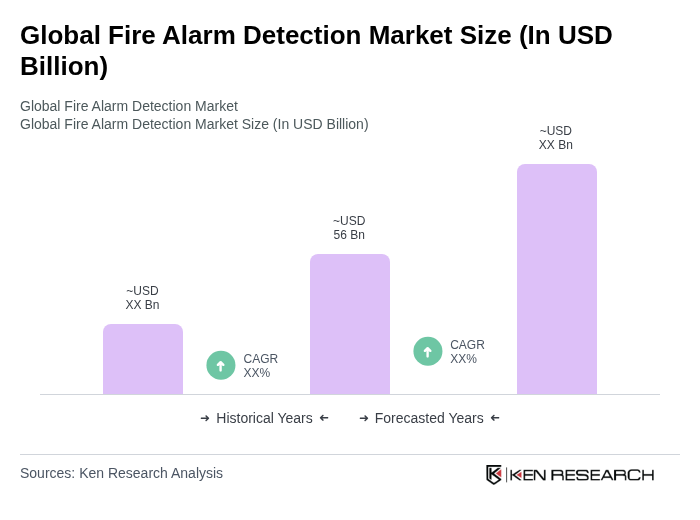
- The Global Fire Alarm Detection Market is valued at USD 56 billion, based on recent analysis. Growth is driven by increasing adoption of smart and connected technologies, stringent fire safety norms, and rising awareness of fire hazards. Addressable systems offering rapid response and reduced cabling, along with the rising integration of IoT-enabled devices, notably boost market development according to Grand View Research and Mordor Intelligence.
- Key players in this market include Honeywell International, Johnson Controls, Siemens AG, Eaton, Bosch, Halma plc, and Gentex Corporation. These companies play a significant role in driving growth and maintaining high standards in fire alarm technology through innovation and the development of smart, connected solutions.
- A significant policy development includes the NFPA 72 code update requiring smoke alarms to meet the UL 217 or UL 268 standards for nuisance alarm resistance in areas near kitchens, enhancing reliability and encouraging the adoption of compliant devices.
Global Fire Alarm Detection Market Segmentation
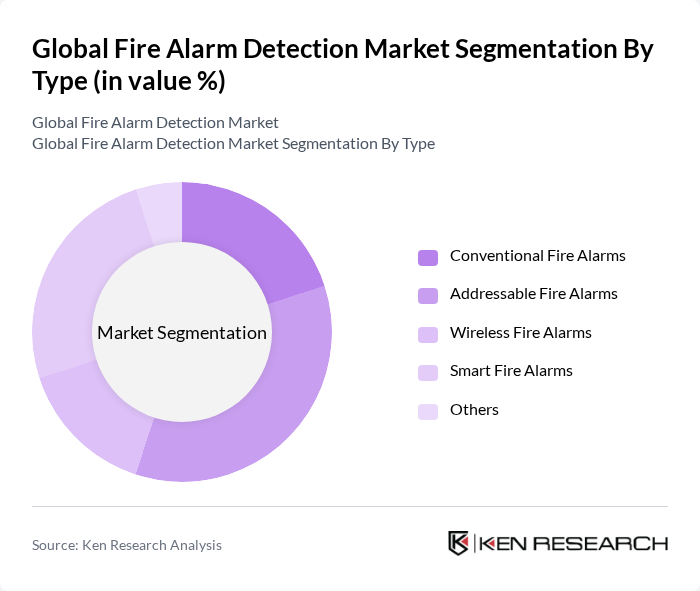
By Type:The fire alarm detection market is segmented into various types, including Conventional Fire Alarms, Addressable Fire Alarms, Wireless Fire Alarms, Smart Fire Alarms, and Others. Among these, Addressable Fire Alarms are gaining significant traction due to their ability to provide precise location information during emergencies, which enhances response times and safety. The increasing demand for smart technologies is also driving the growth of Smart Fire Alarms, which integrate with IoT systems for better monitoring and control.
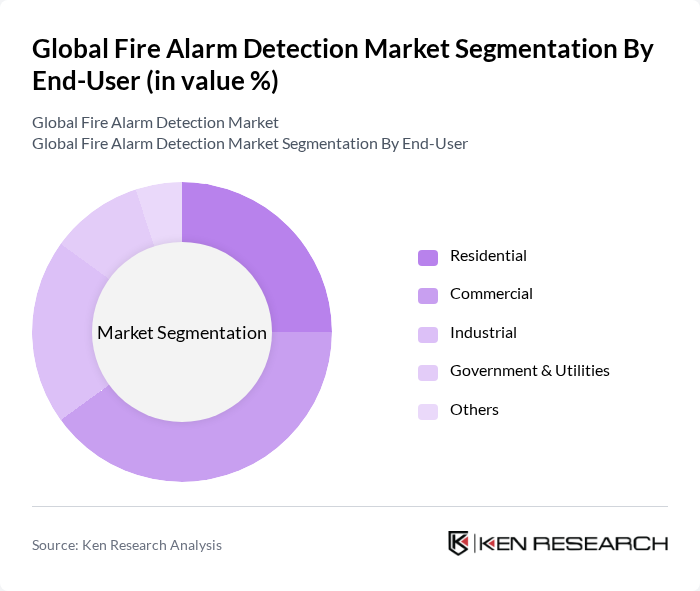
By End-User:The end-user segmentation includes Residential, Commercial, Industrial, Government & Utilities, and Others. The Commercial sector is the largest end-user, driven by stringent safety regulations and the need for reliable fire detection systems in office buildings, retail spaces, and public venues. The Industrial sector is also significant, as factories and manufacturing plants require robust fire safety measures to protect assets and personnel.
Global Fire Alarm Detection Market Competitive Landscape
The Global Fire Alarm Detection Market is characterized by a dynamic mix of regional and international players. Leading participants such as Honeywell International Inc., Siemens AG, Johnson Controls International plc, Bosch Security Systems, Tyco SimplexGrinnell, UTC Fire & Security, Schneider Electric, Eaton Corporation, Kidde (part of Carrier Global Corporation), Gentex Corporation, Apollo Fire Detectors Ltd., System Sensor (Honeywell), Fire-Lite Alarms (Honeywell), Notifier (Honeywell), and Fike Corporation contribute to innovation, geographic expansion, and service delivery in this space.
Global Fire Alarm Detection Market Industry Analysis
Growth Drivers
- Regulatory Enforcement Driving Installations:In future, approximately 340,000 mandated fire alarm system upgrades in commercial properties were enforced due to government regulations. This regulatory push, driven by compliance audits, has significantly increased the demand for fire alarm systems. The need for adherence to safety standards is a crucial factor propelling market growth, as businesses prioritize compliance to avoid penalties and ensure safety for occupants.
- Mandatory System Installations from Code Compliance:The year saw around 520,000 code compliance inspections that triggered the installation of new fire alarm systems. These inspections ensured that outdated systems were either upgraded or replaced, maintaining a robust demand for advanced fire alarm technologies. The enforcement of building codes is a vital driver, as it compels property owners to invest in modern safety solutions to meet legal requirements and enhance safety measures.
- IoT & Smart Detector Adoption:The global market witnessed the sale of approximately 640,000 IoT-connected fire alarm devices in future. This surge in demand reflects a significant shift towards integrated, digital fire safety infrastructure. The adoption of smart technologies enhances the efficiency and effectiveness of fire detection systems, allowing for real-time monitoring and alerts, which is increasingly appealing to both consumers and businesses focused on safety and innovation.
Market Challenges
- Technician Shortages Delaying Projects:The global market is facing a shortfall of approximately 12,000 NFPA-certified technicians, which has delayed around 280,000 installations in future. This shortage of skilled labor poses a significant barrier to timely deployment and expansion of fire alarm systems. The lack of qualified professionals hampers the ability of companies to meet growing demand, ultimately affecting market growth and project timelines.
- Electronic Components Supply Disruptions:In Q4 of future, approximately 260,000 alarm panel shipments were delayed due to a shortage of microcontrollers. This disruption in the supply chain has impeded the production and delivery of fire alarm systems, creating bottlenecks in the market. Such delays not only affect manufacturers but also hinder the ability of end-users to implement necessary safety measures, impacting overall market performance.
Global Fire Alarm Detection Market Future Outlook
The future of the fire alarm detection market is poised for significant transformation, driven by advancements in technology and increasing regulatory demands. The integration of AI and edge computing in fire alarm systems is expected to enhance real-time data processing and predictive capabilities, improving overall safety. Additionally, the deployment of cloud-based monitoring solutions will facilitate remote management, increasing operational efficiency and responsiveness to fire incidents, thereby shaping the market landscape in the coming years.
Market Opportunities
- Emerging Economies’ Infrastructure Expansion:Emerging markets, particularly in Asia-Pacific and Latin America, are experiencing rapid urbanization and infrastructure development. This growth creates a latent demand for fire detection systems, presenting a significant opportunity for market expansion as new buildings require compliant safety solutions.
- Aftermarket & Cloud-Based Services:In future, approximately 215,000 cloud-based fire panel subscriptions were recorded. This trend towards service-oriented models and remote monitoring creates recurring revenue streams for vendors, allowing them to capitalize on the growing demand for efficient and effective fire safety management solutions.
Scope of the Report
| Segment | Sub-Segments |
|---|---|
| By Type | Conventional Fire Alarms Addressable Fire Alarms Wireless Fire Alarms Smart Fire Alarms Others |
| By End-User | Residential Commercial Industrial Government & Utilities Others |
| By Region | North America Europe Asia-Pacific Latin America Middle East & Africa |
| By Technology | Photoelectric Sensors Ionization Sensors Heat Detectors Multi-Sensor Detectors Others |
| By Application | Fire Detection Fire Alarm Notification Fire Suppression Systems Others |
| By Investment Source | Private Investments Public Funding Joint Ventures Others |
| By Policy Support | Government Subsidies Tax Incentives Grants for Fire Safety Improvements Others |
Key Target Audience
Investors and Venture Capitalist Firms
Government and Regulatory Bodies (e.g., National Fire Protection Association, Federal Emergency Management Agency)
Manufacturers and Producers
Distributors and Retailers
Fire Safety Equipment Installers
Insurance Companies
Building and Construction Companies
Fire Safety Consultants
Players Mentioned in the Report:
Honeywell International Inc.
Siemens AG
Johnson Controls International plc
Bosch Security Systems
Tyco SimplexGrinnell
UTC Fire & Security
Schneider Electric
Eaton Corporation
Kidde (part of Carrier Global Corporation)
Gentex Corporation
Apollo Fire Detectors Ltd.
System Sensor (Honeywell)
Fire-Lite Alarms (Honeywell)
Notifier (Honeywell)
Fike Corporation
Table of Contents
Market Assessment Phase
1. Executive Summary and Approach
2. Global Fire Alarm Detection Market Overview
2.1 Key Insights and Strategic Recommendations
2.2 Global Fire Alarm Detection Market Overview
2.3 Definition and Scope
2.4 Evolution of Market Ecosystem
2.5 Timeline of Key Regulatory Milestones
2.6 Value Chain & Stakeholder Mapping
2.7 Business Cycle Analysis
2.8 Policy & Incentive Landscape
3. Global Fire Alarm Detection Market Analysis
3.1 Growth Drivers
3.1.1 Increasing Urbanization
3.1.2 Stringent Safety Regulations
3.1.3 Technological Advancements in Detection Systems
3.1.4 Rising Awareness of Fire Safety
3.2 Market Challenges
3.2.1 High Installation Costs
3.2.2 Lack of Skilled Professionals
3.2.3 Maintenance and Upgradation Issues
3.2.4 Competition from Alternative Safety Solutions
3.3 Market Opportunities
3.3.1 Integration of IoT in Fire Alarm Systems
3.3.2 Expansion in Emerging Markets
3.3.3 Development of Smart Buildings
3.3.4 Government Initiatives for Fire Safety
3.4 Market Trends
3.4.1 Adoption of Wireless Fire Alarm Systems
3.4.2 Growth of Smart Home Technologies
3.4.3 Increasing Use of AI in Fire Detection
3.4.4 Focus on Sustainable Fire Safety Solutions
3.5 Government Regulation
3.5.1 NFPA Standards Compliance
3.5.2 Local Building Codes
3.5.3 Fire Safety Audits and Inspections
3.5.4 Incentives for Fire Safety Upgrades
4. SWOT Analysis
5. Stakeholder Analysis
6. Porter's Five Forces Analysis
7. Global Fire Alarm Detection Market Market Size, 2019-2024
7.1 By Value
7.2 By Volume
7.3 By Average Selling Price
8. Global Fire Alarm Detection Market Segmentation
8.1 By Type
8.1.1 Conventional Fire Alarms
8.1.2 Addressable Fire Alarms
8.1.3 Wireless Fire Alarms
8.1.4 Smart Fire Alarms
8.1.5 Others
8.2 By End-User
8.2.1 Residential
8.2.2 Commercial
8.2.3 Industrial
8.2.4 Government & Utilities
8.2.5 Others
8.3 By Region
8.3.1 North America
8.3.2 Europe
8.3.3 Asia-Pacific
8.3.4 Latin America
8.3.5 Middle East & Africa
8.4 By Technology
8.4.1 Photoelectric Sensors
8.4.2 Ionization Sensors
8.4.3 Heat Detectors
8.4.4 Multi-Sensor Detectors
8.4.5 Others
8.5 By Application
8.5.1 Fire Detection
8.5.2 Fire Alarm Notification
8.5.3 Fire Suppression Systems
8.5.4 Others
8.6 By Investment Source
8.6.1 Private Investments
8.6.2 Public Funding
8.6.3 Joint Ventures
8.6.4 Others
8.7 By Policy Support
8.7.1 Government Subsidies
8.7.2 Tax Incentives
8.7.3 Grants for Fire Safety Improvements
8.7.4 Others
9. Global Fire Alarm Detection Market Competitive Analysis
9.1 Market Share of Key Players
9.2 Cross Comparison of Key Players
9.2.1 Company Name
9.2.2 Group Size (Large, Medium, or Small as per industry convention)
9.2.3 Revenue Growth Rate
9.2.4 Market Penetration Rate
9.2.5 Customer Retention Rate
9.2.6 Pricing Strategy
9.2.7 Product Innovation Rate
9.2.8 Distribution Efficiency
9.2.9 Brand Recognition
9.2.10 Customer Satisfaction Score
9.3 SWOT Analysis of Top Players
9.4 Pricing Analysis
9.5 Detailed Profile of Major Companies
9.5.1 Honeywell International Inc.
9.5.2 Siemens AG
9.5.3 Johnson Controls International plc
9.5.4 Bosch Security Systems
9.5.5 Tyco SimplexGrinnell
9.5.6 UTC Fire & Security
9.5.7 Schneider Electric
9.5.8 Eaton Corporation
9.5.9 Kidde (part of Carrier Global Corporation)
9.5.10 Gentex Corporation
9.5.11 Apollo Fire Detectors Ltd.
9.5.12 System Sensor (Honeywell)
9.5.13 Fire-Lite Alarms (Honeywell)
9.5.14 Notifier (Honeywell)
9.5.15 Fike Corporation
10. Global Fire Alarm Detection Market End-User Analysis
10.1 Procurement Behavior of Key Ministries
10.1.1 Government Procurement Policies
10.1.2 Budget Allocations for Fire Safety
10.1.3 Decision-Making Processes
10.1.4 Supplier Selection Criteria
10.2 Corporate Spend on Infrastructure & Energy
10.2.1 Investment Trends in Fire Safety
10.2.2 Budgeting for Fire Alarm Systems
10.2.3 Cost-Benefit Analysis
10.2.4 Long-term Financial Commitments
10.3 Pain Point Analysis by End-User Category
10.3.1 Common Challenges Faced by Residential Users
10.3.2 Issues in Commercial Installations
10.3.3 Industrial Sector Specific Concerns
10.3.4 Government Facility Requirements
10.4 User Readiness for Adoption
10.4.1 Awareness Levels of Fire Safety
10.4.2 Training and Education Needs
10.4.3 Technology Acceptance
10.4.4 Budget Constraints
10.5 Post-Deployment ROI and Use Case Expansion
10.5.1 Measuring Effectiveness of Fire Alarms
10.5.2 Case Studies of Successful Implementations
10.5.3 Expansion into New Applications
10.5.4 Long-term Maintenance Considerations
11. Global Fire Alarm Detection Market Future Size, 2025-2030
11.1 By Value
11.2 By Volume
11.3 By Average Selling Price
Go-To-Market Strategy Phase
1. Whitespace Analysis + Business Model Canvas
1.1 Market Gaps Identification
1.2 Business Model Framework
2. Marketing and Positioning Recommendations
2.1 Branding Strategies
2.2 Product USPs
3. Distribution Plan
3.1 Urban Retail vs Rural NGO Tie-ups
4. Channel & Pricing Gaps
4.1 Underserved Routes
4.2 Pricing Bands
5. Unmet Demand & Latent Needs
5.1 Category Gaps
5.2 Consumer Segments
6. Customer Relationship
6.1 Loyalty Programs
6.2 After-sales Service
7. Value Proposition
7.1 Sustainability
7.2 Integrated Supply Chains
8. Key Activities
8.1 Regulatory Compliance
8.2 Branding
8.3 Distribution Setup
9. Entry Strategy Evaluation
9.1 Domestic Market Entry Strategy
9.1.1 Product Mix
9.1.2 Pricing Band
9.1.3 Packaging
9.2 Export Entry Strategy
9.2.1 Target Countries
9.2.2 Compliance Roadmap
10. Entry Mode Assessment
10.1 JV
10.2 Greenfield
10.3 M&A
10.4 Distributor Model
11. Capital and Timeline Estimation
11.1 Capital Requirements
11.2 Timelines
12. Control vs Risk Trade-Off
12.1 Ownership vs Partnerships
13. Profitability Outlook
13.1 Breakeven Analysis
13.2 Long-term Sustainability
14. Potential Partner List
14.1 Distributors
14.2 JVs
14.3 Acquisition Targets
15. Execution Roadmap
15.1 Phased Plan for Market Entry
15.1.1 Market Setup
15.1.2 Market Entry
15.1.3 Growth Acceleration
15.1.4 Scale & Stabilize
15.2 Key Activities and Milestones
15.2.1 Milestone Planning
15.2.2 Activity Tracking
Research Methodology
Phase 1: Approach1
Desk Research
- Industry reports from fire safety associations and regulatory bodies
- Market analysis from trade publications and journals focused on fire alarm technologies
- Statistical data from government agencies on fire incidents and safety regulations
Primary Research
- Interviews with fire safety engineers and consultants specializing in alarm systems
- Surveys with facility managers and safety officers across various sectors
- Field interviews with manufacturers and distributors of fire alarm systems
Validation & Triangulation
- Cross-validation of data through multiple industry sources and expert opinions
- Triangulation of market trends with historical data and future projections
- Sanity checks conducted through expert panel discussions and feedback
Phase 2: Market Size Estimation1
Top-down Assessment
- Analysis of global fire safety regulations and their impact on market demand
- Segmentation of the market by end-user industries such as commercial, residential, and industrial
- Incorporation of growth trends in smart building technologies and IoT integration
Bottom-up Modeling
- Estimation of unit sales based on historical sales data from leading manufacturers
- Operational cost analysis derived from pricing models of fire alarm systems
- Volume x price calculations to derive revenue estimates for different market segments
Forecasting & Scenario Analysis
- Multi-variable regression analysis considering factors like urbanization and safety awareness
- Scenario planning based on potential regulatory changes and technological advancements
- Development of baseline, optimistic, and pessimistic market forecasts through 2030
Phase 3: CATI Sample Composition1
| Scope Item/Segment | Sample Size | Target Respondent Profiles |
|---|---|---|
| Commercial Building Fire Safety | 150 | Facility Managers, Safety Compliance Officers |
| Industrial Fire Alarm Systems | 100 | Plant Managers, Safety Engineers |
| Residential Fire Alarm Solutions | 80 | Homeowners, Property Managers |
| Smart Fire Detection Technologies | 70 | Technology Officers, R&D Managers |
| Fire Safety Regulations Impact | 90 | Regulatory Affairs Specialists, Compliance Managers |
Frequently Asked Questions
What is the current value of the Global Fire Alarm Detection Market?
The Global Fire Alarm Detection Market is valued at approximately USD 56 billion. This growth is attributed to the increasing adoption of smart technologies, stringent fire safety regulations, and heightened awareness of fire hazards among consumers and businesses.
What are the main types of fire alarm systems in the market?
Who are the key players in the Global Fire Alarm Detection Market?
What factors are driving the growth of the fire alarm detection market?
Other Regional/Country Reports
Indonesia Fire Alarm Detection Market
Malaysia Fire Alarm Detection Market
KSA Fire Alarm Detection Market
APAC Fire Alarm Detection Market
SEA Fire Alarm Detection Market
Vietnam Fire Alarm Detection Market
Other Adjacent Reports
Indonesia Building Automation Market
Singapore Security Systems Market
UAE Iot Devices MarketPhilippines Emergency Management Market
Indonesia Industrial Safety Market Outlook to 2030Belgium Smart City Solutions Market
India Cloud Computing Market Size, Share & Forecast, By Service Model, Deployment Model & End-Use Industry, 2026-2031Belgium Connected Devices Market
Bahrain Infrastructure Development Market
Why Buy From Us?

What makes us stand out is that our consultants follow Robust, Refine and Result (RRR) methodology. Robust for clear definitions, approaches and sanity checking, Refine for differentiating respondents' facts and opinions, and Result for presenting data with story.

We have set a benchmark in the industry by offering our clients with syndicated and customized market research reports featuring coverage of entire market as well as meticulous research and analyst insights.

While we don't replace traditional research, we flip the method upside down. Our dual approach of Top Bottom & Bottom Top ensures quality deliverable by not just verifying company fundamentals but also looking at the sector and macroeconomic factors.

With one step in the future, our research team constantly tries to show you the bigger picture. We help with some of the tough questions you may encounter along the way: How is the industry positioned? Best marketing channel? KPI's of competitors? By aligning every element, we help maximize success.

Our report gives you instant access to the answers and sources that other companies might choose to hide. We elaborate each steps of research methodology we have used and showcase you the sample size to earn your trust.

If you need any support, we are here! We pride ourselves on universe strength, data quality, and quick, friendly, and professional service.