About the Report
Base Year 2024Listen to the audio summary
Global Football Market Overview
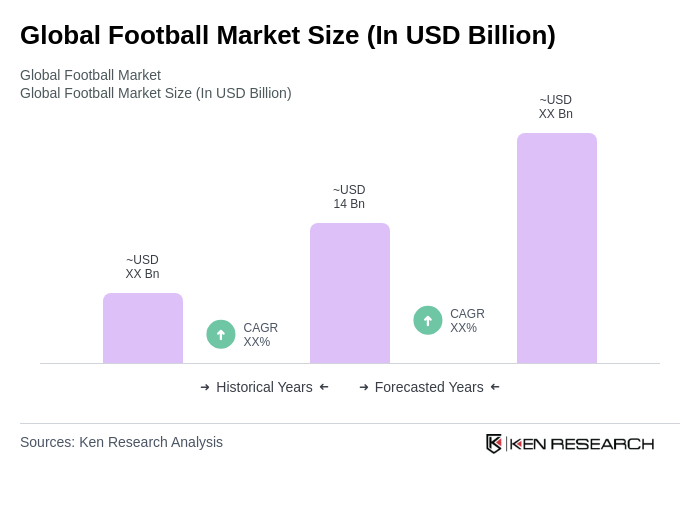
- The Global Football Market is valued at USD 14 billion, based on a five-year historical analysis. This growth is primarily driven by the increasing popularity of football worldwide, fueled by major tournaments, sponsorship deals, and the rise of digital media platforms that enhance fan engagement. The market has seen a surge in revenues from broadcasting rights and merchandise sales, reflecting the sport's global appeal.
- Countries such as the United States, Brazil, Germany, and Spain dominate the Global Football Market due to their rich footballing history, strong domestic leagues, and successful national teams. These nations have established robust infrastructures, including stadiums and training facilities, and benefit from a large fan base that drives ticket sales and merchandise purchases, further solidifying their market position.
- In 2023, the European Union implemented regulations aimed at promoting financial fair play in football clubs. This regulation mandates that clubs must balance their spending with their revenues, ensuring sustainable financial practices. The initiative is designed to prevent clubs from accumulating excessive debt and to promote competitive balance within leagues, ultimately benefiting the overall health of the football market. The principal binding instrument is the “UEFA Club Licensing and Financial Sustainability Regulations, 2022” issued by the Union of European Football Associations (UEFA), which sets operational requirements for financial management, reporting, and cost control for all clubs participating in UEFA competitions.
Global Football Market Segmentation
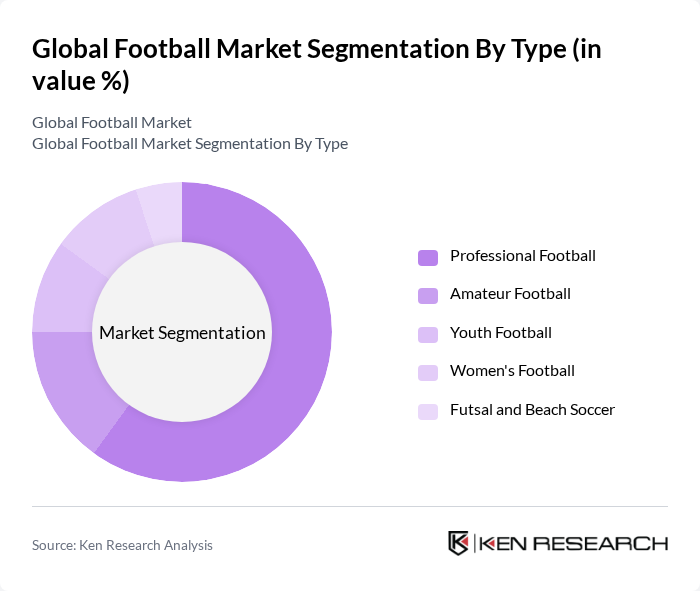
By Type:The Global Football Market can be segmented into various types, including Professional Football, Amateur Football, Youth Football, Women's Football, and Futsal and Beach Soccer. Each of these segments caters to different demographics and levels of play, contributing to the overall market dynamics. Professional Football remains the most lucrative segment, driven by high-profile leagues and tournaments that attract significant viewership and sponsorship.
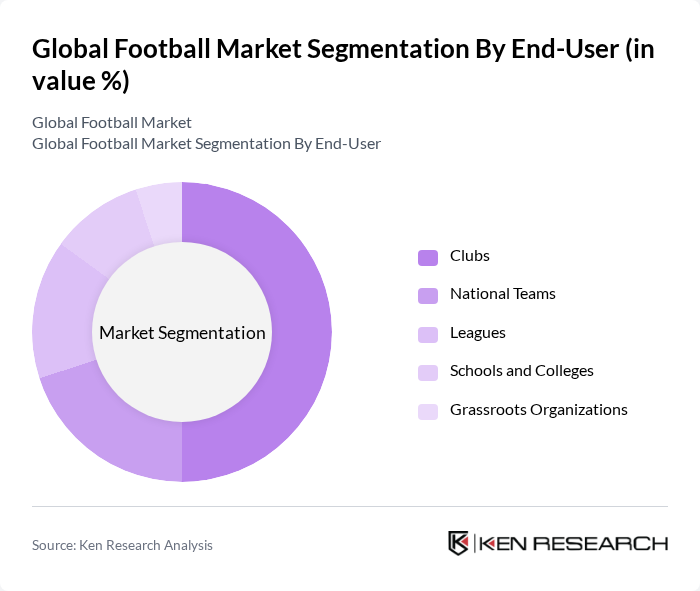
By End-User:The market can also be segmented by end-users, which include Clubs, National Teams, Leagues, Schools and Colleges, and Grassroots Organizations. Each of these end-users plays a crucial role in the development and promotion of football at various levels, from grassroots initiatives to professional leagues. Clubs, particularly in professional football, dominate this segment due to their commercial activities and fan engagement strategies.
Global Football Market Competitive Landscape
The Global Football Market is characterized by a dynamic mix of regional and international players. Leading participants such as FIFA (Fédération Internationale de Football Association), UEFA (Union of European Football Associations), Premier League (The Football Association Premier League Limited), LaLiga (Liga Nacional de Fútbol Profesional), Bundesliga (Deutsche Fußball Liga), Serie A (Lega Nazionale Professionisti Serie A), Major League Soccer (MLS), Asian Football Confederation (AFC), CONCACAF (Confederation of North, Central America and Caribbean Association Football), CONMEBOL (Confederación Sudamericana de Fútbol), The Football Association (FA), DFB (Deutscher Fußball-Bund), AFA (Asociación del Fútbol Argentino), KNVB (Koninklijke Nederlandse Voetbalbond), Football Australia (formerly Football Federation Australia) contribute to innovation, geographic expansion, and service delivery in this space.
Global Football Market Industry Analysis
Growth Drivers
- Increasing Global Participation in Football:The number of registered football players worldwide reached approximately 265 million in future, according to FIFA. This growth is driven by grassroots initiatives and youth programs, particularly in regions like Africa and Asia, where participation has surged by 15% over the past five years. The increasing accessibility of football facilities and community programs is expected to further enhance participation rates, contributing to a more robust global football ecosystem.
- Rising Sponsorship and Advertising Revenues:In future, global sponsorship revenues in football exceeded $40 billion, reflecting a 10% increase from the previous year. Major tournaments like the FIFA World Cup and UEFA Champions League attract significant corporate investment, with brands seeking to leverage the sport's massive audience. This trend is expected to continue, as companies increasingly recognize the value of football in reaching diverse demographics, particularly in emerging markets where brand loyalty is still being established.
- Expansion of Digital Platforms for Broadcasting:The digital broadcasting landscape for football has expanded significantly, with over 1.5 billion viewers tuning into online matches in future. Streaming platforms like DAZN and ESPN+ have reported subscriber growth rates of 20% year-on-year, driven by exclusive content and flexible viewing options. This shift towards digital consumption is reshaping how fans engage with football, creating new revenue streams and enhancing global reach, particularly among younger audiences.
Market Challenges
- Regulatory Compliance Issues:Football clubs face increasing scrutiny regarding financial practices, particularly with Financial Fair Play regulations. In future, UEFA imposed fines totaling $30 million on clubs for non-compliance. These regulations aim to ensure financial stability but can limit clubs' spending capabilities, affecting their competitiveness. As clubs navigate these complex regulations, the potential for sanctions may hinder growth and investment in player development and infrastructure.
- Economic Downturns Affecting Sponsorships:The global economy is projected to grow at a modest rate of 3% in future, according to the IMF. Economic uncertainties can lead to reduced corporate spending on sponsorships, impacting football clubs' revenue streams. For instance, during the 2020 economic downturn, sponsorship revenues fell by 15%, highlighting the vulnerability of football financing to broader economic conditions. Clubs must adapt to these fluctuations to maintain financial health and operational stability.
Global Football Market Future Outlook
The future of the football market appears promising, driven by technological advancements and a growing global fanbase. As clubs increasingly adopt data analytics for player performance and fan engagement, the integration of technology will enhance operational efficiency. Furthermore, the rise of esports in football presents new avenues for revenue generation and audience engagement. With a focus on sustainability and community involvement, the industry is poised for transformative growth, appealing to a diverse and expanding demographic of fans.
Market Opportunities
- Development of Women's Football:The women's football sector is experiencing rapid growth, with participation rates increasing by 20% in the last three years. Major leagues and tournaments are gaining visibility, attracting sponsorships that exceeded $1 billion in future. This trend presents a significant opportunity for clubs and organizations to invest in women's programs, fostering talent and expanding their market reach.
- Technological Innovations in Training:The adoption of advanced training technologies, such as virtual reality and AI-driven analytics, is revolutionizing player development. In future, investments in sports technology reached $5 billion, with football clubs increasingly leveraging these tools to enhance training efficiency. This innovation not only improves player performance but also attracts tech-savvy fans, creating a modernized football experience that resonates with younger audiences.
Scope of the Report
| Segment | Sub-Segments |
|---|---|
| By Type | Professional Football Amateur Football Youth Football Women's Football Futsal and Beach Soccer |
| By End-User | Clubs National Teams Leagues Schools and Colleges Grassroots Organizations |
| By Region | Europe North America South America Asia-Pacific Africa |
| By Revenue Source | Ticket Sales Broadcasting Rights Sponsorships Merchandise Sales Licensing & Royalties |
| By Media Type | Television Online Streaming Social Media Mobile Apps |
| By Event Type | Domestic Leagues International Tournaments Friendly Matches Charity Matches & Exhibitions |
| By Age Group | Under 18 35 50 Over 50 |
Key Target Audience
Investors and Venture Capitalist Firms
Government and Regulatory Bodies (e.g., FIFA, UEFA)
Sports Marketing Agencies
Media and Broadcasting Companies
Stadium and Venue Operators
Sports Equipment Manufacturers
Merchandising Companies
Corporate Sponsors and Advertisers
Players Mentioned in the Report:
FIFA (Federation Internationale de Football Association)
UEFA (Union of European Football Associations)
Premier League (The Football Association Premier League Limited)
LaLiga (Liga Nacional de Futbol Profesional)
Bundesliga (Deutsche Fuball Liga)
Serie A (Lega Nazionale Professionisti Serie A)
Major League Soccer (MLS)
Asian Football Confederation (AFC)
CONCACAF (Confederation of North, Central America and Caribbean Association Football)
CONMEBOL (Confederacion Sudamericana de Futbol)
The Football Association (FA)
DFB (Deutscher Fuball-Bund)
AFA (Asociacion del Futbol Argentino)
KNVB (Koninklijke Nederlandse Voetbalbond)
Football Australia (formerly Football Federation Australia)
Table of Contents
Market Assessment Phase
1. Executive Summary and Approach
2. Global Football Market Overview
2.1 Key Insights and Strategic Recommendations
2.2 Global Football Market Overview
2.3 Definition and Scope
2.4 Evolution of Market Ecosystem
2.5 Timeline of Key Regulatory Milestones
2.6 Value Chain & Stakeholder Mapping
2.7 Business Cycle Analysis
2.8 Policy & Incentive Landscape
3. Global Football Market Analysis
3.1 Growth Drivers
3.1.1 Increasing Global Participation in Football
3.1.2 Rising Sponsorship and Advertising Revenues
3.1.3 Expansion of Digital Platforms for Broadcasting
3.1.4 Growth in Youth Football Programs
3.2 Market Challenges
3.2.1 Regulatory Compliance Issues
3.2.2 Economic Downturns Affecting Sponsorships
3.2.3 Competition from Other Sports
3.2.4 Player Transfer Market Volatility
3.3 Market Opportunities
3.3.1 Development of Women's Football
3.3.2 Technological Innovations in Training
3.3.3 Expansion into Emerging Markets
3.3.4 Enhanced Fan Engagement through Digital Media
3.4 Market Trends
3.4.1 Increased Use of Data Analytics in Player Performance
3.4.2 Growth of Esports in Football
3.4.3 Sustainability Initiatives in Football Clubs
3.4.4 Rise of Social Media Influencers in Football
3.5 Government Regulation
3.5.1 Financial Fair Play Regulations
3.5.2 Player Transfer Regulations
3.5.3 Health and Safety Regulations
3.5.4 Anti-Doping Regulations
4. SWOT Analysis
5. Stakeholder Analysis
6. Porter's Five Forces Analysis
7. Global Football Market Market Size, 2019-2024
7.1 By Value
7.2 By Volume
7.3 By Average Selling Price
8. Global Football Market Segmentation
8.1 By Type
8.1.1 Professional Football
8.1.2 Amateur Football
8.1.3 Youth Football
8.1.4 Women's Football
8.1.5 Futsal and Beach Soccer
8.2 By End-User
8.2.1 Clubs
8.2.2 National Teams
8.2.3 Leagues
8.2.4 Schools and Colleges
8.2.5 Grassroots Organizations
8.3 By Region
8.3.1 Europe
8.3.2 North America
8.3.3 South America
8.3.4 Asia-Pacific
8.3.5 Africa
8.4 By Revenue Source
8.4.1 Ticket Sales
8.4.2 Broadcasting Rights
8.4.3 Sponsorships
8.4.4 Merchandise Sales
8.4.5 Licensing & Royalties
8.5 By Media Type
8.5.1 Television
8.5.2 Online Streaming
8.5.3 Social Media
8.5.4 Mobile Apps
8.6 By Event Type
8.6.1 Domestic Leagues
8.6.2 International Tournaments
8.6.3 Friendly Matches
8.6.4 Charity Matches & Exhibitions
8.7 By Age Group
8.7.1 Under 18
8.7.2 18-35
8.7.3 36-50
8.7.4 Over 50
9. Global Football Market Competitive Analysis
9.1 Market Share of Key Players
9.2 Cross Comparison of Key Players
9.2.1 Company Name
9.2.2 Group Size (Large, Medium, or Small as per industry convention)
9.2.3 Revenue Growth Rate (YoY %)
9.2.4 Market Penetration Rate (Global Fan Base, Regional Reach)
9.2.5 Customer Retention Rate (Season Ticket Renewals, Membership Renewals)
9.2.6 Sponsorship Revenue (Annual Sponsorship Income)
9.2.7 Broadcasting Rights Revenue
9.2.8 Merchandise Sales Volume
9.2.9 Digital Engagement Metrics (Social Media Followers, Streaming Views)
9.2.10 Player Development Success Rate (Academy Graduates to First Team)
9.2.11 Brand Equity (Global Brand Rankings, Valuation)
9.2.12 Profitability Margins (EBITDA, Net Profit)
9.3 SWOT Analysis of Top Players
9.4 Pricing Analysis
9.5 Detailed Profile of Major Companies
9.5.1 FIFA (Fédération Internationale de Football Association)
9.5.2 UEFA (Union of European Football Associations)
9.5.3 Premier League (The Football Association Premier League Limited)
9.5.4 LaLiga (Liga Nacional de Fútbol Profesional)
9.5.5 Bundesliga (Deutsche Fußball Liga)
9.5.6 Serie A (Lega Nazionale Professionisti Serie A)
9.5.7 Major League Soccer (MLS)
9.5.8 Asian Football Confederation (AFC)
9.5.9 CONCACAF (Confederation of North, Central America and Caribbean Association Football)
9.5.10 CONMEBOL (Confederación Sudamericana de Fútbol)
9.5.11 The Football Association (FA)
9.5.12 DFB (Deutscher Fußball-Bund)
9.5.13 AFA (Asociación del Fútbol Argentino)
9.5.14 KNVB (Koninklijke Nederlandse Voetbalbond)
9.5.15 Football Australia (formerly Football Federation Australia)
10. Global Football Market End-User Analysis
10.1 Procurement Behavior of Key Ministries
10.1.1 Funding Allocation for Sports Development
10.1.2 Partnerships with Private Sector
10.1.3 Infrastructure Investment Trends
10.2 Corporate Spend on Infrastructure & Energy
10.2.1 Investment in Stadium Development
10.2.2 Sponsorship Deals with Corporates
10.2.3 Energy Efficiency Initiatives
10.3 Pain Point Analysis by End-User Category
10.3.1 Funding Limitations for Grassroots Programs
10.3.2 Infrastructure Challenges in Developing Regions
10.3.3 Regulatory Compliance Burdens
10.4 User Readiness for Adoption
10.4.1 Awareness of Football Programs
10.4.2 Accessibility of Facilities
10.4.3 Training and Development Opportunities
10.5 Post-Deployment ROI and Use Case Expansion
10.5.1 Measurement of Success Metrics
10.5.2 Expansion of Football Academies
10.5.3 Long-term Sponsorship Agreements
11. Global Football Market Future Size, 2025-2030
11.1 By Value
11.2 By Volume
11.3 By Average Selling Price
Go-To-Market Strategy Phase
1. Whitespace Analysis + Business Model Canvas
1.1 Market Gaps Identification
1.2 Value Proposition Development
1.3 Revenue Streams Analysis
1.4 Cost Structure Evaluation
1.5 Key Partnerships Exploration
1.6 Customer Segments Definition
1.7 Channels Strategy
2. Marketing and Positioning Recommendations
2.1 Branding Strategies
2.2 Product USPs
2.3 Target Audience Identification
2.4 Communication Strategy
2.5 Digital Marketing Tactics
3. Distribution Plan
3.1 Urban Retail Strategies
3.2 Rural NGO Tie-ups
3.3 Online Distribution Channels
3.4 Partnerships with Local Clubs
4. Channel & Pricing Gaps
4.1 Underserved Routes
4.2 Pricing Bands Analysis
4.3 Competitor Pricing Strategies
5. Unmet Demand & Latent Needs
5.1 Category Gaps Identification
5.2 Consumer Segments Analysis
5.3 Emerging Trends Exploration
6. Customer Relationship
6.1 Loyalty Programs Development
6.2 After-sales Service Strategies
6.3 Customer Feedback Mechanisms
7. Value Proposition
7.1 Sustainability Initiatives
7.2 Integrated Supply Chains
7.3 Community Engagement Strategies
8. Key Activities
8.1 Regulatory Compliance
8.2 Branding Initiatives
8.3 Distribution Setup
9. Entry Strategy Evaluation
9.1 Domestic Market Entry Strategy
9.1.1 Product Mix Considerations
9.1.2 Pricing Band Strategy
9.1.3 Packaging Innovations
9.2 Export Entry Strategy
9.2.1 Target Countries Identification
9.2.2 Compliance Roadmap Development
10. Entry Mode Assessment
10.1 Joint Ventures
10.2 Greenfield Investments
10.3 Mergers & Acquisitions
10.4 Distributor Model Evaluation
11. Capital and Timeline Estimation
11.1 Capital Requirements Analysis
11.2 Timelines for Market Entry
12. Control vs Risk Trade-Off
12.1 Ownership vs Partnerships
13. Profitability Outlook
13.1 Breakeven Analysis
13.2 Long-term Sustainability Strategies
14. Potential Partner List
14.1 Distributors Identification
14.2 Joint Ventures Opportunities
14.3 Acquisition Targets
15. Execution Roadmap
15.1 Phased Plan for Market Entry
15.1.1 Market Setup
15.1.2 Market Entry
15.1.3 Growth Acceleration
15.1.4 Scale & Stabilize
15.2 Key Activities and Milestones
15.2.1 Milestone Planning
15.2.2 Activity Tracking
Research Methodology
Phase 1: Approach1
Desk Research
- Analysis of global football market reports from industry associations and sports analytics firms
- Review of financial statements and annual reports from leading football clubs and leagues
- Examination of market trends and consumer behavior studies published in sports marketing journals
Primary Research
- Interviews with executives from major football clubs and governing bodies
- Surveys targeting fans to gauge engagement and spending habits
- Focus groups with sports marketers and sponsorship managers to understand brand partnerships
Validation & Triangulation
- Cross-validation of findings through multiple data sources, including ticket sales and merchandise revenue
- Triangulation of insights from fan surveys, club financials, and sponsorship deals
- Sanity checks conducted through expert panels comprising sports economists and market analysts
Phase 2: Market Size Estimation1
Top-down Assessment
- Estimation of market size based on global sports revenue reports and football's share
- Segmentation by revenue streams including broadcasting rights, ticket sales, and merchandise
- Incorporation of growth rates from emerging markets and increasing global fan engagement
Bottom-up Modeling
- Data collection from individual clubs regarding ticket pricing and attendance figures
- Analysis of merchandise sales data from major retailers and online platforms
- Revenue modeling based on sponsorship deals and broadcasting contracts
Forecasting & Scenario Analysis
- Multi-factor regression analysis incorporating factors such as economic conditions and demographic shifts
- Scenario planning based on potential changes in broadcasting rights and fan engagement strategies
- Development of baseline, optimistic, and pessimistic forecasts through 2030
Phase 3: CATI Sample Composition1
| Scope Item/Segment | Sample Size | Target Respondent Profiles |
|---|---|---|
| Club Revenue Analysis | 100 | Finance Directors, Club Executives |
| Fan Engagement Surveys | 120 | Football Fans, Season Ticket Holders |
| Sponsorship Effectiveness Studies | 60 | Marketing Managers, Brand Strategists |
| Broadcasting Rights Insights | 50 | Media Executives, Sports Analysts |
| Merchandise Sales Feedback | 70 | Retail Managers, E-commerce Specialists |
Frequently Asked Questions
What is the current value of the Global Football Market?
The Global Football Market is valued at approximately USD 14 billion, reflecting significant growth driven by the sport's increasing popularity, major tournaments, sponsorship deals, and enhanced fan engagement through digital media platforms.
Which countries dominate the Global Football Market?
What are the key segments of the Global Football Market?
How has digital media impacted the Global Football Market?
Other Regional/Country Reports
Indonesia Football Market
Malaysia Football Market
APAC Football Market
SEA Football Market
Why Buy From Us?

What makes us stand out is that our consultants follow Robust, Refine and Result (RRR) methodology. Robust for clear definitions, approaches and sanity checking, Refine for differentiating respondents' facts and opinions, and Result for presenting data with story.

We have set a benchmark in the industry by offering our clients with syndicated and customized market research reports featuring coverage of entire market as well as meticulous research and analyst insights.

While we don't replace traditional research, we flip the method upside down. Our dual approach of Top Bottom & Bottom Top ensures quality deliverable by not just verifying company fundamentals but also looking at the sector and macroeconomic factors.

With one step in the future, our research team constantly tries to show you the bigger picture. We help with some of the tough questions you may encounter along the way: How is the industry positioned? Best marketing channel? KPI's of competitors? By aligning every element, we help maximize success.

Our report gives you instant access to the answers and sources that other companies might choose to hide. We elaborate each steps of research methodology we have used and showcase you the sample size to earn your trust.

If you need any support, we are here! We pride ourselves on universe strength, data quality, and quick, friendly, and professional service.